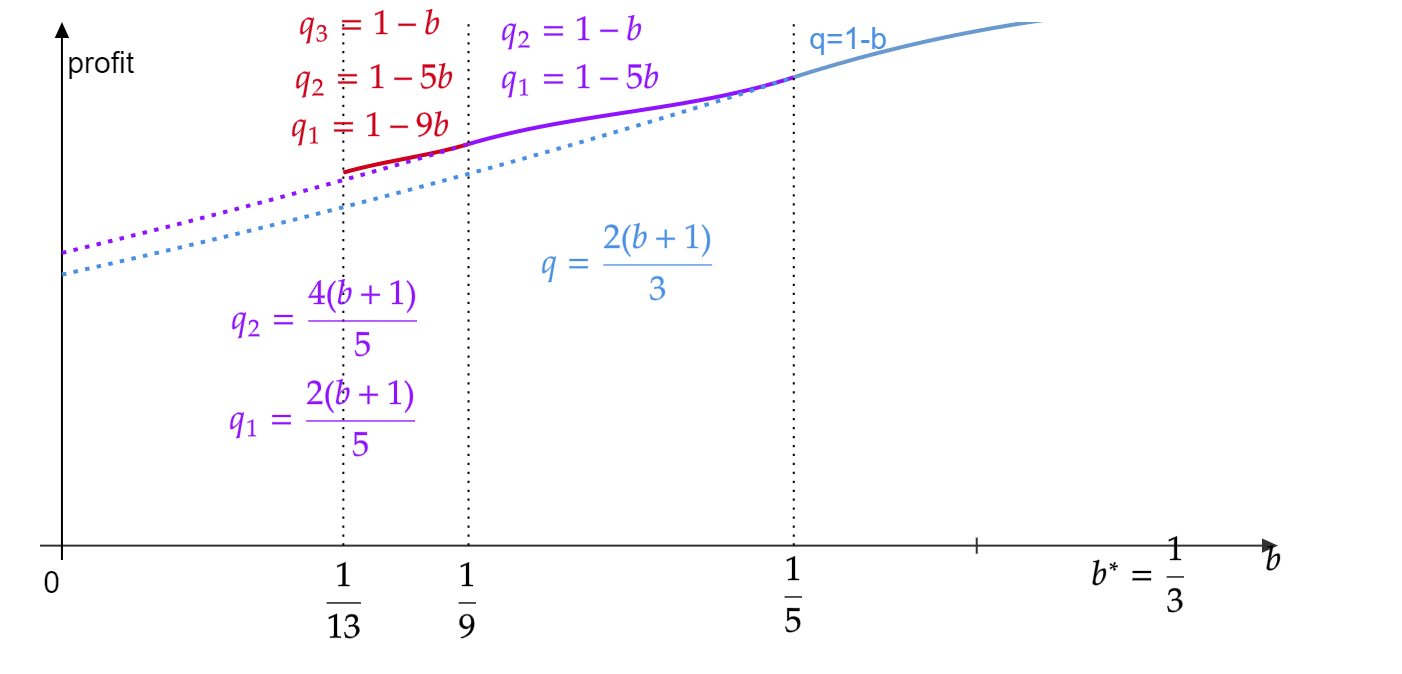
- The paper characterizes how the intermediary’s bias alters the monopolist’s optimal menu design, shifting from single-item to expanded menus as bias decreases.
- It leverages dual price functions and Bayesian persuasion to detail how the intermediary’s role influences consumer learning and product quality discrimination.
- Findings reveal non-monotonic effects on profits, consumer surplus, and market efficiency, highlighting key trade-offs in market design and policy.
This paper investigates a monopolistic screening model where consumers do not possess ex-ante private information concerning their valuation of quality-differentiated products. Instead, an information intermediary—who values both consumer surplus and product quality—acts as a Bayesian persuader, providing information to the consumer after the monopolist posts a product menu. The monopolist recognizes the intermediary’s objective and chooses the menu in anticipation of the induced information structure, shaping both consumer choice and intermediary behavior.
A central modeling novelty arises because the intermediary’s bias toward higher-quality products introduces an additional “obedience” constraint in the monopolist’s mechanism design problem. The intermediary’s utility is given by UI(θ,q,t)=(θ+b)q−t, where θ is consumer value, q is product quality, t is transfer, and b is the bias. The monopolist maximizes expected profit, accounting for both incentive compatibility and the equilibrium behavior of a strategic intermediary.
Theoretical Contributions
The paper delivers a comprehensive characterization of the monopolist’s profit-maximizing finite-item menu as a function of the intermediary’s bias b. When intermediary bias matches the consumer (b=0), the result recovers the classical Mussa-Rosen mechanism, and consumer learning is maximally informative. As intermediary bias increases, the monopolist can more tightly control the information transmitted by the intermediary, culminating in a menu that can be optimally restrictive, particularly when b exceeds a certain threshold. In this limit, the intermediary essentially acts to maximize trade, imitating direct seller-to-consumer information provision.
In the intermediate regime, as b decreases (i.e., the intermediary puts more weight on consumer surplus relative to quality), sellers are forced to strategically expand product variety: they introduce additional, lower-quality options to more precisely match the now-better-informed posterior types of the consumer. This expansion trades off production cost convexity with the ability to discriminate more on type.
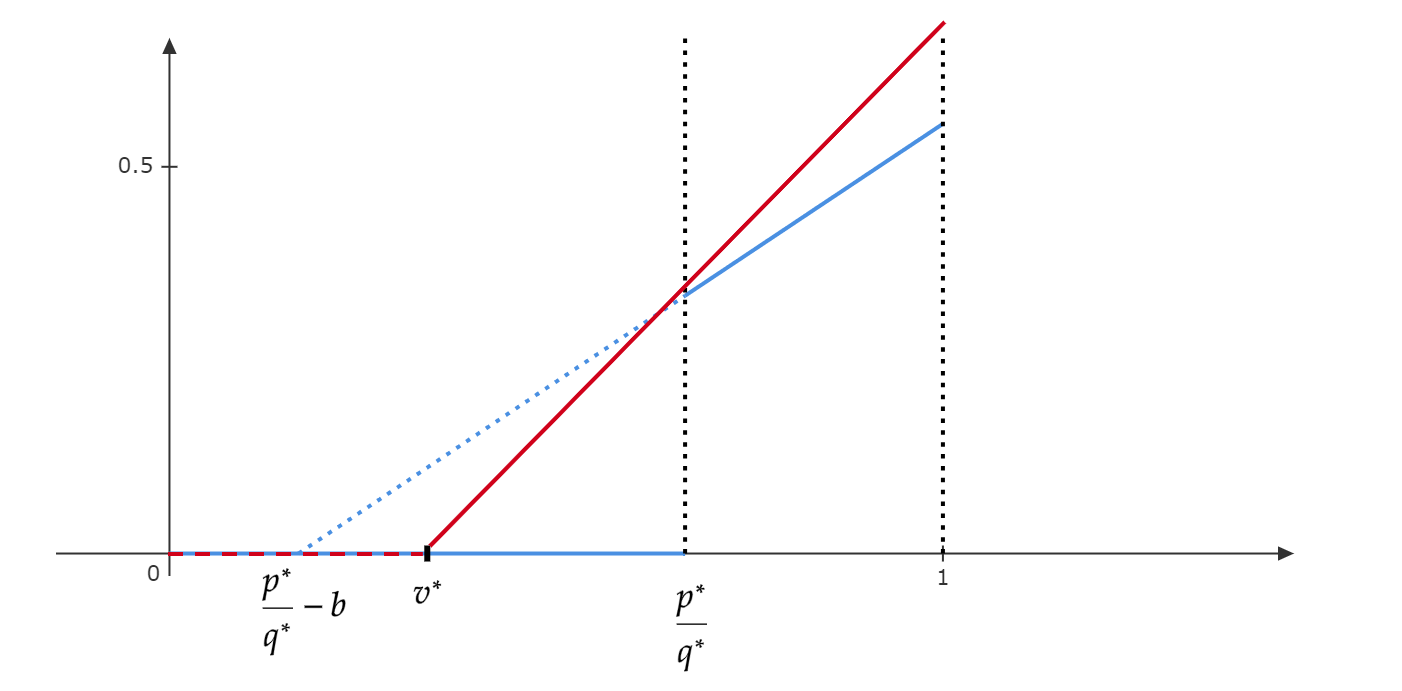
Figure 1: Single-item menu qBHM∗ is optimal only if intermediary bias θ0 exceeds the key threshold, otherwise the menu must expand.
This product expansion is not merely a monotonic increase but occurs in discrete jumps as θ1 crosses thresholds, leading to menus with θ2 items where θ3 is strictly increasing as θ4 falls.
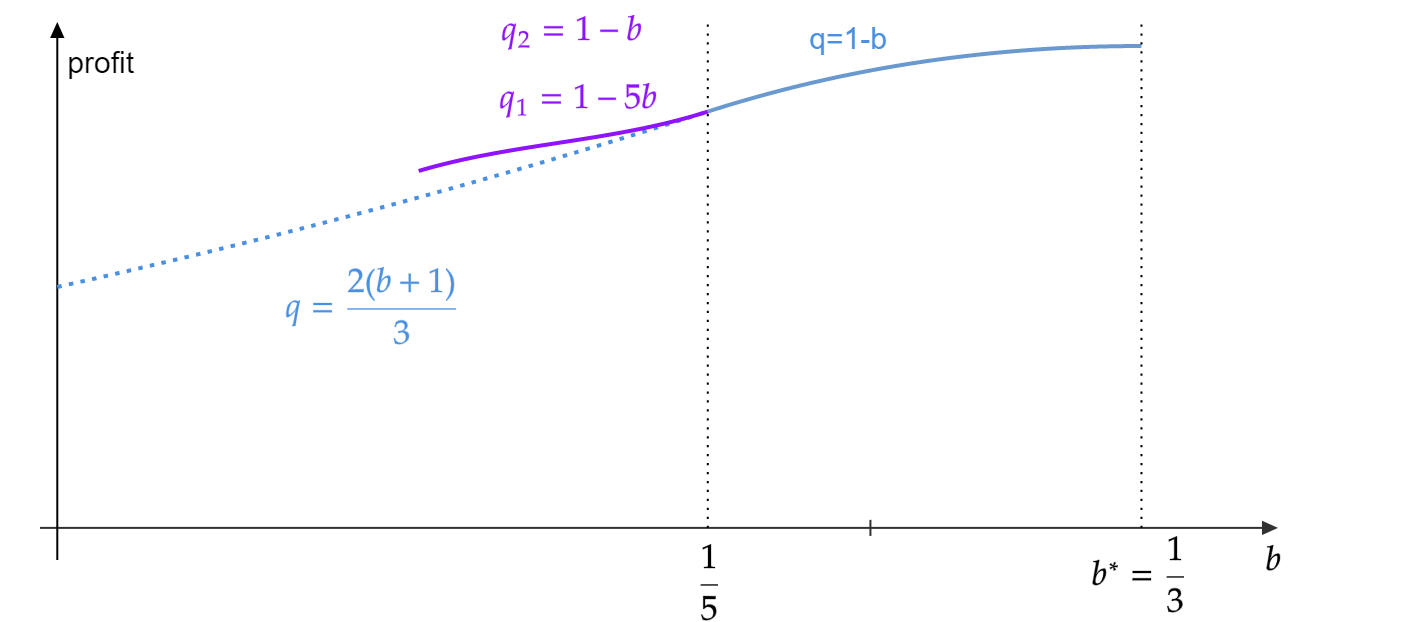
Figure 2: Introducing a lower-quality option and increasing the existing one yields a higher profit to the monopolist by recovering surplus from previously non-participating consumer types.
Dual Price Functions and the Structure of Persuasion
The paper leverages duality theory from Bayesian persuasion. The intermediary’s optimal information structure corresponds to distributions for which a dual price function (convex, upper-bounding, coinciding on support) exists. The solution always lies in the class of bi-pooling/monotone-pooling distributions, which are sharply characterized in terms of the posted menu and the intermediary’s bias.
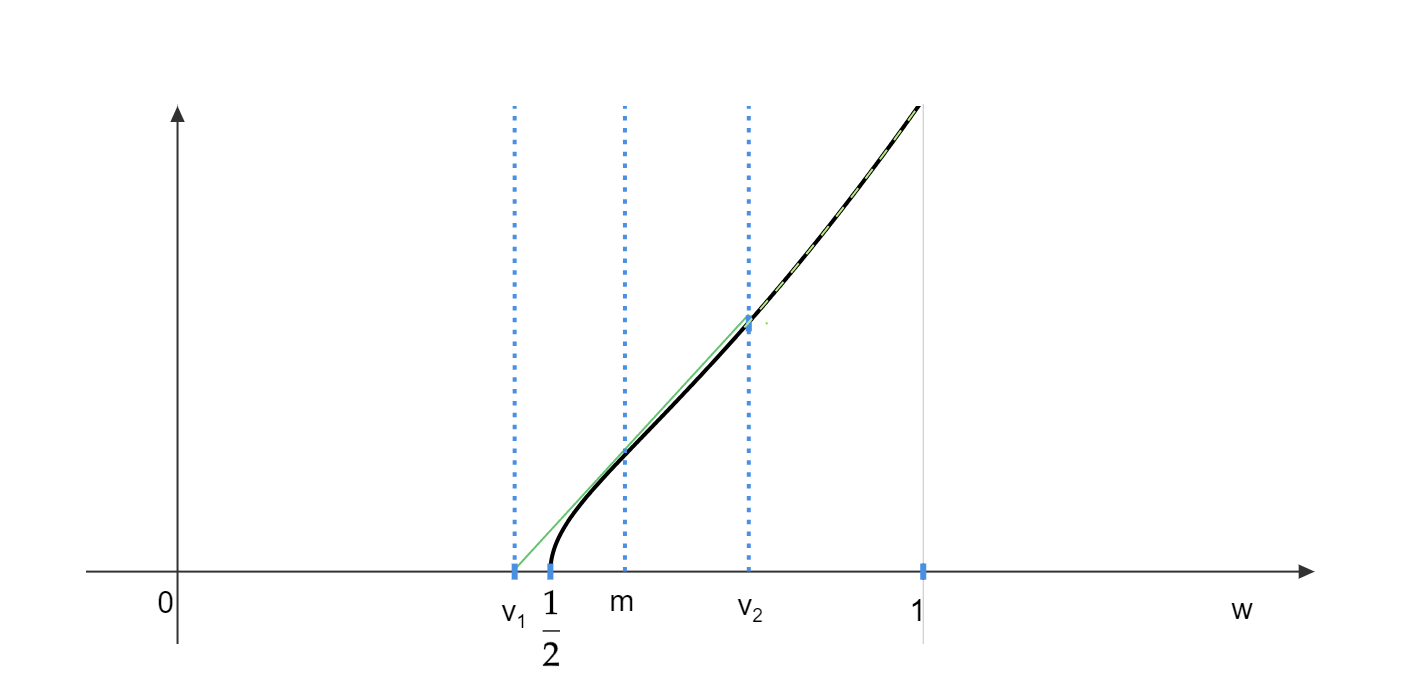
Figure 3: Illustration of the intermediary's indirect utility and the associated dual price function, highlighting the regions of pooling and full disclosure.
Implications for Profits, Welfare, and Market Efficiency
Market and Policy Implications
- Product Variety and Consumer Surplus: Product variety always expands as the intermediary becomes more consumer-aligned. This raises consumer rent, but with non-monotonicity due to profit–variety tradeoffs: modest reductions in bias may cause consumer surplus to decrease before increasing again.
- Profits and Efficiency: Monopolist profit decreases monotonically in θ8 as more product options dilute extraction and increase average cost. Overall market efficiency (total surplus) is also non-monotonic: it is generally lower than in models with direct information provision from the seller, and lower than in classical screening where consumers arrive informed.
- Quality Distortions: The presence of the intermediary moderates quality distortions compared to standard screening, but external constraints on menu size can reintroduce significant inefficiencies.
Methodological Innovations and Literature Connections
Methodologically, the constraint structure induced by the intermediary’s persuasion problem subsumes the classic monopolistic screening results as special cases and imposes nuanced allegiance conditions beyond the direct-revelation principle. Tools from linear persuasion duality (specifically, the existence and construction of bi-pooling/monotone-pooling distributions) are used to characterize both the information design and the menu.
The work directly extends the insights of [Bergemann et al., (Bergemann et al., 2022)], who relax obedience constraints, and complements frameworks such as rational inattention [Mensch & Ravid, (Mensch et al., 2022)], where consumers pay to acquire information. Here, the intermediary acts non-trivially and non-contractibly, and supply response to improved consumer information is a key focus.
Limitations and Directions for Future Research
The paper does not endogenize potential transfer or contracting schemes between the intermediary and the seller, nor does it allow the intermediary to act before the menu is posted. These limitations demarcate fruitful directions, such as analyzing transfer-induced alignment, multi-agent/intermediary competition, or reverse timing (intermediary acts prior to seller commitment), as well as alternative objective functions for the intermediary.
Conclusion
This research provides a full characterization of optimal monopolistic menus under strategic information provision by an intermediary with non-aligned objectives. As intermediaries become more consumer-focused, monopolists must expand product assortment as a strategic response to more refined consumer learning. The presence and bias of intermediaries induce non-monotonic relationships in welfare outcomes and complicate the design of optimal market transparency policies. These findings urge both theorists and applied empirical researchers to account for the endogeneity of information transmission and menu response when inferring market efficiency and policy effectiveness.