- The paper develops a unified framework using quantile-based majorization to integrate information and mechanism design in screening environments.
- It employs concavification and ironing techniques to derive optimal pooling in both allocation and disclosure processes.
- The findings provide robust welfare analysis and actionable insights for market platforms managing product differentiation and information flow.
Framework and Core Problem Definition
The paper "Information Design and Mechanism Design: An Integrated Framework" (2601.17267) develops a unified mathematical apparatus to analyze information design and mechanism design in screening environments with quasilinear utilities. The authors leverage majorization theory combined with quantile functions, enabling a reduction of both mechanism design and information design problems to the maximization of linear functionals under majorization constraints, with bilinear extensions when both instruments are optimized simultaneously.
The seller faces a continuum of buyers indexed by quantiles, with exogenous distributions for buyer values (V(t)) and for inventoried goods qualities (Q(t)). Mechanisms (menus of allocations and transfers) and information structures (signal mappings modifying V(t) to W(t)) are described in quantile space. Feasibility constraints, incentive compatibility, and optimality considerations are translated into quantile-based majorization conditions rather than traditional distributional or value-based formulations.
Revenue and Surplus: Quantile-Space Envelope Theorems
A primary analytic contribution is the envelope representation of revenue and consumer surplus, which yields symmetric, bilinear forms in quantile space:
- Expected Revenue: R(W,X)=∫01(1−t)W(t)dX(t)+X(0)W(0)
- Expected Consumer Surplus: U(W,X)=∫01(1−t)X(t)dW(t)
These formulations exploit the fact that buyer utility is solely a function of the expected quality; the quantile formulations permit separation and tractable optimization over distributions and mechanisms.
Mechanism Design: Majorization and Concavification
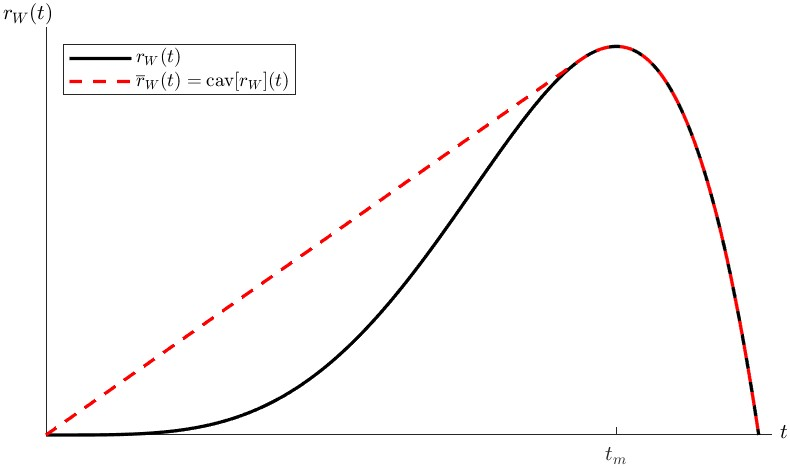
With a fixed information structure, the seller's problem is to select X(t) weakly majorized by Q(t) (X≺wQ) to maximize revenue. The revenue function rW(t)=W(t)(1−t) forms the basis for a concavification procedure. The optimal mechanism involves:
This method generalizes classic ironing procedures in auction and nonlinear pricing, mapping the screening problem to optimal symmetric auctions for Q(t)=tN−1.
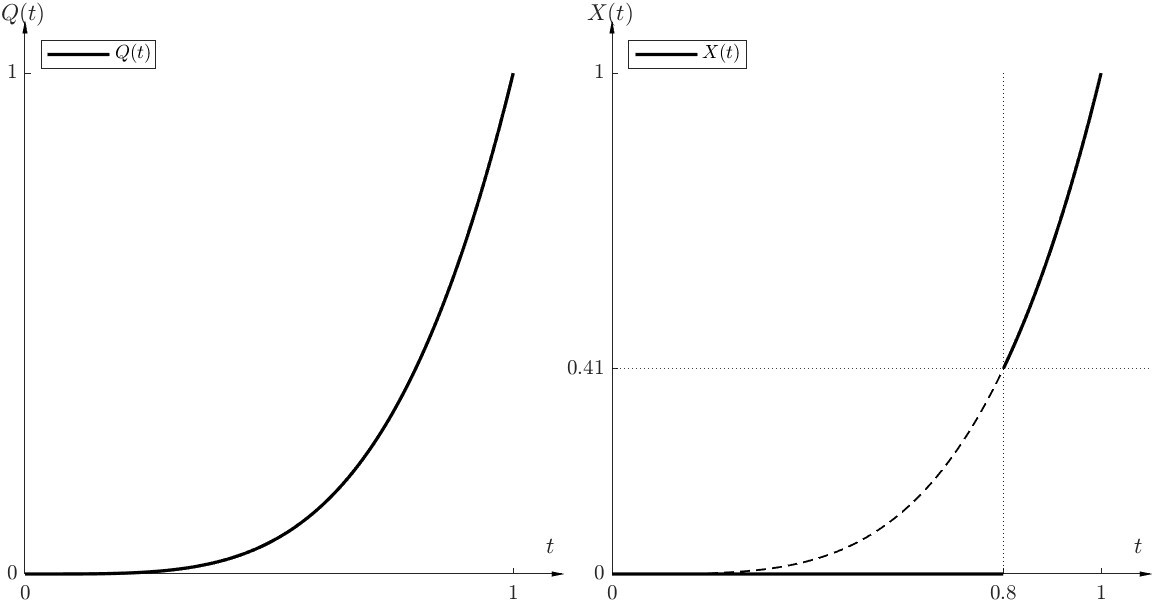
Figure 2: Allocation in the Optimal Auction: Feasible allocation Q(t) versus optimal allocation X(t) where Q≻wX.
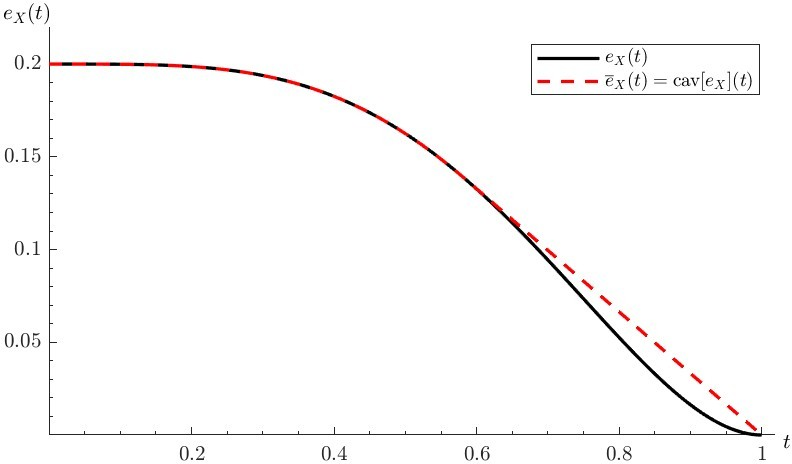
When the mechanism is fixed (typically efficient allocation), the aim is to select W(t) strictly majorized by V(t) (W≺V), maximizing revenue. The key analytic objects are the excess function eX(t), representing surplus quality available at each quantile. The optimal information structure likewise follows a concavification approach:
This reveals the direct link between hazard rates of the quality distribution and the optimality of disclosure or pooling, yielding sharp dichotomies.
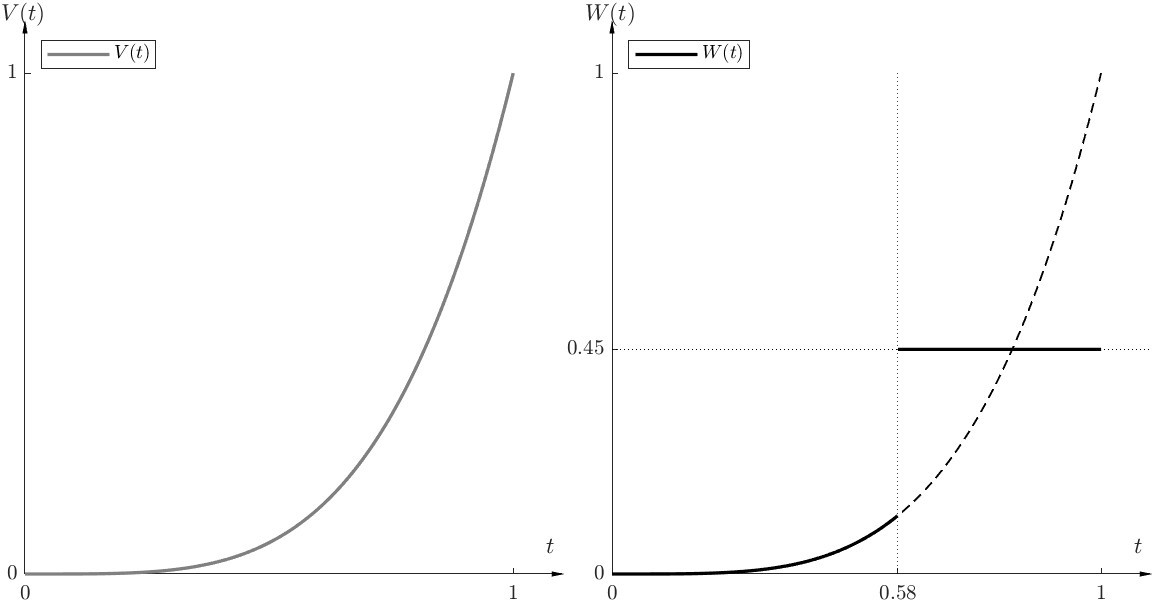
Figure 4: Optimal Information Design compares the ex ante value distribution V(t) to the induced expectation W(t), showcasing majorization V(t)≻W(t) and pooling intervals.
Joint Optimization: Bilinear Majorization and Pervasive Pooling
When both information and allocation can be jointly selected, the optimization is bilinear under two majorization constraints. The analysis establishes that monotone partitional structures with common support for values and qualities are optimal, and pooling is always prevalent: every solution involves pooling intervals in both allocations and information, a robust finding not present in separately optimized problems.
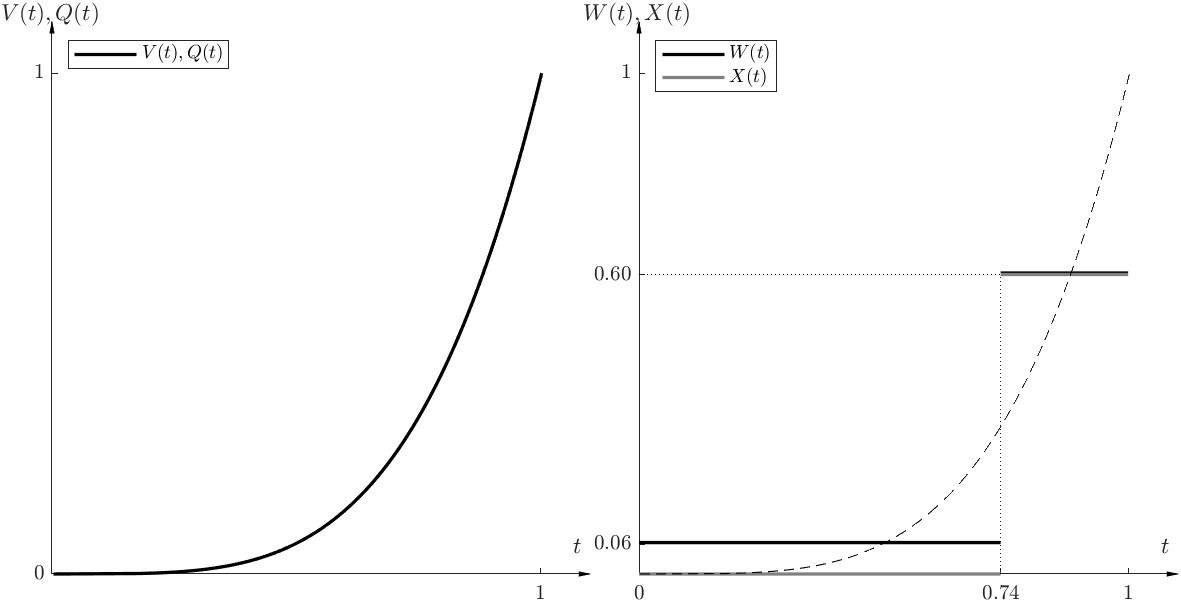
Figure 5: The distributions of values V(t)=t4 and qualities Q(t)=t4, alongside their joint optimal monotone partitional forms W(t) and X(t), reflecting pervasive pooling.
Welfare Frontiers and Robust Predictions
The paper further provides a geometric characterization of the welfare frontier: distributions of feasible revenue and consumer surplus pairs as all possible information structures and mechanisms are considered. The boundary is obtained via upper and lower censoring information structures, with discontinuous switches when total surplus is maximized.
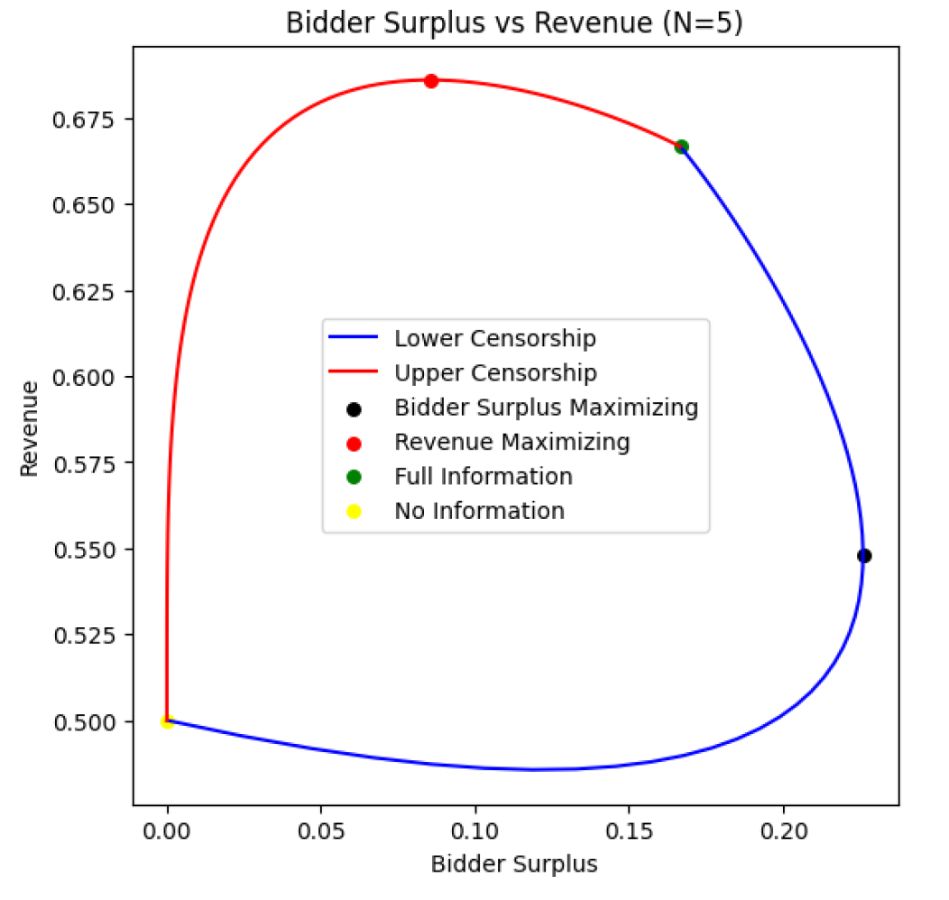
Figure 6: Revenue-consumer surplus frontier across all social welfare weights (λ,m), with non-differentiable regions corresponding to full/no disclosure.
The approach leads to robust predictions: in auctions, as the number of bidders increases, optimal pooling thresholds rise, but the expected number of pooled "top" bidders remains nearly constant, sustaining competition at the margin.
Implications and Future Directions
Practical Implications
- Design of Markets and Platforms: Sellers who control both product differentiation and information flow (e.g., digital platforms) must anticipate that pooling is an optimal outcome when both are designed jointly, influencing both pricing and information policy in product and auction markets.
- Welfare Analysis and Regulation: The explicit welfare frontier computed via majorization and concavification provides regulatory insights into the feasible combinations of consumer surplus and seller revenue under differing platform and information disclosure regimes.
Theoretical Implications
- Generalization of Ironing Techniques: The extension of classic concavification/ironing to the joint, bilinear setting is analytically potent, making a persuasive case for quantile-space formulations across economic design problems.
- Robustness and Bilinearity: Pooling is shown to be a second-order optimal effect in bilinear problems, whereas allocative distortions are third-order, suggesting under-explored robustness to primitives.
Directions for Future Research
The framework can be enriched by considering endogenous inventory choices, asymmetric environments, and environments with multiple objectives or adversarial information design choices. Extension to non-quasilinear utilities and multi-sided platforms would enhance applicability to real-world data-driven markets.
Conclusion
This paper consolidates information design and mechanism design into a quantile-based, majorization-theoretic framework, delivering strong symmetry results, efficient analytic tools (concavification, majorization), and robust economic insights into optimal pooling across designs. The unification enables tractable welfare analysis and supports further exploration of regulatory, computational, and empirical questions in modern data-driven markets, especially as the capability to jointly manipulate allocation and information becomes more prevalent.