- The paper establishes the existence, uniqueness, and asymptotic behavior of self-similar solutions for different nonlinearity exponents in the time-fractional porous medium equation.
- It derives explicit scaling laws and integral representations that link the Caputo fractional derivative with memory effects in anomalous diffusion.
- The analysis distinguishes among linear, slow, and fast diffusion regimes and develops robust numerical schemes alongside sharp asymptotic estimates.
Self-Similar Solutions to the Time-Fractional Porous-Medium Equation
Introduction and Problem Setting
This paper provides a comprehensive theoretical analysis of nonnegative self-similar solutions to the time-fractional Porous Medium Equation (TFPME):
∂tαu=Δ(um),
for t>0, x∈Rd, d≥1, with a Caputo fractional time derivative of order α∈(0,1). The equation is initiated from a Dirac delta u(0,⋅)=Mδ0 and seeks solutions with constant, finite mass M>0 for all t>0. The manuscript focuses on a range of nonlinearity exponents m>mc=(d−2)+/d (the critical exponent), capturing both the classical porous medium (m>1), fast diffusion (t>00), and the linear heat equation as a particular case (t>01).
Self-similar solutions are considered in the form
t>02
with scaling exponents explicitly related to the parameters t>03 to ensure mass conservation. The primary goal is to classify the existence, uniqueness, regularity, and asymptotic behavior of these solutions, developing new integral representations for the self-similar profile t>04, and providing sharp characterizations of their qualitative structure in various regimes.
Main Results and Structural Regimes
Existence and Uniqueness
The analysis establishes the existence of canonical self-similar profiles for all admissible t>05, unifying and extending several strands of the existing literature for both limiting (t>06, t>07) and genuinely nonlocal-in-time settings. Uniqueness is shown for t>08 by a strong comparison and scaling argument, while the case t>09 is left as open for general uniqueness.
Regimes of Diffusive Behavior
The classification bifurcates according to the value of x∈Rd0:
- Linear diffusion (x∈Rd1): Explicit solutions are given via Fourier transform inversion involving the Mittag-Leffler function, inheriting properties from the linear time-fractional heat equation. Profiles display exponential-type decay with precise estimates for their asymptotic scaling.
- Slow diffusion (x∈Rd2): Profiles are compactly supported. The free boundary's sharp asymptotics and the "mesa limit" (x∈Rd3) yield uniform convergence toward a normalized characteristic function, thus matching the classical Barenblatt solution structure. The profiles converge in the classical limit x∈Rd4 to the standard self-similar Barenblatt solutions.
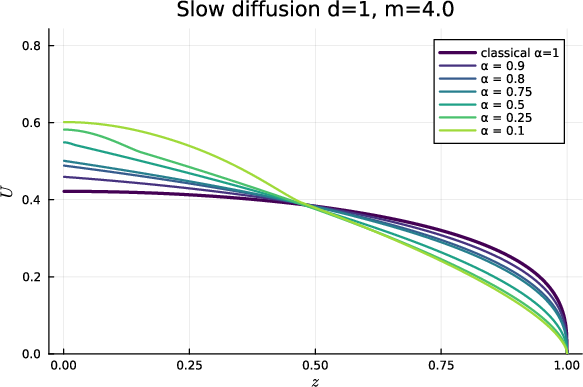
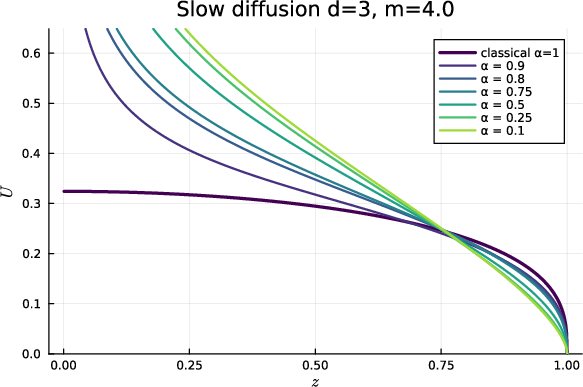
Figure 1: Slow-diffusion profiles for varying x∈Rd5 illustrating the effect of time-fractionality on support and regularity.
- Mildly fast diffusion (x∈Rd6): Profiles are strictly positive and display heavy power-law tails, contrasting the rapid decay of the linear case. The paper identifies a "very singular solution" (VSS) of the form x∈Rd7, parameterized by explicit constants. Canonical profiles asymptotically match the VSS for large x∈Rd8, forming an "asymptotic fan" with precise first-order corrections. For x∈Rd9, profiles converge to the VSS; for d≥10, they vanish.
In all regimes, sharp pointwise asymptotics at d≥11 and at the boundary of the support (when applicable) are computed, with explicit dependence on the dimension and nonlinearity.
A crucial technical advance is the reduction of the problem to a nonlinear integral equation for the self-similar profile d≥12: d≥13
where the kernel d≥14 is explicitly derived and possesses detailed asymptotic properties, enabling sub- and super-solution construction, comparison arguments, and regularity theory. The profile equation admits both analytical analysis (for existence, uniqueness, regularity, and asymptotics) and robust numerical schemes via discretization and fixed-point iteration.
Analytical and Technical Features
Regularity and Initial Trace
The profiles display regularity transitions tied to d≥15: for d≥16, near d≥17, d≥18 typically exhibits a Newtonian (potential theoretic) singularity: d≥19 as α∈(0,1)0 (for α∈(0,1)1); logarithmic singularity for α∈(0,1)2. In α∈(0,1)3, α∈(0,1)4 remains bounded but with a distinct cusp. The analysis shows that the Caputo time-fractional derivative "remembers" the initial Dirac, preserving mass and this nonlocal memory imprint in the solution structure.
Continuity in Parameters
The paper proves strong continuity of the canonical-mass solutions as α∈(0,1)5, so that the nonlinear (porous medium/fast diffusion) profiles limit to the linear, time-fractional heat kernel profile (in mass-normalized form). The detailed limit as α∈(0,1)6 recovers all standard results for the classical (local-in-time) porous medium equation.
Free Boundary Behavior
In the slow-diffusion regime, the profile's sharp behavior as α∈(0,1)7 approaches the support boundary is established: α∈(0,1)8
with the constant α∈(0,1)9 precisely identified. The "mesa" limit u(0,⋅)=Mδ00 returns the characteristic function profile over the unit ball.
Numerical Implementation
A robust and convergent discretization scheme is formulated for u(0,⋅)=Mδ01, based on piecewise-constant profiles and quadrature for the kernel. Picard iterations are used to approximate the fixed point, with explicit construction of effective sub- and super-solutions for initialization.
Theoretical and Practical Implications
The results provide the first complete construction of canonical self-similar solutions to the TFPME with finite mass in all spatial dimensions and for nearly all nonlinearities of subcritical type. Such solutions generalize the role of Barenblatt profiles for nonlocal-in-time equations, and are natural attractors (in conjecture) for the Cauchy problem with arbitrary initial data.
The explicit description of tails and singularity structure underlines how the interplay of spatial nonlinearity and fractional-time diffusion creates fundamentally different propagation and regularization features compared to the classical parabolic case. In slow diffusion, memory effects soften propagation without destroying compactness of support; in fast diffusion, tails are heavier, and the persistence of initial singularities is enhanced by fractional dynamics.
For applications, time-fractional porous media models have been motivated by anomalous transport in heterogeneous media, subdiffusive transport in disordered systems, and memory effects in porous or biological materials. The structural analysis of source-type solutions directly informs the interpretation of observed spreading dynamics and finite propagation speed in experimental and numerical studies.
Open Problems and Future Directions
Relevant open directions highlighted include:
- Uniqueness of mass-preserving solutions for u(0,⋅)=Mδ02.
- Asymptotic stability and attractor properties for general integrable initial data in the TFPME Cauchy problem.
- Extension to fully nonlocal models (e.g., with fractional Laplacians in pressure or flux).
- Numerical schemes in unbounded domains for profiles with power-law tails (fast diffusion).
- The behavior in the very fast diffusion regime u(0,⋅)=Mδ03 (infinite mass solutions), and the existence/role of self-similar profiles.
- Construction and analysis of non-radial, sign-changing, or traveling-wave solutions in the fractional-time context.
Conclusion
This work rigorously characterizes all self-similar, mass-preserving solutions to the time-fractional Porous Medium Equation across all principal diffusion regimes and dimensions, elucidating the qualitative transitions induced by the interplay of spatial nonlinearity and nonlocal temporal memory. Both analysis and numerics substantiate the presence of new classes of source-type solutions—of interest for both theoretical PDE research and advancing physical models of anomalous subdiffusive processes.