Anomalous diffusion for mass transport phenomena I: Analytic solutions to time fractional diffusion
Published 16 Jun 2025 in math-ph | (2506.14043v1)
Abstract: Mass transport problems are ubiquitous in diverse fields of physics and engineering. With the development of fractional calculus, many have taken to studying problems of fractional mass transport either through numerical simulations or through complex mathematical structures (e.g. Fox-H functions). Here, we present a set of analytic solutions to common time fractional diffusion problems, written in terms of Mittag-Leffler and M-Wright functions, as well as generalized fractional error and complementary error functions derived within. We additionally show how time fractional diffusion is a generalization of a two-parameter stretched-time fractional diffusion process. Finally we present a procedure to take canonical solutions to mass transport problems with Fickian diffusion and extend these to systems with anomalous diffusion.
The paper presents explicit analytic solutions for time-fractional diffusion using Mittag-Leffler, M-Wright, and new fractional error functions to capture anomalous transport phenomena.
The paper develops a systematic mapping methodology that translates classical Fickian solutions into stretched-time and time-fractional models applicable to disordered and biological media.
The paper demonstrates improved interpretability and computational efficiency in modeling sub- and superdiffusive mass transport across infinite, semi-infinite, and bounded domains.
Analytic Solutions to Time-Fractional Diffusion and Anomalous Mass Transport
Introduction and Motivation
The study addresses analytic solutions to anomalous mass transport phenomena via the time-fractional (TF) diffusion equation, integrating frameworks from stretched-time (ST) and stretched-time fractional (STF) models. These models are necessitated by broad classes of non-Fickian transport, as observed in disordered and biological media, where empirical evidence has demonstrated sub- and superdiffusive scaling regimes. The work circumvents previous limitations of numerical or Fox-H function-based approaches by formulating explicit analytic solutions utilizing the Mittag-Leffler, M-Wright (Mainardi), and newly introduced generalized fractional error and complementary error functions, thereby enhancing the accessibility and applicability of fractional calculus in physical modeling.
Mathematical Foundations: Fractional Calculus and Special Functions
The framework is built on the Caputo variant of the time-fractional derivative, which ensures well-posed initial value problems and enables tractable Laplace/Fourier analysis. Solutions to the TF diffusion equation
Dtβc=Dβ∇2c
are expressed in terms of the Mittag-Leffler function Eν(z) and the M-Wright function Mν(z), which generalize the exponential and Gaussian solutions of classical diffusion. Explicit connection between these functions is highlighted via Laplace and Fourier pairs, and the M-Wright function is demonstrated to serve as the fundamental solution (Green's function) for TF diffusion in analogy to the Gaussian for Fickian diffusion.
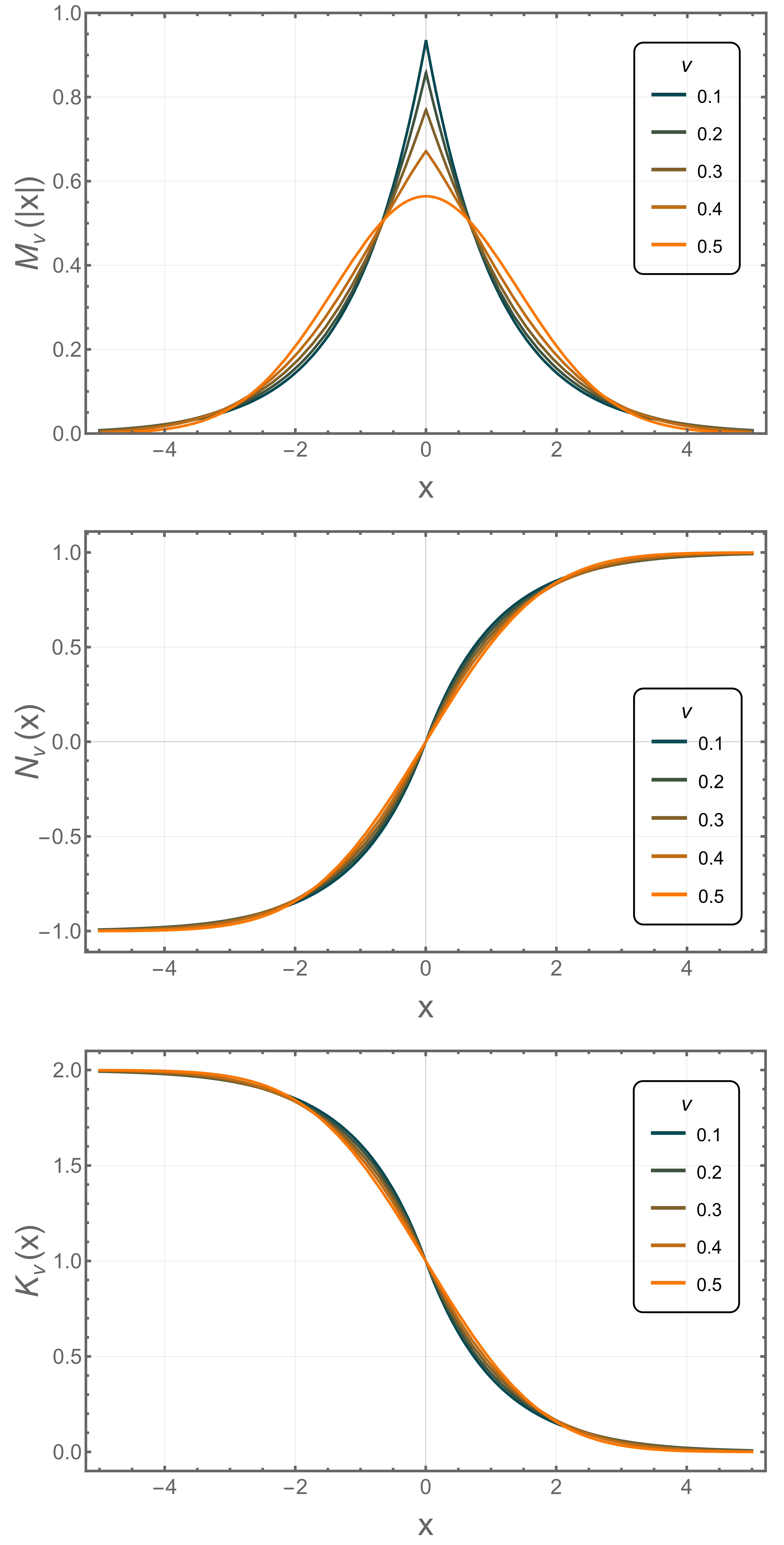
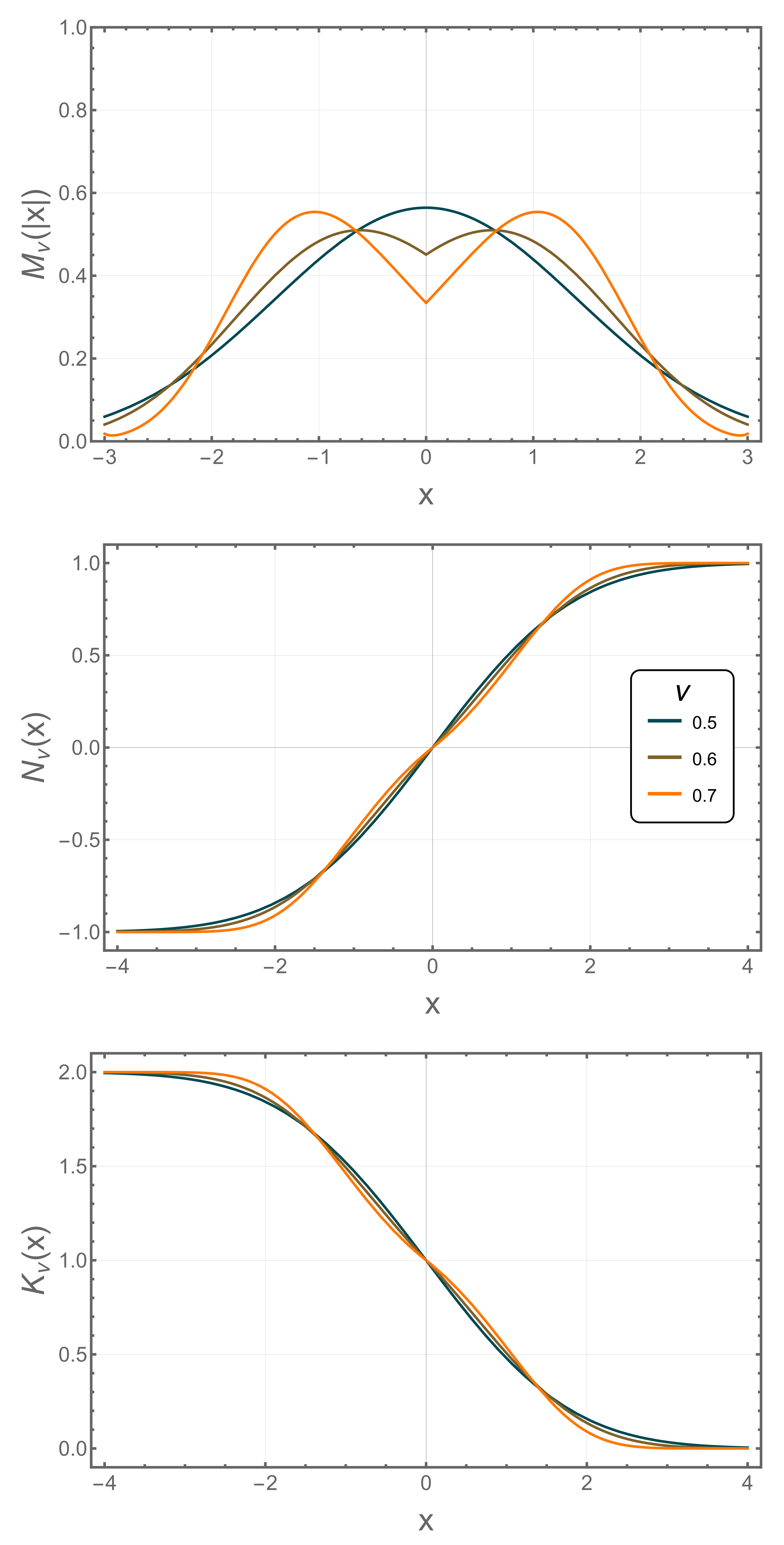
Figure 1: M-Wright, fractional error, and complementary error functions versus derivative order ν, recovering Fickian forms at ν=0.5.
Two novel constructs are defined: the fractional error function Nν(z) and the fractional complementary error function Kν(z), given as integrals over the M-Wright function and generalizing their classical Gaussian counterparts. Their Laplace and Fourier transforms are derived analytically and shown to be distinct from generalized Wright functions, cementing their role in practical analytic solutions.
Solution Mapping and Translation Principles
A methodological highlight is the formal prescription for translating canonical (Fickian) diffusion solutions to their ST, TF, or STF counterparts. In the ST case—inhomogeneous or temporally variable media—the mapping is realized by substituting Dt→Dαtα. For TF systems, the analogous substitution is the replacement of exponentials and error functions with Mittag-Leffler and M-Wright (and associated N, K) functions, and the time variable is subordinated according to the fractional order.
The mapping extends to eigenfunction expansions for bounded domains, where the standard temporal exponential is replaced by Eβ(−λ2Dβtβ).
Analytic Solutions in Canonical Geometries
Infinite Domain
For the Cauchy problem with a plane source, the TF solution is
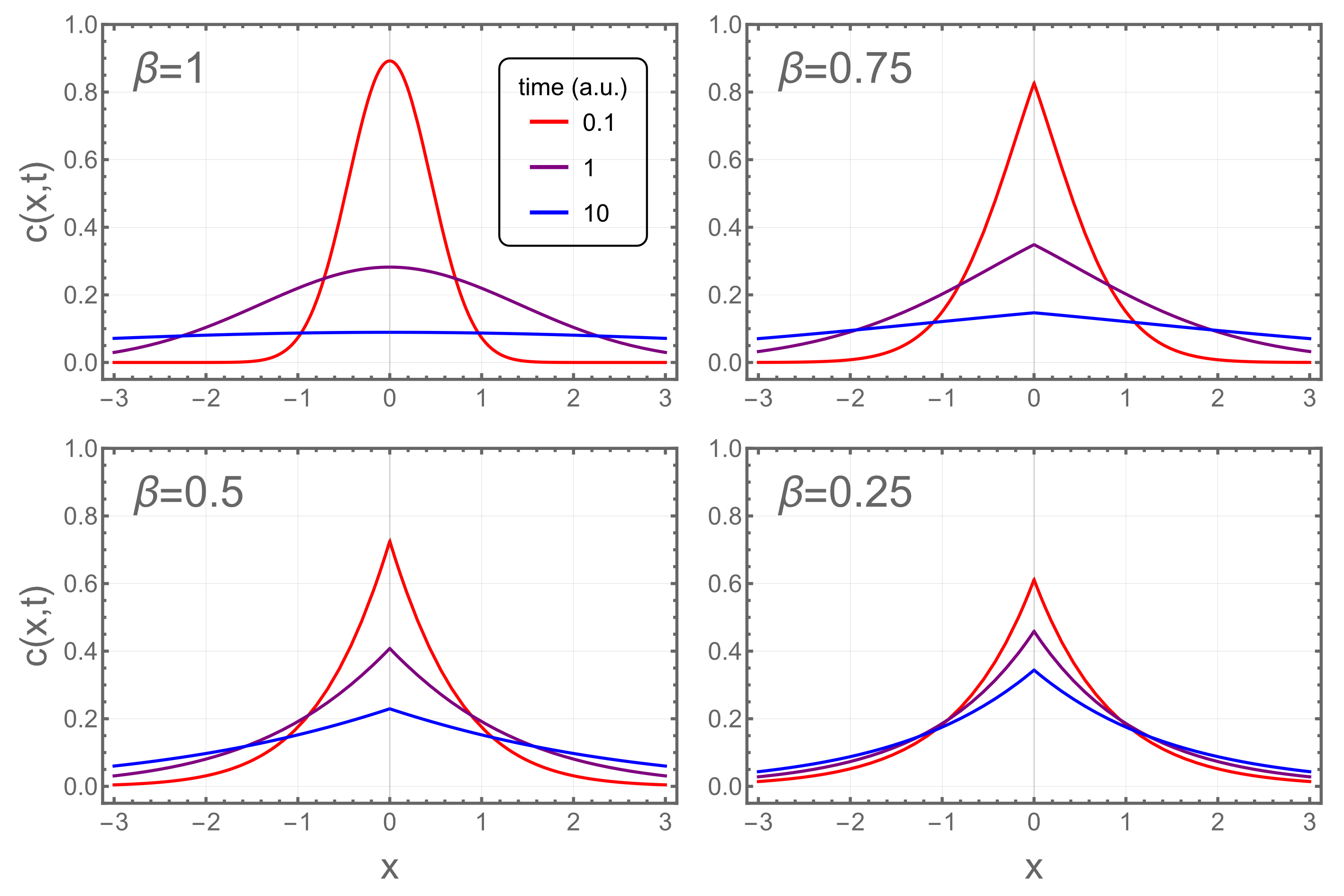
c(x,t)=4DβtβNtotMβ/2(Dβtβ∣x∣)
as a direct generalization of the Gaussian solution. Numerical profiles for varying β confirm the narrowing and enhanced peak of subdiffusive distributions.
Figure 2: TF diffusion in an infinite domain from a delta source; strong peak broadening as β decreases.
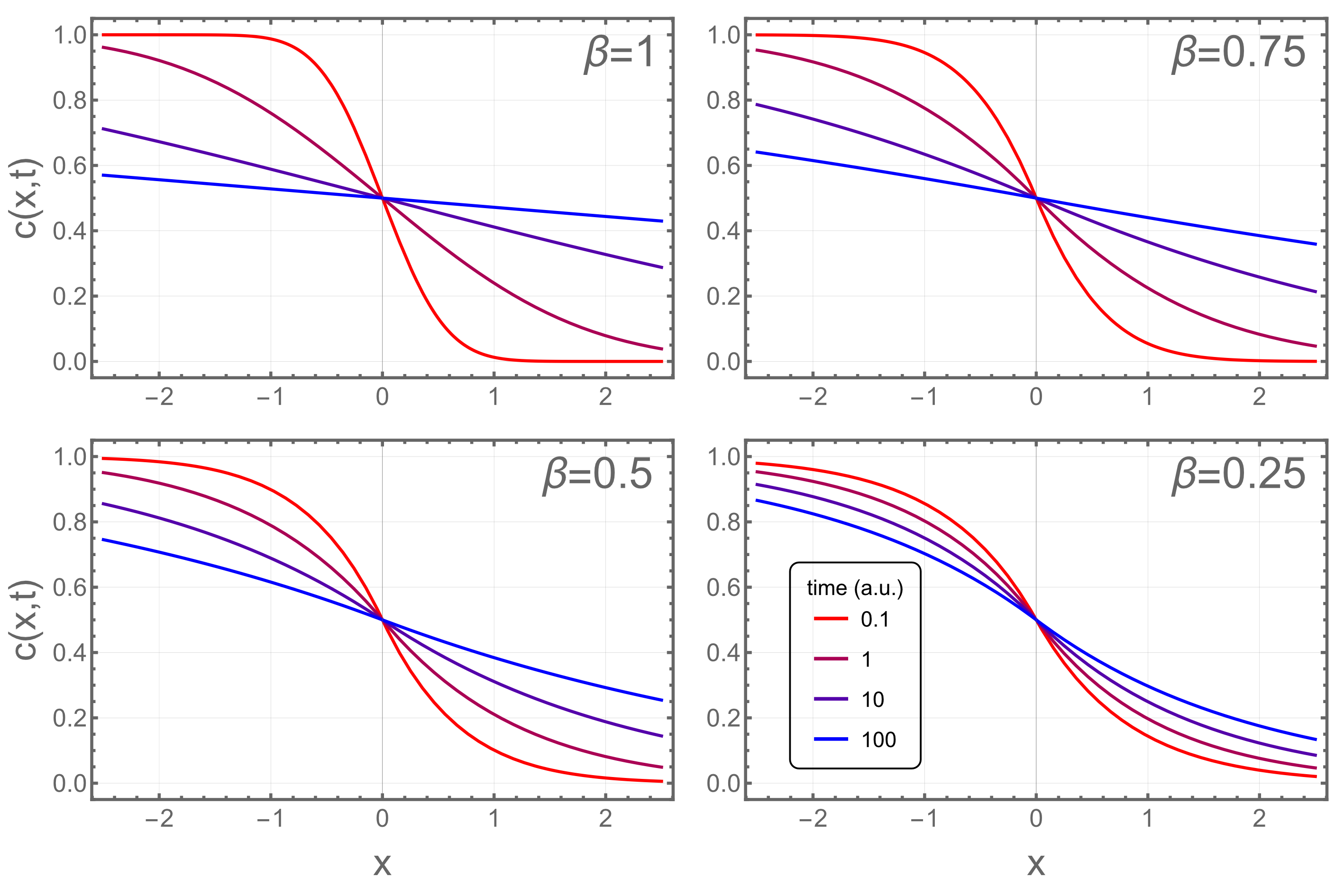
For extended sources, Heaviside initial data yields solutions involving the fractional complementary error function Kβ/2(z):
c(x,t)=2c0Kβ/2(Dβtβx)
Figure 3: TF diffusion for a semi-infinite step initial profile, emphasizing the broadening and non-Gaussianity.
Semi-Infinite and Finite Domains
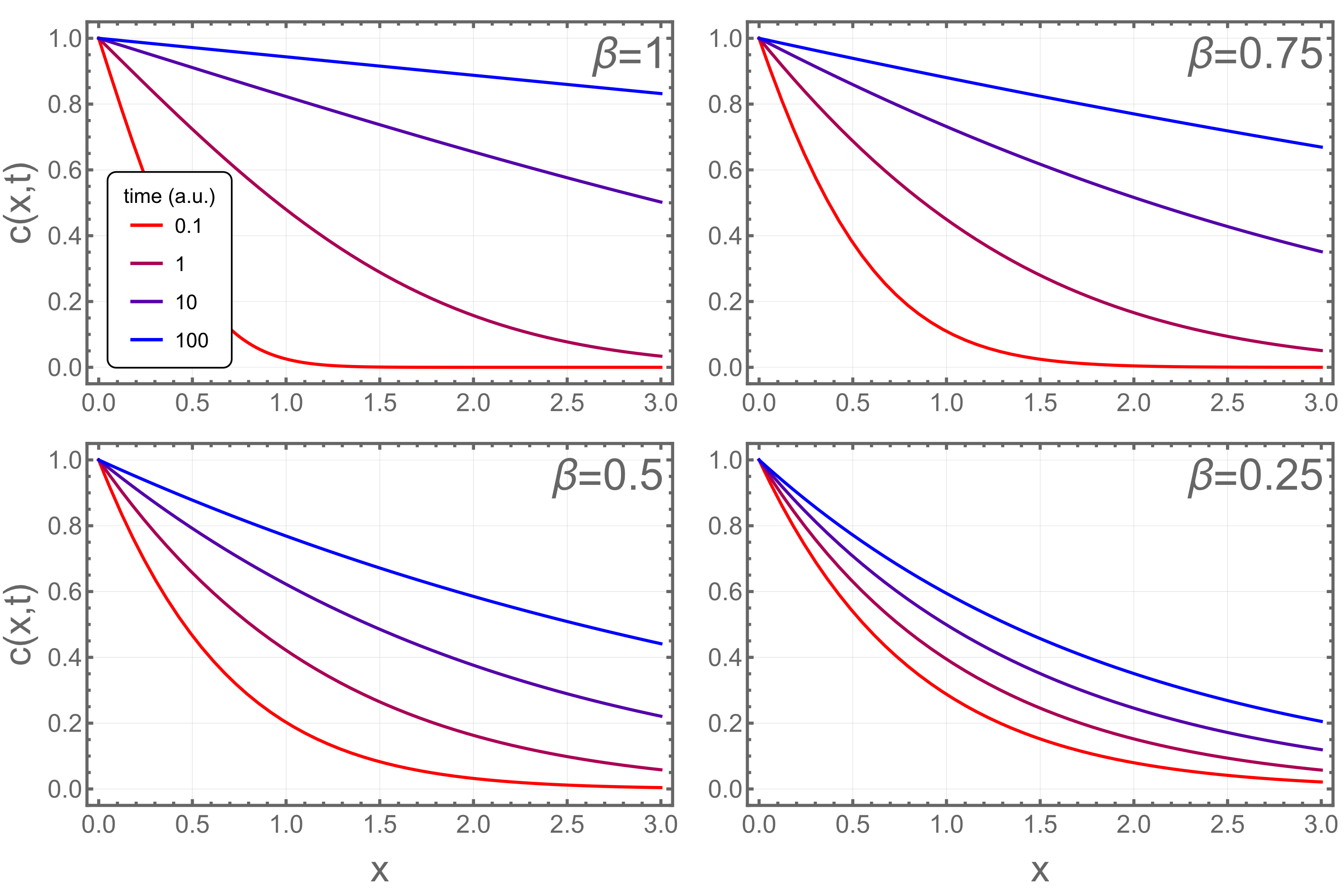
Boundary-driven problems (constant-concentration surface) lead to convolution integrals evaluated explicitly in terms of K:
c(x,t)=c0Kβ/2(Dβtβx)
Figure 4: Fractional diffusion with Dirichlet boundary at x=0; concentration penetration is increasingly impeded for smaller β values.
In bounded domains with fixed or non-equal boundary concentrations, separation of variables yields series solutions with Mittag-Leffler temporal parts. These form a generalized Fourier-Mittag-Leffler expansion, exactly paralleling the Fickian eigenfunction method with operator replacement.
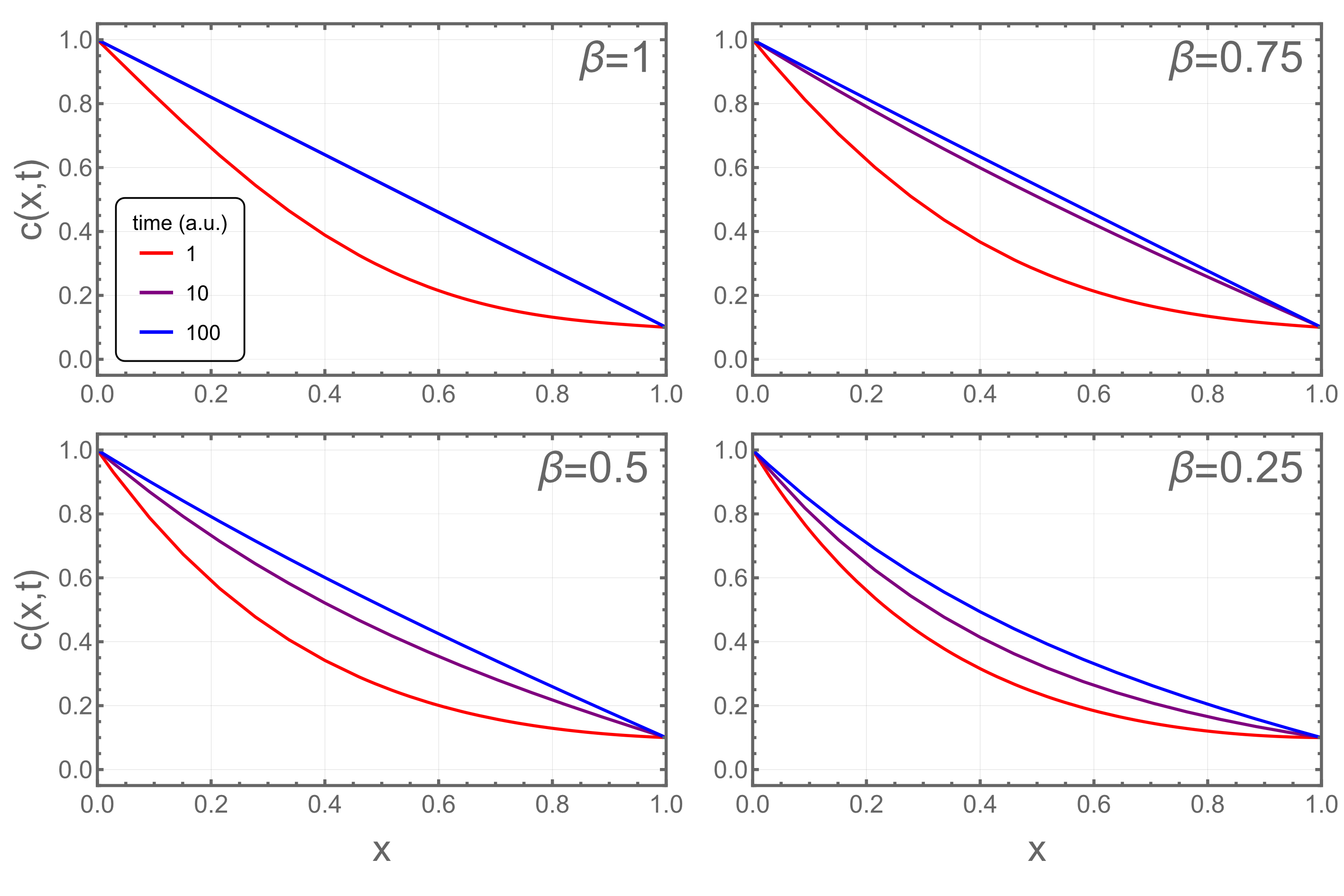
Figure 5: Fractional diffusion in a finite interval with fixed boundary conditions and initial zero concentration.
Extension to Higher Dimensions
In higher-dimensional geometries, analytic closed forms are unavailable except in special cases (radially symmetric 2D via Hankel transforms). The inverse transform integrals must typically be evaluated numerically; no closed-form reduction exists. The physical scenarios (e.g., FRAP) necessitate such generalizations, and the presented formalism offers a direct mapping procedure for constructing the required solutions.
Stretched-Time Fractional Diffusion (STF): A Unified Master Equation
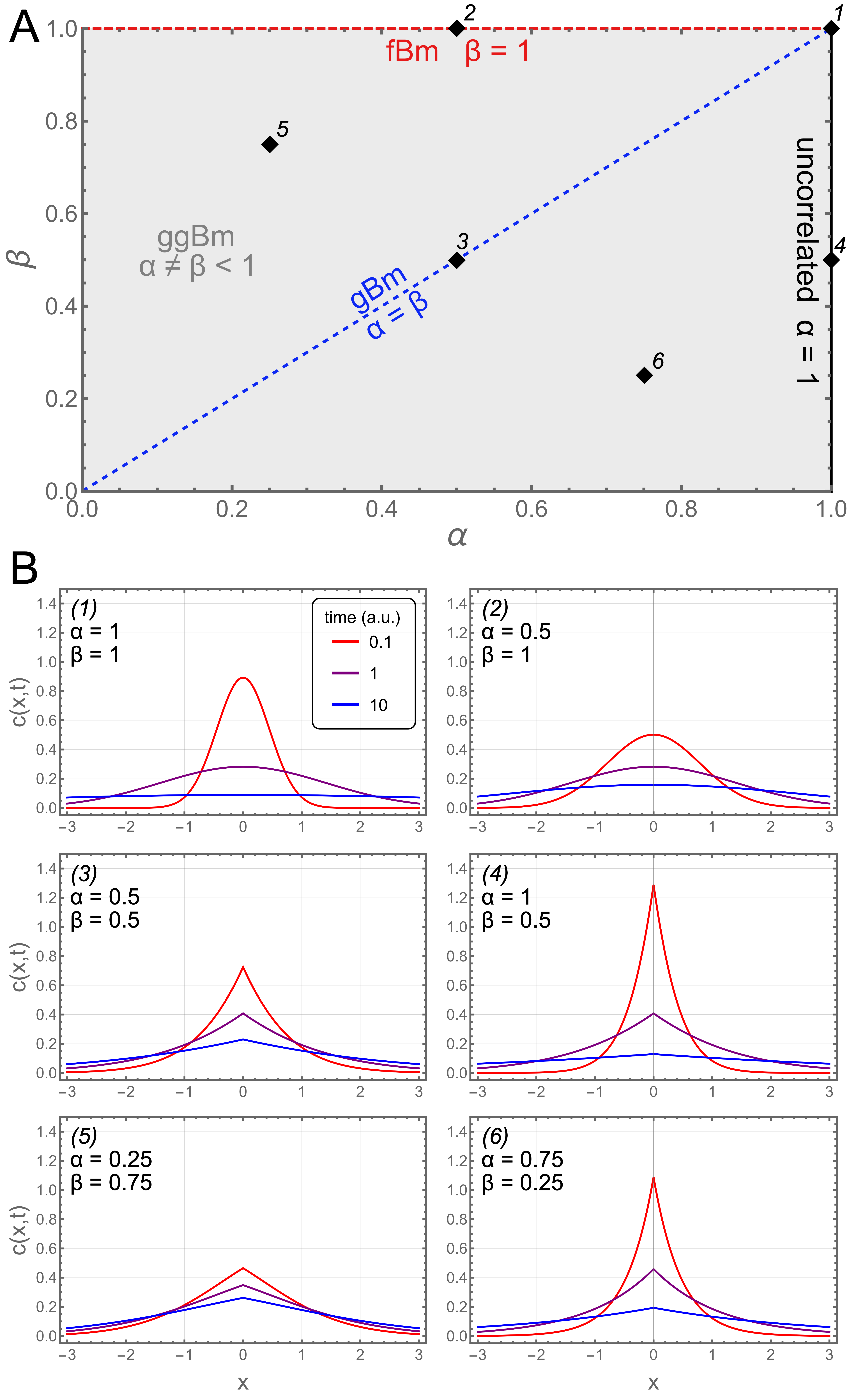
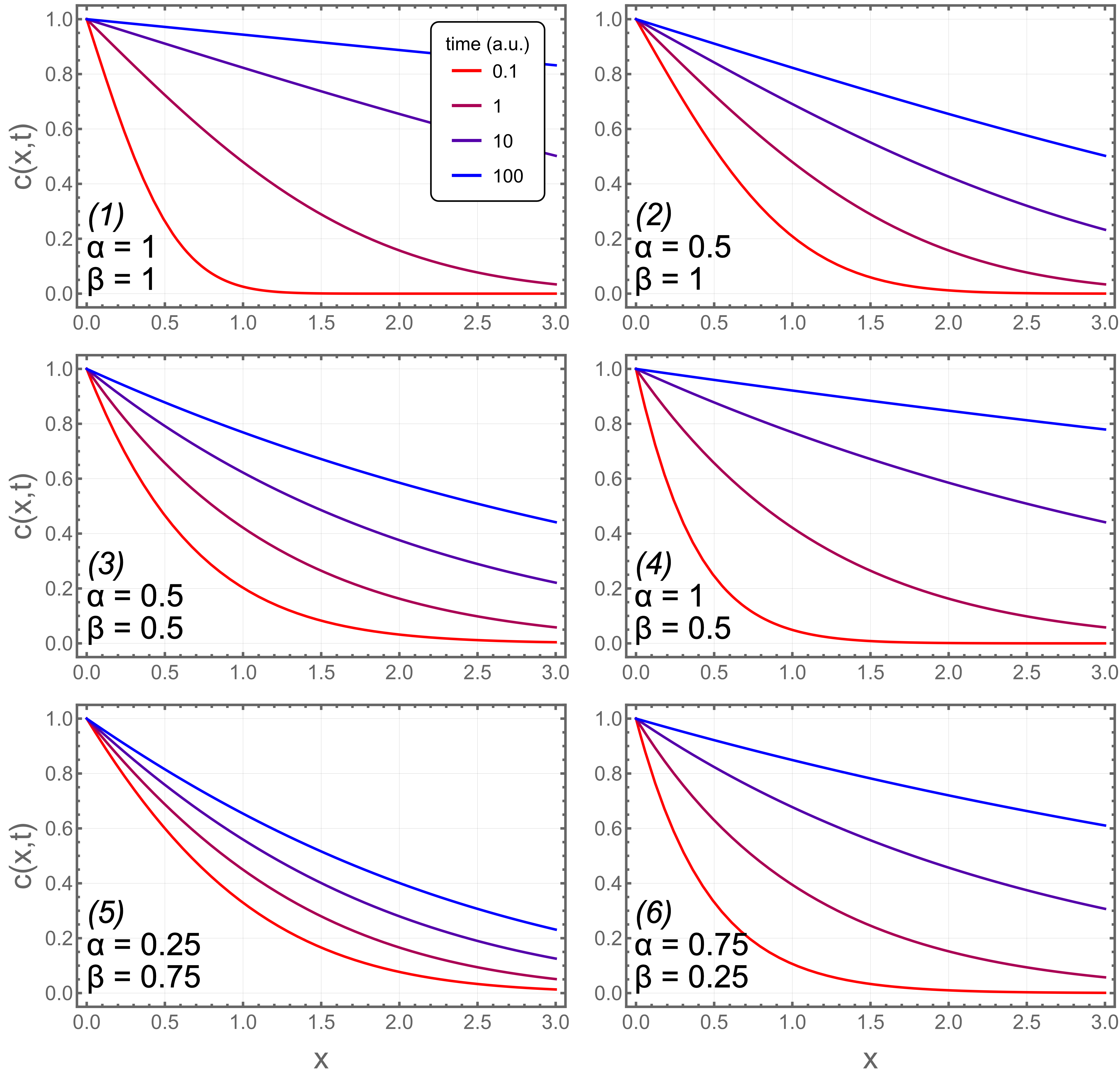
The STF diffusion equation encapsulates ST and TF as special cases and is parameterized by α (temporal scaling) and β (PDF shape/anomalousness). The Green's function remains structurally similar, with arguments and scaling modulated by the respective exponents. The stochastic underpinnings are mapped to generalized gray Brownian motion (ggBm), permitting physical interpretation of each parameter: α governs ensemble-averaged scaling (MSD ∼tα), while β encodes shape heterogeneity and medium disorder.
Figure 6: Parameter space (α,β) and corresponding single-particle probability density functions; clear transition from Gaussian to sharp-peak/heavy-tail behaviors.
Figure 7: Effect of α and β on chemical penetration: a reduction in α yields more pronounced immobilization than does a reduction in β.
Superdiffusion and Space-Fractional Extensions
Appendices extend TF formalism into the superdiffusive regime (1<β<2), highlighting interpolation between diffusion and wave propagation. The same M-Wright-based construct applies, but the numerical implementation suffers at larger β. The work also discusses space-fractional diffusion governed by the Riesz Laplacian; fundamental solutions are shown to be Levy stable distributions, with analytic bridge relations to the M-Wright class.
Figure 8: M-Wright and fractional error/complementary error functions in the superdiffusive regime (ν>0.5).
Implications and Prospects
This analytic framework enables systematic translation of Fickian solutions to model a wide range of anomalous mass transport phenomena. The clarity and tractability provided by explicit special function solutions—rather than numerics or unwieldy special function representations—allows for direct physical interpretation, parameter inference, and predictive modeling in heterogeneous and biologically complex media.
Practically, this methodology facilitates advances in multiscale modeling of porous materials, biological media, viscoelastic networks, and engineered devices (e.g., organ-on-chip systems). The approach generalizes naturally to other evolution equations (e.g., time-fractional wave/Schrödinger equations), setting the stage for analytic studies of wider classes of anomalous dissipative and non-dissipative phenomena.
Conclusion
Explicit analytic solutions for time-fractional and generalized stretched-time fractional diffusion are achieved through the systematic use of Mittag-Leffler, M-Wright, and newly introduced fractional error functions. The presented translation rules map canonical Fickian solutions into the appropriate non-Fickian regime, enabling broad applicability to anomalous transport problems in physics, engineering, and biology. The theoretical structure elucidates the roles of temporal scaling and PDF shape on transport and provides a platform for further theoretical and computational development in anomalous diffusive systems.