- The paper introduces a training-free framework that uses commutator-zero guidance to align low-res previews with high-res outputs, achieving up to 1.53× acceleration in diffusion models.
- The method leverages block-wise downsampling operator selection and iterative correction to maintain perceptual fidelity and preserve fine details.
- Experimental results on FLUX.1-dev and SD3.5-L demonstrate significant computational savings and high image quality compared to traditional downsampling and super-resolution techniques.
Training-Free, Perceptually Consistent Low-Resolution Previews with High-Resolution Image for Efficient Workflows of Diffusion Models
Contemporary workflows in diffusion-based image generation exhibit significant inefficiency due to repeated high-resolution (HR) sampling for diverse seed or prompt exploration. This inefficiency manifests as high computational overhead for both end-users and service providers. Generating low-resolution (LR) candidate images as previews could introduce computational savings, but prior art reveals persistent challenges in ensuring perceptual fidelity between LR previews and their corresponding HR outputs. Downsampling or direct LR generation typically degrades critical local structure, color consistency, and composition, failing to provide users an accurate preview for subsequent HR synthesis.
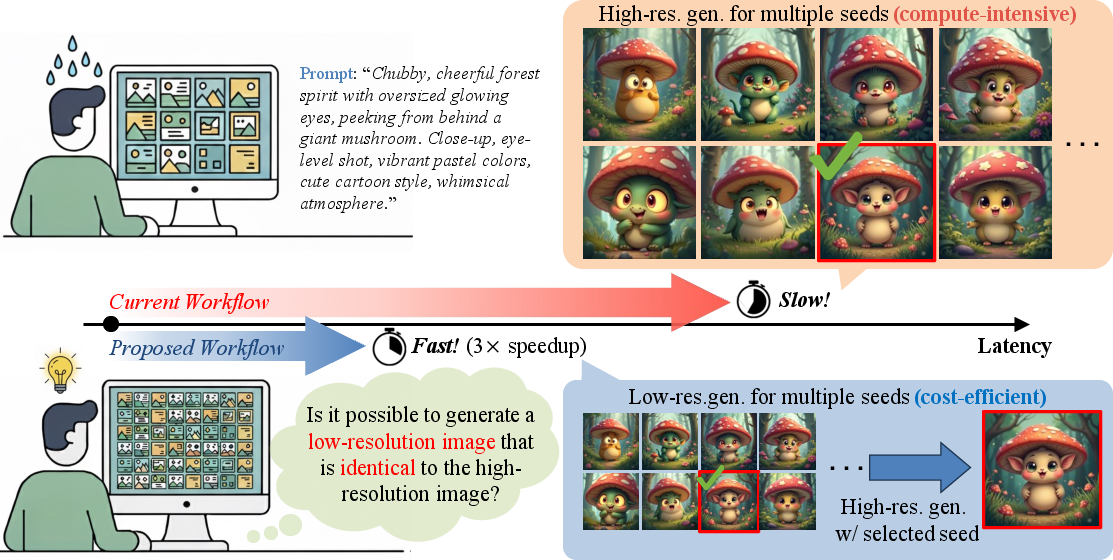
Figure 1: Most users require diverse candidate images derived from multiple seeds or prompts, motivating efficient low-resolution previews for faster feedback cycles.
A rigorous formulation is presented for producing perceptually consistent LR previews, termed "Preview Generation," supporting efficient workflows. The technical core leverages the commutator-zero condition within the flow-matching paradigm, with explicit focus on training-free solutions that guarantee LR-HR perceptual correspondence.
Limitations of Conventional Downsampling and Super-Resolution
Super-resolution techniques applied on LR generations propagate and amplify errors, leading to irreversible loss of fine details and fidelity in HR reconstructions. Empirical analysis using FLUX.1-dev demonstrates that upsampled LR images consistently lack sharpness in highly textured regions (e.g., eyes, fur) compared to directly synthesized HR outputs.
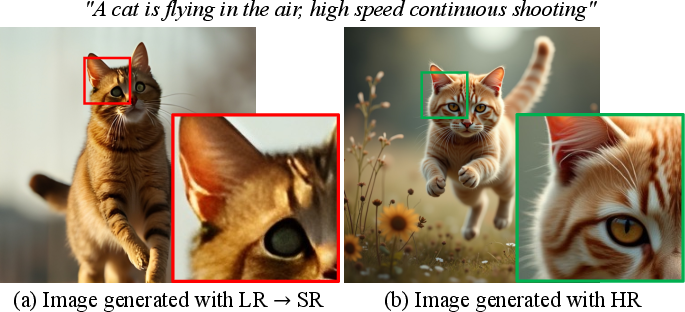
Figure 2: Close-up comparisons highlight super-resolution's inability to recover intricate features lost during LR sampling, whereas direct HR synthesis preserves such content.
This observation aligns with previous findings in generative modeling and motivates the development of mechanisms that enforce stronger LR-HR alignment during the generative process itself.
Technical Framework: Commutator-Zero Guidance and Downsampling Matrix Selection
The proposed method operates within the rectified flow-matching framework, wherein the generative trajectory is discretized and evolved according to learned velocity fields. Preview Generation is enforced by aligning the evolution of downsampled latents xt↓=Dxt with the trajectory of their HR analogs.
The main technical contributions are:
- Downsampling Matrix Selection: A set of mutually exclusive block-wise downsampling operators Ddown is constructed, and at a designated timestep tD (occupying the early, structure-forming phase of the trajectory), the operator yielding minimal commutator norm
[D,vθ](xt,t)=Dvθ(xt,t)−vθ(Dxt,t)
is selected. This process is efficient, requiring only a modest set of forward passes.
- Commutator-Zero Guidance: Instead of costly backpropagation, a fixed-point-inspired iterative correction is employed for m steps after tD, using previously computed full-resolution velocity fields to incrementally align the LR trajectory with the HR outcome. This exploits the empirical linearity of rectified flow fields.
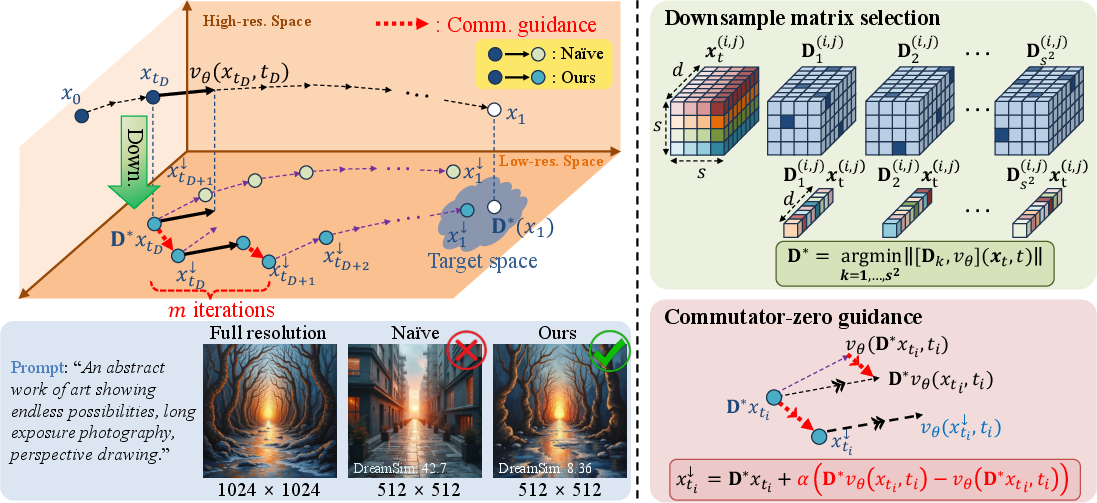
Figure 3: The pipeline alternates HR and LR sampling coupled with downsampling matrix selection and commutator-zero guidance, yielding LR images with improved DreamSim consistency scores.
Quantitative and Qualitative Results
Extensive experiments are performed on state-of-the-art flow-matching models FLUX.1-dev and Stable Diffusion 3.5-Large (SD3.5-L) using the PixArt-Eval30K dataset. The method is systematically compared against alternatives such as reduced-NFE sampling, direct LR generation, and naive downsampling.
Key numerical findings include:
- Up to 1.53× acceleration (for FLUX.1-dev) while preserving or exceeding perceptual and low-level similarity metrics (DreamSim, DiffSim, PSNR, FSIM) when compared to naive baselines.
- Integration with orthogonal temporal-axis acceleration (e.g., TaylorSeer) yields compounding speedups up to 3.05× with negligible perceptual quality degradation.
Qualitative assessment confirms that alternative approaches often alter semantic composition, object size, or chromatic fidelity, while the proposed method maintains close correspondence with reference HR images.
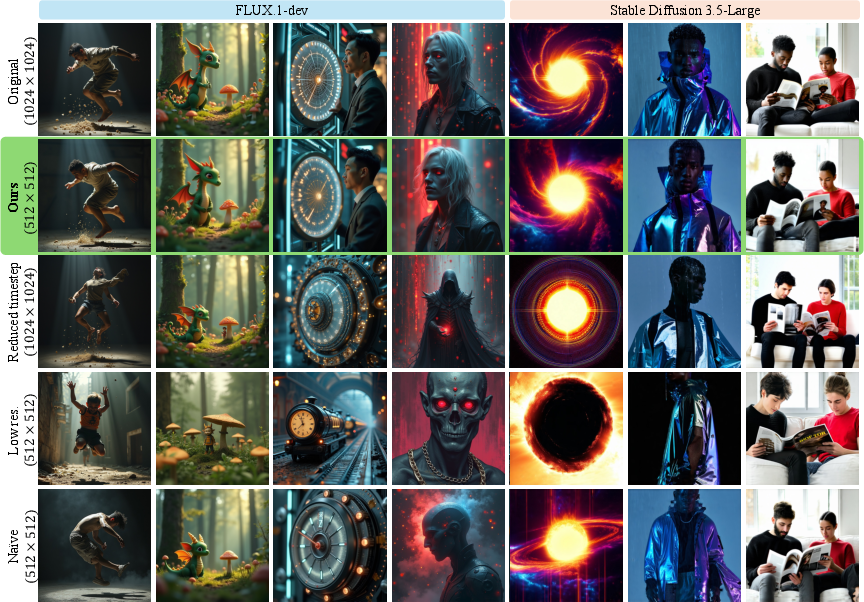
Figure 4: Comparison reveals that the proposed approach preserves global composition and local detail in LR previews, outperforming naive alternatives.
Generalization: Beyond Downsampling
The commutator-zero guidance formulation generalizes to spatial operations beyond downsampling, such as translation and warping. For translation, naive mechanisms introduce spurious objects and alignment errors, whereas commutator-zero guidance yields faithful content preservation. For spatial warping, the proposed correction term suppresses typical distortion artifacts.
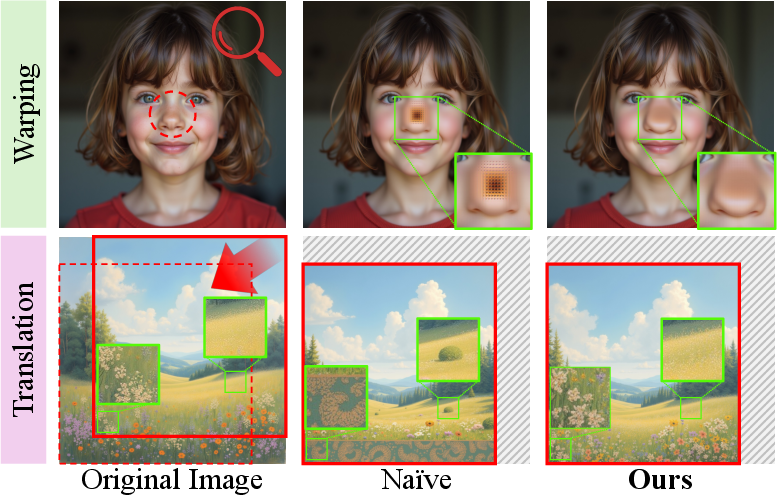
Figure 5: The commutator-zero principle robustly extends to various image-domain manipulations, ensuring high-fidelity spatial transformations.
Ablation, Analysis, and Theoretical Implications
Ablation studies validate that both downsampling matrix selection and commutator-zero guidance are necessary for maximizing perceptual fidelity and PSNR. Empirical analysis of the commutator norm and flow velocity field consistency corroborates the underlying assumptions of rectified flows, with cosine similarity exceeding 0.95 across m≤5 post-downsampling steps.
Pragmatically, this method enables substantial reduction in user and service provider computational cost for generative model-driven workflows, while preserving user trust in previewed content. Theoretically, these results demonstrate that commutator-based constraints offer a unifying perspective on maintaining perceptual consistency under a variety of spatial operations in generative modeling.
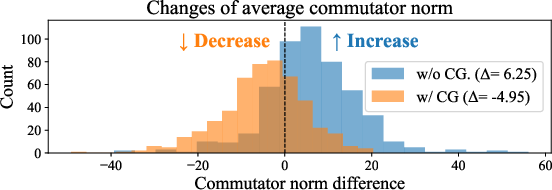
Figure 6: Commutator norm decreases significantly when commutator-zero guidance is applied, confirming its role in aligning LR and HR trajectories.
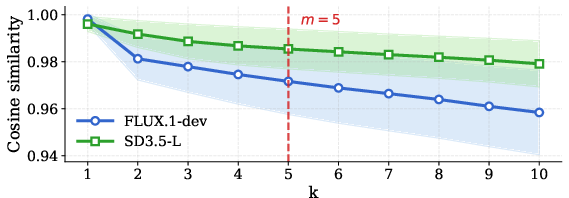
Figure 7: Cosine similarity of the learned velocity field across consecutive timesteps validates the use of previous-step velocity reuse in commutator-zero updates.
Video Generation, Multi-Modal Scalability, and Broader Impact
The framework is shown to generalize to video generative models (e.g., HunyuanVideo), delivering preview videos aligned in composition and semantics with their HR analogs while substantially reducing the number of function evaluations and overall latency.
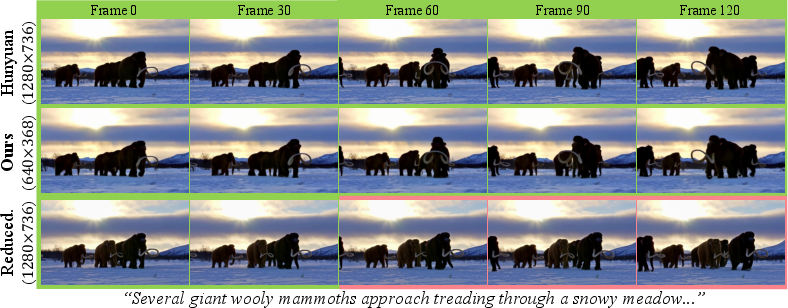
Figure 8: Qualitative evaluation on video diffusion shows robust preservation of scene composition throughout the temporal sequence, outperforming reduced-step baselines.
Conclusion
This work introduces a mathematically principled, training-free framework for generating perceptually consistent, low-resolution previews aligned with high-resolution outputs in flow-matching generative models (2604.09227). By leveraging commutator-zero conditions for both downsampling and more general spatial transformations, the method delivers considerable computational savings and enhanced workflow efficiency for image and video synthesis applications. The paradigm is broadly extensible, laying foundation for future work on efficient, user-centric generative AI workflows, and for further exploration of commutator conditions as constraints for transformation-consistent generative modeling.