- The paper introduces regime theory to distinguish Q-dominant and B-dominant cases based on surface predicates, demonstrating that bridge re-encoding benefits depend on explicit textual cues.
- It presents RegimeRouter, a lightweight, logistic-regression based system using five surface text features to route queries, achieving up to +11.7 pp improvement in controlled experiments.
- Empirical results across multiple datasets and models validate the regime decomposition and highlight the need for query-conditional retrieval strategies in multi-hop QA.
Regime-Conditional Retrieval in Two-Hop Question Answering: Theory and a Transferable Router
Introduction
The paper "Regime-Conditional Retrieval: Theory and a Transferable Router for Two-Hop QA" (2604.09019) rigorously analyzes the two-hop retrieval problem in multi-hop question answering (QA) systems from a regime-theoretic perspective. The central insight is that the utility of bridge passage re-encoding—the standard approach for second-hop retrieval—depends critically on whether the answer entity appears in the surface form of the question ("Q-dominant" regime) or only emerges via explicit linkage in the bridge passage ("B-dominant" regime). The paper formalizes these regimes with three theorems, validates them across models and datasets, and presents RegimeRouter, a simple five-feature, surface-text-based router that achieves robust performance improvement by selectively routing queries between question-only and bridge-conditioned retrieval.
The regime dichotomy is anchored on two surface text predicates:
- Predicate P1: Whether the hop-2 (target) entity appears in the question.
- Predicate P2: Whether the hop-2 entity appears in a relation-bearing sentence in the bridge passage.
P1 is decisive: if P1 is true, the question already identifies the target, and question-only retrieval is optimal (Q-dominant). If P1 is false but P2 is true, the bridge passage introduces and contextualizes the target, making bridge-conditioned retrieval beneficial (B-dominant). Empirical analysis shows these predicates correspond closely to structural query types (e.g., comparison vs. compositional).
Theoretical Analysis and Validation
Theorem 1: AUC–Margin Calibration
The authors prove (under a Gaussian pool score approximation) that per-query AUC is a monotonic function of the cosine similarity separation margin between the query and gold passage embeddings. This theoretical prediction aligns closely with observed data (R2≥0.90 for most type–encoder combinations).
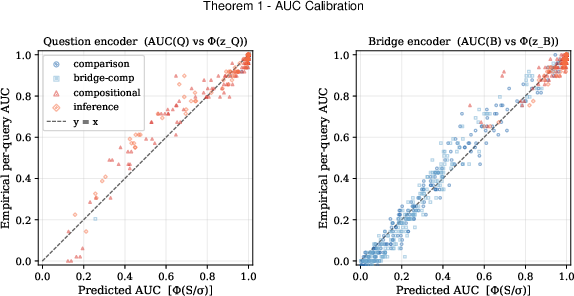
Figure 1: AUCi vs. theoretical prediction Φ(Si/σ) illustrates strong alignment across query types and encoders.
Theorem 2: Regime Decomposition and Mixture Reversal
A formal regime decomposition is established: the sign of the expected separation margin difference between question and bridge embeddings identifies the dominance regime. Importantly, the aggregate retrieval metric can be misleading due to mixture reversal: when Q-dominant queries are prevalent, aggregate statistics may falsely suggest universal question dominance—even when B-dominant queries benefit from bridge re-encoding.
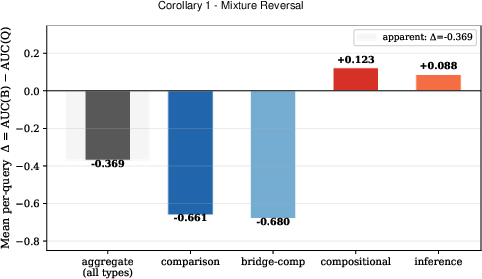
Figure 2: Mixture reversal in 2WikiMultiHopQA demonstrates aggregate AUC masking per-type advantage reversals.
Theorem 3: Necessity of Relational Sentences
The bridge advantage in B-dominant cases strictly requires not just the mention of the answer entity, but the presence of specific relation-bearing sentences in the bridge. Removing such relational sentences collapses performance, underscoring that only relational compositional information enables successful retrieval in these regimes.
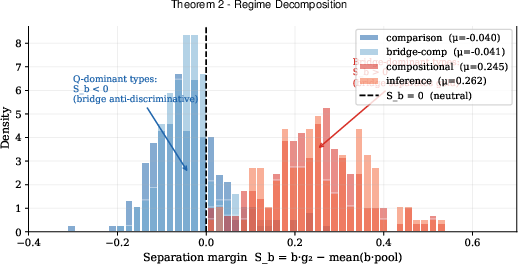
Figure 3: Bridge score separation margins by query type confirm that only B-dominant queries yield positive separation for bridge-based retrieval.
Replication of these results across multiple modern bi-encoder architectures (NV-Embed-v2, BGE-large-en-v1.5, e5-mistral-7b) and three datasets (2WikiMultiHopQA, MuSiQue, HotpotQA) further establishes the structural nature of the regime distinction.
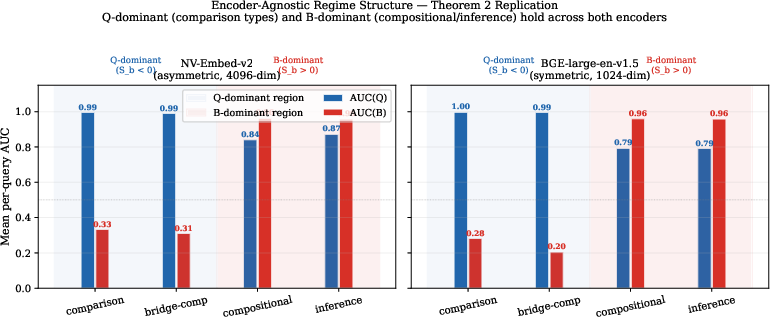
Figure 4: Retrieval regime AUC ordering is encoder-agnostic, with consistent Q-dominant/B-dominant separation across architectures.
RegimeRouter: Lightweight, Transferable Routing
The practical instantiation of the regime theory is RegimeRouter, a binary router relying solely on five surface text features (e.g., question comparison keywords, entity counts, relation-bearing sentence fraction). No embeddings or oracles are required during inference, and routing is determined via logistic regression.
- Retrieval Strategies: For a given question and bridge, RegimeRouter chooses between (1) scoring only on the question embedding, or (2) combining question and relational-bridge embeddings (weighted by a single frozen α=0.25).
- Training: The router and a relation-sentence selector are trained self-supervised on 2WikiMultiHopQA, using only surface text–derived proxies and embedding scores.
- Cost: The overhead for relation-bearing sentence embedding is minimal (∼100 ms latency, $\$$1.2μ per query using Nebius API); routing is CPU-only and extremely fast.
Experimental Results
RegimeRouter is evaluated on three datasets. Major findings include:
- 2WikiMultiHopQA (mixed regime): R@5 improves by 5.6 pp (<0.001).
- MuSiQue (homogeneous B-dominant): R@5 improves by 5.3 pp (AUCi0), robust in zero-shot.
- HotpotQA (near-ceiling Q-dominant): AUCi1 improves by 1.1 pp (not significant; no observed regression).
If using the oracle router (true regime label), the gain is AUCi2 pp, indicating substantial headroom for improved routing. The principal bottleneck is not in extracting relational sentences, but in the accuracy of learned regime prediction.
Ablation studies corroborate that each module (bridge usage, relational-sentence selection, learned routing) contributes meaningful additive improvements, while the fixed AUCi3 parameter ensures robustness across domains.
Implications and Future Directions
The regime-theoretic perspective compels a shift from one-size-fits-all multi-hop retrieval strategies to regime-aware, query-conditional architectures. The principal theoretical and practical claims are strongly supported:
- Bridge re-encoding is not uniformly beneficial: The regime is determined by surface structure, not by dataset or model artifacts.
- Lightweight, generalizable routing is feasible: The structural character of the Q-dominant/B-dominant split enables generalization across models and datasets with no-regret guarantees.
- Path to further improvements: The primary challenge is boosting the discrimination of routing decisions, possibly via more nuanced linguistic features or domain adaptation. The relation-sentence extraction bottleneck is structural, but further gains could be realized by richer syntactic or semantic analysis.
On the theory side, this work foregrounds the need for compositional retrieval analysis in multi-hop and even generalized reasoning tasks, suggesting that such regime splits may extend to deeper multi-step or more implicitly structured reasoning.
Conclusion
This paper provides a rigorous theoretical and empirical dissection of retrieval regimes in two-hop QA, introduces a lightweight and transferable query router validated across models and datasets, and demonstrates that retrieval strategy choice should be conditional on interpretable, surface-level predicates. Future research should pursue improved regime prediction, integration with more sophisticated semantic parsing, and extension of these principles to multi-hop chains and other retrieval-centered tasks in contemporary QA systems.