- The paper presents a novel radio stripe-based ISAC system with dynamic reassignments of antenna processing units to enhance both sensing and communication performance.
- It employs a consensus ADMM approach for distributed sparse scene reconstruction, enabling scalable target localization over a discretized 2D area.
- Numerical results demonstrate trade-offs between improved sensing precision and reduced communication sum-rate, underscoring the need for optimal antenna role allocation.
Radio Stripe-Based Distributed ISAC with Dynamic Sensing-Communication Reconfiguration
Introduction and Motivation
The work analyzes a radio stripe-based architecture for distributed integrated sensing and communication (ISAC), motivated by trends in 6G communication infrastructure toward native ISAC support. It specifically targets the deployment of antenna processing units (APUs) arranged as “radio stripes.” Each APU can be dynamically assigned to either a communication or sensing role, and the paper explores the system-level implications of this configurability for downlink-based multi-static sensing and target localization.
The proposed framework leverages spatial separation of APUs for distributed multi-static radar-like sensing and multi-user OFDMA for communications, with role assignments dynamically optimized for various trade-offs. The authors introduce a batch-based, discretized formulation of the target localization problem and address its computational complexity by adopting a consensus-based distributed reconstruction and fusion approach.
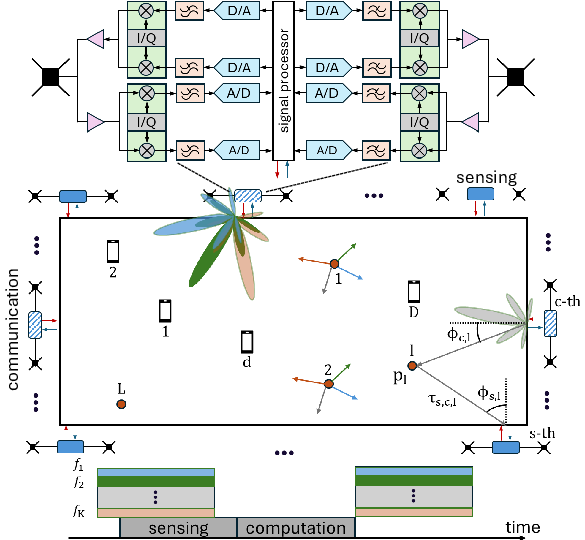
Figure 1: Schematic of the radio stripe-based ISAC system, with APUs dynamically assigned to communication or sensing roles and devices served via OFDMA.
The authors define a model where D single-antenna users are served by C communication APUs (each with M antennas) while S APUs act as distributed sensors. Assignment of communication and sensing roles among C+S APUs is dynamically configurable, providing N=(CC+S) possible configurations.
The focus is on reconstructing the positions and reflectivities of L unknown targets within a 2D service area based on multi-static measurements accrued via various APU role assignments. The forward model incorporates multi-APU distributed illumination and sensing, with the received signal at each sensing APU capturing reflections induced by communication APUs.
The underlying estimation problem is non-convex due to the nonlinear dependence on unknown target locations and the volume of multi-static observations. A direct solution is computationally infeasible given increased dimensionality as both the number of APUs and deployment area grow.
Consensus-Based Scene Reconstruction and Fusion
To address complexity, the service area is discretized onto an I-point grid, and for each APU role assignment, a compressed sensing-based linear inverse problem reconstructs a sparse scene vector. The system is modeled as a set of coupled measurement equations (one per sensing APU) sharing a common underlying scene but subject to local measurement noise and diversity.
The scene reconstruction problem is cast as a consensus ℓ1-regularized minimization, formulated for solution with the consensus ADMM (alternating direction method of multipliers). Each sensing APU solves a local inverse problem, subject to the constraint that all local solutions agree on a global scene estimate. This structure enables scalability and parallelization.
Final fusion across all role assignments is performed via a weighted average of normalized scene estimates, with weights reflecting solution residuals. This process refines the reflectivity map and target localization by aggregating spatial, spectral, and geometric diversity provided by the APUs’ dynamic roles.
Numerical Results: Sensing-Communication Trade-Offs
Key experimental results show the influence of APU assignments and system parameters on both sensing precision and achievable communication rates.
- Scene Reconstruction Quality: Increasing the number of served devices significantly enhances target reconstruction due to improved illumination diversity across the service area.
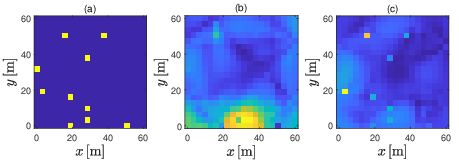
Figure 2: Scene reconstruction quality for different numbers of devices; more devices yield higher fidelity due to improved spatial illumination.
- Fusion Performance: Average sensing precision in fused images improves as the number of devices and sensing APUs increases, but this comes at the expense of sum-rate performance because more APUs are reallocated to sensing.
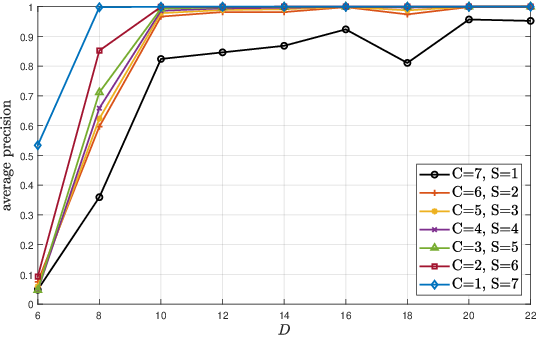
Figure 3: Average precision (reflectivity map accuracy) in fused images as a function of the number of devices, for M=4.
- Pareto Analysis of Sensing vs. Rate: The sum-rate remains largely determined by the number of communication APUs and is insensitive to their specific positions, while sensing precision depends more on which APUs are assigned to sensing and their configuration.
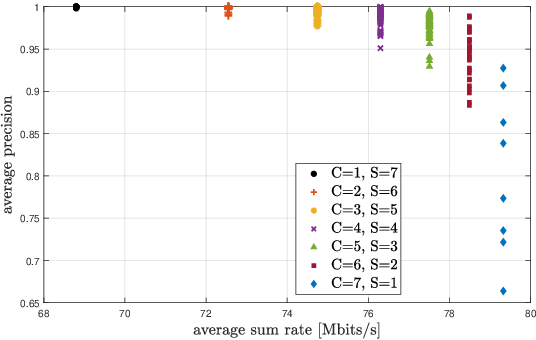
Figure 4: The trade-off between average sensing precision and average sum-rate for various APU configurations.
- Antenna Number Effects: Sensing precision as a function of antennas per APU (C0) is non-monotonic. Initially, increased array size improves angular resolution and gain, but beyond some point, excessive directivity reduces illumination uniformity, degrading reconstruction. At sufficiently high C1, the array gain compensates, restoring performance.
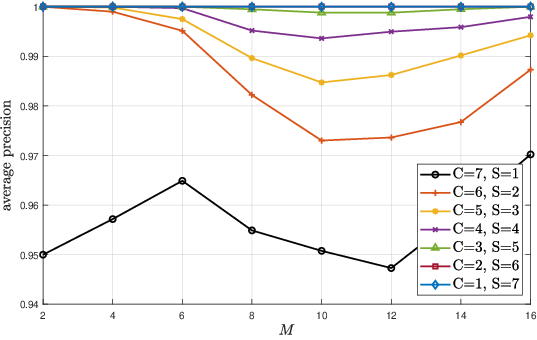
Figure 5: Average precision in fused reflectivity maps versus number of antennas per APU, showing the non-monotonic effect.
Implications and Potential Research Directions
The paper provides several insights relevant for ISAC system deployments:
- Dynamic Role Reconfiguration: The ability to dynamically reassign APU roles enables situational and context-driven optimization—trading communication throughput for improved sensing/scene awareness as needed. This adaptability is essential under non-stationary conditions or in use cases (e.g., smart buildings, industrial IoT) where environmental perception is intermittently prioritized.
- Scalability and Complexity: The proposed consensus-based distributed algorithm provides a tractable computational pathway for large-scale system inference. However, scalability to very dense deployments or hierarchical, multi-region architectures may require further methodological advances, such as model reduction or online adaptation.
- Optimal Role Allocation: While the work illustrates key properties of random or uniform assignments, the development of learning-based or utility-aware role scheduling policies may further exploit spatial and contextual heterogeneity for enhanced ISAC performance.
- Practical Limitations: The analysis assumes ideal phase synchronization and perfect OFDMA channelization. Real-world systems may experience residual synchronization errors, mutual coupling, or non-ideal channel estimation, which could degrade both sensing and communication metrics. Extending the framework to incorporate such effects remains an open research topic.
Conclusion
This paper rigorously addresses the architecture, algorithm, and trade-offs emerging from dynamic communication-sensing reconfiguration in distributed radio stripe-based ISAC systems (2604.08982). Through theoretical analysis and comprehensive simulation, it demonstrates that increasing the number of sensing APUs and communication devices improves sensing precision but imposes strict trade-offs on achievable communication sum-rate. Non-monotonic effects in antenna configuration reveal that optimal system design must simultaneously consider array gain, coverage uniformity, and role allocation. These insights are fundamental for future 6G networks seeking to deeply integrate distributed sensing within the communications infrastructure, and they motivate continued investigation into scalable, context-adaptive ISAC system designs.