- The paper introduces multi-dimensional grouping, combining temporal ExpG-IF neurons and GW-SSA modules for energy-efficient spiking transformer architecture.
- It achieves 79.82% top-1 accuracy on ImageNet-1k with under 15M parameters and sub-3 mJ energy per inference, outperforming existing S-ViT models.
- The approach generalizes across static and neuromorphic datasets, offering robust performance for on-device, real-time SNN applications.
Introduction and Motivation
The pursuit of energy-efficient yet high-performing spiking neural architectures has intensified as resource-constrained edge and mobile deployments come into sharper focus. Spiking Neural Networks (SNNs) inherently exploit event-driven, sparse communication dynamics to achieve substantial reductions in inference energy relative to conventional Artificial Neural Networks (ANNs). However, existing approaches for training and deploying Spiking Vision Transformers (S-ViTs)—notably ANN-SNN conversion and spatial-temporal backpropagation (STBP)—entail critical limitations. These include significant memory overhead, degraded accuracy under low-latency or realistic hardware constraints, and elevated energy consumption, especially when adapting Transformer's spatiotemporal mechanisms to spike-based computation.
The "Ge2mS-T" architecture addresses these intertwined challenges by orchestrating grouped computation across temporal, spatial, and architectural/network structure dimensions. Its innovations include a novel Grouped-Exponential-Coding-based Integrate-and-Fire (ExpG-IF) neuron, and a Group-wise Spiking Self-Attention (GW-SSA) module, each engineered for precise spike regulation, constant memory, and multiplication-free, multi-scale attention. The proposed solution demonstrates substantial improvements in accuracy-energy tradeoffs on ImageNet-1k and generalizes robustly across static and neuromorphic datasets.
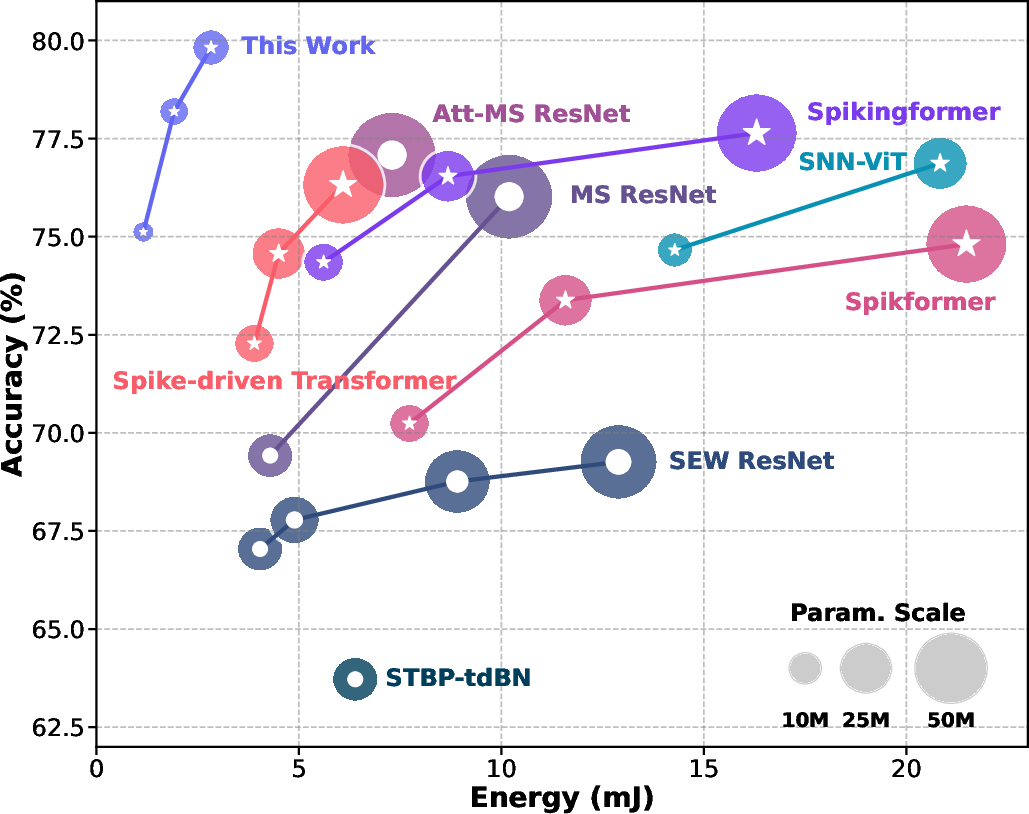
Figure 1: Parameter count, inference accuracy, and energy comparison of Ge2mS-T versus prior S-ViT/S-CNN models on ImageNet-1k; upper-left denotes superior energy efficiency.
Architecture Overview
Ge2mS-T is constructed hierarchically from several key building blocks: ExpG-IF neurons for efficient temporal coding, GW-SSA for energy-optimized global and locality-aware attention, hybrid convolutional feed-forward units, and systematic multi-stage spatial grouping. The architecture applies these mechanisms both within and across layers, compressing memory and computation requirements by constraining and grouping spike activity spatially and temporally.
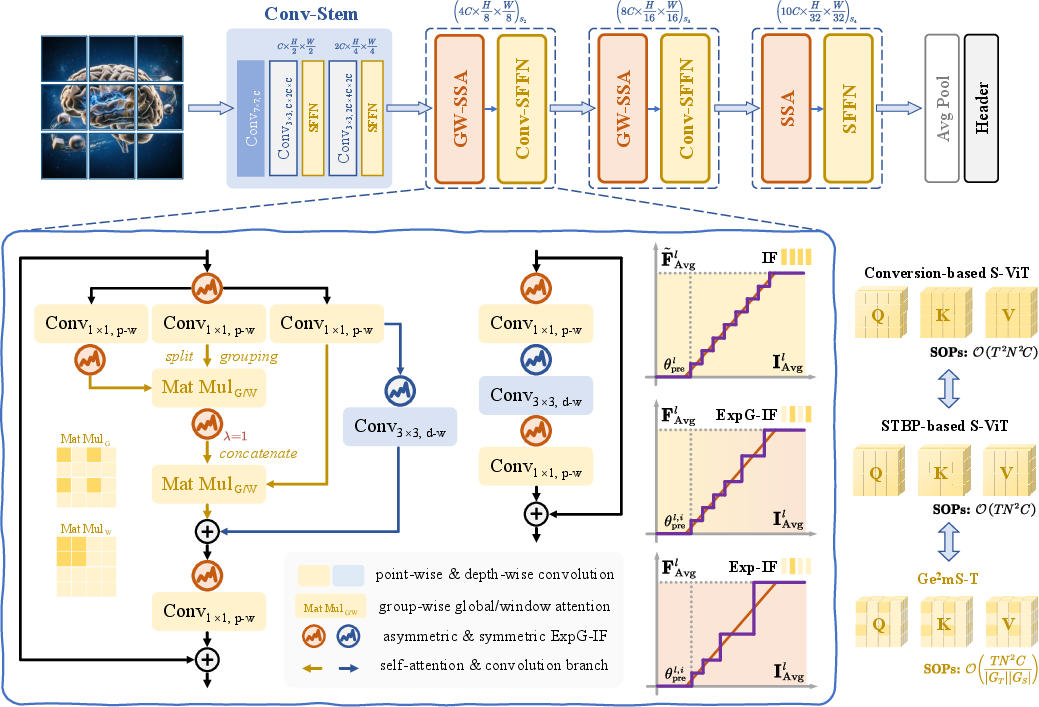
Figure 2: Ge2mS-T end-to-end architecture: composed of stage-wise blocks with SSA, SConv, and SFFN, leveraging multi-dimensional grouping to outperform conversion/STBP-based methods in energy efficiency.
ExpG-IF: Temporal Dimension Grouping
The ExpG-IF model maps inputs onto a non-uniform, exponential quantization space, enabling neurons to emit spikes only on strategically aggregated time-step subsets. The core properties include:
- Lossless conversion with O(1) training overhead (i.e., constant memory usage, independent of inference time-steps).
- Precise, implicit regulation of firing patterns, where neuron spikes are not uniformly distributed, but grouped and encoded exponentially, substantially limiting the spike count.
- Computational parity with standard Integrate-and-Fire, as binary search allows for O(T) complexity spike pattern decoding, but the spike groupings deliver strong upper bounds on inference cost.
GW-SSA: Multi-Scale Spatial Grouping
GW-SSA divides the token set into groups both globally and locally (windows) to confine attention computation within selected clusters, efficiently reducing the quadratic scaling with respect to input spatial size (O(N2) to O(N2/∣Gs∣)). Key technical details include:
- Dual-branch architecture: One branch conducts group/global attention via spatial pooling; the other extracts localized features via convolution.
- Multiplication-free operations: Utilizing addition-based similarity and event streams for SNN compatibility.
- Synergistic grouping with ExpG-IF: The combined effect of spatial and temporal groupings achieves sublinear growth in total synaptic operations (SOPs), strongly constraining overall energy draw.
Experimental Results and Analysis
ImageNet-1k: Accuracy–Energy–Parameter Tradeoffs
Ge2mS-T delivers competitive or superior accuracy on ImageNet-1k, achieving 79.82% top-1 with 20M parameters and 21 mJ energy expenditure—substantially outperforming state-of-the-art S-ViT and S-CNN models, which require many times these resources for comparable accuracy. Notably:
- Ge22mS-T Small achieves 75.12% accuracy with only 23 mJ, dwarfing ResNet-34 in efficiency.
- Ge24mS-T Large surpasses SNN-ViT and Spikingformer backbones, with 2520–80% reduction in parameters and energy per inference.
These results confirm the claim that multi-dimensional grouping offers a unique resolution to the trilemma of accuracy, memory, and energy in S-ViT architectures.
Generalization to Downstream Tasks and Neuromorphic Data
The proposed method maintains its advantage across CIFAR-10/100 and CIFAR10-DVS, surpassing competitive SNN learning algorithms and architectures (e.g., Spikingformer, GAC-SNN) by 3–11% in accuracy at identical or reduced inference time-steps. Notably, Ge26mS-T variants achieve up to 98.59% on CIFAR-10 with only 4 time-steps and consistently outperform recent transformer-based SNNs in both static and event-based visual domains.
Fine-Grained Energy Profiling
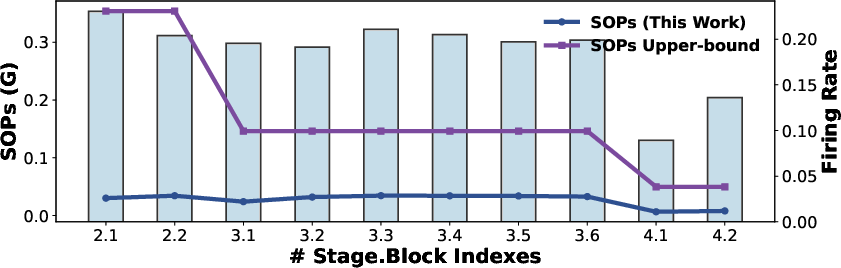
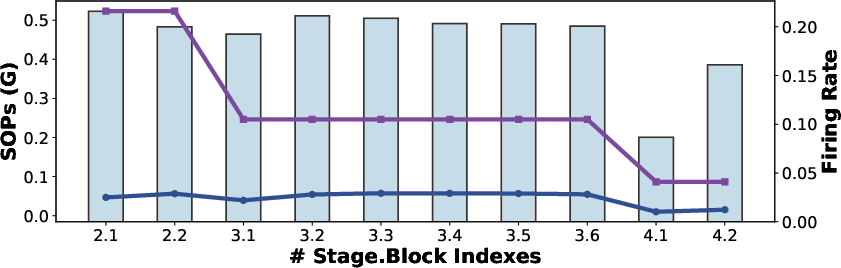
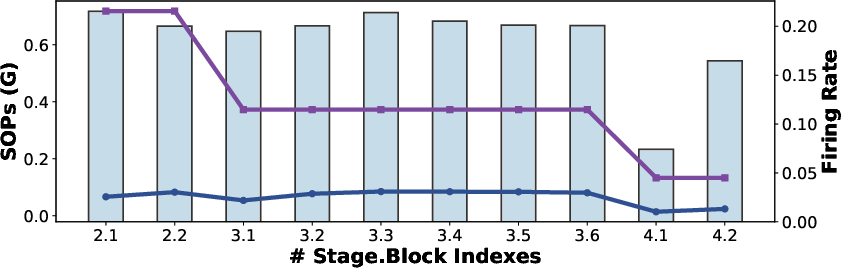
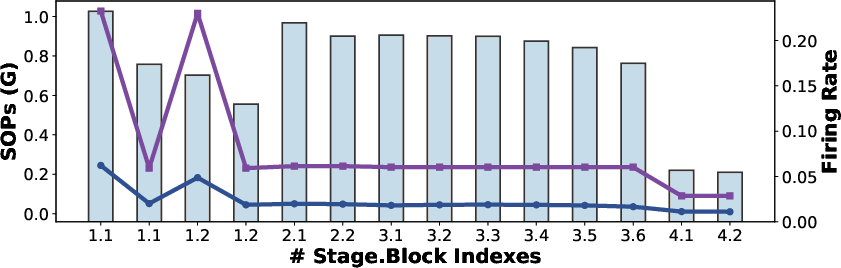
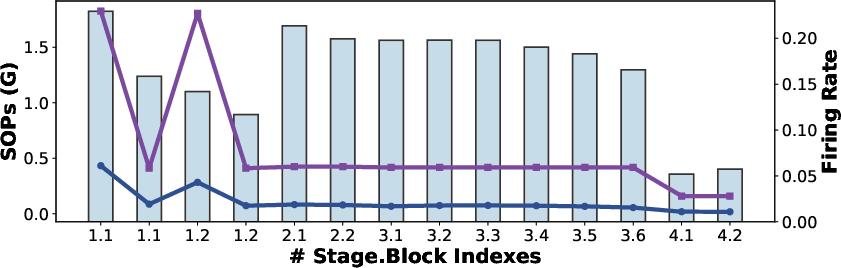
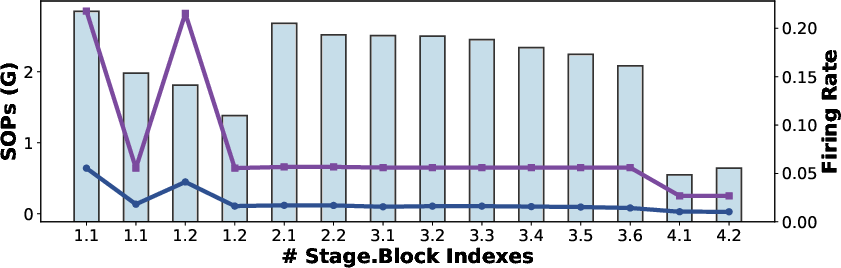
Figure 3: Module-level breakdown of firing rate, average SOPs, and theoretical upper bounds for SSA, SConv, and SFFN modules in Ge27mS-T on ImageNet-1k.
The clustered spatial grouping strategy maintains stable and low SOPs per attention layer, effectively counteracting the exponential growth in tokens. Regularization of spike activity and the adoption of lightweight separable convolutions in SFFNs further compound energy savings at all scales.
Theoretical and Practical Implications
The Ge28mS-T design paradigm generalizes beyond Vision Transformers, providing a blueprint for energy-efficient spike-based processing in architectures with pronounced spatiotemporal and token multiplicity characteristics. In contrast to conversion and surrogate-gradient-based approaches, the explicit grouping of spike events enables joint optimization of efficiency and learning capacity with provable bounds on overhead and precision loss. This has immediate implications for on-device and real-time inference on neuromorphic hardware, where both accuracy and strict power budgets are non-negotiable. Furthermore, the introduction of exponential group encoding for temporal spike patterns opens a direction for coding-theory-inspired SNN dynamics, potentially synergizing with SNN self-distillation, efficient quantization, and hybrid analog-digital co-processing in future research.
Conclusion
Ge29mS-T articulates a comprehensive solution to the central bottlenecks in Spiking Vision Transformers through coordinated grouping over multiple computation axes. The experimental and theoretical analyses validate that multi-dimensional grouped computation, when entangled with spike-efficient coding and multi-scale attention, enables simultaneous achievement of high accuracy, constant-order memory, and ultra-low energy consumption. This approach is poised to facilitate scalable, deployable SNN systems for advanced edge and neural-inspired computing tasks.
(2604.08894)

