- The paper presents a Recursive Inspection Protocol (RIP) that overcomes traditional buyer-evaluator limitations by addressing ex-post information asymmetry.
- It employs a Bayesian valuation framework to reveal how naive protocols can incentivize misleading data through suboptimal action selection.
- The study demonstrates scalable oversight applications, notably in RLHF and market-based fact-checking, by aligning incentives with improved decision-making.
Motivation and Problem Statement
The paper "Extrapolating Volition with Recursive Information Markets" (2604.08606) presents a decision-theoretic and mechanism-design approach for addressing information asymmetry in valuation and oversight settings. This problem is central to information economics and is increasingly significant for AI alignment, particularly scalable oversight in RLHF frameworks. Standard buyer-evaluator protocols fail in the face of persistent asymmetry—where the information-provider (e.g., LLM or agent) is structurally more informed than the buyer or rater. The paper formalizes the limitations of ex-post information valuation using Bayesian models of expected utility, demonstrates failures of existing market protocols under recursive asymmetry, and proposes a more robust recursive inspection protocol (RIP). The implications span the design of information markets, oversight protocols for alignment, and incentive-compatible training mechanisms for capable AI systems.
Bayesian Valuation Framework and Asymmetry
At the theoretical core, the paper presents a Bayesian model for an agent’s value-of-information (VOI) in decision-making. Let (Ω,F,P) be the prior, X the action space, and U:Ω×X→R the utility function. The agent’s decision with and without inspecting an "information good" (random variable I realized as i at price p) yields the familiar VOI expressions, but the model distinguishes between ex-ante, ex-post, and recursively derived value, highlighting that ex-post inspection can still leave critical, context-sensitive asymmetries unresolved.
The authors analytically demonstrate a "fact-checking failure mode": mechanisms rewarding only the immediate ex-post VOI can perversely disincentivize providing corrective context, incentivizing sellers to deliver misleading persuasive fragments rather than full information. The example with nested random variables illustrates that revealing more can decrease marginal gain, making context suppression a strategic equilibrium.
The paper systematically compares naive and recursive protocols for resolving information asymmetry in markets:
- Successive Inspection Protocol (Naive): Recursively constructs higher-order decision problems based on observable offers, but does not guarantee that information chosen to resolve a subproblem is available at the decision point that matters—the protocol is susceptible to suboptimal action selection and possible strategic omission of context.
- Recursive Inspection Protocol (RIP): Models buying decisions as an imperfect-recall extensive-form game. At each recursive step, an LLM or agent acting on behalf of the less-informed buyer can request further information to refine its inspection. Unlike the naive protocol, each buyer at recursion depth n can condition on the full trace of all information acquired via previous recursive queries, ensuring that every purchasing decision is as informed as is recursively feasible for bounded-rational agents.


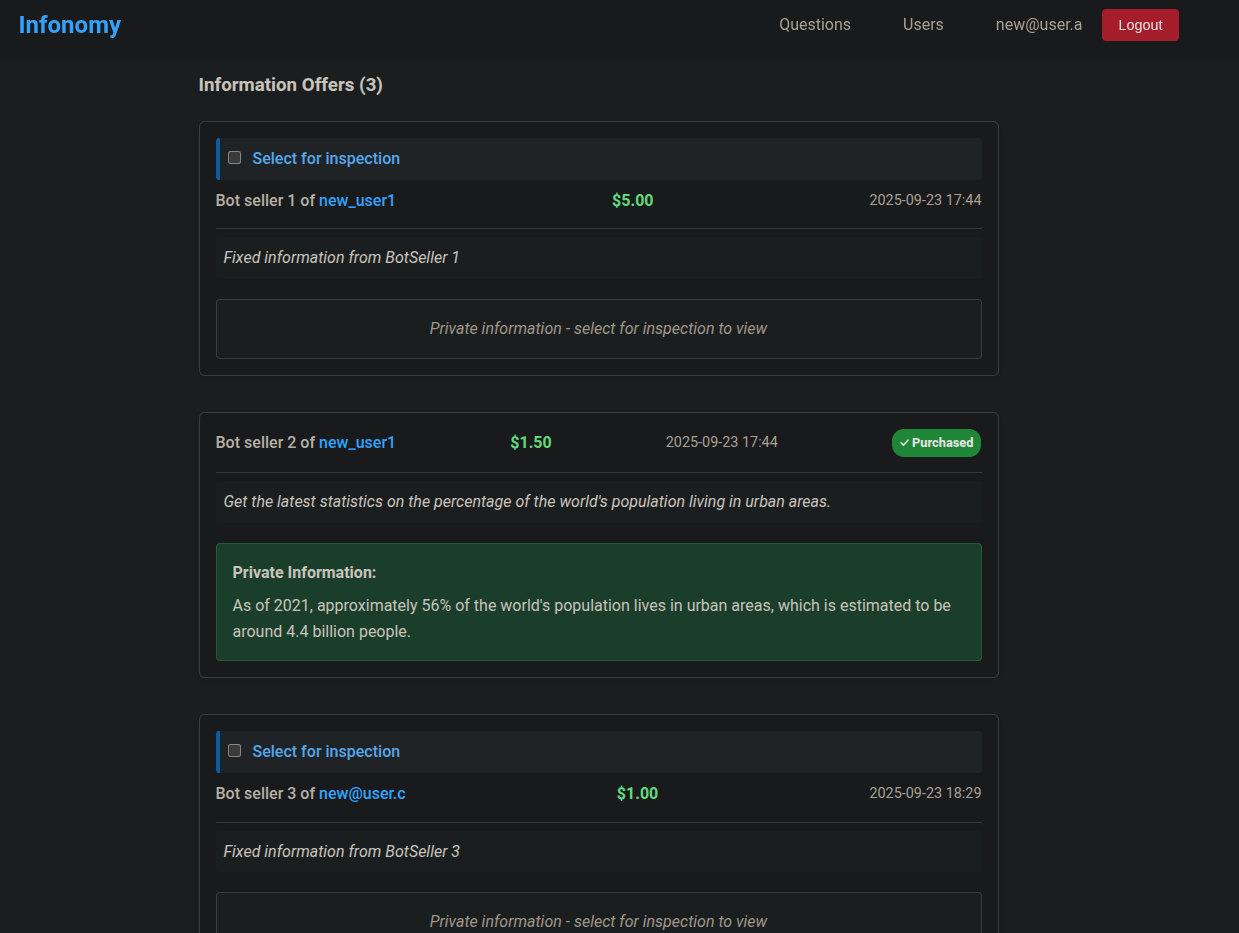
Figure 2: Browser UI for posting a new question (\BuyerContext) and visualizing the hierarchy of recursive contexts on the information market server.

Figure 4: Automated bot-seller agents submitting recursive answers to pending \BuyerContexts, illustrating the protocol’s compositionality and practical implementation as automated market transactions.
The RIP is proven ex-ante optimal against a wide class of admissible protocols, meaning it maximizes expected utility over all protocols that respect the bounds on which information can be used at each stage—accounting for both the costs of additional inspection and the value of recursion.
Scalable Oversight and Marginal-Value Reward Mechanism
Adapting the RIP for the AI alignment setting, the paper abstracts the oversight process for model training as a recursive market involving multiple agents with access to different information subsets. Critically, it proposes a marginal-value reward mechanism: at each recursive step, agents (such as LLMs) generate information designed to maximally improve the utility of the overseer’s (buyer’s) decision, with each incrementally rewarded by the marginal expected utility gain their information enables.
The subgame-perfect equilibrium of this mechanism is characterized: only an "inextensible" primary information offer survives, preventing strategically incomplete or misleading provision, as any extendable offer would be profitably refuted or extended by subsequent agents. Nevertheless, the equilibrium does not guarantee that the market reveals the globally optimal information—rather, the shortfall is lower-bounded by the cost of defeating bad information (i.e., the minimum cost to supply further corrections that overturn misleading or incomplete offerings). This is an explicit recognition of the bounded rationality and cost sensitivity inherent to real-world oversight and information markets.
Implementation and Applications
A concrete implementation—the infonomy-server—realizes the Recursive Inspection Protocol. The platform allows users to post contexts (questions, product inspection queries, claims for fact-checking, etc.) and for seller or bot agents to provide offers, with recursive buyer agents inspecting, purchasing, and aggregating information in a compositional workflow.
Applications include:
- Q&A platforms with market pricing for contextually valuable answers
- Market-based product regulation and review systems
- Community moderation and fact-checking (e.g., analogues to Community Notes)
- Integrated reasoning for complex forecasting or prediction markets requiring recursive evidence aggregation
(Figure 1 appears previously; Figure 3 shows recursive bot response automation).
Implications and Theoretical Developments
The theoretical framework expands the rational expectations paradigm in information economics and illustrates connections to mechanism design with imperfect recall, bounded rationality, and Bayesian learning under transaction costs. It gives operational semantics to the "extrapolated volition" concept in value learning and alignment—the idea of maximizing the utility a less-informed agent would have if made as informed and rational as possible. The marginal-value mechanism's characterization echoes the alternating move structure of AI safety debate and extends it to general market and feedback settings.
Practically, the work suggests that recursive information markets can:
- Partially mitigate scalable oversight bottlenecks in RLHF by using compositional, recursively auditable LLMs rather than relying on a fixed human capability bottleneck.
- Implement market-based incentives for richer, context-complete, and recursively robust information provision.
- Quantify residual misalignment in terms of the cost of defending correct (or more informative) answers—an actionable metric for oversight protocol evaluation.
Future Directions
The current mechanisms, while ex-ante optimal among bounded inspection protocols, remain imperfect for scalable oversight in the presence of high-cost or unscalable corrective interventions. The open theoretical direction concerns developing protocols with tighter guarantees on equilibrium shortfall—characterizing, minimizing, and possibly learning the cost structures that bound alignment failures. Further, practical integration with learning systems calls for dynamic and performant agent orchestration, scalable compositionality, and robustness against coordinated strategic manipulation, all of which connect to broader themes in AI economics, human-in-the-loop learning, and automated market design.
Conclusion
This paper establishes a principled, mathematically rigorous framework for pricing and incentivizing information in the presence of persistent asymmetry, leveraging recursive inspection and compositional market microstructure. It delivers both strong theoretical guarantees—ex-ante optimality, bounded rationality, equilibrium characterization—and a working implementation with practical utility for scalable oversight and information aggregation. It thus contributes foundational mechanisms and analysis for the design of oversight, information markets, and alignment protocols operating under the fundamental constraint: persistent information asymmetry between providers and evaluators.