- The paper introduces SSP-KANs that repurpose standard telecom modules to implement trainable univariate nonlinearities for optical neural computing.
- It achieves high accuracy on benchmarks, including 98.4% on Two Moons and robust R² performance on yacht hydrodynamics with fewer parameters than software models.
- The study shows that increasing network depth compensates for hardware limitations, balancing the trade-offs between incoherent and coherent summation regimes.
Introduction and Motivation
The transition to photonic neural networks (PNNs) promises significant gains in inference latency and energy efficiency by leveraging computation in the optical domain. However, state-of-the-art implementations are typically restricted by hybrid approaches in which linear computations are realized optically but nonlinear activations are performed electronically, introducing significant optical–electrical–optical (OEO) bottlenecks. The Kolmogorov–Arnold Network (KAN) paradigm provides an alternative, restructuring neural computation via trainable univariate nonlinearities assigned to network edges rather than fixed activations at nodes. The theoretical underpinnings of KANs, grounded in the Kolmogorov-Arnold representation theorem, suggest that any multivariate continuous function can be decomposed into superpositions of univariate functions and addition, positioning KANs as an attractive architecture for photonic implementation.
This work introduces small-scale photonic KANs (SSP-KANs), realized entirely with widely available telecommunications hardware: Mach–Zehnder interferometers (MZIs), semiconductor optical amplifiers (SOAs), and variable optical attenuators (VOAs). The central hypothesis is that despite the severely constrained functional expressivity of standard telecom nonlinearities—each module provides only four physically meaningful, independently tunable parameters—compositionality and depth are sufficient to achieve strong nonlinear inference in practical tasks across classification, regression, and image recognition.
SSP-KAN Architecture and Photonic Modules
The SSP-KAN network topology follows the canonical KAN approach by assigning a dedicated MZI-VOA-SOA-VOA module on each edge between input and output nodes. Each module implements a tunable nonlinear transfer function governed by four physical parameters: SOA injection current I, VOA input attenuation α1, VOA output attenuation α2, and MZI phase ϕ. The functional form combines amplitude nonlinearities due to SOA gain saturation and phase-dependent interference at the recombining MZI. Each module thus forms a parameter-efficient yet expressive unit, grounded rigorously in Agrawal–Olsson SOA gain dynamics and standard telecom device specifications.
The essential network operation can be written as
yj=∑iφi,j(xi)
where φi,j is the (learned) transfer function of the module on edge (i,j). Summation is performed optically through incoherent or coherent power combining, depending on hardware configuration and network depth.
Nonlinear Classification: Two Moons Benchmark
To empirically probe nonlinear expressivity with minimal width and depth, SSP-KAN is evaluated on the prototypical Two Moons classification task. A single-layer [2,2] network, corresponding to four physical modules and sixteen parameters, achieves 98.4% test accuracy, closely matching a software-based KAN (B-spline activations, forty parameters) at 99.9% accuracy (Figure 1). Notably, this is achieved with fewer than half the parameters and with all nonlinearities explicitly constrained to be realized by optical hardware.
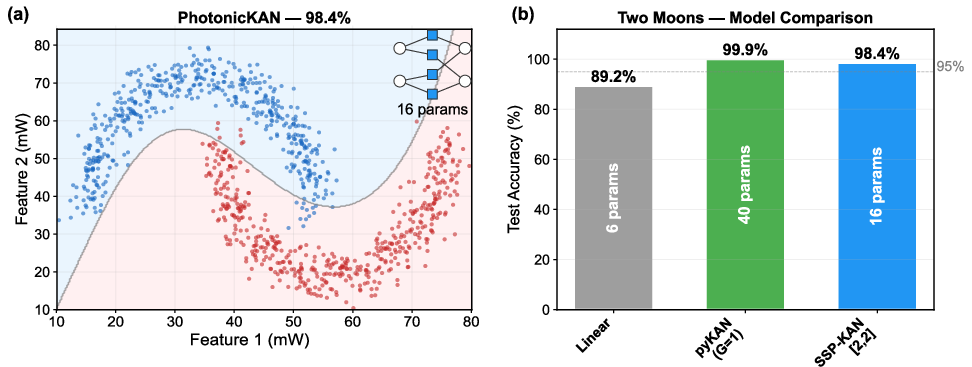
Figure 1: Learned decision boundary and comparative parameter counts for the [2,2] SSP-KAN versus baseline models on the Two Moons classification task.
Robustness to realistic photonic hardware impairments is systematically assessed. Performance is invariant to aggressive DAC quantization (down to 4-bit inputs), confirming that high input resolution is unnecessary. Optical amplification noise is the dominant limiting factor: accuracy remains above 95% at SNR ≥14 dB and degrades below the linear baseline only at extreme SNR (6 dB). The network maintains the characteristic nonlinear boundary in moderate noise conditions; only in severe noise does model capacity revert toward linearity (Figure 2).
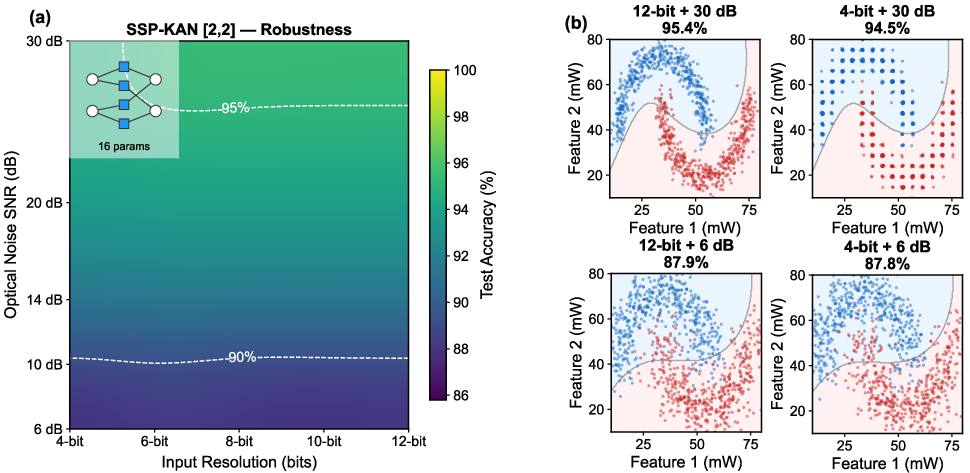
Figure 2: Heatmap of test accuracy as a function of SNR and DAC resolution, and representative nonlinear decision boundaries under hardware impairment for the [2,2] SSP-KAN.
Multivariate Regression: Yacht Hydrodynamics
Scaling to higher-dimensional regression, SSP-KAN is tested on the UCI Yacht Hydrodynamics dataset, with six input features. The single-layer [6,1] architecture (24 parameters) achieves α10, outperforming linear regression but falling short of the α11 MLP and α12 software KAN. Introduction of a second layer ([6,1,1], 28 parameters) elevates the model to α13, reaching parity with the software KAN baseline using less than half the parameter count (Figure 3).
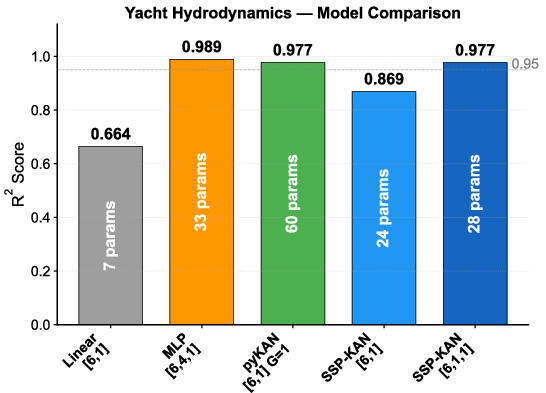
Figure 3: Comparison of α14 scores and parameter counts for SSP-KAN, MLP, linear, and software KAN models on yacht hydrodynamics.
Hardware robustness trends mirror those in classification. Quantization remains negligible, while accuracy is resilient to SNR variations down to 14 dB, with graceful degradation at lower SNR (Figure 5a,5b). The key finding is that compositional network depth is critical: deeper SSP-KANs can compensate for restricted per-module expressivity and fully capture multivariate input interactions.
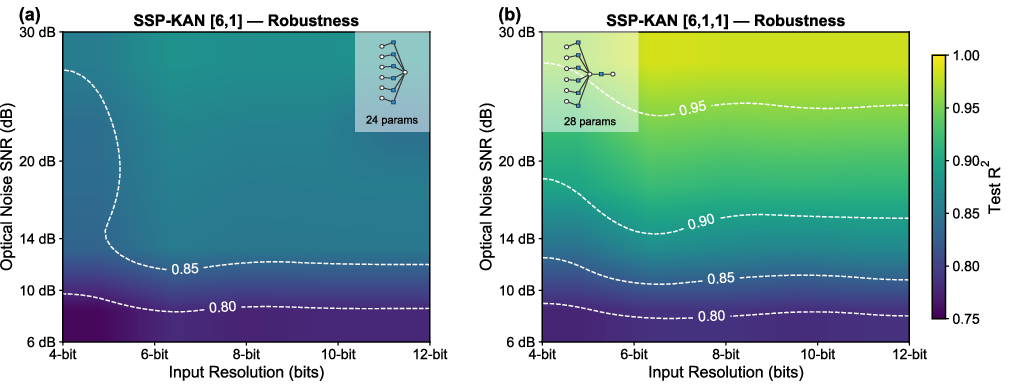
Figure 4: Test α15 as a function of SNR and input quantization for [6,1] and [6,1,1] SSP-KAN regression architectures.
High-Dimensional Image Classification
The models are extended to MNIST and Fashion-MNIST, utilizing [784,20,10] architectures (15,880 physical modules). On MNIST, SSP-KAN reaches 92.7% accuracy (vs 91.0% for the linear baseline); on the more challenging Fashion-MNIST, the advantage is slightly higher at 2.4% over the linear baseline (Figure 5). Notably, the confusion matrices reveal that most errors occur between visually similar classes, highlighting the limits of the fixed, four-parameter nonlinear transfer functions.
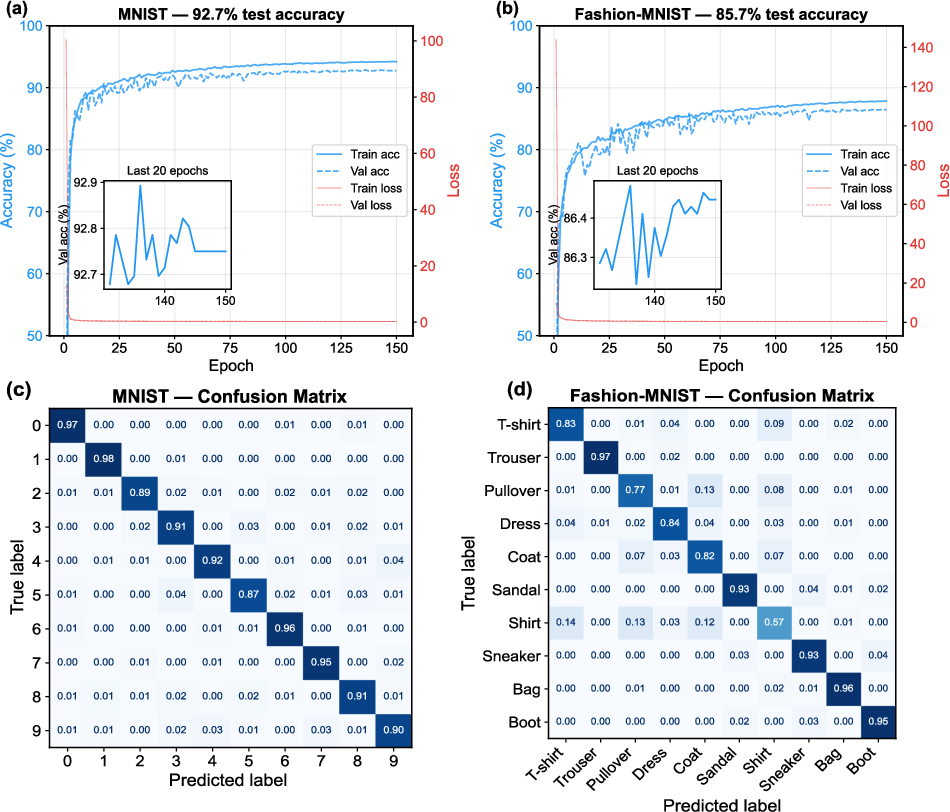
Figure 5: Training curves and confusion matrices for [784,20,10] SSP-KAN on MNIST and Fashion-MNIST.
Network Depth and Feature Interaction
The paper rigorously analyzes the limitations of single-layer SSP-KANs for tasks requiring feature interaction or non-axis-aligned decision boundaries. On problems such as XOR or rotated Two Moons, [2,2] networks (additive in structure) are provably insufficient, whereas adding a layer ([2,2,2] topology) allows the model to recover high accuracy by enabling interactions through composition (Figure 6).
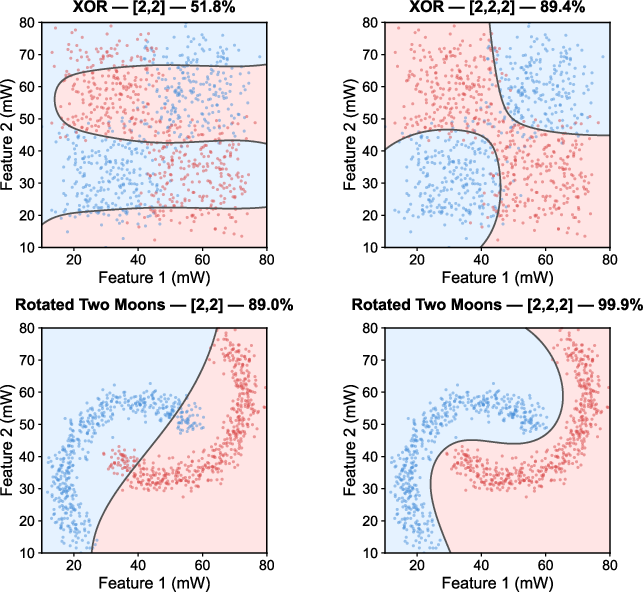
Figure 6: Comparison of single-layer and two-layer SSP-KANs on tasks requiring cross-feature interactions, such as XOR and rotated Two Moons.
Coherent vs. Incoherent Summation: Depth-Dependent Effects
A detailed analysis is presented on the choice between incoherent (power) and coherent (field) summation at recombination nodes. For shallow networks ([2,2]), incoherent summation yields significantly better trainability and final accuracy (99.4% vs 91.8%), as phase–interference coupling in the coherent regime induces highly multimodal loss landscapes that slow convergence. For deeper architectures ([2,2,2]), the situation reverses: coherent models are more expressive and achieve slightly better accuracy than incoherent ones (99.9% vs 99.5%, Figure 7).
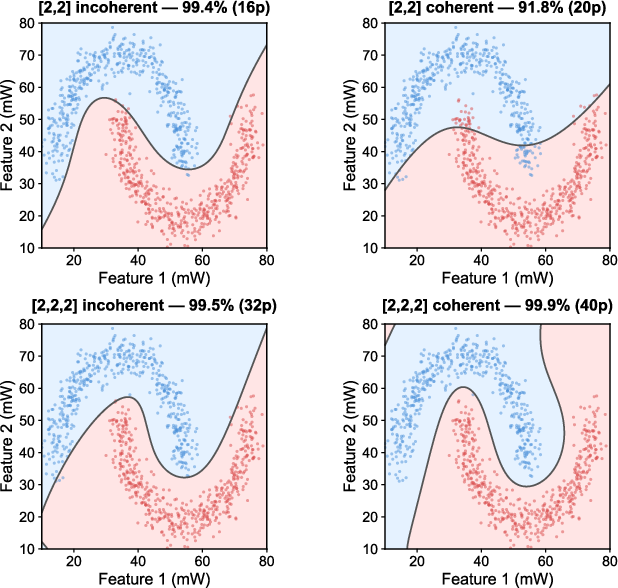
Figure 7: Accuracy and learned boundaries for coherent and incoherent [2,2] and [2,2,2] SSP-KANs, showing expressivity-trainability trade-offs as a function of depth.
Practical Implications and Outlook
The results demonstrate that modest networks (4–8 modules, 16–32 parameters) based entirely on standard, commercially available fiber-coupled components can perform strong nonlinear inference and demonstrate robustness to the primary hardware impairments faced in real-world photonic systems. The approach eschews highly engineered nonlinear elements, relying instead on rigorous physics-based, differentiable models grounded in manufacturer specifications.
In practice, the architecture is especially attractive for applications where interpretability, model simplicity, latency, and hardware integration are paramount (e.g., real-time optical equalization in telecom links, edge photonic sensors). Scaling to high-dimensional workloads (image classification) will require transitions to integrated photonic platforms for efficiency and stability but the underlying optimization framework carries over as long as the nonlinear transfer functions are differentiable.
Through an explicit compositional approach, the observed accuracy gap to more expressive, resonant, or engineered nonlinear architectures (e.g., D-RAMZI) is quantified, suggesting that cascaded or physically richer nonlinearities (e.g., leveraging self-phase modulation or Brillouin gain) would close the gap while retaining the co-design philosophy.
Conclusion
This work establishes that small-scale photonic KANs built entirely from standard telecom hardware and governed by explicit, differentiable physics-based models can act as parameter- and hardware-efficient nonlinear inference engines. Depth can compensate for per-module constraints, robustness to realistic hardware impairment is confirmed, and expressivity-trainability trade-offs favor incoherent summation at low depth but coherent architectures at scale. The developed framework enables rapid transition from simulation-trained parameters to experimental demonstration, paving the way for practical all-optical neural networks deployable in latency-critical and resource-constrained photonic environments.