- The paper demonstrates that spoken song introductions can significantly raise taste-broadening serendipity, with informative introductions elevating TBS rates from 38.4% to 55.9%.
- It employs multilevel structural equation modeling to reveal that narrative transportation and cognitive elaboration mediate the effect of introductions on expanding listener taste.
- The findings suggest practical integration of personalized, high-quality introductions into music recommender systems to overcome algorithmic limitations and foster genre exploration.
Stimulating Taste-Broadening Serendipity in Music Discovery through Song Introductions
Introduction
This paper investigates effective mechanisms for stimulating Taste-Broadening Serendipity (TBS) in music recommendation contexts by augmenting song presentation with spoken introductions. Drawing on appraisal theory of interest and extensive prior work on serendipity in recommender systems, the authors provide a rigorous empirical analysis of how immersive and informative introductions impact the listener's psychological processing during exploration of unfamiliar music. Theoretical modeling is combined with multilevel structural equation modeling (SEM) of user study data to expose the mediation mechanisms underlying successful taste broadening.
A persistent limitation of contemporary Music Recommender Systems (MRS) is their weak support for exploration, particularly in stimulating engagement with music outside a user's usual genre or taste boundaries. Prior approaches—including pathway-based recommendations, direct exposure to distant genres, algorithmic diversification, and the use of segues—focus on surfacing novel content but rarely address how to actively spark user interest in such recommendations.
This work operationalizes Taste-Broadening Serendipity as the fortuitous encounter of content perceived as both refreshing and enriching, specifically focusing on contextually and subjectively unusual yet interesting songs. Building on Silvia's appraisal theory, the study models interest as a function of perceived complexity and coping potential in response to novel stimuli. To operationalize these constructs, two psychological mechanisms are targeted: transportation (absorption in a narrative world), hypothesized to be triggered by immersive introductions; and cognitive elaboration (integration of new information with prior knowledge), hypothesized to be stimulated by informative introductions.
The research design leverages a controlled user study (N=350, stratified by genre unfamiliarity) using a custom web-based platform. Each participant receives three songs from underrepresented genres, each prefaced by either a control, immersive, or informative introduction synthesized with TTS. Post-exposure, multidimensional subjective ratings (including TBS, transportation, cognitive elaboration, coping potential, complexity) are collected.
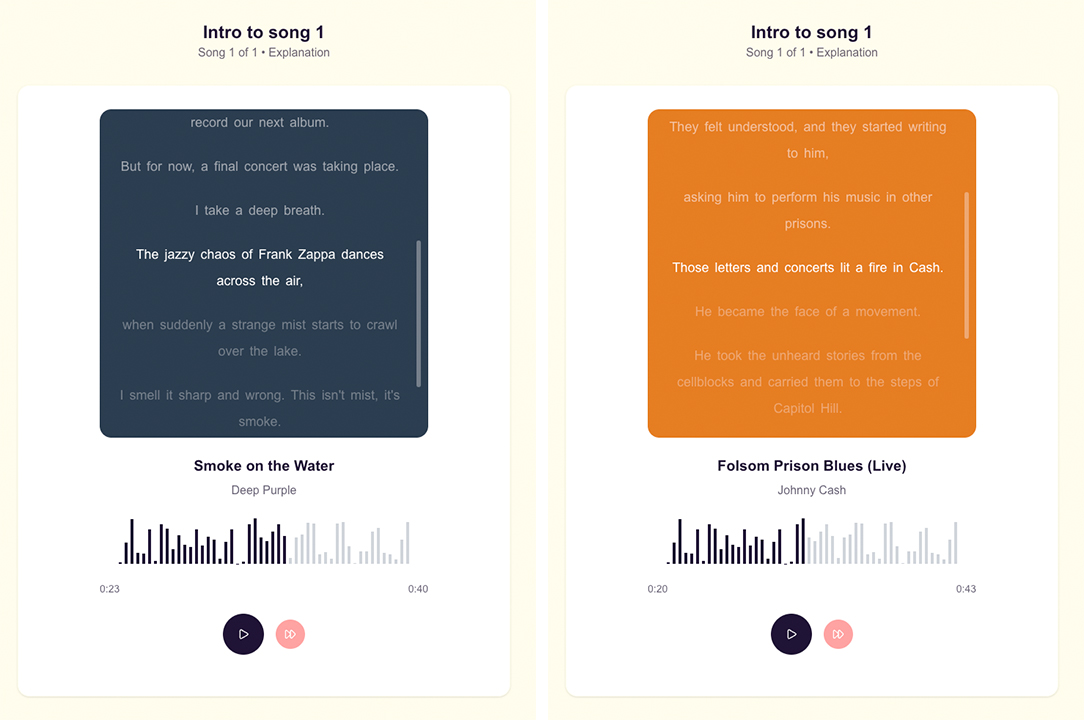
Figure 1: Example immersive and informative introductions for "Smoke on the Water" and "Folsom Prison Blues" illustrating the narrative and factual augmentation strategies.
Empirical Findings
Efficacy of Introductions
The introduction of spoken narratives significantly increases rates of TBS for songs outside the listener's typical preference profile. Without introduction, baseline TBS rates are 38.4%. With immersive introductions, TBS rises to 49.1%; with informative introductions, to 55.9%. Both effect sizes are statistically significant (OR=1.93 and OR=2.66, respectively). These improvements are robust across genres but exhibit moderate variance by song and, crucially, by the perceived interestingness of the introduction. Informative introductions perceived as uninteresting can backfire, decreasing TBS versus control.
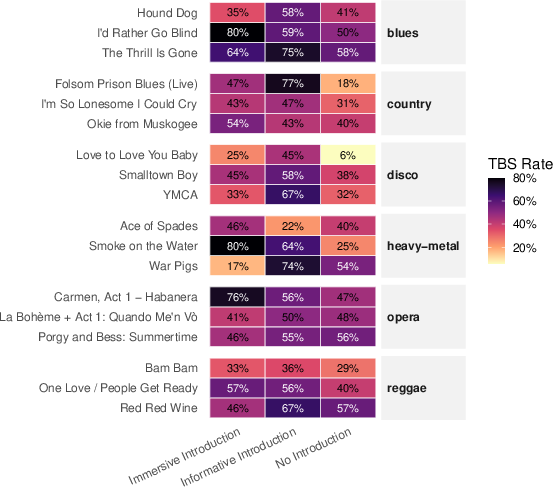
Figure 2: TBS rates distributed by song and introduction method, highlighting songwise and introduction-quality-dependent heterogeneity.
SEM reveals that the positive effect of introductions on TBS is fully mediated by increases in both perceived complexity and coping potential. However, path analysis demonstrates that transportation is the dominant predictor, exerting both direct and mediated effects via coping potential. Cognitive elaboration also predicts TBS, but with a lower direct effect. Thus, transportation subsumes coping potential as a driver for taste broadening—listening experiences that successfully transport the listener into a song's narrative world generate the greatest serendipitous engagement.
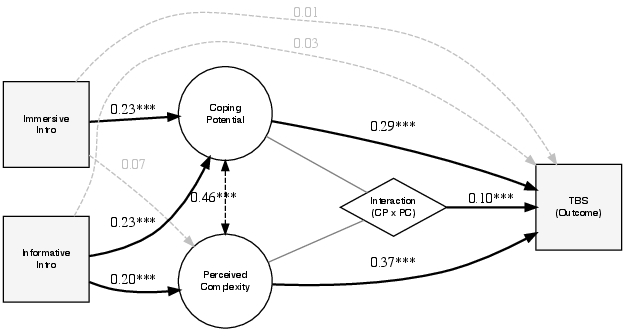
Figure 3: Path diagram showing standardized estimates for mediation through transportation, cognitive elaboration, complexity, and coping potential.
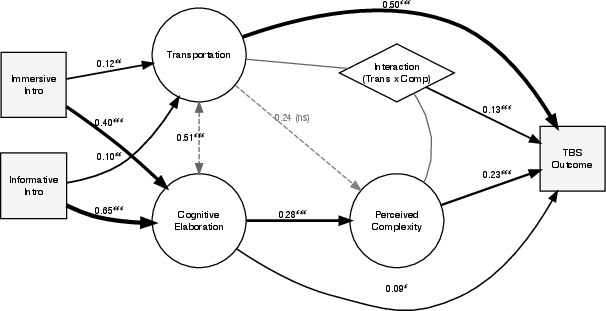
Figure 4: Refined SEM diagram confirming the primacy of transportation and reporting the direct and interaction effects of both mechanisms on TBS.
The mediation analysis indicates that immersive introductions primarily enhance TBS via transportation, while informative introductions do so mainly through cognitive elaboration. Nevertheless, both types stimulate both mechanisms to a significant, correlated extent (r=0.51). This demonstrates that the manipulations are not strictly modular and that effective introductions often combine both narrative and contextual education.
Downstream Effects on Diversity of Listening
Experience of TBS during a listening session is a strong predictor of the desire to further explore the corresponding genre, independent of or in addition to explicit liking ratings. This finding mechanistically links TBS events to sustained openness to musical diversity.
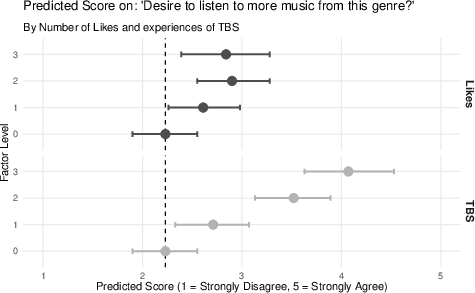
Figure 5: Predicted user desire to continue exploring a genre as a function of accumulated TBS and liking events during the session.
Implications for Music Recommender Systems
These results have several implications for the design of next-generation MRS intended to maximize exploratory diversity and retention. The introduction of algorithmically or human-curated spoken introductions—either immersive narratives or contextualizing factoids—constitutes a scalable and effective strategy for facilitating taste broadening beyond incremental algorithmic diversification.
Immersive introductions are advantageous for songs with strong narrative affordances, but are less robust due to their dependence on high-quality writing and delivery (the fragility of the transportation state). Informative introductions exhibit greater consistency but can still fail or backfire if not perceived as genuinely interesting by the user. As such, maximizing subjective measures of introduction quality is crucial for practical deployment.
Algorithmic detection of repetitive listening patterns (“boredom bubbles”) can be used as a trigger to present “taste-breaker” playlists, augmented with dynamic or personalized introductions. The possibility of scalable, automated introduction generation using LLMs and TTS synthesis is noted, though issues remain regarding perceived authenticity and trust in AI-generated content.
Limitations and Future Directions
The controlled study design, while maximizing internal validity, constrains ecological realism and spontaneity of listening behavior. Additionally, the use of TTS voices negatively biased perceived credibility for a subset of users, indicating that both voice and authorial attribution of introductions play a non-trivial role in user acceptance. Personalization of introduction type based on individual cognitive style (e.g., empathizers vs systemizers) and genre context presents a promising avenue for future research. Further, the long-term effects of repeated TBS events on stable taste shift and subscription retention remain empirically untested.
Conclusion
The presented work advances the theory and practice of serendipitous recommendation in the music domain by demonstrating that contextually rich introductions—when carefully crafted and perceptually compelling—can substantially raise the probability of taste-broadening experiences and, in turn, stimulate broader genre exploration. The effect is robust and mediated strongly by the sense of narrative transportation, though cognitive elaboration additionally contributes independent gains. The findings suggest direct strategies for integrating taste-broadening features into music platforms, with further work needed on personalization and long-term behavioral measurement.

