- The paper presents a unified SPQR-tree approach that achieves linear-time detection of bubble-like subgraphs including superbubbles, snarls, and ultrabubbles.
- It leverages SPQR-tree decomposition to efficiently encode 2-separator structures and applies dynamic programming for acyclicity and reachability analysis.
- The method scales to large (bi)directed graphs in genomics, significantly reducing computational bottlenecks in genetic variation analysis.
Linear-Time Identification of Bubble-like Subgraphs via SPQR-Tree Decomposition
Introduction and Motivation
The paper "Identifying bubble-like subgraphs in linear-time via a unified SPQR-tree framework" (2604.08071) addresses a fundamental computational problem in bioinformatics: efficiently identifying all subgraphs of certain "bubble-like" forms—including superbubbles, snarls, and ultrabubbles—in massive (bi)directed graphs, such as pangenome graphs. These structures encapsulate genetic variation, driving the need for scalable algorithms, as datasets continue growing—e.g., the Human Pangenome Reference Consortium's graphs now contain hundreds of millions of edges.
Traditionally, only superbubbles could be efficiently detected in linear time for directed graphs, while finding snarls and ultrabubbles in bidirected graphs required quadratic or worse complexity. This posed a practical bottleneck and an unresolved theoretical challenge. The paper's core contribution is a unified SPQR-tree-based approach, yielding the first linear-time algorithms for snarl and ultrabubble detection, thus resolving longstanding open problems.
Bubble Structures: Superbubbles, Snarls, and Ultrabubbles
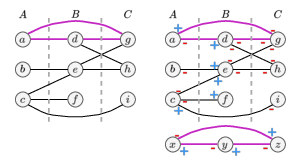
Bubble-like subgraphs are characterized by pairs of "extremities" (vertices or vertex-sides) acting as separators in the underlying undirected graph. For superbubbles in directed graphs, these extremities are source and sink, and the bubble interior is acyclic and minimal. Bidirected graphs (modeling reverse-complement DNA symmetry) generalize this to snarls (minimal subgraphs separated by splitting two vertex-sides) and ultrabubbles (snarls with interior acyclicity and tiplessness).
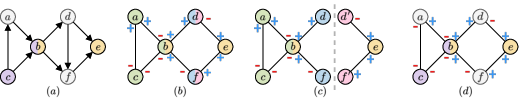
Figure 1: Superbubbles, snarls, and ultrabubbles illustrated in both directed and bidirected graphs, highlighting the colored separation pairs and the topological context.
SPQR-Tree Decomposition: Unified Framework
The key insight is that bubble extremities correspond to 2-separators in the underlying undirected graph. The SPQR-tree data structure encodes all separation pairs and their associated split components in linear space. By leveraging SPQR trees, the paper efficiently enumerates all candidate bubble regions and applies dynamic programming traversals to maintain reachability, acyclicity, and tiplessness.
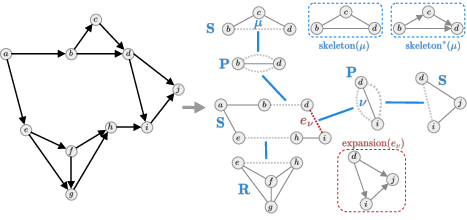
Figure 2: SPQR tree structure for a biconnected graph, with virtual edges and node types; the expansion and skeleton clearly partition the graph's substructures.
Bubble-like regions are mapped directly to specific expansions of virtual edges in SPQR tree skeletons. This reduces the detection of bubbles to verifying properties on these induced subgraphs.
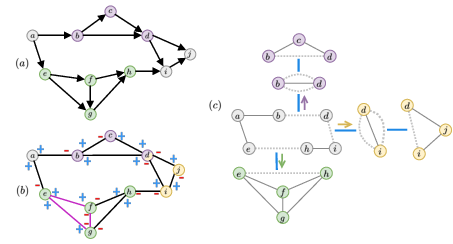
Figure 3: Mapping of superbubbles, snarls, and ultrabubbles onto the SPQR tree of the underlying undirected graph, emphasizing the correspondence between separators and bubble regions.
Superbubble Detection in Directed Graphs
The linear-time superbubble algorithm performs two main traversals of the SPQR tree:
- Phase 1: Bottom-up DFS computes local acyclicity and reachability (source → sink) for expansion graphs of each virtual edge.
- Phase 2: Top-down BFS verifies, for each separator, whether deleting a virtual edge yields an acyclic residual, via feedback arc analysis.
- Phase 3: Reports valid superbubble pairs based on computed properties and verifies minimality.
This approach synthesizes previously disjoint methods and provides a generalized, structurally transparent process.
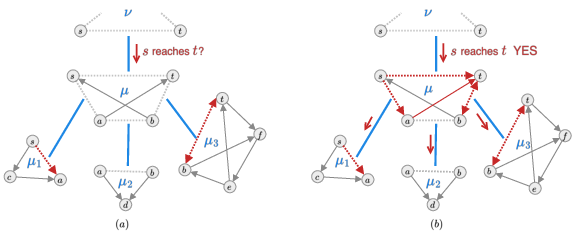
Figure 4: Phase 1 of the superbubble algorithm—DFS on the SPQR tree accumulates reachability and acyclicity information from child expansions.
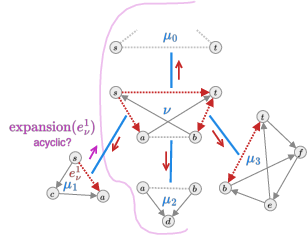
Figure 5: Phase 2—BFS from root evaluates acyclicity of expansion complements, using feedback arc computations for linear scalability.
Strong runtime guarantees are established: superbubbles for a graph G=(V,E) are found in O(∣V∣+∣E∣) time.
Linear-Time Algorithms for Snarls and Ultrabubbles
For snarls (bidirected), the paper provides a new linear-size representation: sign-cut graphs, constructed by splitting sign-consistent cutvertices. This drastically reduces the worst-case quadratic output size to linear.
Structural Properties and Characterization
The analysis delineates the roles of different SPQR nodes (S, P, R) in bubble structure formation:
- S-Nodes: Only specific pairs of "good" vertices form bubbles; nonadjacent pairs not valid (see Figure 7).
- P-Nodes: Parallel split components yield bubble unions; validated by neighbor sets and expansion acyclicity (see Figure 8).
- R-Nodes: Rigid structures admit validated separator-induced bubbles, with minimality witnessed by multiple internally vertex-disjoint paths.
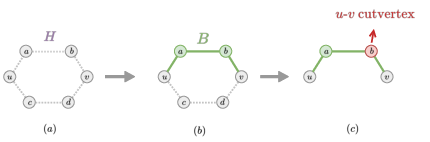
Figure 7: S-node schematic—nonadjacent vertices cannot yield superbubble separations due to unavoidable cutvertices.
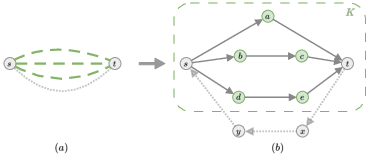
Figure 8: Superbubbloids in P-nodes—combinatorial formation via matching expansion sets.
Sign-cut graphs (Figure 9) and dangling block illustrations (Figure 10) further clarify the partitioning of the input graph, ensuring all snarls are covered without redundant enumeration.
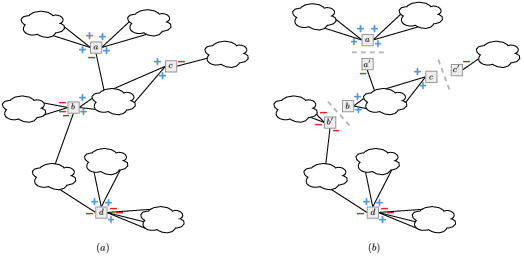
Figure 9: The construction of sign-cut graphs, splitting sign-consistent vertices to reduce snarl complexity.
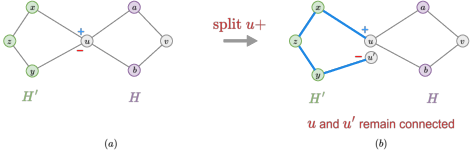
Figure 10: Dangling block scenario—separability is blocked by paths through blocks with mixed vertex-side signs.
Algorithmic Results and Complexity
Key results include:
- Superbubbles: Linear-time detection in directed graphs.
- Snarls: All snarls are represented and detected in linear time; practical encoding reduces output size drastically.
- Ultrabubbles: Linear-time detection for bidirected graphs without tips; general case is hard under k-Clique Conjecture.
- Feedback Analysis: Linear-time feedback edge computation for tipless bidirected graphs; NP-hard otherwise.
The algorithms generalize to bubble-like forms beyond the three main types—potentially enabling linear-time detection for bibubbles, panbubbles, and related structures.
Biological and Theoretical Implications
Practically, scalable detection of bubbles enables efficient analysis of genetic variation in pangenome graphs of ever-growing scale. Theoretical implications are twofold:
- Establishment of a unified, SPQR-based framework drastically simplifies algorithmic design for problems dependent on 2-separators.
- Demonstrates a reduction in complexity for key problems (bubble detection, feedback edge finding), except in cases provably tied to strong complexity-theoretic lower bounds.
This framework may catalyze further algorithmic advances in sequence analysis, metagenomics, and network genomics.
Future Directions
Potential future developments include:
- Extension of SPQR-tree decomposition to emerging bubble-like definitions (bibubbles, panbubbles) in complex genomic graphs.
- Parallelization and distributed deployment on population-scale datasets.
- Formal integration of this framework in pangenome graph toolkits and variant calling pipelines.
- Exploration of fine-grained reductions to other NP-hard problems in bidirected graphs.
Conclusion
This paper introduces a unified, SPQR-tree-based methodology for linear-time identification of superbubbles, snarls, and ultrabubbles in (bi)directed graphs, eliminating long-standing algorithmic bottlenecks. The results combine classical graph decomposition techniques with domain-specific dynamic programming, yielding scalability, practical output representations, and theoretical clarity. The framework holds promise for continued advances in computational biology, sequence graph algorithms, and beyond.