- The paper presents nearly optimal explicit linear expansion bounds for sparse string and region intersection graphs using combinatorial techniques.
- It improves upon previous polylogarithmic bounds by leveraging novel probabilistic sampling and model construction lemmas.
- These results enhance our understanding of graph coloring and algorithmic performance in minor-closed sparse classes.
Sparse String Graphs and Region Intersection Graphs over Minor-Closed Classes: Linear Expansion
Introduction and Motivations
The paper "Sparse String Graphs and Region Intersection Graphs over Minor-Closed Classes have Linear Expansion" (2604.07903) addresses fundamental structural properties of string graphs and, more generally, region intersection graphs (RIGs) over proper minor-closed classes. The focus is on "linear expansion", a strong quantitative property in the context of graph sparsity theory. The main results establish explicit, nearly optimal bounds for the expansion of sparse string graphs in fixed surfaces and for RIGs over any proper minor-closed class, relying on combinatorial, self-contained proofs.
String graphs—intersection graphs of curves in surfaces—originate from classical problems in combinatorics, computational geometry, and applications such as mutation patterns and electrical network layouts. Their inherent complexity is reflected by NP-hard recognition, unbounded chromatic number, and exponentially many realizations in the plane. Previous work using separator-based techniques only established weaker bounds involving polylogarithmic factors; this paper sharpens these to optimal linear dependence, with explicit constants, and generalizes from planar string graphs to the broad setting of RIGs.
Definitions and Technical Framework
A string graph G is defined as the intersection graph of a family of non-self-intersecting curves on a surface: adjacency corresponds to intersecting curves. Region intersection graphs over a graph H (or a class G) generalize this: vertices correspond to connected subgraphs of H, and two vertices are adjacent iff their respective subgraphs share at least one vertex.
Key parameters:
- r-shallow minor: a minor whose branch sets induce connected subgraphs of radius ≤r in the host graph.
- Expansion function ∇r(G): the maximum edge density (edges per vertex) over all r-shallow minors of G.
- Linear expansion: ∇r(G) is H0 for all H1, with explicit dependence.
This paper calls a class sparse if it has bounded maximum density. The translation between sparsity and minor-closed structure is essential for expanding the results beyond string graphs in a fixed surface.
Main Theorems and Proof Schema
The central results specify that:
- For sparse string graphs in a fixed surface (with surface of Euler genus H2), H3, where H4 is density.
- For a region intersection graph H5 over any proper minor-closed class H6 of edge density at most H7 (and with H8 of max density H9): G0.
These bounds are within a constant factor of optimal and strictly improve prior results by eliminating unnecessary polylogarithmic terms. The proofs are composed of combinatorial constructions, avoiding machinery such as multi-flow dualities, metric geometry, or expander-like embeddings prevalent in prior art.
The argument is built on two main lemmas:
- A probabilistic sampling lemma, leveraging Hakimi's orientation theorem and random selection to bound the density of an arbitrary minor, provided certain "junction-free" conditions.
- A model construction lemma, showing that junction-free graphs are closely structurally related to minors of the underlying host graph. This bridges the representational gap between RIGs and their minor-exclusion structure.
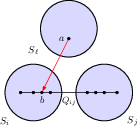
Figure 1: A junction in G1: a pair of edges G2 and G3 such that G4 and G5 for some G6.
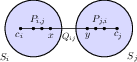
Figure 2: G7—the path properly representing the adjacency between branch sets G8 and G9 in the model.
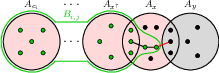
Figure 3: Construction of H0 (green)—the auxiliary set connecting branch set H1 toward H2, illustrating precise intersections in H3.
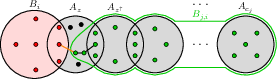
Figure 4: Construction of H4 (green)—the auxiliary set from H5 to H6, with the relevant branch set H7 in red.
Methodological Contributions
Fundamental to the analysis is the systematic use of orientations with bounded in-degree (cf. Hakimi), "junctions" as obstructions, and careful sampling arguments that lead to tight bounds on minor densities. This is combined with meticulous model constructions ensuring that every junction-free subgraph (on vertices of degree at least two) corresponds to a minor in the underlying host graph (for RIGs).
The extension to all sparse minor-closed classes is significant—previous best results only handled planar string graphs and required deep machinery to relate separators and expansion. Here, the embedding structure and sparsity conditions are exploited purely combinatorially.
Alternative Approach via Gap-Cover-Planarity
The paper also provides an alternative proof for linear expansion in sparse string graphs, based on the concept of H8-gap-cover-planarity. It shows that every H9-degenerate string graph in a surface of genus r0 can be realized as a r1-gap-cover-planar graph, and applies recent uniform expansion bounds for this family.
This route highlights that the absence of sublinear-treewidth structure does not preclude linear expansion, and that both the "gap" and "cover" aspects are essential—pure gap-planar or cover-planar notions are insufficient for capturing the structure of even sparse string graphs.
Optimality and Applications to Graph Coloring
The dependence of the expansion bound on r2 and density r3 is tight, up to constant factors, as shown by explicit string graph constructions where the r4-shallow minor density matches the bound r5. Thus, no improvement to sublinear dependence on r6 is possible within this framework.
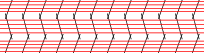
Figure 5: Construction in the proof of Proposition~\ref{main:optimality}, illustrating a string graph with optimal shallow-minor density.
The results have further ramifications in coloring theory. Classes with linear expansion admit explicit bounds on coloring numbers, acyclic chromatic number, and other coloring invariants (using known connections to generalised coloring numbers), thus enabling algorithmic applications such as efficient coloring, dominance, and model-checking in sparse regimes.
Theoretical and Practical Implications
From a structural perspective, the results clarify the boundary between sparse graph classes with highly complex intersection behavior and the regime controllable via linear expansion. The extension to RIGs over minor-closed classes emphasizes the pervasiveness of the results—essentially any graph class characterized by forbidden minors fits into this paradigm, provided sparsity is assumed.
Practically, linear expansion translates to improved algorithmic performance for key graph algorithms relevant in intersection and geometric representation problems, and sharper resource bounds in such applications.
The clarity and explicitness of the bounds, together with the fundamentally combinatorial approach, pave the way for direct further exploration—such as the behavior of other intersection-defined classes, sparsity/expansion tradeoffs under additional constraints, and the embedding of algorithmic graph theoretic routines within more general geometric or topological settings.
Conclusion
This work rigorously establishes that sparse string graphs and, more broadly, sparse region intersection graphs over any proper minor-closed class, have linear expansion with explicit asymptotically optimal bounds. The combinatorial approach, the optimality analysis, and ancillary results on coloring invariants and alternative gap-cover-planarity routes deepen the understanding of the structure of intersection graphs and their algorithmic properties. These findings set a benchmark for future work exploring the intersection of geometric representability and graph sparsity, as well as further generalizations in minor-closed settings.