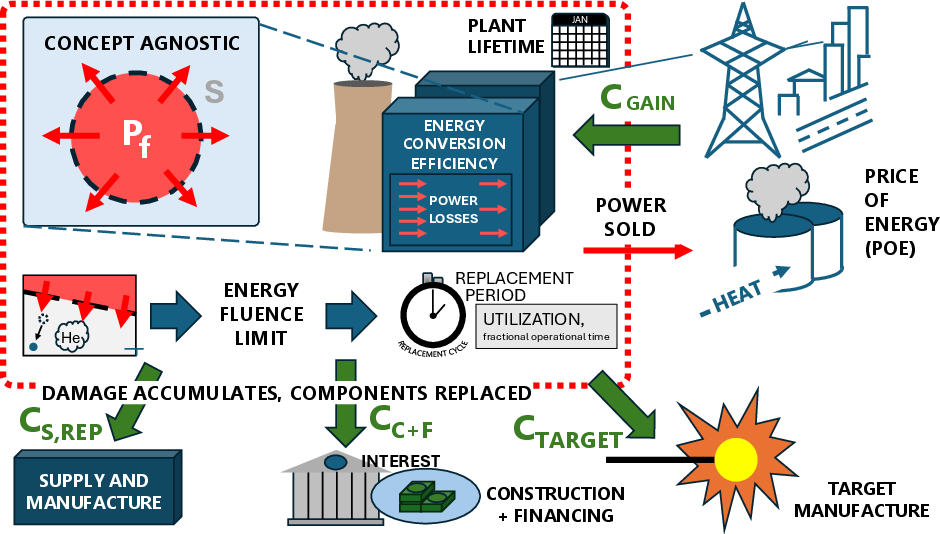
- The paper introduces a universal economic gain factor, Qₑₙₒ𝚌, analogous to Lawson's criterion, which assesses fusion plant viability using ten normalized parameters.
- The analysis highlights critical trade-offs, revealing that a high power density and rapid, low-cost replacement of the energy-extracting surface are essential for economic success.
- Numerical results and isoquant analyses show that low power density designs are economically unviable, guiding designers toward optimal parameter ranges for practical implementation.
A Universal Economic Criterion for Fusion Power Plants
Introduction
The transition from the scientific feasibility of fusion energy to its economic and commercial deployment presents a high-dimensional, nonlinear challenge. Traditionally, Lawson's criterion has provided a universal, technology-agnostic physical performance metric for scientific viability of fusion—the product of density and confinement time required for net energy gain. This work, "Criteria for the economic viability of fusion power plants" (2604.07367), formulates an analogous, rigorous, and general framework for economic viability, deriving a set of controlling parameters and a universal criterion for net economic gain applicable to any fusion technology, power level, or confinement concept.
The Economic Framework and Its Universality
The framework adopts a control surface S surrounding the fusion volume, through which all fusion-generated energy must be extracted. All engineering and cost parameters are normalized to this energy-extracting surface. Key aspects include:
Definition of Economic Gain Factor
Central to the framework is the economic gain factor, Qecon, defined analogously to the physical gain Qp from Lawson's criterion:
Qecon≡Annualized operational + capital + replacement + fueling costsAnnualized energy-derived revenue
This is constructed as a fully nonlinear function of ten normalized parameters:
- Fusion power areal density, Pf/S
- Surface replacement time, τrep
- Plant lifetime, τlife
- Net price of energy, POEnet
- Energy fluence limit at S, S0
- Net energy conversion efficiency, S1
- Target cost per fusion energy yield, S2
- Areal cost for S replacement, S3/S)_SS4(M\$S$5
- Real interest rate, $S$6
These parameters are fully agnostic to fusion-specific details such as field topology, driver technology, or tritium breeding scheme.
Nonlinear Parameter Couplings and Thresholds
The nonlinear structure of the framework yields robust qualitative and quantitative design insights:
- There exists a hard lower threshold on $S$7 (typically $S$8 MW/m$S$9 for NOAK plants under conventional economic assumptions), below which economic viability ($S$0) cannot be achieved, regardless of manipulations of other parameters. This contradicts prior intuition that arbitrarily low power density is desirable due to surface lifetime concerns.
- Rapid and low-cost replacement of the energy-extracting surface S is more critical than maximizing its survivability. Trade-off analysis reveals that economic return is far more sensitive to replacement cost and time than to S's energy fluence limit, once a modest threshold for $S$1 is met.
- The model formalizes and quantifies how improvements in technical parameters (e.g., increasing $S$2 or $S$3, reducing $S4/S)S) interact, and what minimum values are required for plant viability under given market and financial assumptions.
Isoquant and Trade-off Analysis
By sweeping the multi-dimensional parameter space, the framework produces "isoquants"—contours of constant S5—that illustrate the marginal rate of technical substitution between, for example, power density and surface lifetime. The contours are convex, as in Figure 1, providing a geometric intuition for preferred design directions, and encode the diminishing returns or "cliffs" associated with crossing minimal viability boundaries.
Monte Carlo sampling and optimization over the 10-dimensional parameter space demonstrate that the region of economic viability is contiguous, convex in log-parameter space, and often sharply bounded by these nonlinear thresholds. Weighted optimization allows quantification of the least-cost or least-risk path to viability for a proposed design.
Numerical Results, Sensitivity, and Contradictory Claims
The model is exercised over a wide range of plausible values, often extracted from large-scale fusion and fission deployments. Key numerical outcomes include:
- For a representative case with S6100S7X_S = 3.1S82S9\eta_E = 0.4Qecon01.9Qecon12Qecon2\sim \$Q_{\mathrm{econ}}$3/W (non-competitive except for pilot projects), decreasing to $Q_{\mathrm{econ}}$4/W at higher gains.
- Improvements to S service lifetime beyond $Q_{\mathrm{econ}}$5 MW-y/m$Q_{\mathrm{econ}}$6 only marginally increase economic gain—for S replacement times below roughly 0.15 years, further reductions in downtime have little impact compared to reducing S replacement cost itself.
- Strong claim: The conventional wisdom that low power density operation is economically advantageous is contradicted—plants with low $Q_{\mathrm{econ}}$7 are universally non-viable due to capital and replacement cost inertia.
- Several sets of parameters (e.g., $Q_{\mathrm{econ}}$8 MW/m$Q_{\mathrm{econ}}$9, $Q_p$0 MW-y/m$Q_p$1, $Q_p2/S)S≤0.3Q_p$3/m$Q_p$4) are shown to be common to all viable FPP design studies, regardless of confinement or fueling scheme.
Practical and Theoretical Implications
Practically, the framework provides FPP design teams and investors a compact, computable, and technology-neutral tool for early-phase techno-economic screening. The corresponding online calculator, referenced in the supplement, allows for rapid scenario evaluation.
Theoretically, the model is shown to exhibit log-log-concavity in all ten parameters, guaranteeing uniqueness and geometric regularity of the economic viability domain. This offers strong guarantees for optimization, portfolio methods, and multi-objective tradeoff analyses in future FPP and energy system planning.
The Role of Policy and Market Modifiers
The framework makes clear that policy interventions (e.g., contracts-for-difference, loan guarantees), market design levers (stacked revenue products), and reductions in risk-loaded cost of capital can shift economic viability surfaces almost as effectively as technical advances. Conversely, failure to control S fabrication cost or provide rapid S replacement mechanisms cannot be compensated by market factors.
Conclusion
This work supplies the fusion systems community with a top-down, transparent economic criterion for plant viability, paralleling the universality of the scientific Lawson criterion. The model not only identifies the minimal necessary performance of next-generation fusion power plants but also directs engineering and financial effort toward the parameters with greatest influence for achieving Qp5. In doing so, it rectifies several longstanding misconceptions regarding tradeoffs among power density, lifetime, and replacement strategy, while providing a rigorous formalism to underpin scenario planning, risk analysis, and the translation of scientific progress into commercial deployment.