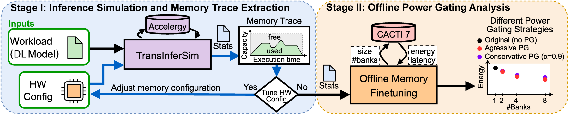
- The paper presents the TRAPTI framework that leverages cycle-level simulation to extract time-resolved memory occupancy traces.
- It demonstrates significant reductions in SRAM energy (up to 78%) and latency improvements using GQA compared to MHA.
- The study validates banking and power-gating policies as key enablers for efficient embedded Transformer inference designs.
Overview
The paper "TRAPTI: Time-Resolved Analysis for SRAM Banking and Power Gating Optimization in Embedded Transformer Inference" (2604.06955) introduces a comprehensive methodology for optimizing embedded accelerator memory hierarchies during Transformer inference. By leveraging cycle-level simulation and time-resolved memory occupancy profiling, the TRAPTI framework enables systematic design-space exploration of SRAM banking schemes and power-gating policies, particularly in the context of attention mechanism variants such as Multi-Head Attention (MHA) and Grouped-Query Attention (GQA). The analysis demonstrates substantial reductions in memory requirements and energy consumption when adopting GQA and banked/gated SRAM architectures, yielding strong empirical evidence for integrating workload-driven occupancy traces in hardware design flows.
Attention Mechanism Impact on Memory Utilization
Transformer architectures rely extensively on self-attention, with MHA yielding significant memory overhead due to independent key and value tensors per head. The migration to GQA, which consolidates key/value representations within query head groups, directly reduces the KV cache footprint—a critical bottleneck for embedded inference.
The empirical comparison (Figure 1) confirms GQA achieves 2.89× lower energy and 3.14× lower latency at equivalent scale and computational complexity relative to MHA, substantiating the efficacy of GQA workload in embedded contexts.
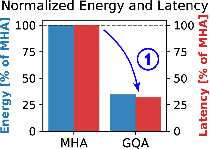
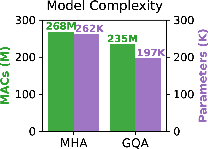
Figure 1: Normalized energy and latency comparison between MHA and GQA at matched parameter and MAC counts.
The conceptual distinction among MHA, GQA, and MQA is further delineated (Figure 2), highlighting the trade-off between memory footprint reduction versus representational flexibility.
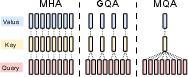
Figure 2: Schematic of attention variant designs illustrating KV projection sharing across heads/groups.
TRAPTI Framework and Methodology
TRAPTI combines cycle-level inference simulation (via TransInferSim) and offline banking/gating analysis (using CACTI characterization) in a two-stage workflow:
Experimental Setup and Results
The evaluation employs GPT-2 XL (MHA) and DeepSeek-R1-Distill-Qwen-1.5B (GQA) workloads, executed on a uniform accelerator setup (Figure 4), including four 128×128 Systolic Arrays and a shared SRAM. Both models are quantized to 8-bit.
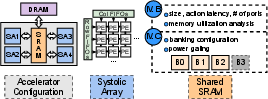
Figure 4: Accelerator configuration used for experimental evaluation, supporting high throughput and parallelism.
Memory Occupancy and Execution Dynamics
Time-resolved occupancy analysis reveals GQA-based DS-R1D~Q-1.5B requires 2.72× less peak SRAM than MHA-based GPT-2 XL (39.1 MiB vs. 107.3 MiB), resulting in extended intervals of idle SRAM and facilitating further memory optimization (Figure 5).

Figure 5: SRAM occupancy traces showing markedly lower and more variable memory demand for GQA compared to MHA.
Memory-bound stall analysis (Figure 6) verifies GPT-2 XL suffers from prolonged memory-induced delays, leading to low PE utilization and energy inefficiency. In contrast, DS-R1D~Q-1.5B exhibits higher compute utilization (77% vs. 38%) with less time spent on memory accesses (Figure 7).
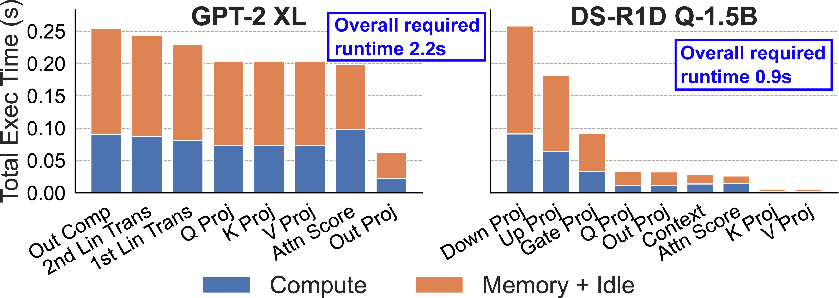
Figure 6: Operation-level latency decomposition, highlighting memory access bottlenecks in MHA workloads.
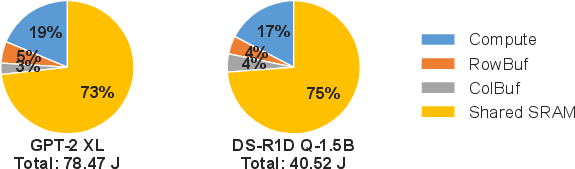
Figure 7: On-chip energy consumption profile, indicating superior compute utilization and lower total energy for GQA.
Banking and Power-Gating Trade-Offs
Banking analysis exploits occupancy traces to infer bank activity timelines (Figure 8), accounting for realistic headroom factors (α) that influence packing and gating eligibility. Energy–area trade-off curves (Figure 9) demonstrate up to 78\% reduction in SRAM energy at α=0.9, with diminishing returns as bank count increases beyond 8–16.
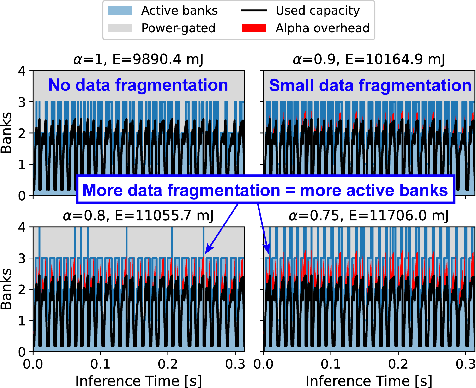
Figure 8: Bank activity timeline for DS-R1D~Q-1.5B under varying headroom assumptions, revealing gating windows.
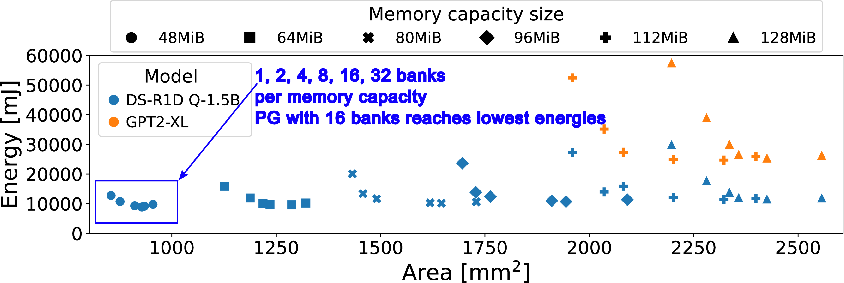
Figure 9: Energy–area trade-off curves for banked SRAM configurations at α=0.9, emphasizing optimal banking points.
DS-R1D~Q-1.5B benefits more from banking due to temporal memory variability, while GPT-2 XL's sustained occupancy and larger KV cache footprint restricts gating opportunities.
Memory Hierarchy Generalization
TRAPTI is extendable to multi-level memory hierarchies (Figure 10), with dedicated per-array memories augmenting the shared SRAM. The distribution of occupancy across multiple banks increases idle/gate-eligible intervals and amplifies energy savings, albeit at the cost of suboptimal scheduling-induced latency and coordination overhead.
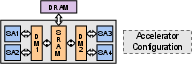
Figure 10: Multi-level on-chip memory hierarchy setup integrating dedicated memories for enhanced banking/gating potential.
Implications and Future Directions
The results underscore the importance of aligning memory subsystem optimization with temporal workload occupancy traces. KV cache reduction mechanisms (e.g., GQA) unlock a broader SRAM design space, maximizing static energy savings through aggressive banking and power-gating. For embedded accelerators, integrating cycle-accurate trace extraction and policy-driven banking/gating flows is necessary to achieve near-optimal memory efficiency.
Theoretically, the separation of execution scheduling and memory organization enables scalable, offline exploration of memory configurations without incurring simulation overhead for each candidate. Practically, this approach will be crucial for deploying long-sequence, resource-constrained LLMs and Transformer models in edge hardware.
Future research should further refine transition overhead modeling, extend trace-based analysis to more complex memory hierarchies, and study policy sensitivity under diverse inference regimes. Optimized data placement and scheduling algorithms are required for multi-level hierarchy designs to mitigate added coordination costs.
Conclusion
The TRAPTI methodology offers a robust framework for optimizing on-chip memory organization in embedded Transformer inference, leveraging time-resolved occupancy analysis to guide banking and power-gating decisions. GQA workloads provide significantly lower and more variable memory demand than MHA, enabling higher SRAM energy reduction and compute utilization. The separation of execution tracing and offline memory configuration evaluation facilitates efficient design space exploration and lays the foundation for further scaling transformer deployments in low-latency, energy-constrained environments.