- The paper introduces a sequence-level optimization framework that jointly learns a variable-length pipeline and image-adaptive parameters to enhance task-specific performance.
- It achieves significant improvements in object detection, instance segmentation, image enhancement, and depth estimation by addressing limitations of fixed pipeline orders and unstable RL methods.
- Empirical results demonstrate enhanced stability, improved runtime efficiency, and flexible accuracy-efficiency trade-offs, making it viable for real-world embedded and real-time vision applications.
POS-ISP: Sequence-Level Pipeline Optimization for Task-Aware ISP
Introduction
This work introduces POS-ISP, a novel framework for Image Signal Processing (ISP) pipeline optimization. In contrast to prior methods that either rely on fixed-length, stepwise, or reinforcement learning-driven approaches, POS-ISP formulates ISP design as a sequence-level optimization problem. The framework jointly learns both the sequence of modular ISP operations and their associated parameters, explicitly conditioning pipeline selection on the requirements of a downstream vision task. The paper provides comprehensive analysis and strong empirical results across multiple vision tasks—including object detection, instance segmentation, image enhancement, and depth estimation—demonstrating the method’s generalizability and stability.
Motivation and Limitations of Prior Work
Traditional ISP design, either in hardware-embedded pipelines or learned systems, typically follows a static ordering of operations such as denoising, white-balance, tone mapping, and color correction. This rigid structure is not optimally aligned with task-specific performance objectives. Recent methods attempt task-aware adaptation by either using deep reinforcement learning (DRL-ISP) or differentiable architectures with fixed module order (ReconfigISP, AdaptiveISP), but they are hindered by several factors:
POS-ISP addresses these limitations by:
- Optimizing the entire sequence of ISP modules jointly via a stable sequence-level policy, avoiding actor–critic or bootstrapped value estimation.
- Enabling both dynamic module selection (including variable pipeline length via an <eos> token) and image-specific parameter adaptation.
Methodology
Pipeline and Sequence Learning
POS-ISP consists of two key components:
- Sequence Predictor: A GRU-based autoregressive policy selects a variable-length sequence of ISP modules (e.g., exposure/gamma correction, denoising, blur, color correction, etc.), with an explicit termination token. Each training step samples module indices with a temperature-scheduled softmax, supporting dynamic exploration.
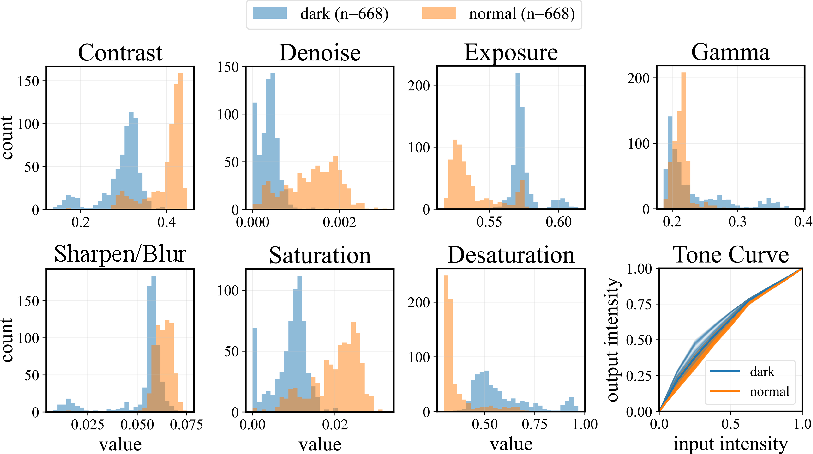
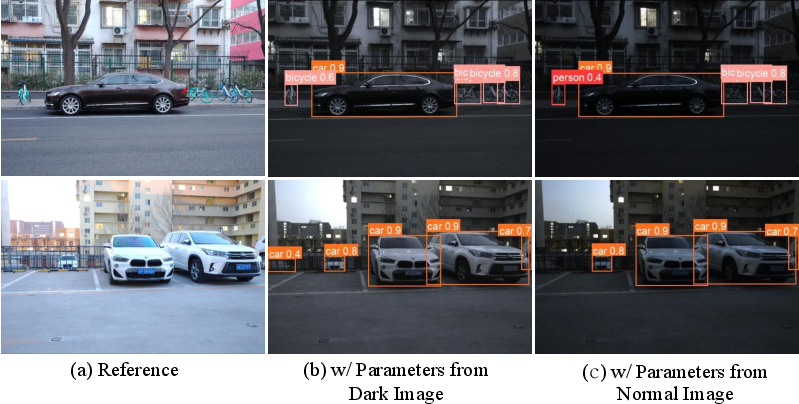
- Parameter Predictor: A lightweight ConvMLP encoder predicts per-image parameter vectors for the selected modules, ensuring image-adaptivity. Conditioning is image-only, as sequence-conditioned predictors exhibit higher variance and reduced robustness.
The pipeline output is directly assessed against the downstream task objective (e.g., mAP for detection, RMSE for depth), and final-output rewards guide the joint optimization.
Module Pool
A rich pool of 10 ISP modules (exposure control, gamma, tone map, contrast, saturation/desaturation, white balance, denoise, sharpen/blur, color correction) supports diverse transformations, each parameterized and differentiable (see Implementation Details in the original paper for mathematical definitions).
Optimization Procedure
Empirical Results
Object Detection and Instance Segmentation
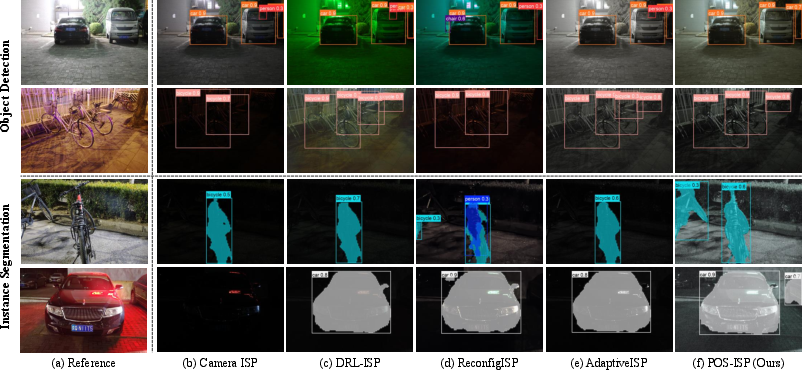
POS-ISP consistently outperforms previous ISP optimization frameworks (DRL-ISP, ReconfigISP, AdaptiveISP) across LOD and LIS datasets. Margins are most pronounced in low-light (Dark) scenarios, with the following findings:
Image Enhancement
On the Adobe FiveK benchmark (image retouching), POS-ISP achieves best-in-class full-reference metrics:
- PSNR: 23.11 (↑)
- SSIM: 0.923 (↑)
- LPIPS: 0.097 (↓)
This surpasses AdaptiveISP and ablation studies confirm gains arise from joint sequence/parameter optimization, not merely longer pipelines.
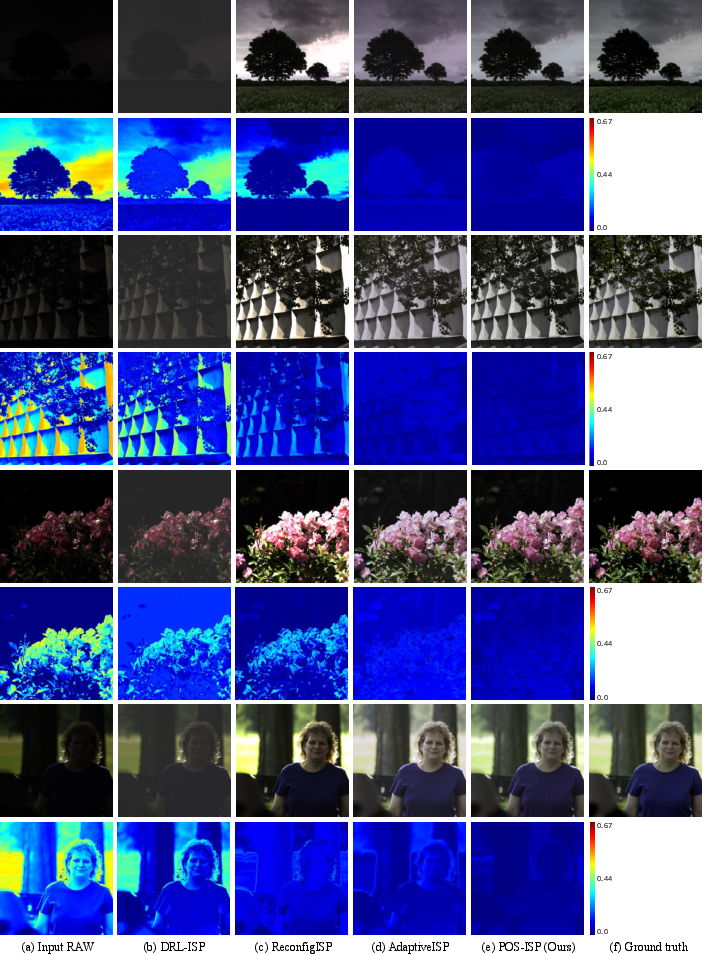
Figure 4: Qualitative enhancement results and error maps for POS-ISP versus ground truth and competing methods, showing alignment with expert retouching.
Depth Estimation
Monocular depth prediction on KITTI shows POS-ISP exceeding baselines under varied loss objectives (RMSE, AbsDiff, AbsRel). For RMSE:
- AbsRel: 0.128 (POS-ISP) vs. 0.131 (AdaptiveISP)
- δ<1.25: 0.847 (POS-ISP) vs. 0.840 (AdaptiveISP)
All error metrics are improved, and robustness is maintained across different backbone networks and losses.
Stability and Efficiency
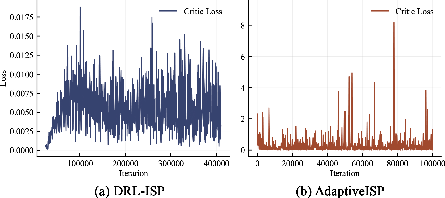
- Optimization stability: Actor–critic methods (DRL-ISP, AdaptiveISP) exhibit unstable critic losses, while POS-ISP converges reliably.
- Runtime: On-device evaluation on a Galaxy S10 CPU (no quantization) shows a 4× speedup relative to AdaptiveISP when runtime penalty is applied. The framework enables explicit accuracy/efficiency tradeoff without significant quality loss.
Analysis and Ablation Studies
Broader Implications and Theoretical Insights
POS-ISP unifies global sequence optimization with fine-grained parameter prediction, offering a flexible, stable, and task-adaptable ISP design paradigm. The sequence-level RL framework sidesteps the chronic instabilities of actor–critic RL observed in previous approaches, establishing a robust foundation for practical deployment. The empirical evidence that a single optimized sequence suffices for a broad domain, provided its parameters remain per-image adaptive, highlights a practical design avenue for ISP in embedded and edge systems.
The methodology’s capacity for runtime-aware optimization, backbone-agnosticity, and reliable performance across loss functions establishes its relevance both as a research tool and for integration into real-time vision systems.
Conclusion
POS-ISP presents a principled and practical approach to ISP pipeline learning, centered on sequence-level policy optimization and per-image parameter adaptation. Empirical results demonstrate clear performance improvements on diverse vision tasks, enhanced stability over RL-based alternatives, and flexible efficiency/accuracy trade-offs for deployment. The findings further elucidate the importance of task-focused module ordering and adaptive parameterization in ISP. Future research may explore integration with automated NAS for ISP, broader module sets, or cross-modal task optimization, deepening the synergy between computational photography and downstream perception.