- The paper refines WASP-43b's orbital ephemeris using 188 high-precision transit timings, finding no significant orbital decay or TTVs.
- It employs multi-instrument transmission spectroscopy from HST, JWST, and ground-based facilities to investigate atmospheric properties.
- Systematic uncertainties in light curve detrending and limb-darkening highlight challenges in precise atmospheric retrievals for hot Jupiters.
Detailed Analysis of "The Transit Timing and Transmission Spectrum of Hot Jupiter WASP-43 b from a decade of Multi-band Transit Follow-up Observations"
Observational Overview and Methodological Framework
This work presents an extensive, homogeneous analysis of WASP-43 b, leveraging more than a decade of time-series photometry and spectro-photometry obtained from ground-based facilities, TESS, HST, and JWST. The observational campaign incorporates 35 new transit light curves from the SPEARNET network, synthesizing a total of 188 high-precision transit epochs across the UV–mid-IR regime. This uniform treatment—achieved using the TransitFit package—enables direct intercomparisons and robust detection/exclusion of timing variations, and supports a self-consistent atmospheric retrieval effort employing TauREx.
The simultaneous analysis of diverse datasets with instrument- and epoch-specific systematics modeling, nested-sampling for parameter inference, and joint light curve fitting is critical for unbiased orbital and atmospheric parameter estimation.
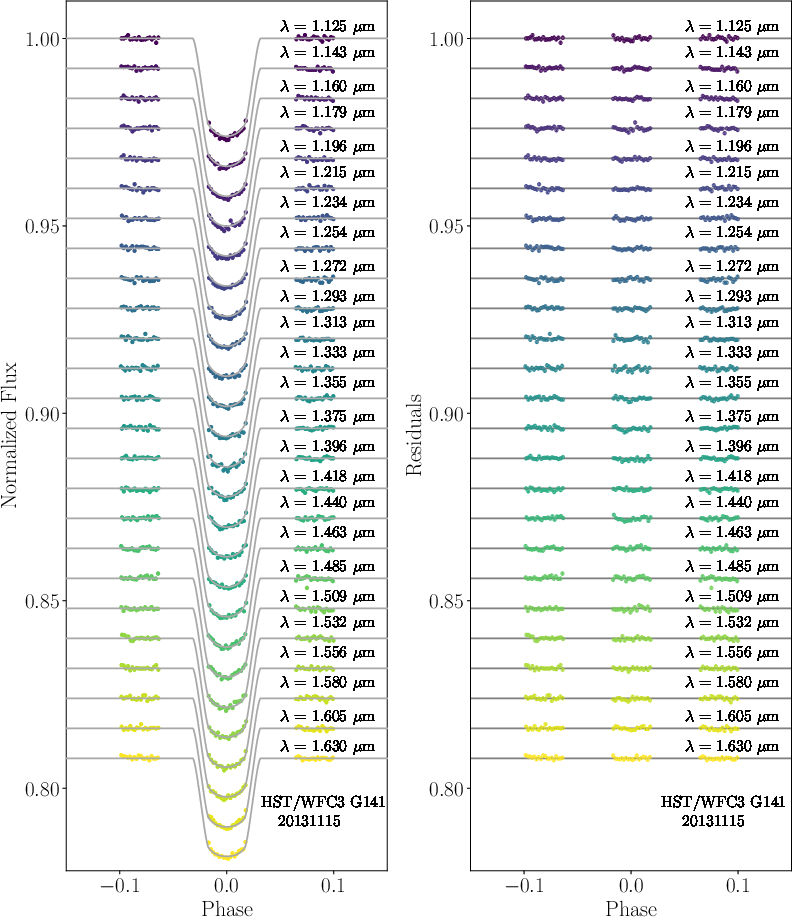
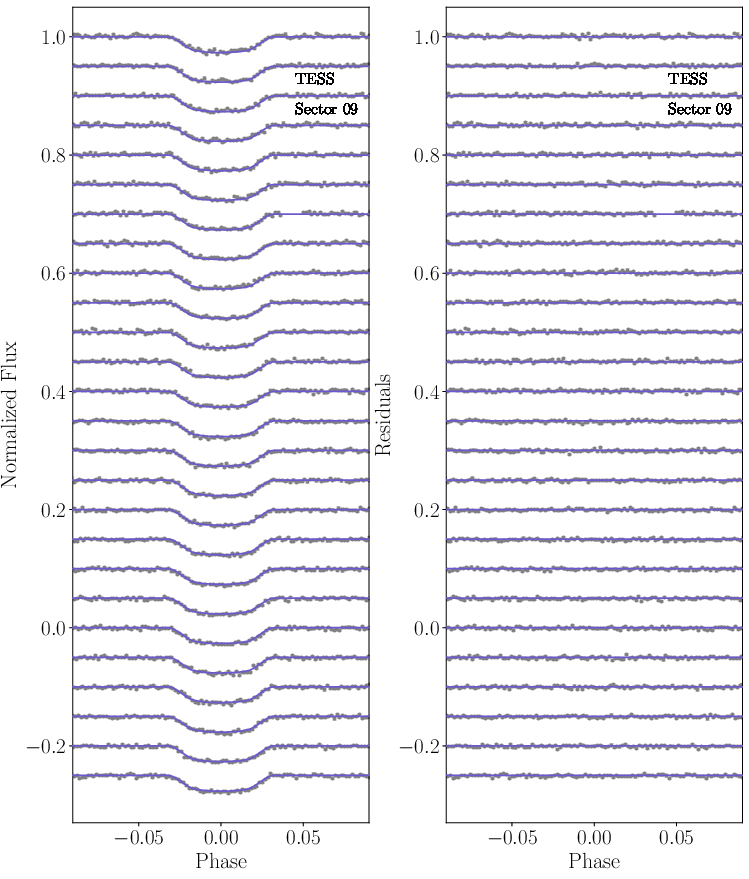
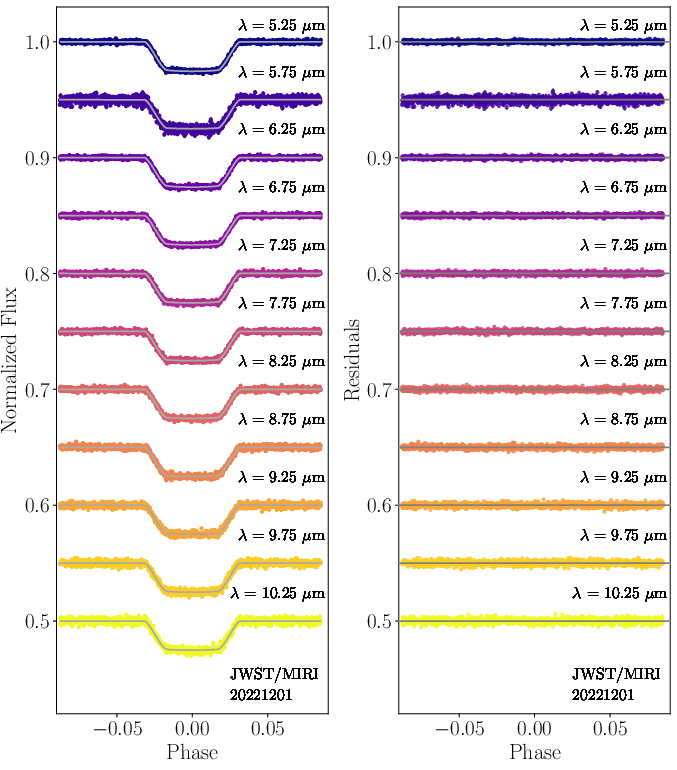
Figure 1: Phase-folded, detrended transit light curves for WASP-43 b from HST, TESS, and JWST, fitted with the TransitFit procedure and showing residuals.
Transit Timing: Linear Ephemeris and Orbital Decay Constraints
A central component of this study is the refinement of the WASP-43 b linear ephemeris and a search for non-Keplerian effects (orbital decay, TTVs). The aggregate of 188 robust mid-transit timings is modeled with both a constant-period and a quadratic (decay) ephemeris using MCMC. The measured orbital period is P=0.81347406−1×10⁻⁸+1×10⁻⁸ d. The best-fitting quadratic (orbital decay) term yields dEdP=−3−1+1×10⁻¹¹ d/epoch, which is statistically consistent with zero. The Bayesian Information Criterion marginally favors the more complex model, but the difference is not significant.
This null result for orbital decay is emphasized by the O−C (Observed minus Calculated) diagram, which shows residuals consistent with theoretical expectation for a strictly periodic orbit.
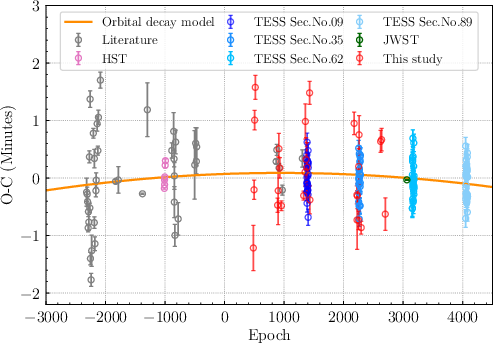
Figure 2: O−C diagram comparing observed mid-transit times (literature and this work) to the constant-period and orbital decay models. The orange curve is the best-fit orbital decay solution.
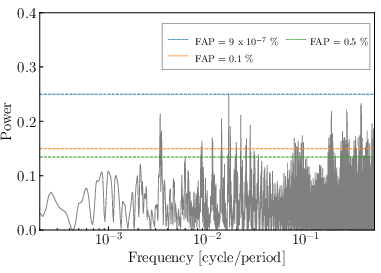
Figure 3: Generalized Lomb–Scargle periodogram of O−C residuals for all datasets yields no statistically significant periodic signal (FAP ≫5σ).
Analysis of TESS light curves spanning multiple years independently confirms the absence of TTVs or decay signatures (Figs. 5, 6). The resulting upper limits on the presence of any nearby massive perturbers in the system are stringent: no planets exceeding 100M⊕ are permitted at P<2 d from the TTV amplitude constraints.
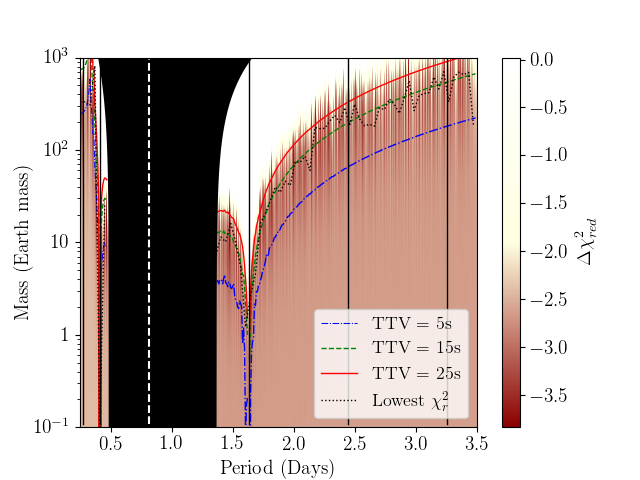
Figure 4: Upper mass limits for hypothetical planetary companions based on TTV analysis.
Transmission Spectroscopy: HST, JWST, and Multi-instrument Retrieval
The second focus of the study is a homogeneous, hierarchical retrieval of WASP-43 b’s atmospheric properties. Transmission spectra are constructed and analyzed for HST G141 (1.1-1.7 μm), JWST/MIRI (5–12 μm), and broadband data (SPEARNET, TESS). Both the Iraclis and TransitFit reduction pipelines for HST data are considered; differences in treatment of limb-darkening lead to measurable but not qualitative offsets in transit depths.
The atmospheric retrieval (via TauREx 3) indicates a broad range of statistically allowed solutions for temperature and H2O abundance from HST data alone, a result that is consistent with the well-known degeneracy between temperature, water mixing ratio, and cloud-top pressure for hot Jupiters in the probed regimes. For instance, the HST/Iraclis solution yields T=900−400+500 K and dEdP=−3−1+1×10−110(HdEdP=−3−1+1×10−111O) dEdP=−3−1+1×10−112 (Case I), with solution subgroups at lower and higher dEdP=−3−1+1×10−113 and corresponding water abundances (Case I.I: dEdP=−3−1+1×10−114 K, dEdP=−3−1+1×10−115(HdEdP=−3−1+1×10−116O)dEdP=−3−1+1×10−117, Case I.II: dEdP=−3−1+1×10−118 K, dEdP=−3−1+1×10−119(HO−C0O)O−C1).
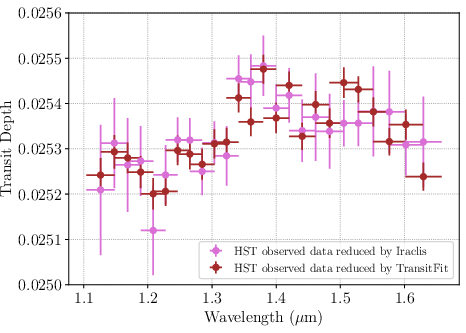
Figure 5: HST transmission spectrum from both Iraclis and TransitFit reductions shows their minor systematic offsets.
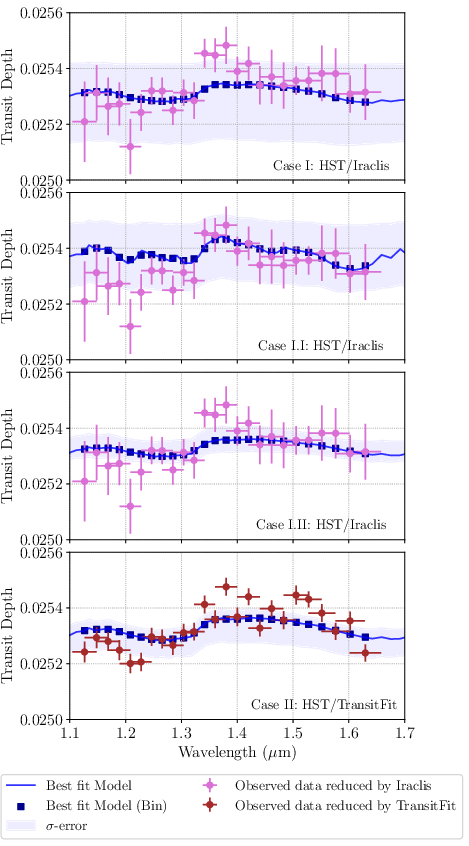
Figure 6: TauREx retrieval for HST data, showing the synthetic transmission spectrum and observational points.
The inclusion of the extended wavelength baseline (optical through mid-IR) via joint fitting (Case III: Ground+TESS+HST(Iraclis)+JWST; Case IV: Ground+TESS+HST(TransitFit)+JWST) leads to high O−C2 values and the effective loss of sensitivity to molecular species, including water. The study highlights that uncertainties in cross-instrument alignment, instrumental systematics, and (likely) the need for higher S/N at long wavelength coverage dominate the error budget and preclude robust constraints on atmospheric structure and chemistry.
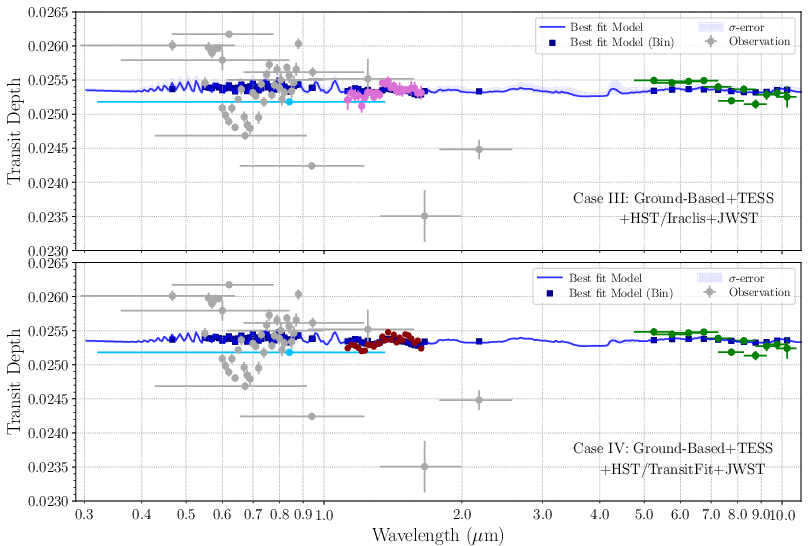
Figure 7: Best-fit transmission spectrum model for the full dataset (optical to mid-IR); points of all datasets and outlier filters are indicated.
Statistical and Systematic Implications
The dominant limitations on atmospheric parameter retrievals are the systematic differences in light curve detrending, limb-darkening, and instrument-to-instrument normalization. The multi-modal posteriors for atmospheric properties reinforce the significant degeneracies present. No statistically significant detection of species beyond HO−C3O is observed at the current levels of precision.
The absence of any robust orbital decay signal or persistent TTVs, despite the short period of WASP-43 b and the system’s (comparatively) strong predicted tidal effects, substantively restricts plausible tidal Q for the host and places strong limits on close-in, massive companions.
Pathways for Future Work
This study underscores the critical need for higher-precision, better-calibrated multi-wavelength datasets and unified analysis pipelines. Particularly, JWST and future ELTs will be essential in breaking temperature–abundance–cloud degeneracies and in providing ultra-precise timing measurements for constraining tidal interaction and orbital evolution. Improvements in limb-darkening parameter estimation and direct calibration across space- and ground-based platforms will directly enhance the robustness and physical interpretation of atmospheric transmission spectra for WASP-43 b and other archetypal hot Jupiters.
Conclusion
This comprehensive analysis of WASP-43 b, incorporating a decade of multi-facility data, yields the following major results:
- No statistically significant orbital decay or TTVs are observed, with O−C4 d/orbit at high confidence.
- Combined transit timing and TTV analysis exclude any undetected planetary companions with O−C5 at O−C6 d.
- HST-alone atmospheric retrievals support a water-rich, isothermal atmosphere but exhibit a broad, degenerate range of solutions for temperature and HO−C7O.
- Combined broad-wavelength spectra sharply illustrate the limitations and model complexities faced in multi-instrument atmospheric retrieval and data reduction.
- Future breakthroughs in the field will critically depend on both increased S/N across broad spectral domains and coordinated analysis frameworks.
These results provide high-fidelity constraints on both the migration history and atmospheric composition of WASP-43 b, but also clearly define the precision frontier for tides and exoplanet atmospheres at the hot Jupiter regime (2604.05907).

