Geodesics from Quantum Field Theory: A Case Study in AdS
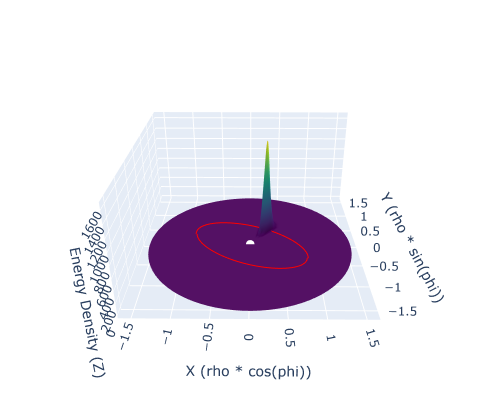
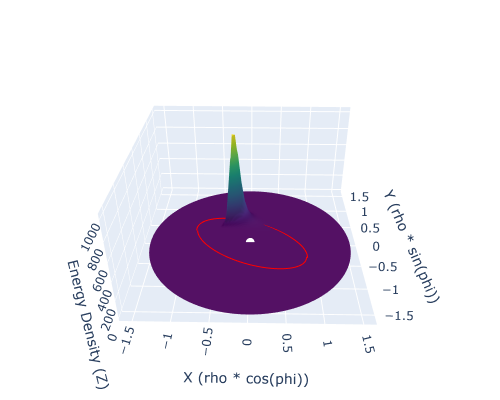
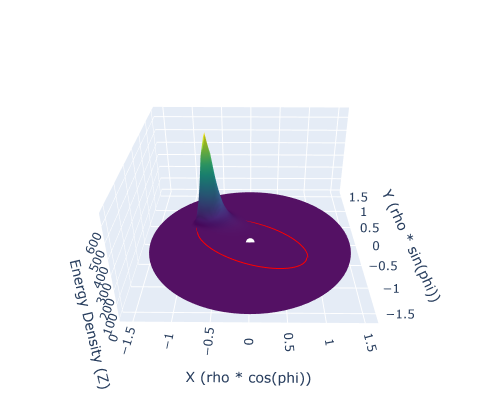
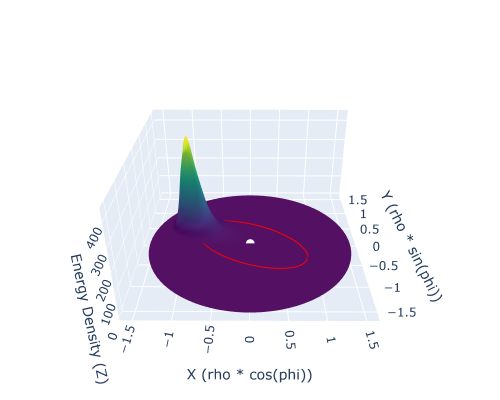
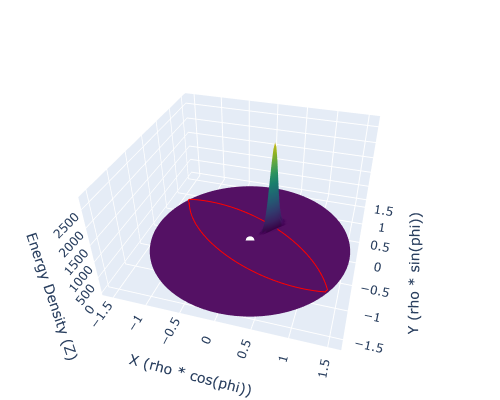
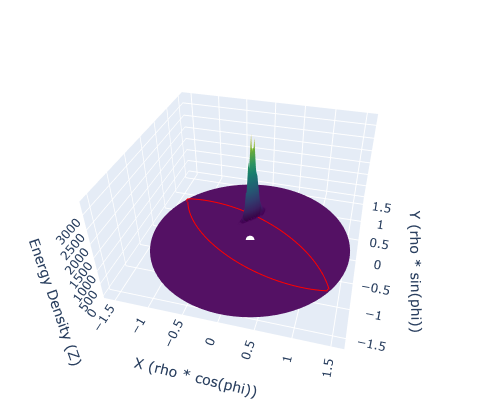
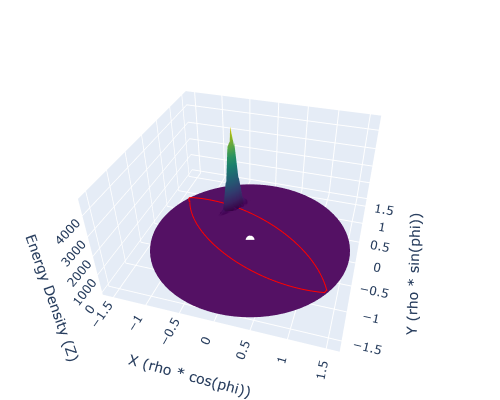
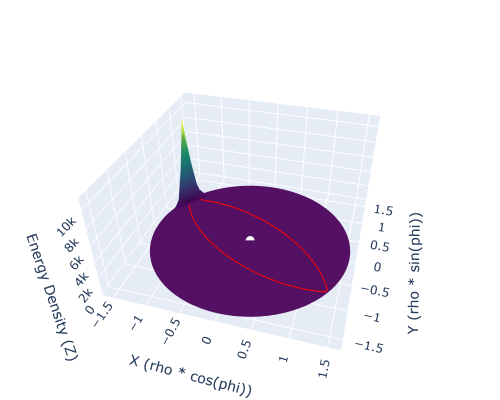
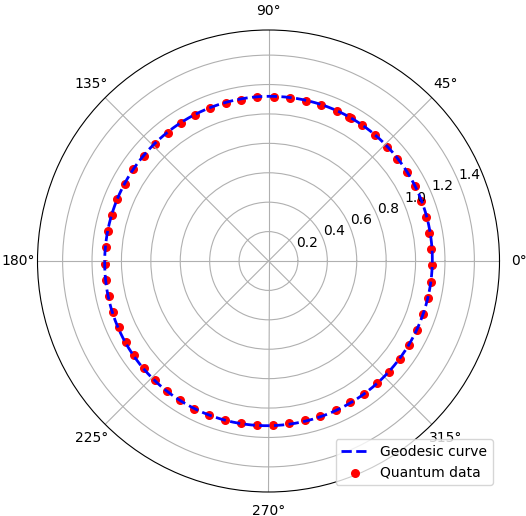
Abstract: Localized one-particle states of a quantum field theory--whether in flat space or on a curved background--are expected to exhibit geodesic motion in an appropriate semiclassical regime. This expectation is often invoked heuristically: in this work we develop two precise implementations and test them in detail in global AdS$3$. First, we define a covariant ''center-of-mass'' trajectory from the expectation value of the stress tensor operator and show, using only $\nablaμ\langle T{μν}\rangle=0$, that it obeys the geodesic equation in the monopole (sufficiently localized) approximation in a general spacetime. This provides a QFT-in-curved-spacetime generalization of the Mathisson-Papapetrou-Dixon framework in classical general relativity. Second, we construct position operators from the Klein--Gordon inner product and mode completeness, and compute their expectation values in generic single-particle wave packet states. We then build explicit normalizable wave packets of a free scalar field in empty AdS$_3$ with tunable energy and angular momentum, and demonstrate analytically and numerically that both prescriptions reproduce the expected radial, circular, and elliptical-like timelike and null geodesics. Our discussion also isolates a natural ultra-relativistic regime in which the wave packet trajectory exhibits a controlled crossover from timelike to null geodesic behavior. We identify precise limits where the localized geodesic interpretation of the wave packet breaks down. On the CFT side, we show that bulk localization--specifically the radial data--is captured by how the state is distributed over global descendants of the dual primary.
Paper Prompts
Sign up for free to create and run prompts on this paper using GPT-5.
Top Community Prompts
Explain it Like I'm 14
Plain‑English Summary of “Geodesics from Quantum Field Theory: A Case Study in AdS”
What is this paper about?
The paper shows, carefully and step by step, how a “particle” that is really a wave in a quantum field can move like a classical object following the straightest possible path in curved space (a geodesic). The authors test this in a curved universe called AdS3 (anti–de Sitter space in 2+1 dimensions), a favorite playground for studying gravity and holography.
Think of a “wave packet” as a fuzzy ball of energy. The question is: does the center of that fuzzy ball move like a normal particle would in curved space? The authors build two different ways to define the “position” of this fuzzy ball and then check whether that position follows geodesics.
What big questions are they asking?
- How can we define the position of a relativistic quantum “particle” (really, a wave) without running into the usual problems of trying to pin it down too sharply?
- If we define position sensibly, does the center of a localized wave packet move along a geodesic in curved space?
- How does this work in AdS3, where space is curved like a bowl and motion is special and periodic?
- When does the “moves like a particle” picture stop being accurate (i.e., when does the wave nature become too important)?
- How is the bulk “radial location” (how far from the center you are) encoded in the dual boundary conformal field theory (CFT), as suggested by holography?
How do they approach it? (Two complementary methods)
1) Energy‑centroid (stress tensor) method
- Idea in everyday terms: If you have a spread‑out blob of energy (your wave packet), find its “center of mass” by balancing it—like finding the balance point of a lopsided plate. In physics language, they use the stress‑energy tensor (a map of where energy and momentum are in space) and compute its energy‑weighted centroid at each moment in time.
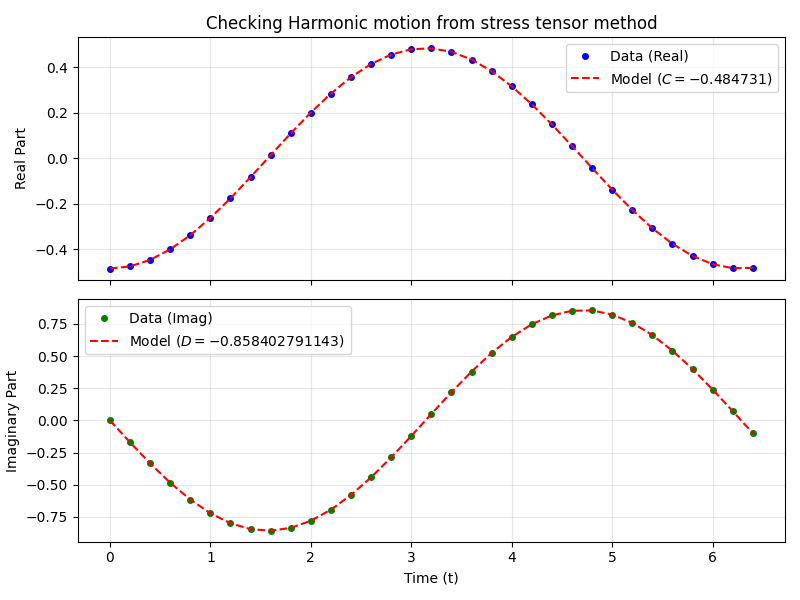
- Key point: Using only the fact that energy and momentum are locally conserved (a very general rule), they show that this centroid moves along a geodesic—so long as the packet is sufficiently localized. This is like saying: if the blob is tight enough, its center moves as if it’s a point particle. This is the “monopole approximation,” meaning higher “shape details” of the blob don’t matter much.
- Why this is powerful: It works in any curved spacetime where quantum field theory makes sense; it doesn’t require a special “position operator.”
2) Position‑operator method in AdS3
- Idea in everyday terms: They build mathematical “position rulers” (operators) for the curved space using the natural vibration modes of a scalar field in AdS3 (like harmonics on a drum, but for curved space). Then they use these rulers to track the average position of a smooth, normalizable wave packet over time.
- Important caution: They never use exact position eigenstates (infinitely sharp positions), because those behave badly in relativistic quantum theory (they spread instantly and can look acausal). Instead, they use smooth wave packets and only compute expectation values (averages), which is safe and physical.
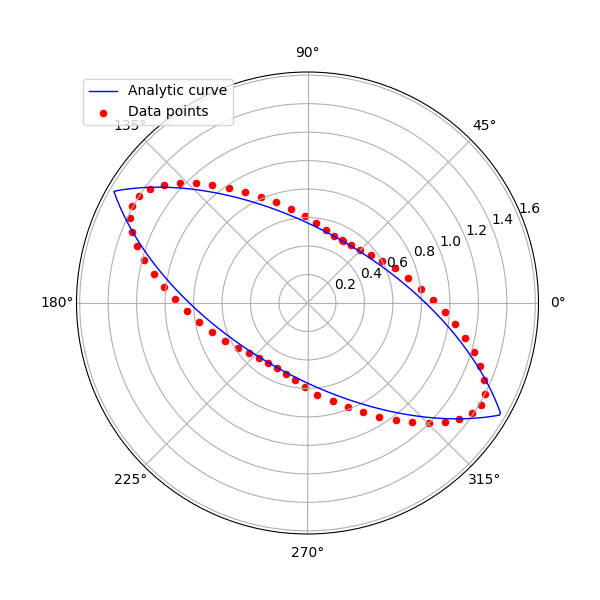
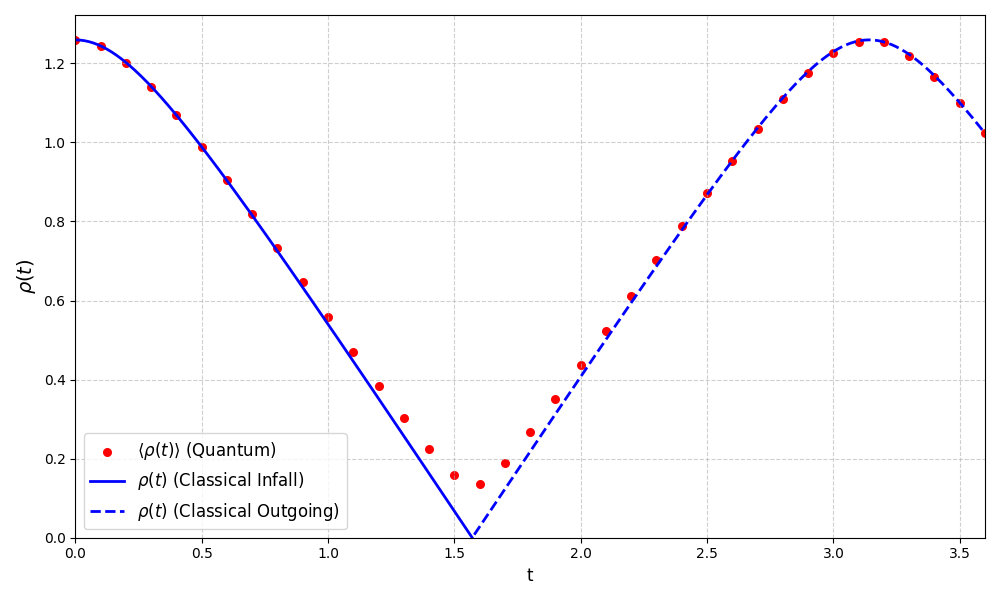
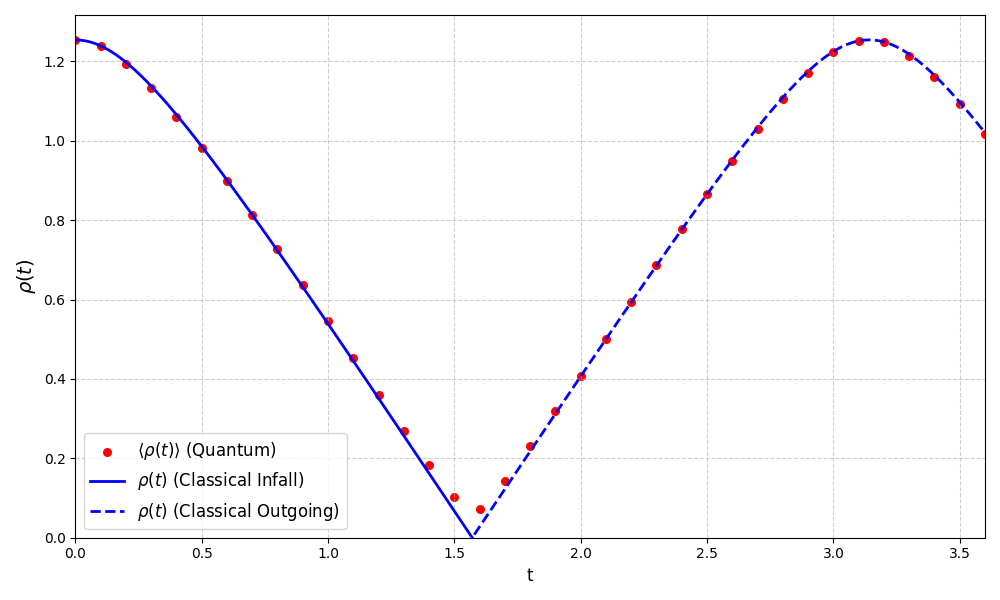
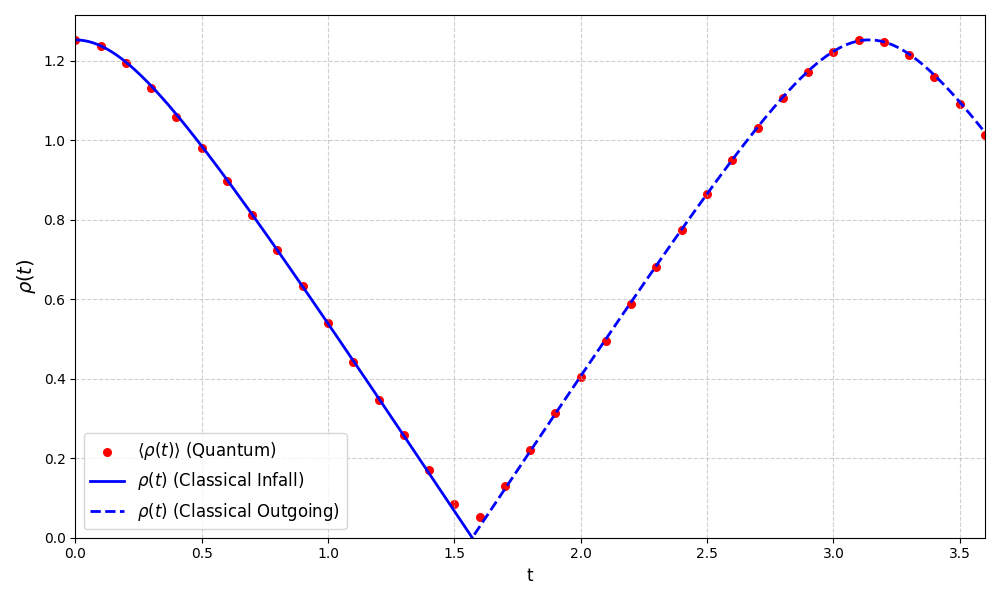
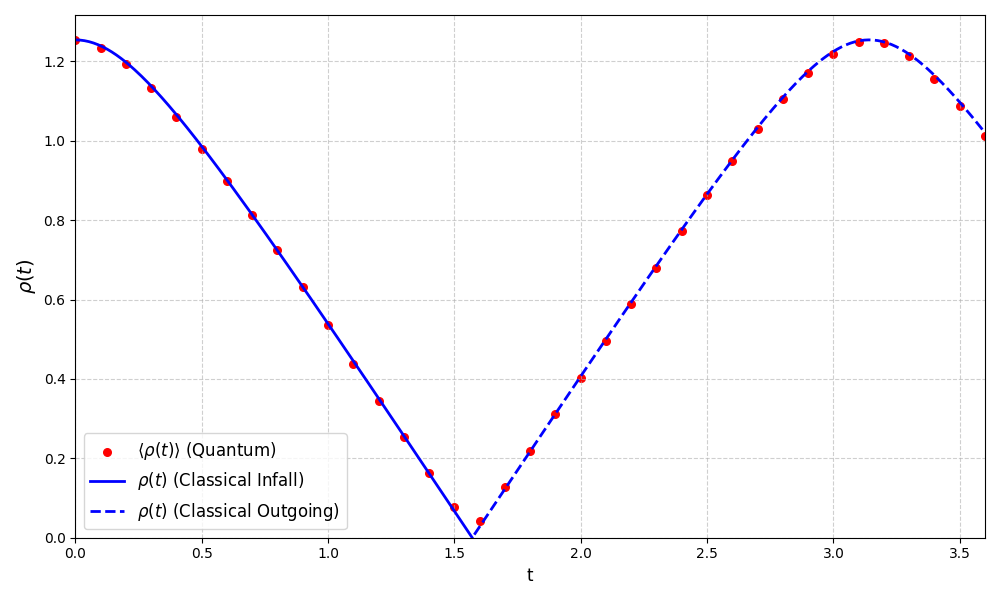
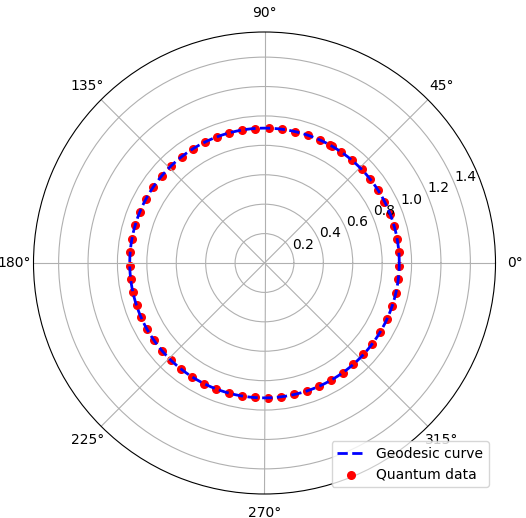
- What they actually do: They construct packets with adjustable energy and angular momentum, evolve them, and compute the average radius and angle. They compare these averages to the geodesics that a classical particle (massive or massless) would follow in the same curved space.
What did they find, and why does it matter?
- Both methods agree: The centroid from energy and the average position from the operators travel along the expected geodesics in AdS3, for many kinds of motion:
- Radial in‑and‑out “bounces” (particles head out and come back because AdS is like a gravitational bowl).
- Circular orbits (stable for massive particles).
- Ellipse‑like orbits (closed, no precession in this setup).
- Massless (“lightlike”) versions of these paths.
- Smooth crossover from massive to massless behavior: As the packet’s energy gets very large (ultra‑relativistic), its trajectory smoothly transitions from a massive‑particle geodesic to a lightlike (photon‑like) geodesic.
- Limits of the “particle” picture: If you try to make the wave packet too narrow (too sharply localized) compared to a scale set by its energy (~1/E), the wave spreads more quickly and the average path starts to drift away from the ideal geodesic. In short, you can’t make it infinitely sharp and still expect clean, long‑lasting particle‑like motion.
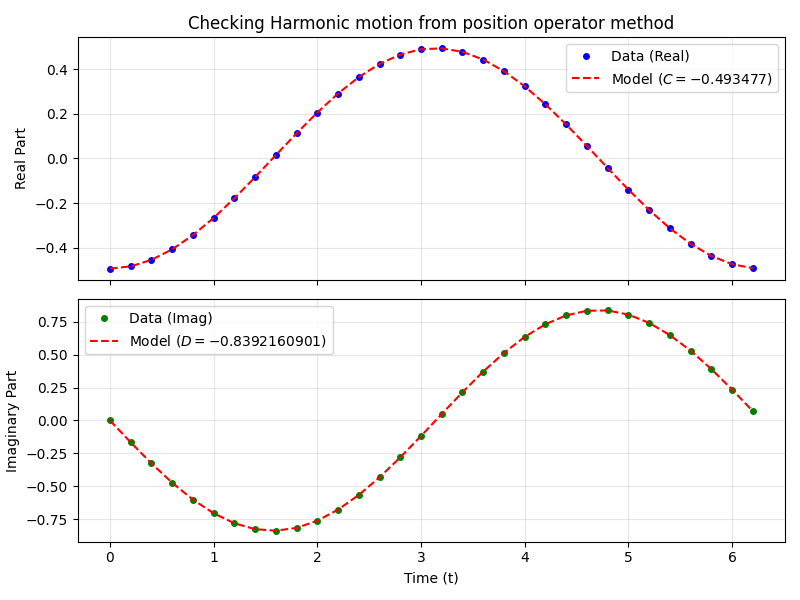
- Exact “spring‑like” relations in AdS3: Because AdS3 has special symmetries, certain combinations of the motion obey exact simple‑harmonic‑motion equations (like a mass on a spring) even at the level of expectation values. This cleanly separates the part fixed by symmetry from the small deviations due to the wave’s spread.
- Charges vs path: The total conserved quantities (like energy and angular momentum) of the wave packet don’t have to match exactly those of the “best‑fit” point‑particle geodesic, because the packet has a finite width. But the path itself still matches very well when the packet is localized enough.
- Holographic (CFT) perspective: On the boundary theory side, how the state’s weight is distributed over “descendants” (states related to a primary operator by the symmetry algebra) tells you about the packet’s bulk radial information—like how far from the center it is and how it moves. This helps explain how “depth” in the bulk is encoded in the boundary data.
Why is this important?
- It gives a precise, practical way to see classical motion (geodesics) emerge from quantum fields in curved space—without needing unphysical “sharp position” states.
- It works generally (the energy‑centroid method) and is demonstrated concretely (the position‑operator method) in a highly relevant curved space used in holography (AdS3).
- It shows exactly when the classical picture holds and when it breaks down, which is crucial for studying more complicated questions like how bulk regions (or even black hole interiors) might emerge from quantum information on the boundary.
- It clarifies how the boundary CFT encodes bulk radial location and motion, offering a concrete step toward understanding how “where you are” in the bulk shows up on the boundary.
Final takeaway
Imagine a fuzzy, moving glow (a quantum wave packet) in a curved bowl‑shaped universe (AdS3). Track its balance point over time using two different, careful methods. When the glow isn’t too tightly squeezed, that balance point traces the same paths that a classical bead would take on the bowl—straightest‑possible paths in curved space, called geodesics. Push the glow too tight, and the bead analogy breaks down. This work nails down that story precisely and shows how the “depth” of the glow in the bowl can be read from information painted on the bowl’s rim (the boundary CFT).
Knowledge Gaps
Knowledge gaps, limitations, and open questions
Below is a single consolidated list of concrete gaps and open problems that the paper leaves unresolved, phrased to be actionable for future work:
- Generality beyond AdS3: Extend both constructions (stress-tensor centroid and position operators) from global AdS3 to higher-dimensional AdS (with multiple angular coordinates), Poincaré AdS, AdS black holes (e.g., BTZ), and non-AdS curved spacetimes (especially non-static or non-stationary backgrounds).
- Foliation/slicing dependence: Quantify how the stress-tensor centroid depends on the choice of ADM foliation and time function in generic spacetimes without a timelike Killing vector, and identify conditions or prescriptions that minimize or remove this dependence.
- Renormalization of Tμν: Provide a systematic treatment of renormalization and scheme dependence of ⟨Tμν⟩ in curved spacetime, and analyze how the centroid and its geodesic limit depend on the regulator and subtraction scheme (including anomaly effects).
- Rigorous monopole-approximation bounds: Derive explicit quantitative error bounds on the RHS “multipole” terms in the centroid equation (Eq. (gd eqn)), expressed in terms of wave-packet width, curvature scale, and gradients of the Christoffels; give precise small-parameter conditions guaranteeing geodesic motion.
- Variance growth and breakdown timescales: Develop analytic estimates (not only numerics) for the time evolution of variances (Δρ, Δφ) and the timescale at which departures from geodesic motion become O(1), as functions of energy, width, and AdS radius.
- Ultra-relativistic crossover: Make precise the “controlled crossover” from timelike to null behavior by specifying scaling relations between wave-packet width, energy, and localization scale that govern the approach to null geodesics; test universality beyond AdS3.
- Finite-width charge shifts: Provide a systematic expansion (e.g., in powers of packet width) relating the wave packet’s conserved charges to those of the best-fit geodesic, including explicit leading-order correction formulas tied to higher moments of the packet.
- Position-operator self-adjointness and domains: Establish rigorously the self-adjointness, domain, and spectral properties of the constructed position operators (ρ̂, φ̂), including their covariance under AdS isometries and uniqueness with respect to the chosen mode basis.
- Periodic angle operator: Replace the ad hoc use of ⟨e{iφ}⟩ by a fully consistent periodic angle-operator framework (e.g., via unitary shift operators) and work out the associated operator algebra and uncertainty relations on S1.
- Coordinate and basis dependence: Quantify how the position operators (built from mode completeness) depend on the coordinate choice and the specific mode basis; characterize equivalence classes of “position” operators that yield the same semiclassical trajectories.
- Robustness of “exact” AdS relations: Assess how the exact expectation-value relations that mirror classical geodesic equations in AdS degrade in less symmetric spacetimes; develop approximate analogs and error estimates when selection rules are absent.
- Interacting QFT effects: Incorporate interactions (self-interactions or couplings to other fields) and analyze how scattering, loop corrections, and non-conservation of particle number affect localization, variance growth, and the geodesic limit.
- Spin and internal structure: Generalize to fields with spin and internal charges; derive how spin-curvature coupling (à la Mathisson–Papapetrou–Dixon) and gauge forces modify the centroid equation and the position-operator framework.
- Backreaction and gravitational dressing: Include gravitational backreaction for sufficiently energetic wave packets and analyze how gravitational dressing and gauge invariance (in gravity) modify the definitions of position and centroid.
- Time-dependent and horizon spacetimes: Test the framework in time-dependent geometries (e.g., FRW) and spacetimes with horizons (BTZ, de Sitter), including effects of particle production and Hawking radiation on wave-packet propagation and localization.
- Multi-particle and entangled states: Extend the analysis beyond single-particle states to superpositions, entangled multi-particle states, and wave packets with nontrivial number statistics; determine conditions under which a “center of mass” still tracks a geodesic.
- Measurement back-action and decoherence: Investigate how measurement schemes (in the bulk or boundary) and environmental decoherence influence the emergence and persistence of geodesic motion of expectation values.
- Flat-space and semiclassical limits: Provide a unified treatment of the ℏ→0 and flat-space (ℛ→∞) limits of both constructions, including controlled asymptotic expansions and explicit matching to known flat-space results.
- Boundary effects and normalizability: Analyze how boundary conditions at ρ=π/2 (reflecting vs alternative quantizations) affect wave-packet construction, normalizability, and the behavior of position operators and centroids near the boundary.
- Sensitivity to packet shape: Systematically compare different initial packet profiles (Gaussian vs non-Gaussian, compact support approximants, phase-engineered packets) and quantify their impact on geodesic tracking accuracy and dispersion rates.
- Numerical truncation and errors: Provide systematic convergence studies (n,m cutoff dependence), error bars, and stability analyses for the numerical demonstrations; assess sensitivity to discretization and mode-resolution choices.
- CFT reconstruction of radial data: Turn the qualitative CFT-side link into a practical reconstruction algorithm: given a boundary state (e.g., distribution over global descendants), produce quantitative bulk radial profiles and trajectories with error estimates.
- 1/N and multi-trace effects: Study how finite-1/N effects and multi-trace mixing in the CFT modify the one-particle correspondence, radial localization, and the exact AdS kinematical relations found at leading order.
- Relation to HKLL and bulk operators: Clarify the connection between the position operators/centroids and HKLL-type bulk operator reconstructions (and their gravitational dressings), including the role of smearing kernels and boundary anchoring.
- Comparisons with alternative localization schemes: Benchmark the proposed constructions against Newton–Wigner, Pryce, and other relativistic localization proposals (in curved space where applicable), identifying regimes of agreement and deviation.
Practical Applications
Immediate Applications
The paper develops two practical, complementary ways to extract geodesic motion from quantum field theory—(i) a covariant “center-of-mass” (COM) trajectory built from the stress-tensor expectation value, and (ii) position operators constructed from mode completeness in static spacetimes (demonstrated in AdS3). These methods, together with exact evolution identities in AdS and explicit wave-packet constructions, enable several deployable workflows:
- Gauge-invariant trajectory extraction in curved-spacetime simulations (Academia; Computational Physics/GR)
- Use case: Track the motion of localized quantum excitations (“particle-like” scalar wave packets) as effective geodesics in numerical relativity and QFT-in-curved-spacetime simulations by evolving the energy-weighted centroid of ⟨Tμν⟩.
- Tools/products/workflows:
- A library function to compute x̄σ(t) = ∫Σ dV √σ NΣ xσ nμ⟨Tμν⟩nν / ∫Σ dV √σ NΣ nμ⟨Tμν⟩nν on discretized meshes;
- Plug-ins for Einstein Toolkit/GRMHD codes to track COM geodesics of field lumps without relying on coordinate choices.
- Assumptions/dependencies: Valid in the “monopole” (sufficiently localized) regime; requires computable, renormalized ⟨Tμν⟩ on the background; background metric known; breakdown when packet variance grows too large.
- Semiclassical propagation module for QFT in static spacetimes (Academia; Software)
- Use case: Rapidly prototype and validate semiclassical motion of one-particle states by constructing position operators from Sturm–Liouville mode completeness and computing expectation values in smooth wave packets.
- Tools/products/workflows:
- A Python/C++ toolkit to generate mode functions, build operators (ρ̂, φ̂), evolve g(n,m,t)=g(n,m)e{-iωnm t}, and compute ⟨ρ̂⟩, ⟨e{iφ}⟩ as synthetic “trajectories”; templates provided for AdS3 with extension recipes to generic static metrics (Appendix guidance).
- Assumptions/dependencies: One-particle sector; static (or stationary) background with known mode basis and inner product; avoids using eigenstates physically—works with smooth, normalizable packets.
- Physics-informed constraints and benchmarks for simulators of curved spacetime (Quantum Technologies; Experimental Physics)
- Use case: Validate analog/quantum simulators claimed to realize AdS-like or curved-space dynamics using exact expectation-value identities derived in the paper (e.g., for u(t)=cos(2ρ): ü+4u=const, and for Z(t)=sinρ e{iφ}: Z̈=−Z).
- Tools/products/workflows:
- Benchmark test suites that compare measured expectation values to the exact harmonic laws over many cycles; pass/fail criteria for simulator calibration.
- Assumptions/dependencies: Ability to implement and measure effective AdS-like Hamiltonians and relevant observables; control of decoherence/finite-size effects.
- Holographic data analysis: inferring bulk radial data from CFT states (Academia; High-Energy Theory)
- Use case: From the distribution of a CFT state over global descendants of a primary, estimate mean bulk conserved charges and reconstruct approximate bulk geodesics (radial position/motion), enabling tangible “radial localization” diagnostics in AdS/CFT numerics.
- Tools/products/workflows:
- A boundary-to-bulk inference pipeline that maps descendant coefficients to (E,L) and hence to orbit parameters, using the paper’s analytic relations.
- Assumptions/dependencies: Large-N, single-particle sector of a dual scalar primary; global AdS setting; relies on exact spectral structure selection rules in AdS.
- Beam-path and ray-steering proxies via energy-centroid geodesics in effective metrics (Engineering; Photonics/Acoustics; Healthcare imaging)
- Use case: Approximate beam/ray paths in graded-index (GRIN) optics, photonic crystals, or acoustic media by evolving the centroid of energy density/flux using the COM framework—an alternative to (or cross-check on) eikonal/ray-tracing.
- Tools/products/workflows:
- COMSOL/ANSYS plug-ins that map refractive-index profiles to effective metrics and propagate the “stress-tensor centroid” of electromagnetic/elastic energy; design workflows for GRIN lenses and ultrasound focusing.
- Assumptions/dependencies: Valid semiclassical regime (paraxial or slowly varying media); effective-metric mapping holds; negligible strong nonlinearities or multiple-scattering beyond the monopole approximation.
- Machine-learning surrogates constrained by exact geodesic relations (Software; ML for Physics)
- Use case: Train ML models for wave-packet dynamics with hard physics priors using the exact ODE constraints (e.g., ü+4u=c, Z̈=−Z) to regularize learned trajectories and improve extrapolation.
- Tools/products/workflows:
- Physics-informed loss terms and differentiable solvers enforcing the paper’s exact expectation-value identities as constraints.
- Assumptions/dependencies: Training data from simulations or experiments; validity in the localized, single-particle regime.
- Pedagogical modules and visualization (Education)
- Use case: Teach emergence of classical trajectories from quantum fields in curved spacetime, including breakdown regimes and timelike-to-null crossover.
- Tools/products/workflows:
- Jupyter notebooks illustrating wave-packet construction, evolution, centroid tracking, and comparison to geodesics in AdS3; assignments for advanced GR/QFT courses.
- Assumptions/dependencies: None beyond standard computing resources; relies on free-field, single-particle sector.
Long-Term Applications
Beyond immediate use in simulation, benchmarking, and pedagogy, the methods and insights point to ambitious future directions that require further research, engineering, or scaling:
- Bulk geometry and radial coordinate reconstruction from boundary data (Academia; Quantum Gravity)
- Use case: Systematically infer bulk spatial information and eventually coarse-grained geometry from boundary CFT states using mappings between descendant distributions and semiclassical geodesics.
- Tools/products/workflows:
- End-to-end pipelines that ingest boundary correlator/state data and output bulk kinematic reconstructions; integration with tensor-network/holographic-code frameworks.
- Assumptions/dependencies: Extension beyond free scalars and AdS3; handling interactions, multi-particle sectors, finite-N effects; robust statistical inference from noisy data.
- Experimental analogs of AdS geodesic dynamics (Quantum Simulation; Photonics/Cold Atoms)
- Use case: Engineer effective AdS-like potentials/metrics in optical lattices, trapped ions, or photonic lattices to observe centroid trajectories that interpolate from timelike to null behavior and validate the COM/geodesic correspondence.
- Tools/products/workflows:
- Design and control of spatially varying couplings; measurement of local energy densities/fluxes to reconstruct centroids; comparison to the exact harmonic identities.
- Assumptions/dependencies: Precise Hamiltonian engineering; low decoherence; high-resolution readout of spatial profiles.
- Quantum-enhanced ray/wave modeling in strong gravity (Aerospace/Astronomy)
- Use case: Incorporate quantum wave-packet corrections to classical geodesics for neutrinos, axionlike particles, or photons near compact objects to refine ray-tracing and potential observational signatures (e.g., high-precision lensing, EHT-era modeling).
- Tools/products/workflows:
- Hybrid classical–quantum propagation modules that evolve stress-tensor centroids with variance corrections; pipelines integrated into astro-imaging tools.
- Assumptions/dependencies: Generalization from AdS to realistic metrics (Schwarzschild/Kerr); interacting/spinful fields; small-packet-width regime around astrophysical sources.
- Generalized position-operator and COM frameworks for interacting/spinning fields (Academia)
- Use case: Extend the operator and centroid constructions to Dirac/Maxwell fields and include spin-curvature couplings (quantum analogue of Mathisson–Papapetrou–Dixon with spin), enabling broader semiclassical transport tools.
- Tools/products/workflows:
- Operator constructions from appropriate mode bases; renormalized ⟨Tμν⟩ with spin/charge; numerical solvers capturing finite-width and spin-precession effects.
- Assumptions/dependencies: Nontrivial renormalization; control of interactions; careful treatment of localization/spreading.
- CAD for metamaterial devices via geodesic-informed centroid propagation (Engineering; Photonics/Acoustics)
- Use case: Design graded media that enforce specified “geodesic” paths for beams/wave packets by inverting from desired centroid trajectories to material parameter profiles.
- Tools/products/workflows:
- Inverse-design solvers coupling the centroid geodesic equations to material constraints and fabrication rules; integration with topology optimization.
- Assumptions/dependencies: Reliable mapping between effective metric and material parameters; manufacturability; robustness to disorder and bandwidth constraints.
- Quantum error-correcting architectures inspired by radial/descendant mapping (Quantum Computing)
- Use case: Use the link between bulk radial localization and descendant structure to design holographically motivated code architectures where “depth”/descendant level encodes spatial hierarchy and routing.
- Tools/products/workflows:
- Code constructions that organize logical information by conformal-module layering; protocols for encoding/decoding that exploit the bulk–boundary mapping.
- Assumptions/dependencies: Concrete realizations of CFT-like modules in hardware; fault-tolerance analysis; performance relative to existing codes.
- Standards and policy for benchmarking “curved-spacetime emulators” (Policy; Standards)
- Use case: Define cross-platform benchmarks (e.g., harmonic expectation-value identities) to assess claims of analog gravity/AdS emulation.
- Tools/products/workflows:
- Community-accepted test suites and metrics for validation; reporting formats for reproducibility.
- Assumptions/dependencies: Consensus-building in the community; availability of reference implementations and datasets.
Notes on feasibility and scope:
- The COM/geodesic correspondence hinges on conservation ∇μ⟨Tμν⟩=0 and small multipole moments (monopole approximation). It breaks down as packet width becomes too small relative to energy scales, or spreads significantly over time.
- Exact expectation-value identities rely on AdS features (discrete spectrum, selection rules). While the COM framework is generally covariant, operator-based identities will require adaptation in other spacetimes.
- The paper’s demonstrations are for a free scalar in global AdS3; extensions to higher dimensions, interactions, and other field content are open but technically feasible avenues.
Glossary
- ADM formalism: A decomposition of spacetime into spatial slices and time used to express general relativity and field theories on curved backgrounds. "For a general spacetime metric written in the ADM formalism,"
- AdS/CFT: The correspondence relating gravity in anti–de Sitter space to a conformal field theory on its boundary. "The AdS/CFT language provides a useful interpretation of several of the results."
- affine parameter: A parameter along a geodesic for which the geodesic equation takes its simplest form (straightest-possible lines). "Here, is a geodesic parametrized by an affine parameter ,"
- Anti-de Sitter (AdS) space: A maximally symmetric spacetime of constant negative curvature used widely in holography and quantum gravity. "in anti-de Sitter space where one would like to understand bulk localization from the boundary CFT,"
- center-of-mass trajectory: A covariantly defined path extracted from energy density that tracks the effective position of a quantum state. "we define a covariant ``center-of-mass'' trajectory"
- Christoffel symbols: Connection coefficients encoding how vectors parallel transport in curved or curvilinear coordinates. "generic Christoffel symbols (like curved spacetime or even flat space in curvilinear coordinates)"
- conformal boundary: The boundary at infinity of AdS reached by a conformal rescaling, where the dual CFT resides. "The conformal boundary is located at ,"
- effective potential: A radial potential governing geodesic motion after separating constants of motion. "the effective potential is given by $V_{\text{eff}=L^{2}/\sin^{2}\rho+\mathcal{R}^{2}/\cos^{2}\rho$."
- Euclidean-regularized: A procedure using imaginary-time smearing to define well-behaved operator states in CFT. "Euclidean-regularized operator insertions provide a standard class of CFT states"
- geodesic equation: The differential equation whose solutions are the straightest possible paths in a given geometry. "that it obeys the geodesic equation in the monopole (sufficiently localized) approximation"
- global conformal module: The representation space generated by acting with global conformal generators on a primary operator. "is naturally identified with the global conformal module of the dual scalar primary,"
- global descendants: States obtained by applying global (non-Virasoro) conformal generators to a primary in a CFT. "captured by how the state is distributed over global descendants of the dual primary."
- Heisenberg picture: A formulation of quantum mechanics where operators evolve in time and states are fixed. "We will work in the Heisenberg picture where the operator evolves"
- Hegerfeldt's theorem: A no-go result showing that strictly localized positive-energy states spread instantaneously. "Hegerfeldt's theorem~\cite{Hegerfeldt1974,Hegerfeldt1998} shows that, in a theory with a Hamiltonian bounded below,"
- Klein--Gordon inner product: The natural conserved inner product for solutions of the Klein–Gordon equation used to define the one-particle Hilbert space. "we use the Klein--Gordon inner product together with the completeness of the modes to construct position operators"
- Klein--Gordon wavefunction: A relativistic scalar field mode profile solving the Klein–Gordon equation. "when an NW eigenstate is represented as an ordinary equal-time positive-frequency Klein--Gordon wavefunction,"
- Killing vectors: Vector fields generating spacetime symmetries that lead to conserved quantities along geodesics. "there are two manifest Killing vectors, and ,"
- Mathisson--Papapetrou--Dixon framework: A covariant multipole expansion describing motion of extended bodies (with spin) in general relativity. "Mathisson--Papapetrou--Dixon framework familiar from classical general relativity"
- mode completeness: The property that a set of eigenmodes forms a complete basis for expanding fields or states. "from the Klein--Gordon inner product and mode completeness,"
- monopole approximation: The leading, localized limit of a multipole expansion where only the total mass/energy (monopole) is kept. "in the monopole (sufficiently localized) approximation"
- Newton--Wigner construction: A framework defining a relativistic position operator and localized states for particles. "The Newton--Wigner construction."
- Noether energy: The conserved energy obtained from time-translation symmetry via Noether’s theorem. "coincides with the conserved Noether energy associated to the (scalar) field."
- no-go results: Theorems showing certain constructions are impossible given specified assumptions. "standard no-go results"
- null geodesics: Lightlike trajectories with zero proper time separation between points. "radial null geodesics reach the boundary in finite coordinate time"
- one-particle Hilbert space: The subspace spanned by single-quantum excitations of a quantum field. "The one-particle Hilbert space of a bulk scalar in global AdS is naturally identified with the global conformal module of the dual scalar primary,"
- Paley--Wiener analyticity: Analyticity properties relating decay/localization of functions to bounds on their Fourier transforms. "Paley--Wiener type analyticity arguments."
- positive-frequency: Refers to modes or states built from energies above the ground state (excluding negative frequencies). "positive-frequency one-particle states generically exhibit instantaneous spreading"
- proper time: The physical time measured along a timelike worldline, used to parameterize massive geodesics. "here may be taken as proper time "
- selection rules: Constraints from symmetries that restrict allowed transitions or couplings. "the associated selection rules imply exact statements on one-particle states."
- stress-energy tensor: The operator encoding energy, momentum, and stress densities of a quantum field in spacetime. "the expectation value of the stress tensor operator"
- Sturm-Liouville problem: A class of differential equations with orthogonal eigenfunctions under a weighted inner product. "This is a standard Sturm-Liouville problem"
- Sturm--Liouville completeness: The property that the Sturm–Liouville eigenfunctions form a complete basis for expansions. "constructed from the Sturm--Liouville completeness of the radial mode functions"
- timelike geodesics: Trajectories of massive particles with positive proper-time separation. "with for timelike geodesics"
- ultra-relativistic regime: The high-energy limit where particle speeds approach the speed of light and dynamics approximate null behavior. "a natural ultra-relativistic regime in which the wave packet trajectory exhibits a controlled crossover"
- Virasoro symmetry: The infinite-dimensional conformal symmetry in two dimensions generated by the Virasoro algebra. "Virasoro symmetry are not of much relevance to our QFT-in-curved-space discussion."
- wave packet: A localized superposition of modes used to model particle-like states in quantum field theory. "smooth, normalizable wave packets"
Collections
Sign up for free to add this paper to one or more collections.

