- The paper demonstrates the integration of torsion bar technology, QND speed meter interferometry, and cryogenic sapphire mirrors to advance sub-hertz gravitational wave detection.
- It uses a multi-stage suspension system, balanced-homodyne detection, and cryogenic noise suppression to achieve over 40 dB motion suppression below 0.2 Hz.
- The commissioning results validate critical noise reduction strategies, paving the way for bridging the sensitivity gap between ground-based interferometers and space detectors.
Instrumental Development for CHRONOS: A Cryogenic sub-Hz Cross Torsion Bar Detector with Quantum Non-Demolition Speed Meter
Introduction
The CHRONOS project targets direct gravitational-wave (GW) detection in the sub-hertz regime, focusing on sources such as intermediate-mass black hole (IMBH) binaries and the stochastic GW background at frequencies near 2 Hz. This frequency regime is particularly challenging due to overwhelming seismic, radiation pressure, and thermal noises that dominate conventional interferometric detectors. CHRONOS integrates advanced instrumental techniques—orthogonal torsion bars, quantum non-demolition (QND) speed meter readout, and cryogenic sapphire mirrors—to suppress low-frequency noise and extend GW astronomy into a band inaccessible to current terrestrial observatories.
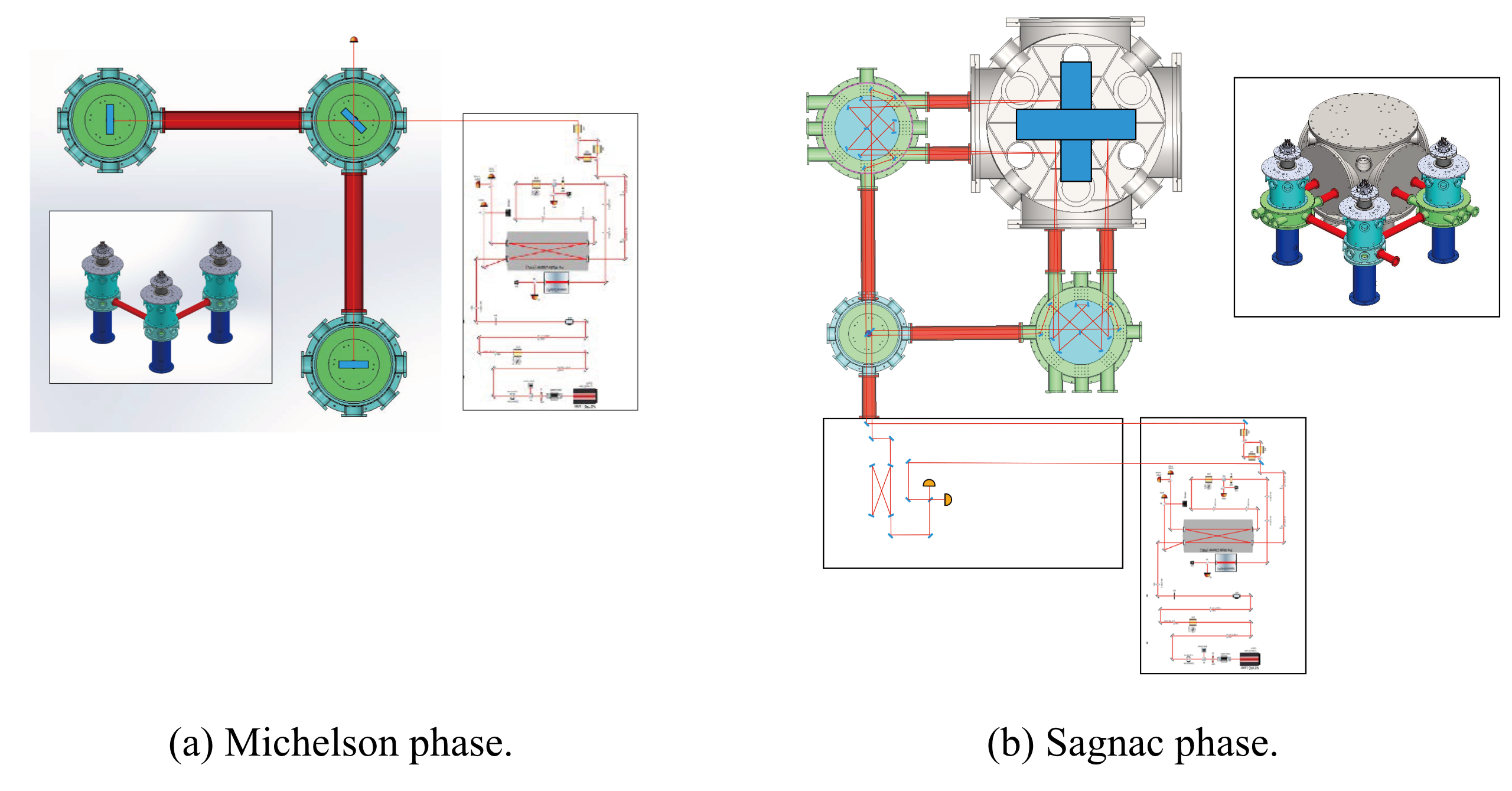
Figure 1: Interferometer configurations of CHRONOS commissioned in NCU during the Michelson and Sagnac phases.
Detector Configuration and Key Techniques
CHRONOS employs two orthogonally crossed torsion bars as test masses, each equipped with mirrors and suspended from pre-isolated towers. This architecture maximizes seismic isolation by leveraging the low resonant frequencies characteristic of torsional suspensions. In the implemented scheme, the rotational mode frequency is placed in the millihertz domain, drastically reducing seismic coupling above this band compared with pendulum-suspended masses.
The interferometric readout is based on a Sagnac configuration operated as a speed meter, wherein the GW-induced signal is encoded in the velocity of the test masses rather than their displacement. This QND approach yields a significant reduction in radiation pressure noise, which is the limiting noise source below ~10 Hz for large-scale GW detectors operating in the standard quantum limit. By adopting balanced-homodyne detection in the output port, CHRONOS achieves independent adjustment of detuning angles for power- and signal-recycling cavities and efficient subtraction of common-mode noise.
Thermal noise suppression is achieved via cryogenic operation. The torsion bars are fabricated from high-purity sapphire, maintained at 10 K via pulse-tube cryocoolers. The mechanical Q-factor and high thermal conductivity of sapphire at cryogenic temperatures, as demonstrated for KAGRA mirrors, minimize Brownian and thermoelastic noise. Hydroxide-catalysis bonding is utilized to assemble bars beyond the size limitations of commercial substrates.
Commissioning Status and Experimental Results
The phased commissioning at National Central University (NCU) progresses from a Michelson interferometer layout (~2 m arm length) to the eventual Sagnac speed meter configuration. The Michelson prototype validates critical technologies: multi-stage test mass suspension, feedback control, input optics, and interferometric locking.
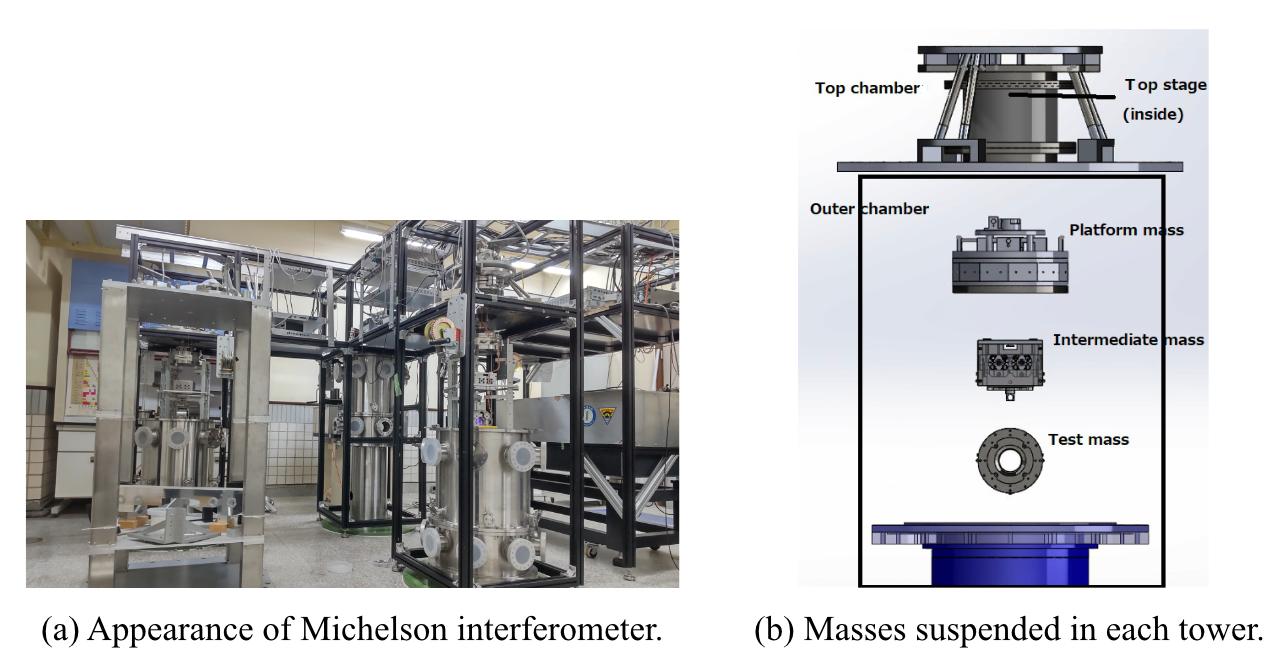
Figure 2: Michelson interferometer and its mirror suspension tower in NCU.
The central beam splitter and arm cavity mirrors are suspended via cascaded mass stages, enabling feedback control predominantly through coil-magnet actuators. Motion monitoring is realized by optical lever sensors. Experimental noise spectra confirm effective feedback, with motion suppression exceeding 40 dB at frequencies below 0.2 Hz.
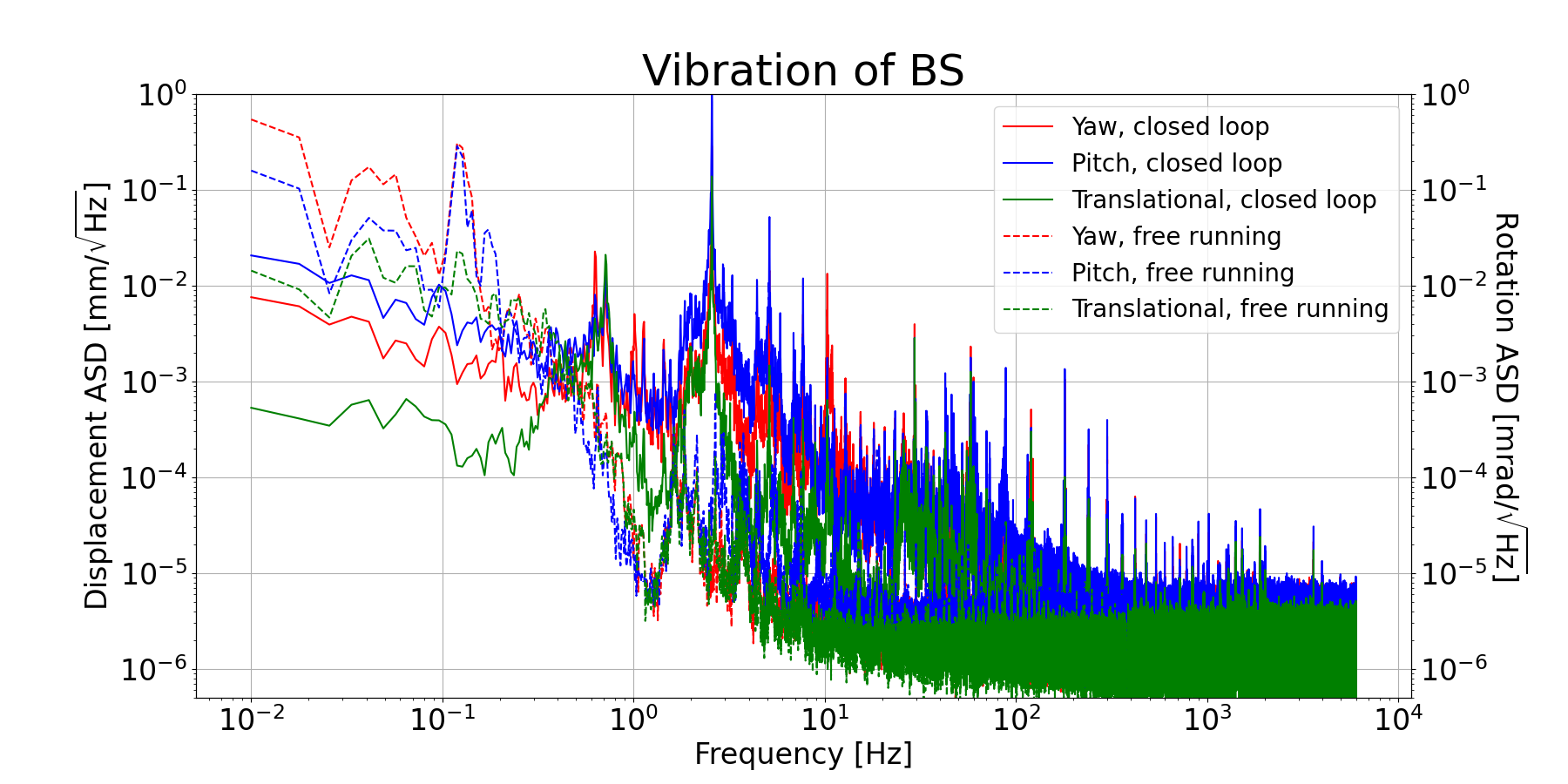
Figure 3: Noise spectrum of the motion of beam splitter, showing closed-loop suppression in displacement and angular degrees of freedom.
Input optics comprise a pre-mode cleaner (PMC) in a bow-tie configuration, stages for frequency and intensity stabilization, and alignment systematics. Stability of the PMC lock (~1 hour) and pronounced reduction in relative intensity noise (RIN), with 20 dB suppression at 10 Hz, have been demonstrated. Improvements in mode matching, resonant peak damping in both yaw and pitch, and the implementation of temperature stabilization schemes for optical components are identified as essential for full interferometric locking at the sub-micron and micro-radian levels.
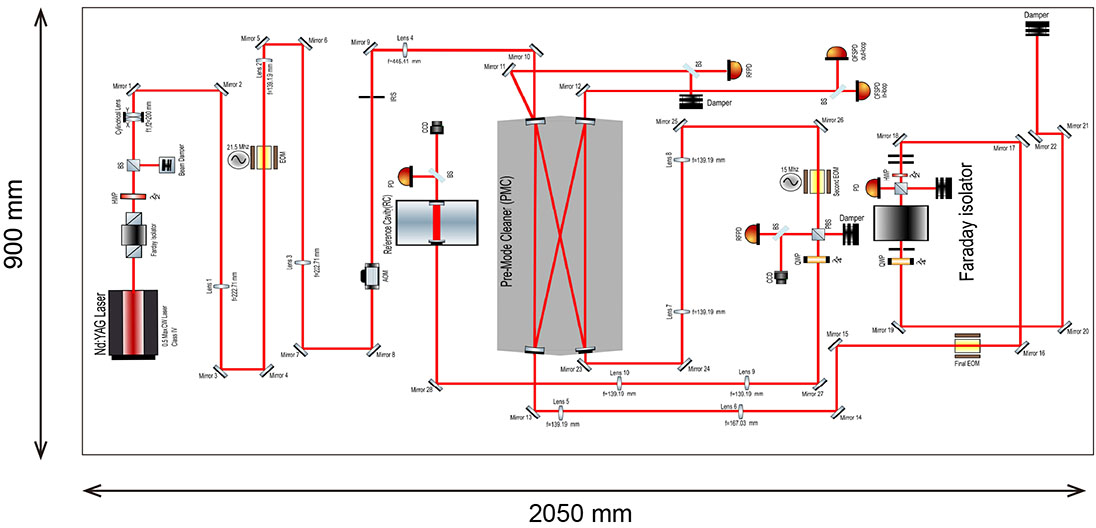
Figure 4: Schematic diagram of the CHRONOS input optics, illustrating mode cleaning and stabilization.
Implications and Future Prospects
CHRONOS extends the architectural paradigm of laser interferometric GW detection toward the sub-hertz band, addressing a key gap between the current sensitivity floor of ground-based detectors (Advanced LIGO, Virgo, KAGRA) and the planned millihertz-space-based observatories (LISA). Methodologically, the integration of torsion bar technology (as studied in TOBA (Shimoda et al., 2018)), Sagnac speed meter topologies, and cryogenic sapphire mirrors into a single platform sets a comprehensive standard for low-frequency sensitivity engineering.
Theoretical implications include direct access to GW signatures from IMBH mergers (masses ∼104 M⊙) and the stochastic GW background, providing constraints on early universe cosmology and black hole formation channels. Practically, scalability of the current suspension and QND systems, and the robustness of cryogenic apparatus in continuous operation, will inform the feasibility of larger-scale detectors with strain sensitivities at 10−18 Hz−1/2.
Key technical challenges remain in the suppression of angular resonances, improvement of thermal isolation, and further reduction of technical laser noise. The ongoing transition to the Sagnac phase, including the assembly of end test mass chambers and realization of the full speed meter configuration, will concretely validate the feasibility of sub-hertz terrestrial GW detection.
Conclusion
CHRONOS presents a rigorous instrumental platform to bridge the sub-hertz GW detection gap, exploiting torsional suspensions, QND speed meter interferometry, and cryogenic sapphire mirrors. The initial commissioning results verify critical enabling technologies, including multi-order-of-magnitude vibration isolation and intensity noise suppression. Theoretical and practical advances stemming from CHRONOS are poised to inform the future landscape of GW astronomy and fundamental physics in the low-frequency regime.

