- The paper demonstrates that demographics-agnostic spectral augmentation, especially frequency masking, achieves up to an 83.65% reduction in age bias.
- The study employs SSL-based teacher distillation to transfer robust acoustic features, improving fairness for sex and age metrics without using demographic labels.
- Different augmentation techniques show attribute-specific effects, as methods like FilterAugment enhance sex fairness but can detrimentally impact accent fairness.
Demographics-Agnostic Training for Fairness in Wake-up Word Detection
Introduction
Ensuring equitable performance of speech technologies across diverse populations is a core challenge, especially for Wake-up Word (WuW) detection systems that must operate in real-time on resource-constrained devices. "OK Aura, Be Fair With Me": Demographics-Agnostic Training for Bias Mitigation in Wake-up Word Detection (2604.05830) presents methodical analyses and mitigation strategies aimed at reducing demographic biases—particularly those associated with sex, age, and accent—in WuW systems, employing the Spanish-language OK Aura dataset as a primary benchmark. The central hypothesis is that effective fairness interventions can be realized without explicit reliance on demographic metadata during training, thereby enhancing privacy and broad applicability.
Dataset and Bias Characterization
The study utilizes the proprietary OK Aura database, comprised of 546 speakers and approximately 5.8k labeled Spanish utterances, annotated at both speaker and utterance levels for sex, age, and regional Spanish accent. The dataset also incorporates challenging negative samples and realistic device/environmental variations. The experimental pipeline leverages OK Aura for training, validation, and bias evaluation, supplementing with out-of-domain corpora for data augmentation.
Demographic imbalance is quantified using Disparate Impact (DI), revealing significant skews: male speakers and those aged 41-50 are overrepresented, and accent distributions are heavily centralized around Central Southern Spain. Age and accent imbalances are particularly notable, with Central Southern Spain vastly outnumbering all other accent divisions.
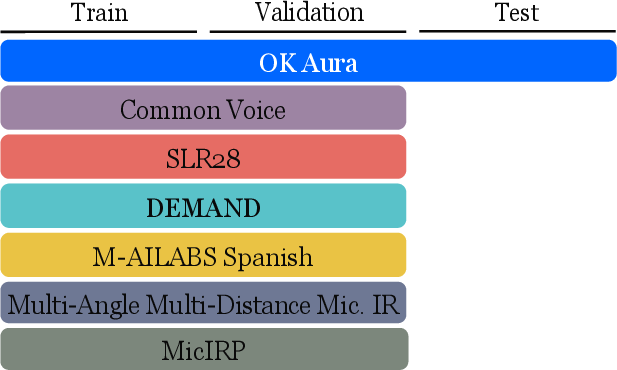
Figure 1: Dataset usage across train/validation/test splits, illustrating OK Aura’s comprehensive coverage and the auxiliary role of public corpora for augmentation and robustness.
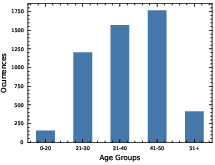
Figure 2: Age distribution in OK Aura (training and validation), highlighting underrepresentation of youth and seniors.
These imbalances propagate to predictive performance, evidenced by the baseline model’s maximum F1-score disparity of 1.29% across age groups, smaller but measurable gaps for sex (0.38%) and accent (0.92%). Thus, the focus transitions to developing label-agnostic mitigation techniques that reduce these disparities.
Demographics-Agnostic Bias Mitigation Techniques
Data Augmentation Approaches
Spectral and temporal perturbations are central to demographics-agnostic training. The following techniques were systematically evaluated:
- FreqMixStyle: Frequency-wise mixture of spectrogram statistics across samples; theoretically promotes domain-invariant representations by disrupting demographic correlates in spectral structure.
- FilterAugment: Applies smooth frequency-dependent gain perturbations, simulating real-world device and channel variability.
- SpecAugment (Frequency Masking): Suppresses random spectral bands in the input, preventing overfitting to any single frequency region correlated with demographic attributes.
- Device Impulse Response (DIR) Convolution: Simulates hardware capture diversity, primarily to induce robustness to device-specific artifacts.
Knowledge Distillation (KD)
Large, frozen SSL speech encoders (specifically w2v-BERT 2.0, a Conformer-based model pretrained on 4.5M hours of audio) are utilized as teachers. The compact on-device GRU-based WuW detector (device-sgru) is distilled via logit-matching, with a loss combining cross-entropy and temperature-scaled KL divergence. The teacher’s demographically robust representations are thus transferred without exposure to explicit demographic labels.
Experimental Results and Analysis
Attribute-dependent Effects of Data Augmentation
- Frequency Masking consistently offered the largest reduction in bias across all attributes, with relative reductions of Predictive Disparity (RRPD) of 39.94% (sex), 83.65% (age), and 40.48% (accent) compared to the baseline. Importantly, these gains were achieved without sacrificing subgroup F1-scores.
- DIR and FilterAugment yielded high RRPD for sex (DIR: 67.35%; FilterAugment: 88.26%) but were inconsistent or counterproductive for accent fairness, highlighting that demographic cues may be encoded in a highly attribute-specific manner. For instance, frequency envelope perturbation (FilterAugment) improved sex fairness but destabilized accent fairness.
- FreqMixStyle exhibited attribute-specific effects, improving accent fairness (40.48% RRPD) but negatively impacting sex fairness (-21.42% RRPD), indicating that aggressive frequency statistics perturbation may destroy beneficial information for some subpopulations.
Supervised Transfer and Hybrid Approaches
- Knowledge Distillation from SSL-based teachers led to substantial disparity reductions for sex (67.35%) and age (15.10%), but not for accent, likely due to insufficient accent coverage in the in-domain distillation set.
- Combining KD with Frequency Masking did not reinforce gains and in some cases increased disparity for accent, suggesting complex interactions and limitations of student model capacity in absorbing complementary regularization signals.
Practical and Theoretical Implications
The empirical results strongly support the thesis that demographics-blind augmentation policies, especially frequency masking, are effective strategies for fairness-oriented WuW training in the absence of demographic labels. The analysis underscores that optimal mitigation is attribute- and dataset-specific: spectral strategies may not generalize across all bias axes, and their utility depends critically on the nature of attribute encoding in the acoustic domain.
From a privacy perspective, these methods offer the advantage that sensitive demographic labels are not required during training, and fairness gains are acquired as a function of model robustness and domain generalization, not direct bias supervision.
The constraint of accent invariance in transfer underscores an important theoretical limitation: when source or teacher data are themselves limited in diversity, label-agnostic generalization will saturate. The interplay between augmentation intensity and model architecture (capacity, regularization) also emerges as critical—excessive spectral corruption can destroy discriminative cues, leading to divergent fairness/accuracy trade-offs.
Future Directions
Future work should:
- Extend evaluation to intersectional fairness scenarios (e.g., age-sex-accent intersections), where compound underrepresentation is known to exacerbate disparity.
- Address accent generalization with more systematically diversified and stratified augmentation and pretraining regimes.
- Develop multi-objective optimization (accuracy, robustness, fairness on each attribute separately and jointly) for deployment-critical WuW.
- Explore more advanced fairness metrics, including decomposing F1 disparities into accept/reject asymmetries, particularly relevant for real-world human-computer interaction burdens.
Conclusion
Demographics-agnostic training, specifically frequency-domain augmentation and SSL-based teacher distillation, are demonstrated to be effective in reducing bias in WuW detection without leveraging demographic labels. Frequency masking emerges as the most robust single intervention, with RRPD values up to 83.65% for age disparity. However, no intervention universally improves fairness across all attributes, emphasizing the importance of systematic, attribute-specific analysis. The proposed methods are directly transferable to privacy-sensitive edge-AI speech systems, but further research is necessary to address intersectional, accent-driven, and other rare-case disparities.