- The paper establishes a geometric link between flat-space Abelian vortex equations and harmonic spinors on Nappi–Witten space.
- It employs soliton geometry and gauge theory techniques to lift vortex solutions, like the Jackiw–Pi equations, to produce twisted Dirac zero-modes.
- It demonstrates the propagation of vortex-generated zero-modes from NW space to Minkowski spacetime using conformal flatness and explicit Lorentz transformations.
Vortex Harmonic Spinors and Abelian Zero-Modes via the Nappi–Witten Space
Introduction
This paper establishes a geometric link between flat-space Abelian vortex equations and harmonic spinors on the Nappi–Witten (NW) space, a four-dimensional, solvable Lie group representing a central extension of SE(2). The approach merges techniques from soliton geometry, gauge theory, and spinorial analysis, exploiting the conformal flatness of NW space to propagate explicit Abelian zero-modes onto Minkowski spacetime. By lifting vortex solutions—especially the integrable Jackiw–Pi (JP) equations—from R2 to NW, the work constructs families of twisted Dirac zero-modes, thereby extending the geometric correspondence between integrable vortices and magnetic zero-modes explored previously for hyperbolic, elliptic, and 3D Euclidean settings.
The Nappi–Witten Group Structure, Metric, and Spin Geometry
NW space N is a four-dimensional central extension of SE(2), realized by the generators P1,P2,J,T obeying solvable commutation relations. Unlike SE(2), whose degenerate Killing form stymies standard harmonic spinor constructions, NW admits a two-parameter family of non-degenerate Ad-invariant Lorentzian metrics with bi-invariant structure.
The left-invariant coframe (σ1,σ2,σ3,σ4) and vector fields are explicitly constructed, and a global orthonormal frame (U0,U1,U2,U3) is extracted via Gram–Schmidt, providing a handle for spin and Dirac structures. Importantly, N is parallelizable and admits two inequivalent spin structures; the analysis centers on the trivial case where the spinor bundle is globally trivializable, enabling the explicit realization of Dirac spinors as C4-valued functions.
Dirac operators are constructed in the Weyl representation, and the chiral splitting isolates equations for right-handed Weyl spinors. The explicit matrix form of the Dirac operator is derived in terms of the left-invariant frame, leading to component differential operators with gauge field couplings.
Vortex Equations and Their Lifting to the Nappi–Witten Space
JP and Laplace vortex equations are posed on a flat Riemann surface R20, with the vortex solutions characterized by a R21 connection R22 and a Higgs field R23 obeying the generalized Bogomolny equations. Their integrable cases arise for specific curvature parameters and are solvable in terms of rational functions for JP vortices, reflecting Chern–Simons theory relations.
The main geometric construction consists of lifting vortex data from R24 to R25 via the bundle projection R26 and section R27. This translates Abelian vortex solutions into so-called vortex configurations R28 on R29, expressed using the left-invariant coframe and complex coordinates. The pullback intertwines the flat vortex data and the N0-geometric structure, maintaining explicit control over Higgs and gauge fields.
Harmonic Spinors From Vortex Data on Nappi–Witten
The central technical achievement is the construction of vortex harmonic spinors, i.e., Dirac zero-modes on N1 twisted by Abelian vortex-generated gauge fields. For a vortex configuration N2, the spinor N3 is shown to solve the chiral Dirac system in the presence of the modified connection N4, provided the connection and Higgs pair satisfy the vortex configuration equations lifted from N5. The verification reduces to algebraic properties of the lifted fields and the geometry of the left-invariant frame.
Propagation to Minkowski Space
A core theoretical implication arises from the conformal flatness of NW space; using explicit local isometries, one demonstrates that the NW metric is conformally equivalent to Minkowski space (excluding a singular null hypersurface), with the conformal factor N6. This, together with an explicit Lorentz transformation relating the orthonormal frames of N7 and Minkowski space, allows the transfer of spinorial and gauge content via conformal rescaling and spin frame rotation.
The explicit procedure involves pulling back vortex harmonic spinors to Minkowski space, applying the conformal rescaling associated with the dimension and spin character, and acting by the spin lift N8 of the Lorentz transformation N9. The general formula for the transformed spinor
SE(2)0
produces massless Dirac zero-modes in the presence of Abelian fields whose curvature is induced from the original vortex.
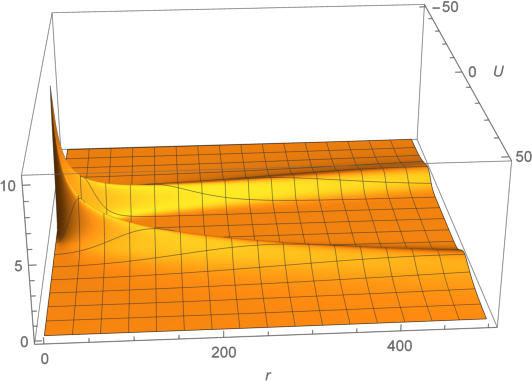
Figure 1: A plot of the norm of the spinor SE(2)1 in Minkowski coordinates, showing localization at SE(2)2.
Explicit Solutions and Analytical Structure
The construction is made concrete via explicit examples, such as JP vortices with SE(2)3, yielding closed-form expressions for the Higgs, connection, and the associated right-handed spinor on SE(2)4. These, once pushed forward to Minkowski coordinates, result in analytic formulae for Dirac zero-modes, with their squared norms revealing sharply localized structure in light-cone coordinates (see Figure 1). The formalism naturally accommodates generalizations to higher topological charge and could, in principle, cope with more complex vortex moduli spaces.
Implications and Outlook
This work completes the program linking vortex equations on 2D Riemannian geometries with harmonic spinors in higher-dimensional group manifolds, particularly for the flat, plane-wave NW metrics. The resulting correspondence promotes Abelian vortex data, previously classified in the context of Chern–Simons and integrable systems, into explicit four-dimensional zero-modes of the massless (twisted) Dirac operator on Minkowski spacetime.
Potential applications include the engineering of explicit spinor zero-modes relevant for Abelian (and speculative non-Abelian extensions) gauge backgrounds in curved or flat Lorentzian geometry. The construction provides new families of magnetic zero-modes, and might inform investigations in integrable systems, quantum field theory with background gauge fields, or even cold atom analogues where geometric gauge structures are imposed artificially.
Future directions include extending these results to non-Abelian gauge structures, exploring further the moduli space of such zero-modes, and identifying physical systems (classical or quantum) wherein the localization and structure of these four-dimensional spinors may be realized or exploited.
Conclusion
Through a geometric and analytic pipeline, this paper systematically constructs harmonic spinors on both NW space and, via conformal geometry, on Minkowski spacetime, arising from Abelian vortex data on the plane. This construction advances the understanding of how integrable soliton systems intertwine with spin geometry, and it opens new possibilities for explicit modeling of Dirac zero-modes in the presence of gauge fields with topological content.