- The paper introduces CDT as a lattice-based path integral formulation that builds quantum spacetime from causal, piecewise-linear Minkowskian units.
- It employs Monte Carlo simulations to reveal emergent de Sitter geometry with finite-size scaling that mirrors semiclassical general relativity.
- The study uncovers a nontrivial phase structure and a candidate UV fixed point, underscoring CDT's promise as a robust nonperturbative quantum gravity framework.
Causal Dynamical Triangulations: A Lattice Quantum Gravity Framework
Introduction and Motivation
The formulation of a consistent nonperturbative quantum theory of gravity remains an outstanding problem in theoretical physics. "Causal Dynamical Triangulations: New Lattice Theory of Quantum Gravity" (2604.05641) provides a comprehensive exposition of the Causal Dynamical Triangulations (CDT) approach, a lattice-based path integral formulation designed to regularize and compute gravitational dynamics without relying on a background metric. CDT achieves this by summing over causally well-behaved, piecewise-linear Lorentzian geometries constructed from elementary Minkowskian building blocks, encoding curvature and causal structure through their gluing relations and edge lengths.
This essay details the core principles, computational prescriptions, central numerical results, and the implications of CDT as presented in the paper.
CDT Lattice Construction and Causality
CDT avoids the traditional pitfalls of previous lattice quantum gravity formulations by enforcing a well-defined causal structure on the configuration sum. Each spacetime history is a sequence of three-dimensional simplicial slices labeled by a discrete "proper time" parameter, and the system's total geometry is a finite product topology [0,1]×Σ, eliminating topology change between spatial slices. Distinct building blocks—specifically, (3,2) and (4,1)-type four-simplices (and their time-reflected counterparts)—serve as the elementary units of spacetime assembly. The gluing rules ensure that timelike and spacelike edge assignments are respected, manifesting global hyperbolicity.
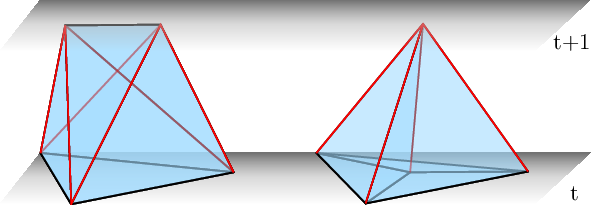
Figure 1: Elementary Minkowskian building blocks of CDT, showing types (3,2) and (4,1), and their embedding in a neighboring time slice.
This construction guarantees that, in the continuum limit, the approach retains only configurations with compatible causal structures, as opposed to the pathological dominance found in previous Euclidean approaches.
Gravitational Path Integral and Wick Rotation
CDT implements the formal gravitational path integral without gauge redundancies by summing over unlabelled, causal triangulations, with each configuration weighted by an appropriately discretized Regge version of the Einstein-Hilbert action. A crucial technical step is a unique, globally well-defined lattice Wick rotation, mapping Lorentzian triangulations to their Euclidean counterparts. Post-rotation, the partition function is expressed as a conventional statistical sum with positive-definite Boltzmann weights, making it tractable for Markov Chain Monte Carlo simulations.
The resulting action depends primarily on the counts of vertices and four-simplices:
SE[T]=−k^0N0(T)+k^4N4(T),
where N0 and N4 are the numbers of vertices and four-simplices, and (k^0,k^4) are related to the continuum Newton and cosmological constants via the cutoff a.
Phase Structure of Quantum Geometry
The CDT ensemble demonstrates a nontrivial phase structure in the space of bare coupling constants (k0,Δ). Multiple geometrically distinct phases exist, separated by both first and second order transitions. Critically, only the "de Sitter" phase, labeled CdS, displays physical features consistent with a four-dimensional macroscopic universe.
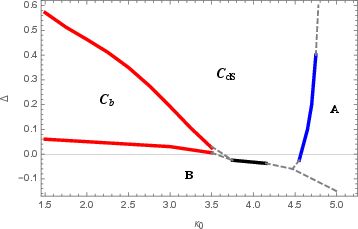
Figure 2: CDT phase diagram in (k0,Δ) space, emphasizing the physically relevant de Sitter phase CdS.
This phase is characterized by emergent extended geometry, appropriate scaling behavior, and semiclassical properties on large scales.
Emergent Macroscopic de Sitter Universe and Scaling Laws
A pivotal observable in CDT is the "volume profile," SE[T]=−k^0N0(T)+k^4N4(T),0, representing the expectation value of the spatial three-volume as a function of discrete time. Numerical simulations in SE[T]=−k^0N0(T)+k^4N4(T),1 reveal that the ensemble average is sharply peaked and exhibits perfect finite-size scaling, with the global volume profile matching that of a four-dimensional Euclidean de Sitter space (a four-sphere). Fluctuations around the mean show universality when rescaled properly.
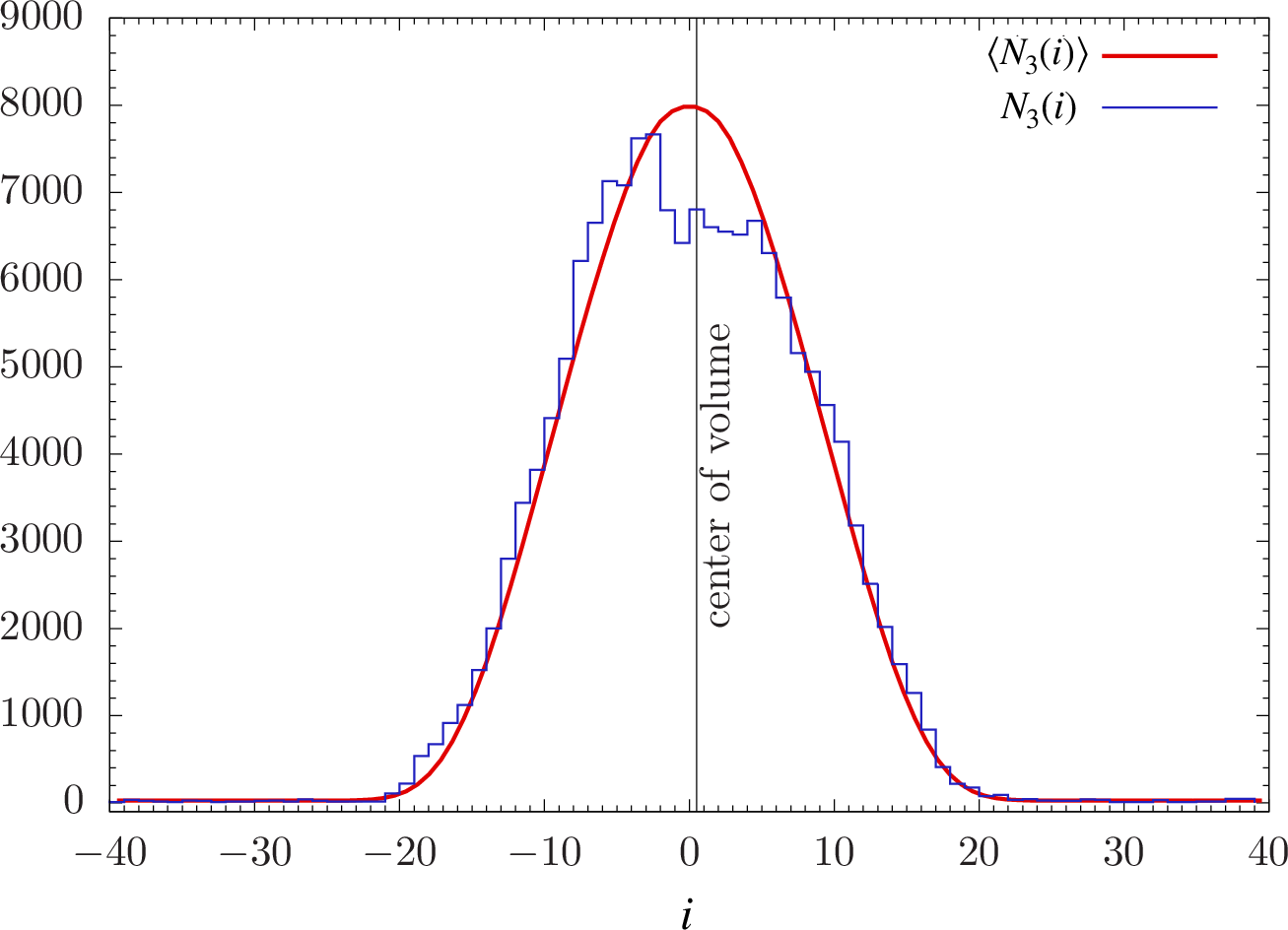
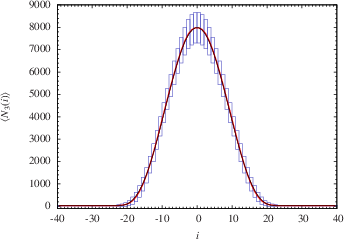
Figure 3: Left—typical single-sample spatial volume distribution SE[T]=−k^0N0(T)+k^4N4(T),2. Right—averaged volume profile SE[T]=−k^0N0(T)+k^4N4(T),3 and its quantum fluctuations.
Explicitly, the measured time and volume scaling behaviors (height SE[T]=−k^0N0(T)+k^4N4(T),4, duration SE[T]=−k^0N0(T)+k^4N4(T),5) reflect the emergent macroscopic dimensionality and validate the continuum reduction to minisuperspace effective dynamics. The resulting effective action for the volume profile recovers the minisuperspace action of classical general relativity (GR) on SE[T]=−k^0N0(T)+k^4N4(T),6, but here derived through explicit nonperturbative path integral dynamics.
Renormalization Group Flow and Indications of UV Fixed Point
CDT enables study of both infrared (IR) and ultraviolet (UV) limits through scaling trajectories in the coupling constant space. Finite-size scaling considerations and the observed critical exponents indicate that the SE[T]=−k^0N0(T)+k^4N4(T),7--SE[T]=−k^0N0(T)+k^4N4(T),8 phase transition line may serve as a candidate for a UV fixed point. On certain RG trajectories, the product SE[T]=−k^0N0(T)+k^4N4(T),9 (where N00 are phase-specific scaling parameters) exhibits scaling compatible with a fixed N01 in the continuum limit, substantiating the claim of continuum universality and the existence of a non-Gaussian UV fixed point—a requirement for asymptotic safety scenarios. Remarkably, these universes are only N0220 Planck lengths in diameter, yet display reliable semiclassical observables.
Quantum Geometry Observables: Ricci Curvature and Spectral Dimension
Constructing diffeomorphism-invariant observables in a nonperturbative background-independent context is inherently challenging. The quantum Ricci curvature, defined via the relative average distance of nearby geodesic spheres, provides a well-defined quasi-local curvature observable. Numerical results demonstrate that its scaling in phase N03 matches that of classical de Sitter space, reinforcing CDT's recovery of correct semiclassical geometry.
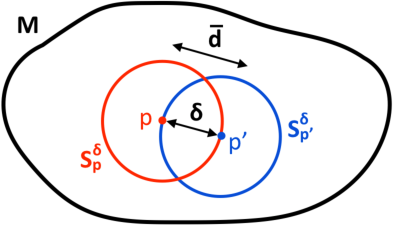
Figure 4: Schematic illustration of quantum Ricci curvature: the average distance between N04-spheres in quantum geometry.
More fundamentally, CDT delivers a signature quantum gravity effect through the scale-dependent running of the spectral dimension N05. Diffusion processes on triangulated quantum spacetime reveal that, while the spectral dimension is N06 at large scales, it smoothly reduces to N07 at short (Planckian) scales:
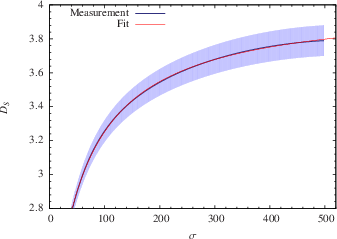
Figure 5: Spectral dimension N08 as a function of diffusion time N09, showing dynamical dimensional reduction from 4 to approximately 2.
This dynamical dimensional reduction is a distinctly nonperturbative quantum feature of gravity. Its value near the Planck scale is compatible with several independent nonperturbative approaches and has been proposed as a universal quantum gravitational phenomenon.
Computational Framework and Future Directions
CDT's framework utilizes state-of-the-art MCMC methods to sample geometries with N40 up to N41. The approach is computationally robust and continues to evolve as new observables are constructed, including diffeomorphism-invariant measures of homogeneity, curvature two-point functions, and extensions to coupled matter sectors.
Key open problems include clarifying the nature and universality class of the UV critical line, explicit computation of further physical observables, and connecting the nonperturbative Planckian fluctuations to phenomenology in early-universe cosmology. The demonstrated emergence of semiclassical geometry from purely quantum, background-independent CDT path integrals is a crucial step towards bridging quantum gravity with standard cosmology.
Conclusion
The CDT lattice formulation described in "Causal Dynamical Triangulations: New Lattice Theory of Quantum Gravity" establishes a consistent, nonperturbative computational framework for quantum gravity. The formation of macroscopic four-dimensional geometry, appropriate semiclassical limits, identification of critical phase structure and potential UV fixed points, alongside invariant quantum observables such as the running spectral dimension, collectively attest to the theoretical soundness and computational accessibility of the approach. CDT provides a solid foundation for further investigations into the nonperturbative quantum origins of spacetime and the possibility of connecting quantum gravitational dynamics with observable cosmological phenomena.