- The paper introduces a dual-strategy framework combining dynamic idle duration adjustment and intelligent request waiting to achieve up to 51.2% cold start reduction.
- It employs a probabilistic sliding-window model and online clustering to enhance resource utilization efficiency and adapt to variable cloud workloads.
- Experimental results demonstrate significant improvements in latency, cost-performance, and scalability, outperforming existing serverless resource managers.
Adaptive Serverless Resource Management via Slot-Survival Prediction and Event-Driven Lifecycle Control
Introduction
This work develops a comprehensive engineering framework for serverless resource management that leverages event-driven lifecycle control and prediction-based slot survival modeling to optimize both cold start mitigation and resource utilization. The core architectural innovation integrates a dual-strategy mechanism—dynamic idle duration adjustment and intelligent request waiting—within a probabilistic, sliding-window-based prediction backbone. By addressing the primary limitations of static allocation and simplistic heuristics, the framework aims to minimize latency and operational cost across heterogeneous, variable workload profiles in multi-cloud environments.
System Architecture and Resource Lifecycle Engineering
The proposed framework is built around a multi-layered system architecture, which incorporates gRPC-driven service interfaces, a core optimization engine, and temporal context modeling. The system abstracts compute resource lifecycle into a discrete state machine, factoring in the multidimensional historical context of request intensity, resource allocation, and queuing dynamics.
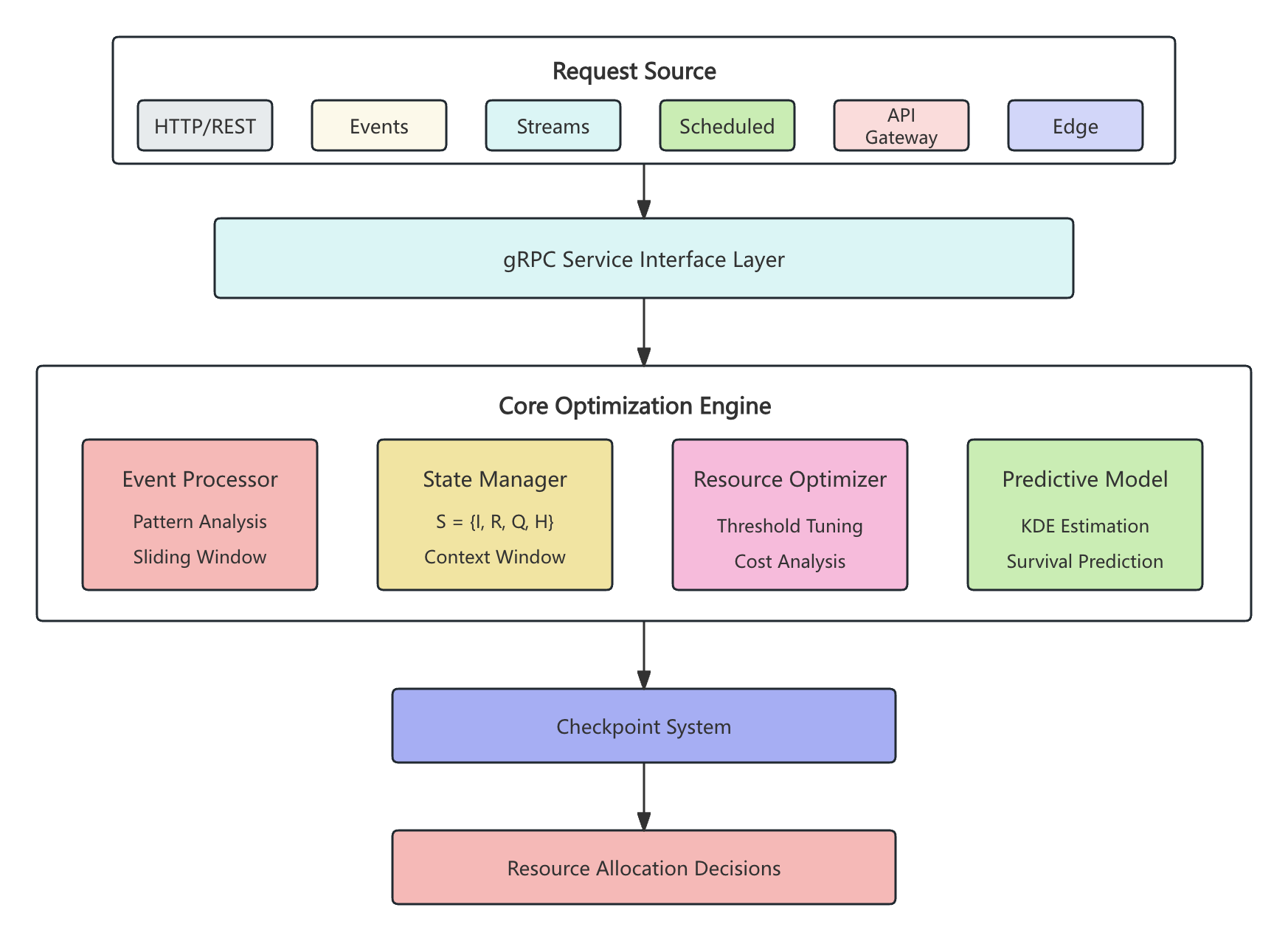
Figure 1: The five-layer system architecture captures the flow from external request sources through the core optimization logic to final resource allocation and lifecycle control decisions.
Dynamic resource lifecycle management is achieved via a state machine augmented with online parameter adjustment. The transition logic is guided by predictive analytics—slot survival time estimation driven by nonparametric density modeling on recent request intervals, thus enabling rapid adaptation to workload nonstationarity. This setup directly addresses the pathological cases of static idle thresholds that cause waste under sparse loads and excessive latency under burst traffic.
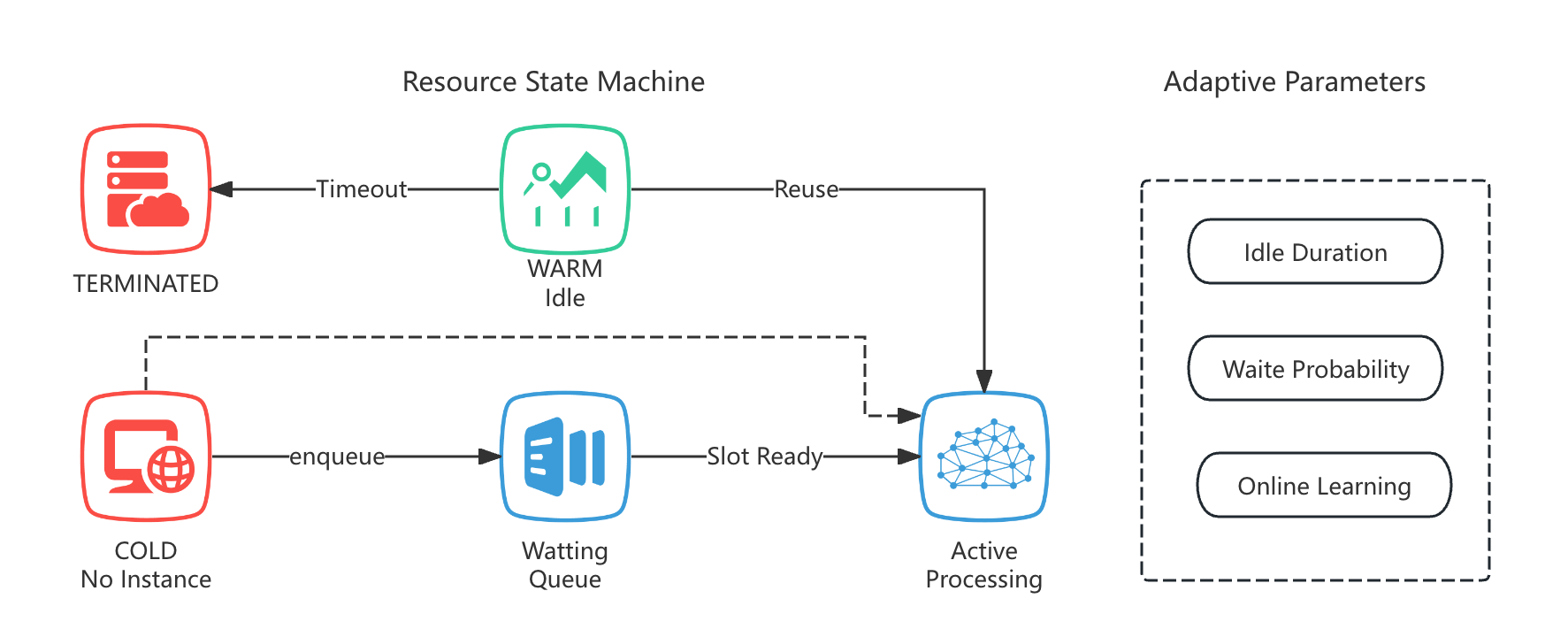
Figure 2: Resource lifecycle state machine with adaptive transition parameters, illustrating the interplay of probabilistic survival time estimation, request waiting probability, and online learning for continual control strategy refinement.
Data Preprocessing and Request Profiling
Practical deployment in production serverless systems necessitates robust data preprocessing, including temporal normalization and real-time request categorization, to support the downstream predictive models. The framework implements multi-resolution temporal binning, adaptive to local request density, preserving both burst and trend-level features. Feature extraction draws on both statistical and time-frequency analyses, including wavelet-based decomposition for multi-scale pattern capture.
Request logs are further subjected to online clustering (using weighted Euclidean metrics for resource-related features) and incremental PCA for dimensionality reduction, enabling scalable, low-latency classification of resource demand patterns. These preprocessed and profiled metrics form the basis for effective slot-survival prediction and adaptive control.
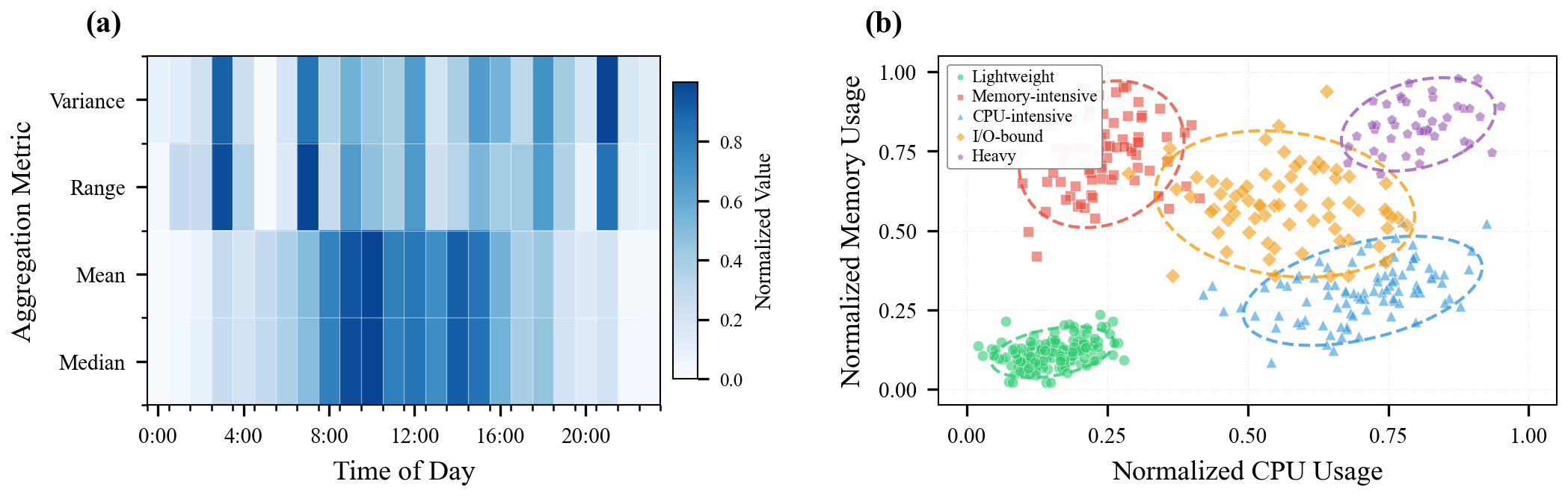
Figure 3: (a) Multi-resolution temporal analysis delineating burst and steady-state patterns; (b) Online clustering identifies distinct request profiles relevant to downstream resource optimization, visualized with confidence ellipses.
Dual-Strategy Optimization: Method and Implementation
The exploitation of event-driven resource lifecycle control is centered on two symbiotic strategies:
- Dynamic Idle Duration: Real-time adjustment informed by predictive modeling over historical request patterns, delivered via a kernel density estimator on a sliding window of inter-arrival times. This mechanism enables proactive resource retention when burst probability is high, and efficient resource release under sparse conditions.
- Intelligent Request Waiting: Each request is associated with a predicted survival probability for resource slot reuse, with a dynamically calculated wait timeout that leverages empirical execution variability as a risk gauge. The queue synchronization uses lock-free, atomic operations to achieve scalability under high concurrency.
The methodologies are generalized to support multi-cloud infrastructures by introducing an abstraction layer for provider-specific API translations and optimization parameters that are learned or inferred via benchmarking-driven meta-optimization.
Evaluation and Results
System performance is assessed via Cold Start Reduction Rate (CSRR), Resource Utilization Efficiency (RUE), Adaptive Response Latency (ARL), and Cost-Performance Index (CPI). The evaluation spans high-frequency uniform, periodic burst, and irregular sparse workloads. The proposed Adaptive Serverless Resource Manager (ASRM) is benchmarked against OpenWhisk-Default, SOCK, Firecracker-snap, and Knative-KPA baselines.
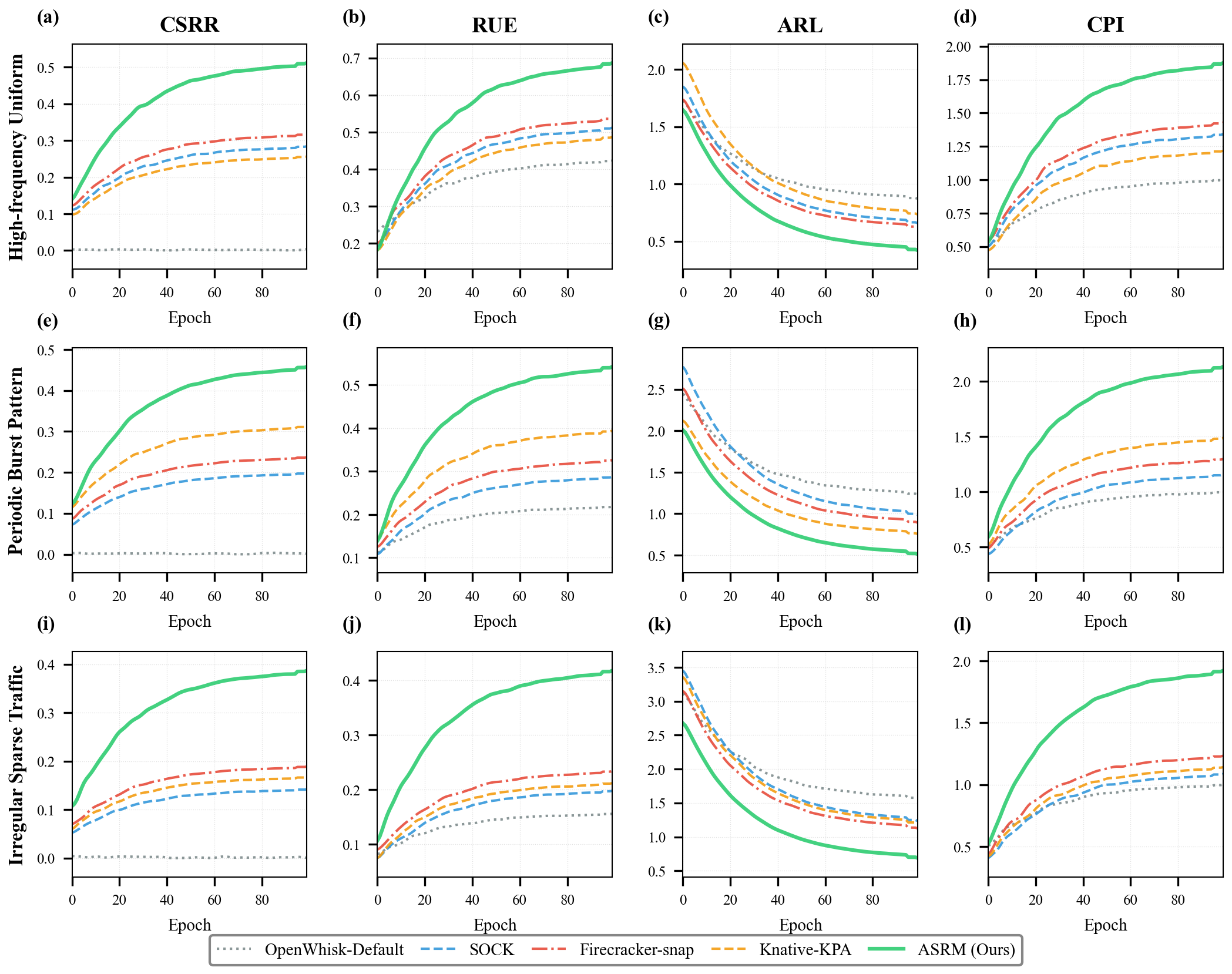
Figure 4: Comparative convergence and steady-state performance of ASRM and baselines on three representative workload types, across four major metrics.
The results demonstrate that ASRM consistently dominates baselines in both convergence speed and final metric values. Specifically, ASRM achieves up to 51.2% cold start reduction, RUE improvements exceeding 62% over OpenWhisk-Default, ARL reductions evidencing improved performance stability, and a CPI nearly 2× higher than traditional static methods.
Production Deployment and Practical Implications
Key practical contributions include a closed-loop observability and debugging infrastructure leveraging distributed tracing and adaptive sampling. The empirical findings highlight the criticality of adaptive garbage collection and the interaction between resource pattern classification and control logic. The multi-cloud adaptation layer enables robust deployment portability, while validation across production-trace-driven scenarios confirms scalability to 100× baseline request rates and resilience to heterogeneous workload mixes.
Theoretical and Practical Implications
By unifying probabilistic survival prediction, online learning-based request profiling, and event-driven resource lifecycle engineering, this research advances the state of adaptive serverless resource management. The methodological blueprint is broadly extensible to variable workload resource scheduling, particularly in latency-sensitive AI, microservice, and edge-cloud workloads. Future research may integrate deep meta-learning for provider parameter inference, decentralized adaptation, or causal tracing for automated root-cause analysis in complex distributed environments.
Conclusion
The ASRM framework robustly demonstrates that a dual-strategy combination of dynamic survival prediction and intelligent, context-aware waiting yields substantial improvements in cold start reduction, resource efficiency, and cost-performance tradeoffs over prevailing static and semi-heuristic methods. The system’s architecture, data preprocessing, and lifecycle control mechanisms offer a model for next-generation serverless computing platforms, with empirically validated gains under diverse and adversarial workload regimes.
(2604.05465)

