- The paper demonstrates that SU(2) symmetry uniquely limits randomness, as unentangled product states fail to reach Haar-random statistics.
- It develops an analytic and numerical framework comparing symmetry-constrained ensembles to Haar ensembles via trace distance and entanglement entropy scaling.
- Results indicate that experimental protocols starting from product states cannot achieve full quantum randomness, setting practical limits for quantum simulators.
Quantum State Randomization Constrained by Non-Abelian Symmetries
Introduction and Problem Statement
The randomization of quantum states under chaotic unitary dynamics constitutes a foundation for quantum statistical mechanics and has practical significance in quantum computing, benchmarking, and state tomography. This paper, "Quantum state randomization constrained by non-Abelian symmetries" (2604.05043), systematically analyzes how non-Abelian symmetries—specifically SU(2)—fundamentally alter the degree of randomness generated by chaotic quantum evolution, with an emphasis on the operationally available randomization as measured by finite statistical moments and entanglement entropy (EE), given experimentally relevant constraints on initial state preparation. The core assertion is that, contrary to Abelian-symmetry-constrained cases, the limiting factor for emergent randomness is not the symmetry-constrained dynamics, but the limited ability of unentangled (low-complexity) initial states to mimic the statistical properties of Haar-random states.
Statistical Structure of Symmetry-Constrained Randomization
The Random Ensemble Approach
The authors build an analytic and numerical framework wherein they define symmetry-constrained ensembles that emulate time-evolved quantum states: within each symmetry sector, the state is Haar-random, but the distribution between sectors is fixed by the initial state's conserved quantities. The comparison with the Haar ensemble is performed at each statistical moment order k. For SU(2), strict conservation of all spin components is imposed.
The main technical result is a demonstration that, for any local or even nonlocal operator probed at finite statistical moment order (i.e., accessible with polynomially many state copies), the statistical distinguishability (trace distance) between the symmetry-constrained ensemble and the unconstrained Haar ensemble decreases exponentially with system size, provided the initial state’s conserved charge distribution matches the Haar expectation up to the relevant order.
This result generalizes symmetry-constrained randomization results from U(1) [2025PRB_latetimeensemble] to SU(2) symmetry, but only holds when the initial state realizes the Haar ensemble's full distribution of conserved charge moments.
Limitation Imposed by Low-Complexity Initial States
Variance Constraints for Product States
Physical experiments invariably start with unentangled product states. For such states, the total spin variances satisfy σx2+σy2+σz2=L/2 for L spin-1/2 objects, whereas the Haar-random expectation is $3L/4$. This variance mismatch means unentangled states cannot be randomized into the symmetry-constrained ensemble that is exponentially close at all finite moments to Haar; thus, strong deviations from Haar randomization persist at long times, even under maximally chaotic dynamics.
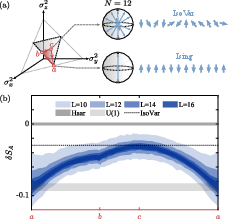
Figure 1: (a) Physically allowed spin variance region for product states and reference points for high-symmetry initial states; (b) System size and variance dependence of late-time half-system EE relative to Haar, exposing a persistent deviation for unentangled initializations.
Figure 1 illustrates the allowed region in the (σx,σy,σz) space for product initial states and quantifies, as a function of initial variances and system size, the persistent deviations in late-time EE from Haar entropy.
Quantifying Randomization: Entanglement Entropy Scaling
The entanglement entropy of a bipartition is a highly sensitive probe that encodes high-order moments of the reduced state. In the absence of symmetry constraints, the average Page entropy sets the benchmark for achievable randomness. For a single conserved charge (U(1)), corrections to Page entropy are known, and when the variance of the charge matches Haar, the correction vanishes. For SU(2), the scenario is more intricate due to the noncommutativity of the three spin components.
The authors show analytically and numerically that for generic unentangled initial states, late-time EE does not reach the Haar value; the maximal achievable entropy is strictly less and obeys a universal correction determined solely by the spin variances, distributed according to σx2+σy2+σz2=L/2. When the variances are maximally isotropic (σx2=σy2=σz2=L/6), this correction is minimized but remains finite in the thermodynamic limit.
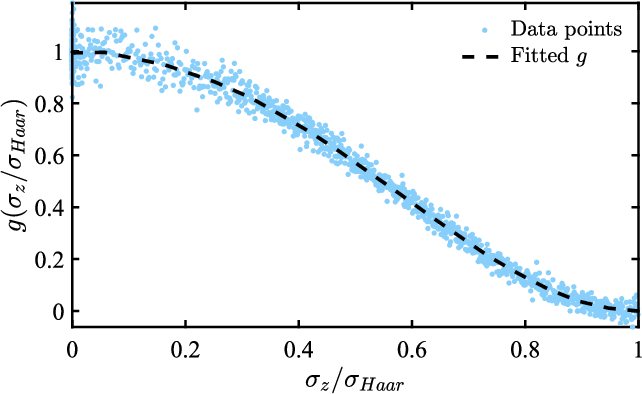
Figure 2: Evaluation of the universal scaling function g(x) that governs the entanglement entropy correction as a function of conserved charge variance.
Analytic predictions for intermediate corrections are corroborated by direct numerical construction of random states with fixed charge variances (Figure 2).
Role of Initial-State Variance Structures
Detailed numerical experiments in SU(2)-symmetric random quantum circuits (RQCs) and in explicit SU(2)-invariant Hamiltonian evolution confirm that late-time EE is controlled solely by the initial state's vector of variances, independent of the microscopic spin configuration. The volume-law EE correction for each charge component is additive; for the most isotropic variances (the "IsoVar" state), the correction is O(1), with sublinear finite-size corrections.
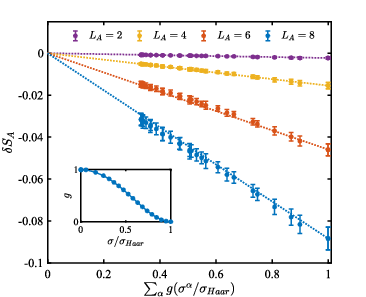
Figure 3: Collapse of the late-time EE distribution for all subsystem sizes and initial conditions, parametrized by the functional dependence on charge variances derived analytically.
Full distributions of EE collapse onto the predicted scaling over numerous subsystem sizes and initial conditions, verifying the analytic theory (Figure 3).
Hamiltonian Dynamics and Additional Constraints
To verify robustness, the analysis is extended to time evolution under SU(2)-symmetric Hamiltonians with additional energy conservation. The same variance-dependent limitations on randomization and entanglement generation are apparent, provided the initial state's energy moments are similarly matched to the ensemble's. The scaling of EE in Hamiltonian dynamics is quantitatively indistinguishable from that seen in RQCs and matches theoretical expectations.
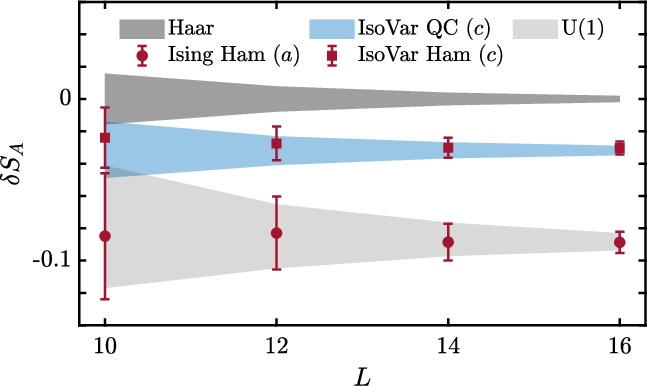
Figure 4: Finite-size scaling of late-time EE under SU(2)-symmetric Hamiltonian dynamics for different initial variance specifications.
Sampling Statistics and Preparation Algorithms
The generation of random product initial states with prescribed mean and variance is nontrivial. The paper provides a practical sampling algorithm that iteratively projects trial product states onto the allowed set with target spin variances and zero total magnetization.
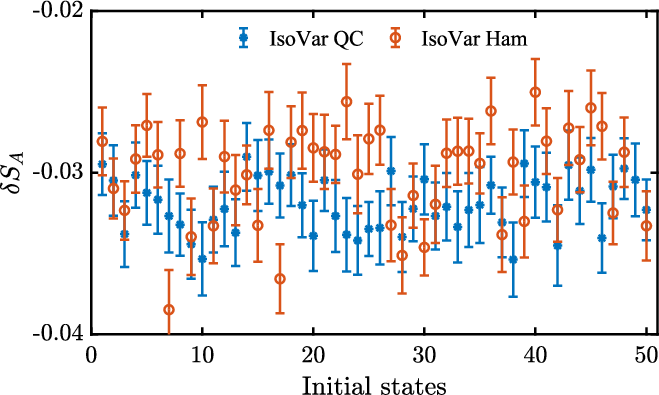
Figure 5: Statistical fluctuations in the entanglement entropy of multiple initial product states, comparing time and sample mean variances.
The algorithm's statistical properties and the comparability of sampling versus temporal averaging are elucidated (Figure 5).
Theoretical and Practical Implications
The findings establish that, in quantum systems with non-Abelian symmetries, Hilbert space exploration at the level of accessible statistical moments is ultimately delimited not by symmetry constraints alone but by initialization protocols. Practically, this means that experiments starting from product states—even with maximally chaotic dynamics—cannot realize the full spectrum of randomness and entropy predicted absent these initialization restrictions. Theoretical extensions, such as to lattice gauge symmetries or spatially local constraints, are natural and motivated by experimental feasibility.
The work also highlights the challenge of reaching Haar-random statistics using only state evolution, even with local entanglement added during initialization; naively pairing spins into singlets increases, rather than lowers, the entropic correction relative to Haar.
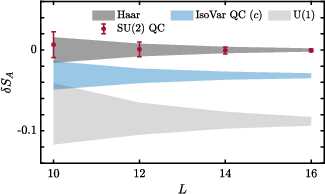
Figure 6: Finite-size scaling of EE distribution for the constrained ensemble of states with strict zero magnetization and matched variances, demonstrating exponential closeness to Haar at operationally finite moments.
Conclusion
This paper demonstrates that non-Abelian symmetry constraints, when combined with realistic (unentangled) quantum state preparation protocols, generically obstruct Haar-randomization in quantum many-body systems, resulting in persistent entropic signatures even in the thermodynamic chaotic regime. The analytic machinery developed allows precise quantification of this obstruction, and the results are extensively validated via numerical simulation in both random circuits and Hamiltonian evolutions. The implications are direct for experimental quantum simulators and motivate future work on the role of alternative constraints, improved initialization strategies, and the scaling of equilibration times under symmetry-driven dynamics.

