- The paper introduces the inert doublet dark matter model as a minimal, technically natural framework that explains the Galactic halo gamma-ray excess.
- It employs gauge-mediated annihilation with inelastic scattering to reconcile direct-detection limits with the observed gamma-ray signals.
- The model predicts dark matter masses of 400–800 GeV with a ~150 keV mass splitting, offering precise testable signals in collider and astrophysical experiments.
Electroweak Doublet Dark Matter and the Galactic Halo Gamma-Ray Excess
Introduction
This work systematically investigates the viability of minimal electroweak doublet dark matter (DM), with Higgs-portal interactions, as an explanation for the gamma-ray excess in the Galactic halo peaking at ∼20 GeV, compatible with DM annihilation masses in the $400$–$800$ GeV range. The proposed scenario satisfies the requirements of a thermal relic, renormalizable field content, and consistency with both direct and indirect experimental constraints, while remaining minimal and highly predictive.
Phenomenological Motivation: Fits to Heavy Final States
The recently observed Galactic halo gamma-ray excess can be fit by DM annihilation into not only bbˉ and W+W−, but also heavier SM states such as ttˉ, hh, and ZZ within DM masses $400$–$800$ GeV. The best-fit annihilation cross section hovers near the canonical thermal relic value, although mildly larger values (by one or two orders of magnitude) are permitted if significant astrophysical boost factors are invoked.
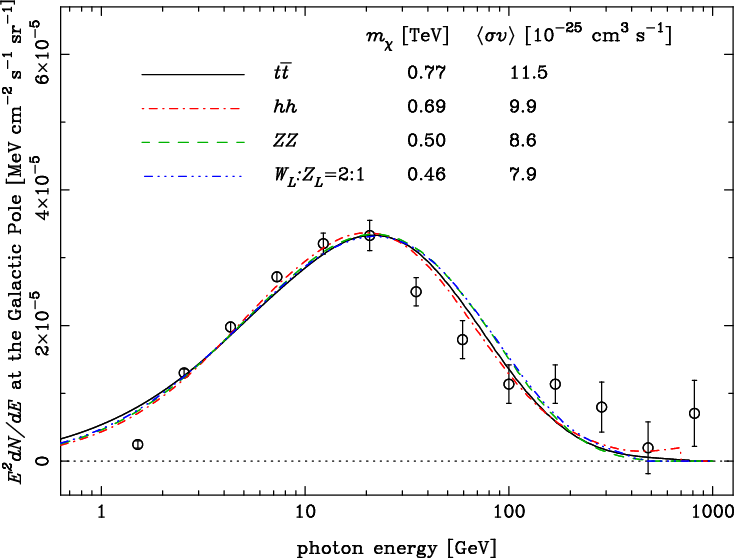
Figure 1: Representative fits to the Galactic halo excess for different SM final states highlight the flexibility and commonality across $400$0, $400$1, $400$2, and longitudinal electroweak gauge boson channels.
This observation imposes constraints on the nature of viable DM candidates. Models in which annihilation into a single SM channel dominates, such as simple Higgs-portal scenarios, generally cannot achieve the observed signal without overproducing direct-detection signals. Conversely, scenarios predicting a specific mixture of heavy SM final states—driven by either gauge or Higgs interactions—are favored.
Minimal gauge extensions with an $400$3 triplet ("wino") or doublet ("higgsino") DM typically exhibit thermal masses near $400$4–$400$5 TeV, exceeding the favored mass window for the observed excess. These scenarios are therefore disfavored without additional ingredients.
Singlet Scalar Higgs-Portal Dark Matter
A minimal Higgs-portal scenario involving a real scalar singlet $400$6 is excluded in the relevant mass range, as the required Higgs-mediated coupling to achieve the desired relic abundance produces elastic scattering rates with nuclei far above direct-detection bounds. The situation is unchanged for a complex scalar singlet. The branching ratios in the heavy-mass regime correctly predict dominant annihilation into $400$7, $400$8, and $400$9 with ratios $800$0, but these scenarios are experimentally untenable due to direct-detection constraints.
Electroweak Doublet (‘Inert Doublet’) Dark Matter
An SU(2)$800$1 doublet scalar, stabilized by a $800$2 symmetry, provides an economical and viable alternative. The DM candidate is the lightest neutral component of the doublet $800$3. Annihilation to $800$4 and $800$5 proceeds with relative strengths $800$6, predominantly set by gauge interactions. Relic density is naturally achieved for $800$7–$800$8 GeV doublet masses, comfortably within the signal region.
Critically, this scenario predicts the DM to be inelastic, with two nearly degenerate neutral states split by $800$9 set by the bbˉ0 parameter in the scalar potential. Direct-detection limits are evaded for bbˉ1 keV, for which elastic bbˉ2-mediated scattering is kinematically forbidden. This technical naturalness for small bbˉ3 is protected by an enhanced global symmetry for bbˉ4.
Due to the interplay of suppressed Higgs-portal couplings (as required by direct-detection null results) and dominant gauge-mediated annihilation, the inert doublet model in this regime is theoretically minimal, highly predictive, and consistent with current bounds. The inferred values for bbˉ5, mass, and the required small bbˉ6 are aligned with recent direct-detection anomalies indicating an inelastic signature with a splitting bbˉ7 keV and bbˉ8 GeV.
Indirect Detection Cross Section and Sommerfeld Enhancement
The best-fit indirect-detection cross section is bbˉ9 cmW+W−0/s, exceeding the naïve thermal value by W+W−1. This motivates consideration of nontrivial present-day enhancements, such as Sommerfeld enhancement via the exchange of a new scalar W+W−2. The requisite enhancement is achieved for a coupling W+W−3 and light mediator masses W+W−4 MeV, such that enhancement is efficient in the Galactic halo (velocity W+W−5), but can be suppressed in dSphs (smaller W+W−6 and larger W+W−7), thereby avoiding tension with their gamma-ray limits.
The scalar W+W−8 may be incorporated with negligible impact on direct detection, relic abundance, or collider signatures, provided its mixing with the SM Higgs is sufficiently small. Alternative mechanisms for late-time enhancement (e.g., near-resonant s-channel or W+W−9-wave Sommerfeld) are also mentioned, with associated model-building challenges (e.g., collisionless constraints, direct-detection bounds).
Theoretical and Experimental Implications
The inert doublet scenario situates thermal DM at the confluence of indirect-detection (gamma-ray observations), direct-detection (inelastic signals), and collider searches. Present LHC and LEP limits are weak for inert doublet masses ttˉ0 with small mass splittings. Predicted signals at future lepton colliders running at ttˉ1 provide a sharp test of the model via direct production.
The theoretically minimal, renormalizable, and technically natural construction—together with correlated signals in multiple experimental fronts—places electroweak doublet DM in a privileged position for falsification as data improves.
Conclusion
The electroweak inert doublet model with suppressed Higgs-portal coupling and inelastic neutral states robustly explains the Galactic halo gamma-ray excess for DM masses ttˉ2–ttˉ3 GeV. It simultaneously accounts for inelastic direct-detection anomalies and avoids experimental bounds. Sommerfeld enhancement via a light scalar can bridge discrepancies in annihilation cross sections, with model parameters set to simultaneously evade dSph constraints.
This framework maintains consistency with all current data and provides concrete, testable predictions for future indirect, direct, and collider probes. Ongoing and planned experiments will either discover or robustly exclude this minimal WIMP scenario.