- The paper introduces Sing-HiResNet, a joint fullband-subband model that captures global and localized spectral features from high-resolution 44.1 kHz audio for advanced SingFake detection.
- It employs a dual-track architecture with a fullband model and multiple subband experts, using fusion strategies like cross-expert distillation to enhance discrimination.
- Experimental results on the WildSVDD dataset demonstrate significant EER improvements, validating the method's robustness across domain and language shifts.
Joint Fullband-Subband Modeling for High-Resolution SingFake Detection: An Expert Analysis
Motivation and Problem Setting
The proliferation of advanced singing voice synthesis techniques (notably VISinger and DiffSinger) has heightened risks associated with unauthorized vocal imitation. Standard detection systems for singing voice deepfakes (SingFake Detection, or SVDD) predominantly inherit methodologies from speech spoofing frameworks, mostly operating on 16 kHz audio. This restricts their spectral coverage to below 8 kHz and systematically omits higher-frequency information crucial in professional singing, where harmonic complexity and nuanced breath textures can extend across the full audible spectrum.
Existing SVDD detectors, therefore, lose vital discriminative cues embedded in the high-frequency domain. The paper presents the first systematic investigation into leveraging high-resolution audio (44.1 kHz sampling rate) for SVDD, aiming to capture both global spectral structure and localized subband artifacts. The authors introduce Sing-HiResNet, a joint fullband-subband modeling framework, and empirically demonstrate that high-frequency subbands deliver essential complementary cues relative to traditional low-resolution approaches.
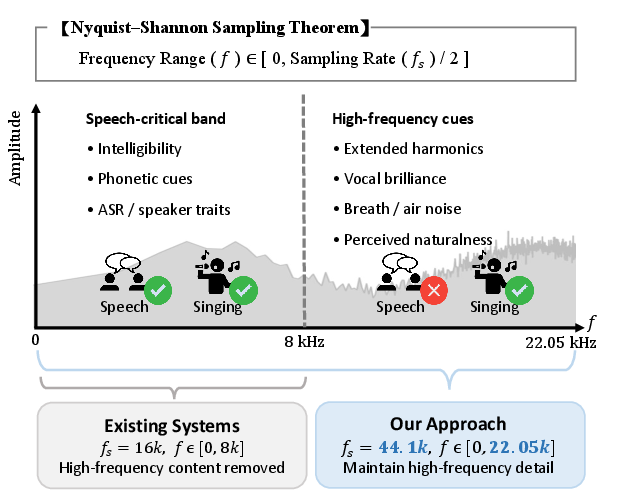
Figure 1: Expanded spectral coverage of 44.1 kHz audio compared to 16 kHz, illustrating preservation of harmonics and breath textures necessary for detection of sophisticated singing forgeries.
Sing-HiResNet Framework: Architecture and Methodology
Sing-HiResNet is structured in two primary phases:
- Expert Model Construction: A dual track backbone assembles a fullband model (capturing broad spectral dependencies) and multiple subband experts (focused on frequency-localized artifact isolation). Subband partitioning divides the full 22.05 kHz Nyquist bandwidth into N∈{1,2,4,8} uniform, non-overlapping bands, each routed to an independent ResNet18-based expert.
- Fusion Strategies: Multi-scale feature integration leverages one of four strategies: (i) decision-level unweighted aggregation, (ii) feature-level concatenation via MLP, (iii) cross-expert interaction using Multi-Head Self-Attention (MHSA), and (iv) cross-expert knowledge distillation, aligning a fullband student to specialized subband teachers through both logit- and feature-level objectives.
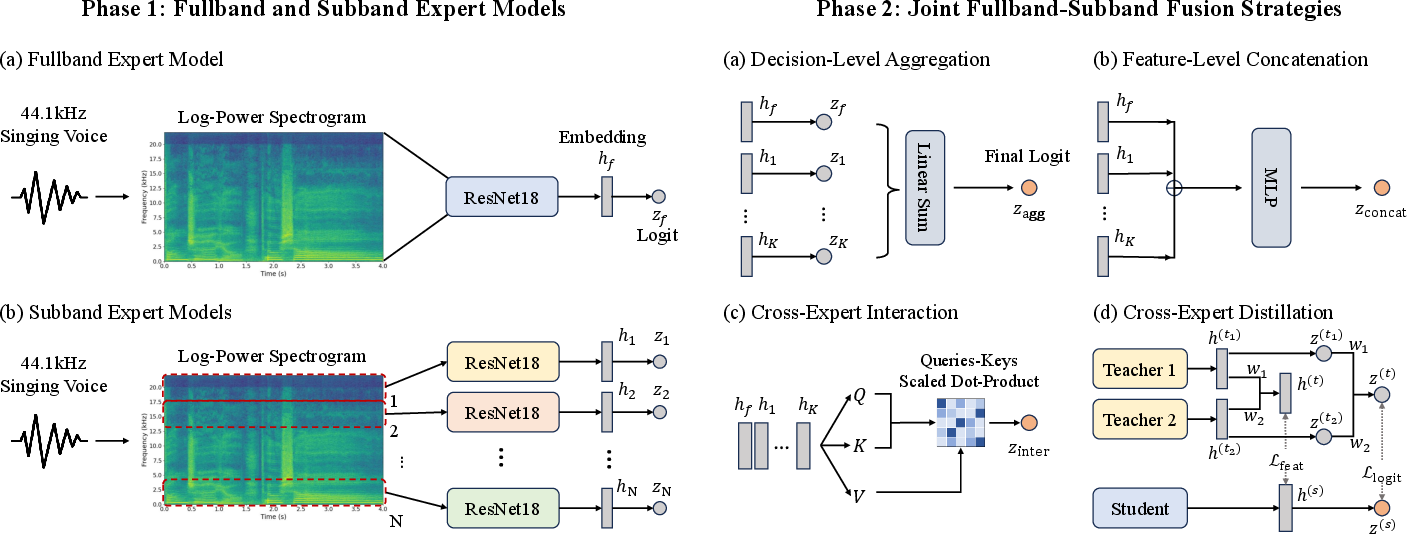
Figure 2: High-level schematic of Sing-HiResNet, depicting fullband/subband expert models and subsequent fusion phase.
Empirical Analysis: Subband Contributions and Fusion Effects
Subband Modeling Insights
Comprehensive experiments on the WildSVDD dataset reveal that artifacts are highly non-uniformly distributed across the spectrum. Fullband models generalize best, but subbands covering 0–11 kHz and 11–16.5 kHz offer significant discriminative power, especially for out-of-domain sample detection. Excessively granular partitioning (N=8) leads to loss of feature sufficiency and degraded generalization, underscoring a necessary balance between artifact isolation and contextual information.
Evaluation of Fusion Strategies
Decision-level aggregation and cross-expert distillation outperform MLP-based concatenation and MHSA interaction in terms of equal error rate (EER). Aggregation excels by merging independent logits, while distillation efficiently transfers spectral specificity from subband teachers to a compact fullband student. Notably, including high-frequency experts (SBH covering 11–22.05 kHz) does not yield incremental gains, suggesting generative artifacts outside audible ranges lack consistent forensic signatures and are obfuscated by stochastic noise.
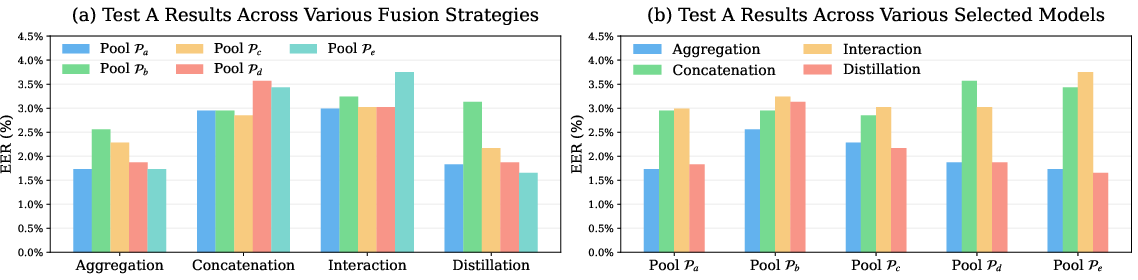
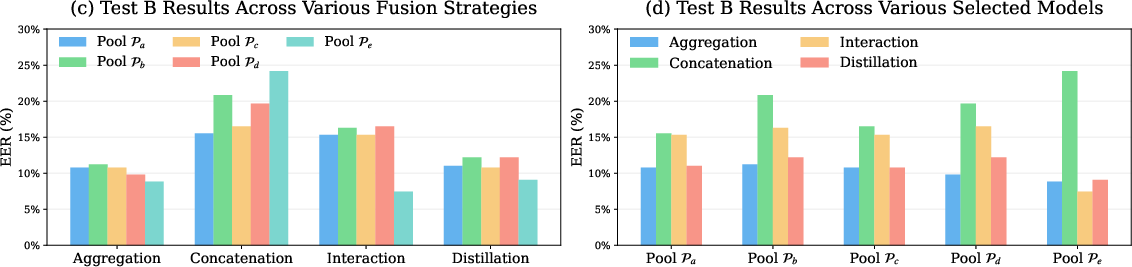
Figure 3: EER results across model pools and fusion mechanisms, highlighting frequency impact and integration strategy effectiveness.
Distillation Analysis and Model Interpretability
Grad-CAM visualizations illustrate effective knowledge transfer: post-distillation, the fullband student shifts its attention to subband regions prioritized by specialized teachers. Single-teacher distillation targets low-frequency cues, while dual-teacher distillation broadens focus to include mid-high artifacts, facilitating improved classification of challenging bonafide and deepfake cases.
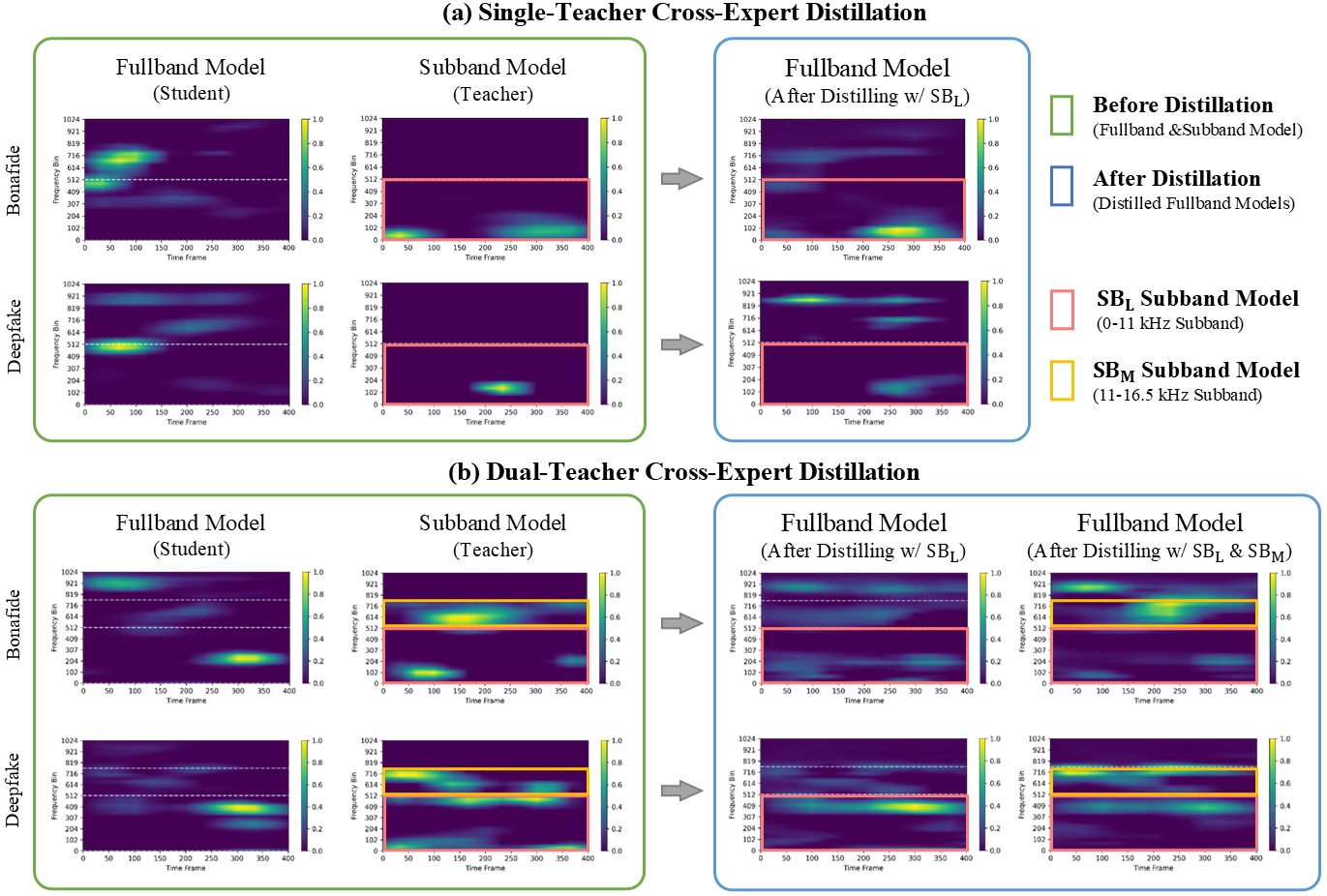
Figure 4: Grad-CAM heatmaps demonstrating attention realignment after distillation, with clear spectral focus matching teacher guidance.
Benchmarking and Numerical Results
Sing-HiResNet variants exhibit state-of-the-art EERs on WildSVDD, outperforming baseline 44.1 kHz fullband-only models (UNIBS) and large-scale SSL-based backbones operating at 16 kHz. The best fullband–subband fusion model (FB_FSA-D-LM) achieves an EER of 1.58% on Test A and 8.77% on Test B, representing relative reductions of 31.6% and 30.9%, respectively, compared to the strongest baseline. These results are robust across domain and language shifts, establishing high-resolution, joint modeling as a practical necessity.
Theoretical and Practical Implications
This work formally establishes that high-resolution spectral coverage and multi-scale expert modeling are essential for effective singing voice deepfake detection. Subband-aware distillation enables model compression without sacrificing frequency locality, facilitating efficient deployment in large-scale forensic pipelines. The results challenge the prevailing assumption that SSL pretraining alone is sufficient for SVDD: explicit spectral structure preservation and strategic fusion materially improve robustness, especially on unconstrained and cross-lingual samples.
Future developments may focus on further optimizing model pools for domain adaptation, dynamic subband partitioning based on input content, and extending distillation frameworks to more complex, multimodal forensic analyses where visual or textual cues complement spectral evidence.
Conclusion
This paper delivers a rigorous, systematic analysis of joint fullband-subband modeling for high-resolution SingFake detection. By leveraging 44.1 kHz audio inputs, Sing-HiResNet captures both global and frequency-localized artifacts. Empirical and qualitative results demonstrate superior performance relative to baselines, motivating adoption of multi-scale spectral modeling and distillation in practical singing voice forensics. The findings lay theoretical groundwork for future SVDD research and inform the design of forensic tools resistant to increasingly sophisticated synthetic vocal forgeries.