- The paper establishes that instanton-induced interactions produce a strong attractive force in the scalar channel, resulting in a uniquely compact glueball as confirmed by lattice QCD.
- It employs a constituent gluon model featuring adjoint Coulomb interactions, screened confinement, and relativistic corrections via Schrödinger and Bethe–Salpeter equations.
- The work maps lattice QCD findings to nonperturbative QCD parameters, revealing Regge behavior and clarifying mass hierarchies across glueball channels.
Constituent Gluons and Instanton Effects in Glueball Structure and Spectroscopy
Introduction
The study "Glueballs, Constituent Gluons and Instantons" (2604.04803) provides an in-depth analysis of glueballs in pure Yang--Mills theory, focusing on their internal structure and mass spectra through a constituent gluon framework supplemented by nonperturbative instanton effects. The work systematically connects analytic and numerical approaches, notably Schrödinger and Bethe–Salpeter equations, to lattice QCD results and incorporates instanton-induced dynamical gluon masses, adjoint confining potentials, and short-distance central and tensor forces.
Central to the investigation is the channel-selective role of instanton-induced interactions in glueball formation, the identification of parameter regimes capturing lattice-observed compactness of scalar glueballs, and an analytic description of Regge behavior and mass hierarchies.
Nonperturbative Interactions and Instanton Effects
Instanton contributions are shown to induce channel-specific nonperturbative forces. The early work of Schäfer and Shuryak established that in the instanton liquid model (ILM), instantons generate a strong attractive interaction in the scalar (0++) glueball channel and a repulsive one in the pseudoscalar (0−+) channel, while the tensor channel (2++) remains largely unaffected. This leads to a notable prediction: the scalar glueball is spatially compact, with a root-mean-square (rms) radius consistent with the average instanton size, ρ∼0.2−0.3fm, while the tensor glueball is more spatially extended.
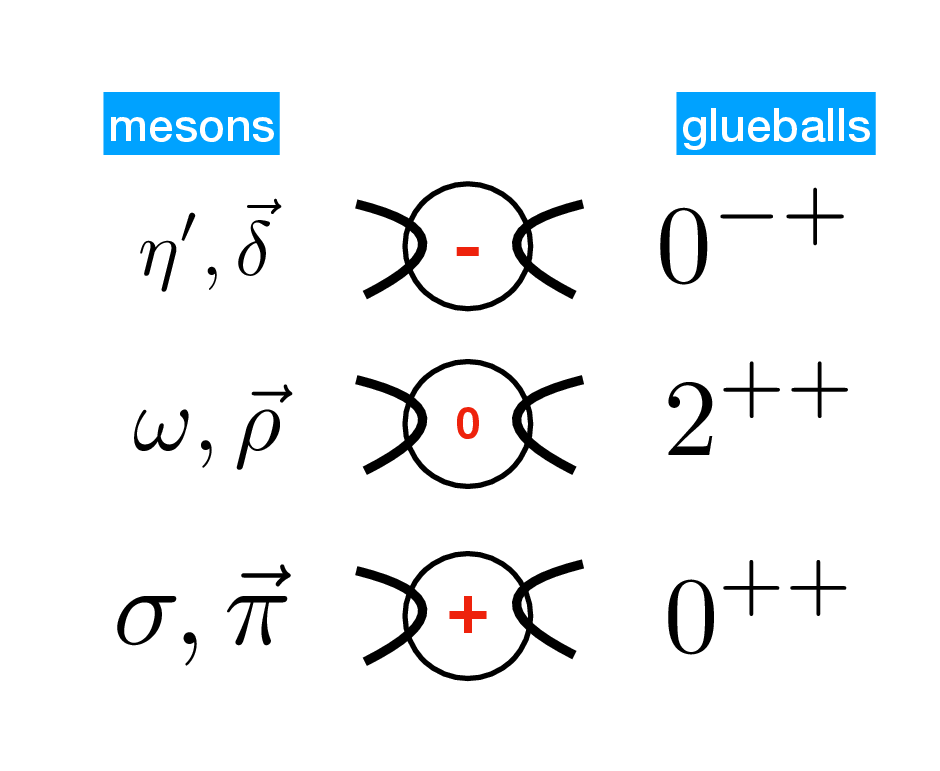
Figure 1: Repulsive, neutral and attractive channels induced by instanton-induced effects in Euclidean correlation functions, for mesons and glueballs.
The corresponding correlation functions calculated in the ILM sharply display these channel dependencies and serve as input for parameter fits and phenomenological modeling.
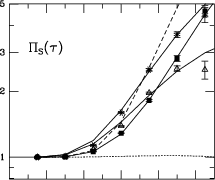
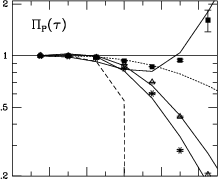
Figure 2: Scalar G2 and pseudoscalar GG~ gluonic correlation functions normalized to the corresponding free correlators as functions of the Euclidean time separation.
Constituent Gluon Hamiltonian and Model Construction
The backbone of the work is a constituent two-gluon Hamiltonian including:
- Adjoint Coulomb interaction: Enhanced by a factor of $9/4$ over the fundamental color representation.
- Screened adjoint confinement: Governed by Casimir scaling, with numerical implementations ensuring no artificial bound-state destabilization.
- Instanton-induced short-range forces: Modeled as Gaussian attractions (for the scalar channel), with strengths and ranges set by the instanton size and density.
- Spin-spin and tensor interactions: Incorporating both instanton and perturbative contributions.
The effective constituent gluon mass is dynamically generated, with values mg∼0.9 GeV required to reproduce higher-J state spectra, a parameter regime intermediate between strange and charm quark masses, and obtained self-consistently from the dense instanton ensemble scaling.
Glueball Spectroscopy: Schrödinger and Bethe–Salpeter Results
Bulk Spectroscopy and Regge Structure
The spectrum of "normal" (C=+, 0−+0) glueball states is obtained using the nonrelativistic Hamiltonian, with radial and orbital excitations mapping accurately onto lattice spectra for all but the lowest 0−+1 state. The Schrödinger equation, using parameters fixed from lattice results for higher radial excitations (0−+2), yields both masses and radii in qualitative and quantitative agreement with lattice results.
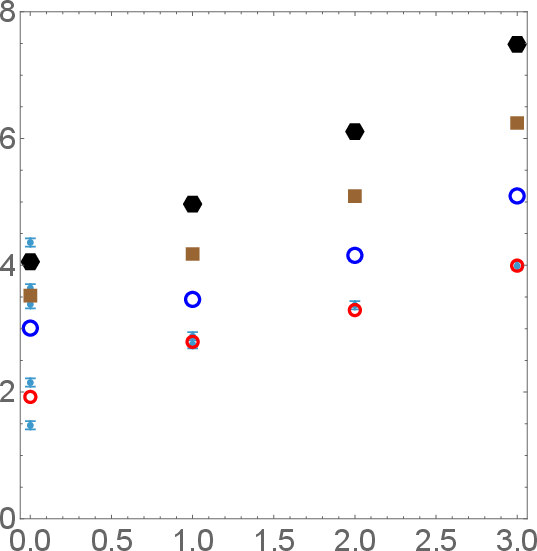
Figure 4: Calculated energies 0−+3 (GeV) of the four lowest 0−+4 glueball states compared to lattice values.
Wave function analysis confirms that the ground scalar state is significantly more compact than its radial excitations or tensor partners.
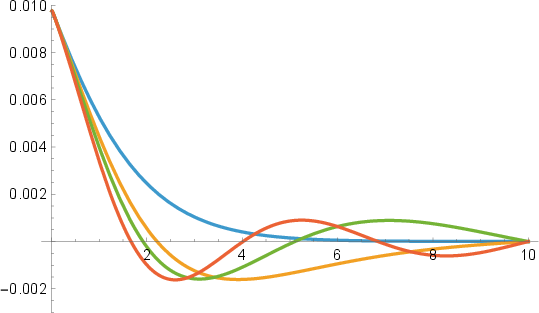
Figure 6: Wave functions 0−+5 for 0−+6 as functions of 0−+7 (0−+8), highlighting the compactness of the lowest 0−+9 state.
Exceptional Channels: Compact Scalar Glueball from Instanton-Induced Binding
For the lowest scalar glueball, the nonrelativistic approach fails to account for both the observed compactness and the low mass. The relativistic reduction of the Bethe–Salpeter equation with a rigorous instanton-induced separable interaction is constructed. This approach yields a compact 2++0 glueball with a mass below the constituent two-gluon threshold and an rms radius of 2++1, in line with lattice determinations.
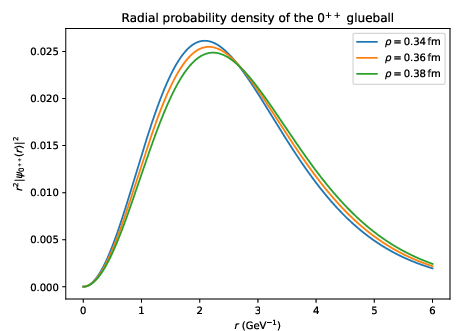
Figure 3: 2++2 glueball radial probability distribution 2++3 for various instanton sizes 2++4.
The tensor glueball, in contrast, is not affected by the instanton interaction at leading order due to symmetry constraints and centrifugal suppression. S-D mixing (between 2++5 and 2++6) further disperses the wave function, increasing its spatial extent relative to the scalar state.
Systematics Across the Spectrum
The calculated glueball spectrum, including higher-spin and pseudoscalar states, reproduces the main features seen in lattice QCD, particularly the Regge-like organization for 2++7. The pseudoscalar 2++8 sector displays larger deviations, attributed to complications in the treatment of short-distance dynamics and the sign structure of instanton contributions.
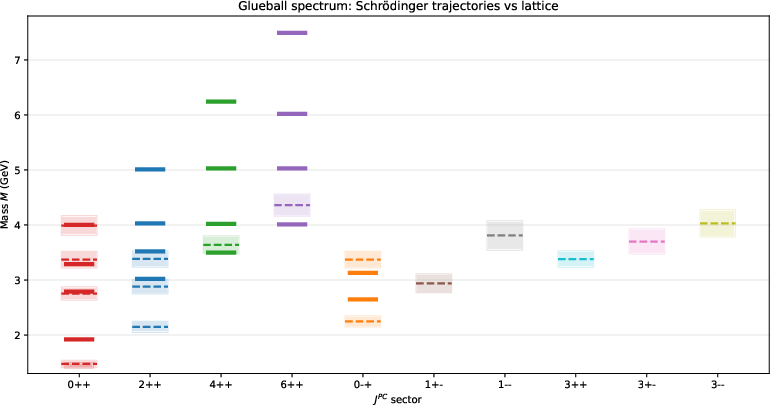
Figure 5: Glueball mass spectrum organized by 2++9, comparing Hamiltonian predictions to quenched SU(3) lattice results.
Confinement Potential: Adjoint Versus Fundamental
Monte Carlo simulation of static potentials using Wilson loops in both fundamental and adjoint representations confirms the expected ρ∼0.2−0.3fm0 scaling and the realistic saturation behavior of the potential at large ρ∼0.2−0.3fm1.
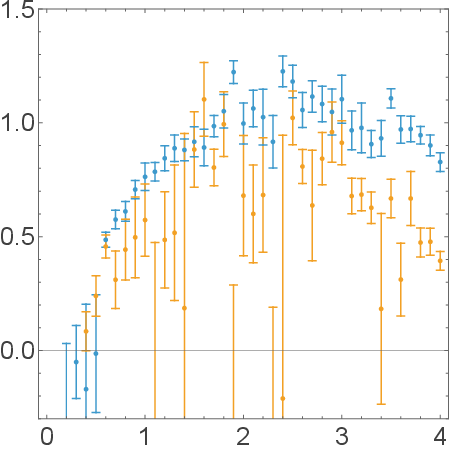
Figure 7: Static potentials ρ∼0.2−0.3fm2 for fundamental and adjoint sources, highlighting Casimir scaling and screening behavior.
Symmetry and Selection Rules: Absence of Vector Glueball States
The Landau–Yang selection rule enforces the absence of vector glueballs (ρ∼0.2−0.3fm3) in the leading two-gluon sector, consistent with lattice spectra. Channels with ρ∼0.2−0.3fm4 and low ρ∼0.2−0.3fm5 are either absent or only present as multi-gluon configurations.
Theoretical and Practical Implications
This analysis offers a rigorous constituent-gluon underpinning for glueball spectroscopy:
- Channel-dependent instanton effects: Only the parity-even scalar receives a strong instanton-induced attraction, explaining its unique compact structure. Other channels are organized primarily by confining and centrifugal dynamics.
- Parameter mapping to QCD vacuum structure: The value of the constituent gluon mass, effective adjoint string tension, and instanton parameters are directly linked to those inferred from lattice calculations and phenomenology, providing a minimal and physically motivated model.
- Regge behavior: The semiclassical (WKB) treatment relates masses and level spacings, reproducing the observed quasi-linear trajectories for tensor and higher-spin glueballs.
Future Directions
The constituent framework, incorporating instanton-induced binding, can be extended in several directions:
- Calculation of glueball form factors (including gravitational and electromagnetic) to compare more finely with lattice results.
- Generalization to full QCD (inclusion of light quarks and mixing with quarkonia).
- Light-front formulation for accessing partonic structure and distribution amplitudes relevant for high energy processes.
- Investigation of multi-gluon hybrid states and glueball-quarkonium mixing.
Conclusion
This work demonstrates that glueball spectroscopy, as observed in lattice Yang--Mills theory, is captured quantitatively and systematically within a constituent gluon Hamiltonian including screened adjoint confinement, strong channel-dependent instanton attraction, and relativistic corrections in the scalar sector. The findings reinforce the interpretation of the scalar glueball as uniquely compact and instanton-bound, with all other channels governed primarily by confining and centrifugal physics. This framework establishes a direct quantitative bridge between lattice QCD, nonperturbative modeling, and potential phenomenological applications.