- The paper presents empirically derived guidelines for effective game-based refresher training of CHWs in low-resource contexts.
- It utilizes design-based research with mixed-method synthesis to integrate diverse game modalities and ensure contextual realism and adaptive feedback.
- The study emphasizes ethical transparency, hybrid physical–digital interactions, and tailored motivational mechanisms to sustain CHW engagement.
Introduction
The paper "Design Guidelines for Game-Based Refresher Training of Community Health Workers in Low-Resource Contexts" (2604.04671) synthesizes findings from a four-year design-based research program on serious games for Community Health Workers (CHWs) in India. The authors conduct a mixed-methods synthesis—integrating results from diverse deployments, including quiz apps, physical and AR games, card-based and location-based games—engaging ASHAs and Anganwadi Workers. The work systematically abstracts generalizable design guidelines relevant for HCI4D, digital health, and serious games research, emphasizing the situated, socio-technical, and ethical dimensions required for the effective and sustainable deployment of game-based training systems for CHWs in resource-constrained environments.
Methodological Approach
The research leverages design-based research (DBR) for longitudinal and iterative co-design, deployment, and evaluation cycles across different game modalities. This approach supports the accumulation of both practice-based and theoretical insights, bridging contextual challenges that emerge from the field with broader principles. Data from 80 CHWs over multiple years was triangulated across interviews, field observations, and system logs. The use of grounded theory-driven thematic analysis enabled the synthesis of cross-cutting themes, with rigorous researcher and data triangulation, negative case analysis, and member checking to enhance theoretical robustness and transferability.
Synthesis of Design Guidelines
Eight empirically derived design guidelines articulate how game-based refresher training should be constructed for CHWs:
- Prioritize Contextual Realism over Abstract Correctness: Simulation and scenario-based gameplay resonating with CHWs' real counseling contexts significantly improved perceived value and transfer.
- Support Progressive Complexity with Adaptive Feedback: Incremental onboarding and dynamic adjustment to user proficiency minimized intimidation, supported learning, and sustained engagement.
- Employ Hybrid Physical–Digital Interaction: Blending physical artifacts (cards, boards) with digital technologies during group work augmented legibility, trust, and facilitated peer learning.
- Leverage Location Awareness for Salience and Accountability: Geographically situated tasks bridge the game with daily work routines, reinforcing applicability and purpose.
- Foster Social Motivation without Surveillance: Cooperative over competitive mechanics reduced anxiety and negative affect around social comparison and punitive performance ranking.
- Establish Explainability over Opaque Automation: CHWs sought rationale for game feedback, especially in judgment-based scenarios, reinforcing trust and enabling justification to stakeholders.
- Preserve Professional Identity: Aesthetic and reward structures must respect the seriousness of medical work and occupational identity, avoiding excessive trivialization.
- Adopt Ethical Sensitivity in Data Collection: Transparency regarding data use, clear boundaries between participation and formal evaluation, and voluntary engagement were critical to counteract perceptions of surveillance and maintain trust.
These guidelines encapsulate the balance needed between playfulness, professional legitimacy, sociality, and ethical accountability.
Theoretical Positioning and Conceptual Framework
The paper situates its findings within literature on situated learning, SDT, professional identity, explainable systems, and ethics in digital health. It expands on situated learning theory, noting that realism must encompass not only technical fidelity but also socio-cultural and resource-bound realities—a point often under-addressed in serious games for health. The analysis complicates the notion that gamification universally enhances motivation; competitive elements were found to be detrimental for frontline professionalized worker cadres in contexts with complex social dynamics.
Explainability and ethical transparency—topics of ascending importance with the rise of interactive and AI-augmented health systems—emerge as indispensable, even when AI is not directly deployed. The interplay between learning, interaction, and ethical-professional layers is illustrated in the paper's conceptual framework, which is presented as follows:
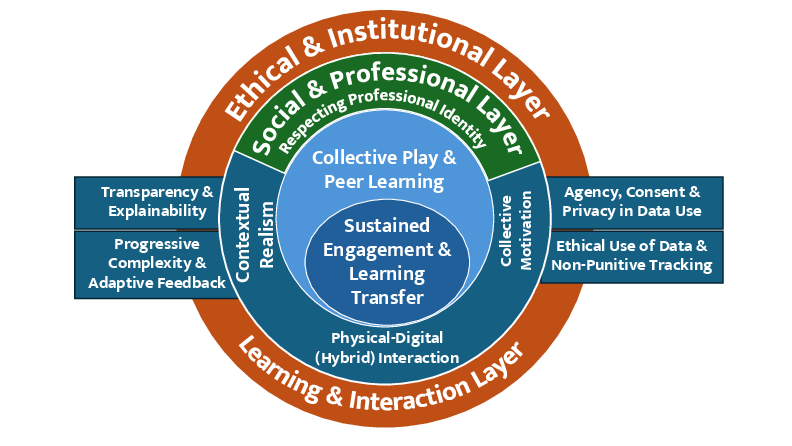
Figure 1: Conceptual framework delineating learning (contextual realism, progressive complexity, explainability), interaction (hybrid, location, cooperative), and ethical-professional (identity, surveillance) layers for game-based CHW training.
Field Implications
Practically, these guidelines shift the development paradigm from standalone prototypes to sustained, field-aligned interventions. They demand hybrid deployment models capable of functioning under infrastructural and cultural constraints, transparency protocols for data and algorithm use, and participatory design structures that augment, rather than compromise, CHW dignity and agency.
Rigorous evidence is provided that competitive features such as leaderboards are misaligned with the professional culture, a finding that contradicts a persistent trope of gamification research in other application domains. Hybrid interaction and location awareness were confirmed to enhance accountability and relevance, supporting both intrinsic and community-oriented motivation in a manner distinct from more individual-centric digital learning modalities.
Limitations and Directions for Future Work
Although multi-site and longitudinal, the investigation is bounded by its Indian focus and duration of deployments. Generalizability to other LMICs and to long-term clinical or health outcome measures, as opposed to adoption and engagement, remains to be demonstrated empirically. Further, integration with state-run and large-scale digital health infrastructure, as well as the scaling of participatory co-governance and transparency practices regarding the use of personal and geolocated data, is essential to address in future research.
Emerging AI techniques—especially those related to adaptive personalization and explainability—will require careful contextualization and participatory calibration if introduced. This extends not only to user-facing guidance but also system designers and policy stakeholders.
Conclusion
The work delivers theoretically and empirically robust design guidelines for serious games targeting community-based health workers in low-resource settings. By integrating contextual realism, progressive learning, hybrid embodiment, and ethical stewardship, the resulting conceptual framework advances both HCI4D and digital health discourse. The study reinforces the need for participatory, context-grounded, and ethics-oriented approaches in the design and evaluation of serious games for professional cohorts, with implications for ongoing and future interactive health interventions in both Global South and broader international domains (2604.04671).