- The paper demonstrates that localized spin-flip and dispersive magnon modes coexist in La₄Ni₃O₁₀ using high-resolution RIXS and theoretical modeling.
- It quantifies exchange interactions (SJ₁=12 meV, SJ₂=8 meV, SJ⊥=20 meV), underscoring the transition to 3D magnetic dynamics over bilayer systems.
- The study reveals suppressed magnetic spectral weight in trilayer nickelates, emphasizing its relevance for spin-mediated superconductivity.
Collective Spin Excitations in Trilayer Nickelate La4Ni3O10
Introduction
The paper "Collective spin excitations in trilayer nickelate La4Ni3O10" (2604.04643) presents a comprehensive Ni L-edge RIXS investigation into the magnetic excitation spectrum of bulk La4Ni3O10, a member of the Ruddlesden-Popper (RP) nickelate family. The study critically addresses the persistence and character of spin correlations in trilayer nickelates and their contrast with bilayer analogs, scrutinizing their implications for unconventional superconductivity. Through combined high-resolution spectroscopy and theoretical modeling, the authors dissect the interplay between dimensionality, electronic correlations, multiorbital effects, and low-energy magnetic dynamics.
Electronic Structure and Low-Energy Excitations
The characterization starts with oxygen 30-edge and Ni 31-edge XAS, establishing strong hybridization between O 232 and Ni 333 orbitals and the presence of substantial ligand hole character in La34Ni35O36, consistent with the extended multiband character of RP nickelates.
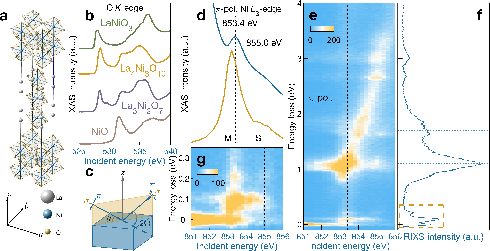
Figure 1: Crystal structure, comparative XAS of La37Ni38O39 (10), La100Ni101O102 (7), NiO, and LaNiO103, and RIXS energy dependence at the Ni 104-edge, highlighting the resonance conditions and incident energy selection.
The fine structure around the Ni 105-edge enables selective enhancement of both 106 and low-energy spin excitations in the RIXS response. The main resonance corresponds to 107 transitions, with a significant satellite at higher energy reflecting less efficient core-hole screening. The robust pre-edge features and comparison among reference systems confirm the importance of ligand holes and substantial three-dimensional and multiorbital character.
Magnetic Excitation Spectrum: Dispersion and Localization
Detailed momentum-resolved RIXS at low energies reveals several distinct excitation features. The excitations at ~100 meV and ~200 meV are sharp, resolution-limited, and momentum-independent, with polarization analysis indicating their predominant magnetic origin. In contrast, a weaker mode at ~60 meV shows clear dispersion, especially along high-symmetry directions in reciprocal space.
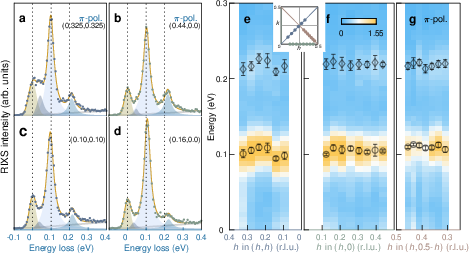
Figure 2: Representative RIXS spectra deconvolved into elastic, magnetic, and high-energy contributions; momentum-mapped RIXS intensity with the assignment of in-plane tracks and low-temperature data acquisition.
The dispersionless excitations are understood as localized single-ion spin-flip processes, whereas the 60 meV excitation is assigned to collective magnon modes associated with the incommensurate SDW order observed in previous neutron studies.
Polarimetric RIXS and Theoretical Modeling
Polarimetric selection rules confirm the magnetic nature of the low-energy excitations. Exact diagonalization (ED) simulations of a high-spin 108 configuration under an effective exchange field of 109 meV successfully reproduce both the energies and selection rules of the localized excitations, supporting the single-ion interpretation.
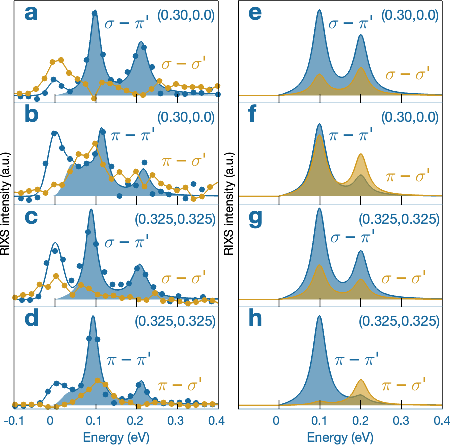
Figure 3: Polarimetric RIXS of La40Ni41O42, showing decomposed 43- and 44-channels, and ED-based calculation of spin excitation spectra capturing experimental features with lifetime broadening.
The collective mode's dispersion is quantitatively captured using linear spin wave theory (LSWT) for a Heisenberg Hamiltonian including two distinct in-plane and one interlayer exchange interactions. The exchange constants 45 meV, 46 meV, and 47 meV describe a quasi-3D magnetically ordered state with the interlayer coupling being the dominant exchange. This three-dimensionality contrasts the more two-dimensional bilayer compounds.
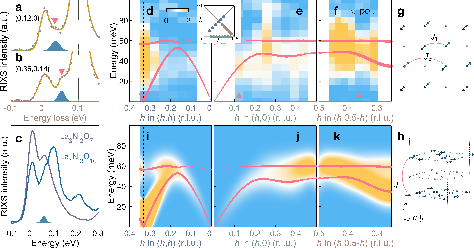
Figure 4: Momentum dependence and dispersion of low-energy RIXS intensity, spectral weight comparison between La48Ni49O30 and La31Ni32O33, and depiction of the adopted magnetic structure for LSWT.
Comparative Analysis and Implications
The bandwidth (~60 meV) of collective excitations in La34Ni35O36 is comparable to that of La37Ni38O39; however, the spectral weight is nearly an order of magnitude lower, consistent with reduced correlation strength and an itinerant SDW ground state induced by Fermi surface nesting. The lower 100 in trilayer nickelates correlates with this diminished interlayer exchange and suppressed magnetic spectral weight, reinforcing the spin-mediated pairing hypothesis for unconventional superconductivity in RP nickelates.
The coexistence of localized and dispersive spin excitations underscores complex interplay between orbital selective correlation effects and nesting-driven itinerancy. ARPES studies referenced by the authors corroborate the electronic signatures of SDW formation and substantial three-dimensionality, emphasizing that increasing 101 in RP structures shifts the balance from two-dimensional Mott physics toward strongly hybridized three-dimensional metallicity with itinerant magnetism.
Future Outlook
The data and analysis advocate for treating trilayer and higher-nickelate compounds as intrinsically three-dimensional systems with essential multi-orbital and itinerant features. Future investigations should integrate RIXS, ARPES, and neutron scattering with advanced models incorporating both quasi-local and itinerant magnetism, and explore doping and pressure tuning. The results suggest that variations in dimensionality and correlation strength, more so than strict analogy to cuprates, will be decisive in defining the pairing mechanism and the ultimate 102 in RP nickelate superconductors.
Conclusion
This study demonstrates that La103Ni104O105 realizes a unique regime in the RP nickelates, where three-dimensionality and multiorbital physics manifest in both the collective and local spin excitation spectrum. The experimentally established suppression of magnetic spectral weight and enhanced three-dimensional exchange highlight essential differences with the bilayer analogs and emphasize the need for a broader theoretical framework for nickelate superconductivity. These findings provide critical constraints for future modeling of high-temperature superconductivity beyond the cuprate paradigm.