- The paper introduces a novel method replacing intractable nonlinear compositions with conic-representable convex approximations.
- It formulates three convex reformulations (inverse, root, logarithm probit) to jointly optimize risk allocation and feedback control.
- Empirical evaluations on stochastic path planning show faster solve times and reduced conservatism compared to conventional exhaustive search.
Disjunctive Convex Chance-Constrained SMPC via Online Risk Allocation and Feedback Gain Selection
This paper addresses a prominent issue in stochastic model predictive control (SMPC): the simultaneous optimization over risk allocations and feedback policies under joint chance-constraints. The compositional nonconvexity, primarily arising from products between risk allocation variables and feedback gains embedded in Gaussian quantile (probit) functions, renders the exact finite-horizon stochastic OCP intractable. Existing approaches either fix risk allocations a priori—inducing conservatism—or use bi-level optimization without optimality guarantees.
The authors propose replacing the intractable nonlinear composition by three alternative disjunctive convex reformulations using conic representable (power and exponential) approximations, thus recasting the SMPC as a mixed-integer conic optimization problem. The approach generalizes to chance constraints involving products of exclusive disjunctive (binary selection) and Gaussian random variables, extending the class of tractable robust and stochastic controllers for constrained systems.
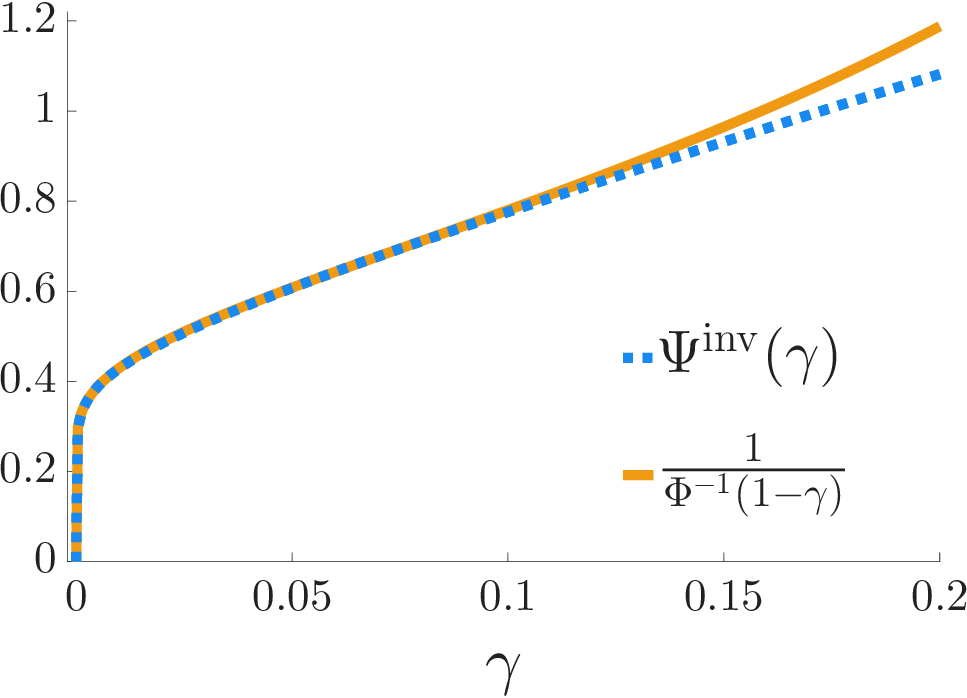
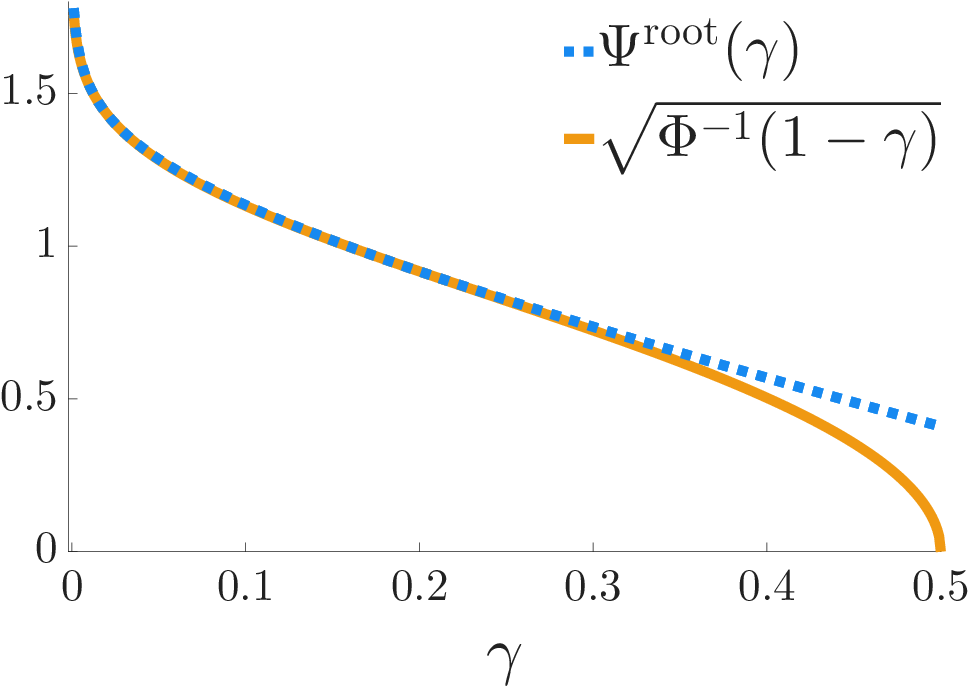
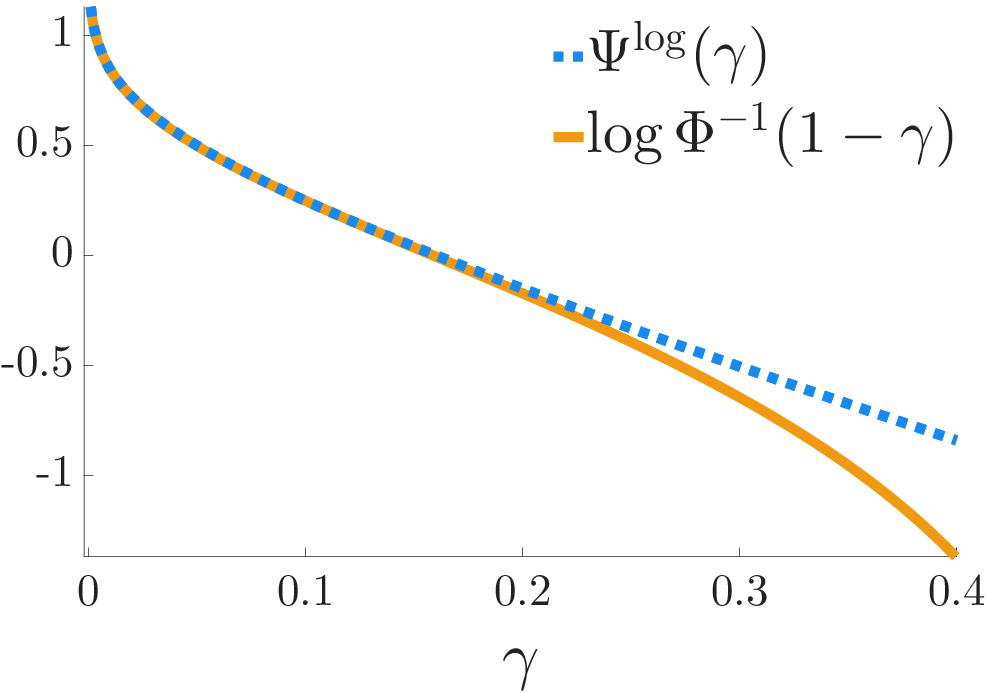
Figure 1: The curves of the nonconvex function compositions resulting from the proposed convex reformulations, alongside their power/exponential-cone based convex approximations.
System Model and Affine Disturbance Feedback
The system follows a standard discrete-time linear stochastic process:
xi+1=Axi+Bui+Gωi
with i.i.d. Gaussian disturbances. The control action utilizes affine disturbance feedback policies, parameterized as ui=j=0∑i−1Mi,jωj+vi, providing causal, convex parameterization of policy space.
Traditional robust (min-max) and tube-based RMPC methods are eschewed due to inherent conservatism and poor utilization of disturbance statistics. Chance constraints permit explicit probabilistic guarantees of constraint satisfaction, achieving a key robustness-performance tradeoff.
Convexification of Nonconvex Chance Constraints
After decomposing joint chance constraints via Boole's inequality, the main challenge is joint (online) optimization of feedback and risk allocations. The deterministic reformulation yields terms of the form
fℓ(V)+∥cℓ(M)∥Φ−1(1−γℓ)≤0
where both M (controller selection) and γℓ (risk allocation) are decision variables. Their product, embedded in the nonconvex, non-elementary probit function, precludes direct convex optimization.
Disjunctive Controller Selection
To circumvent this, a finite set of feedback laws {Lk} is precomputed, and the online optimization selects among them via binary indicators δk with ∑kδk=1. The resulting deterministic chance constraint,
k∑δkrkΦ−1(1−γ)≤−f(V),
is still nonconvex due to the composite structure.
The core technical contribution consists of three mathematical formulations replacing the intractable compositions by conic-representable constraints, leveraging properties of disjunctive indicator variables.
- Inverse Probit Approach: Reformulates the constraint to t≤Ψinv(γ) as a rotated second-order cone, with ui=j=0∑i−1Mi,jωj+vi0 a power-cone-based conservative lower approximation for ui=j=0∑i−1Mi,jωj+vi1.
- Root Probit Approach: Utilizes ui=j=0∑i−1Mi,jωj+vi2 linked to the upper power-cone representable convexification ui=j=0∑i−1Mi,jωj+vi3.
- Logarithm Probit Approach: Uses an exponential-cone-relaxation, invoking an upper bound ui=j=0∑i−1Mi,jωj+vi4 and modeling the constraint using auxiliary variables and exponential cones.
Each approach produces a continuous convex relaxation compatible with modern conic mixed-integer solvers (MOSEK, SCS, ECOS). The power and exponential cones cover a broad functional class (including the essential inverse, root, and logarithm of the probit). Parameterizations for all conic approximations are empirically optimized via least-squares fitting.
The proposed methods are benchmarked in a chance-constrained path-planning SMPC case study, with and without obstacle avoidance, under additive Gaussian disturbances. The feasible set is specified by stay-in (ui=j=0∑i−1Mi,jωj+vi5) and stay-out (ui=j=0∑i−1Mi,jωj+vi6) polyhedral regions. Binary variables select a feedback law at each instant; the optimization jointly selects risk allocations for each stage and region constraint.
Monte Carlo simulation results demonstrate the probabilistic envelopes of the predicted state trajectories under both best-case and worst-case controller selections.
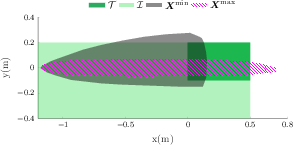
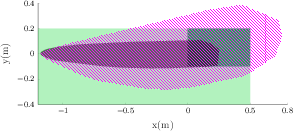
Figure 2: 1000 Monte Carlo simulations of the state predictions at the first sampling instant, using best and worst feasible controller selections, showing prediction envelopes.
For the case without obstacles:

Figure 3: 100 Monte Carlo simulations (Case 1, no obstacles); the vehicle reliably navigates inside ui=j=0∑i−1Mi,jωj+vi7 toward the target ui=j=0∑i−1Mi,jωj+vi8, avoiding the region boundaries.
In the presence of obstacles, tuned risk weights directly impact the conservativeness of resulting trajectories:

Figure 4: 100 Monte Carlo simulations (Case 2, with obstacles); lower weights on risk allocation yield less conservative trajectories, higher weights induce wider margins from boundaries/obstacles.
The impact on computational tractability is pronounced: compared to exhaustive search over feedback selections, all three conic relaxations yield significant reductions in solve time per sampling instant, visible especially in the presence of additional disjunctive (obstacle avoidance) constraints.
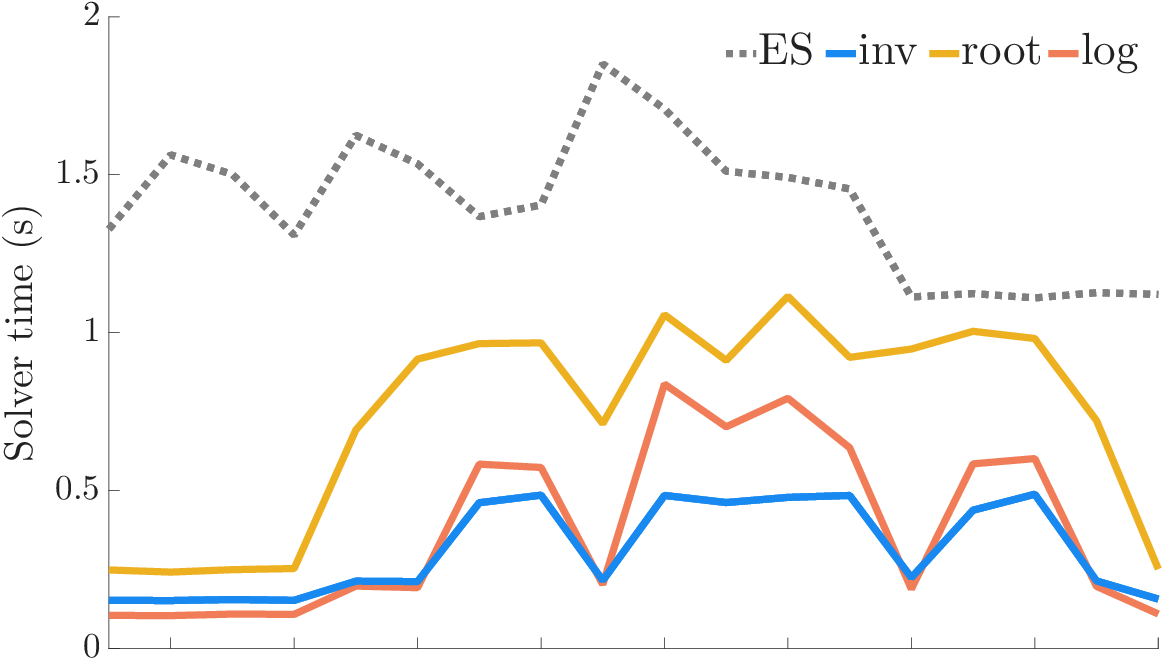
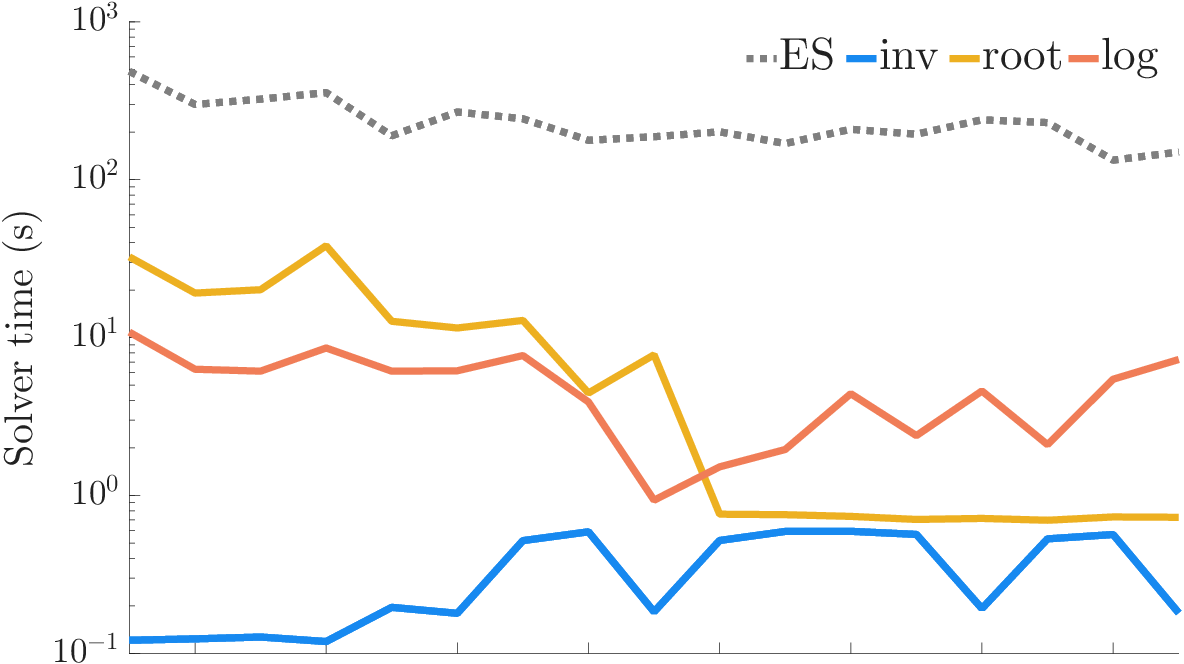
Figure 5: Solution times per sampling instant for all approaches; conic methods (inverse/root/logarithmic probit) are consistently faster than exhaustive search, especially as complexity grows (logarithmic scale).
Implications, Limitations, and Future Directions
The presented framework offers a tractable route for SMPC design with online risk allocation and feedback selection, via mixed-integer conic programming. This expands the feasible set of directly optimizable control policies and risk distributions, bridging the gap between conservative robust MPC and nonconvex bi-level (risk allocation + feedback) SMPC. The explicit use of power and exponential cones in modeling and approximation provides a new pathway for broader classes of nonconvex, non-elementary constraint representations.
Limitations include the restriction to mutually exclusive binary selection (finite law switching), and the need for conic representable approximations to degrade gracefully for high-risk constraints (e.g., as ui=j=0∑i−1Mi,jωj+vi9). Recursive feasibility is not addressed, and extension beyond Gaussian disturbances is left for future work.
The presented methodology suggests several research avenues: extending the approach to Gaussian mixture models, multi-agent and distributed settings, adaptive feedback law set generation, and integration with scenario-based or sample-based SMPC approximations. Further improvement of the power/exponential-cone convexification for broader risk intervals and reduction of conservativeness are critical for practical large-scale deployment.
Conclusion
The methods proposed in this paper yield tractable convex reformulations of SMPC under simultaneous feedback selection and online risk allocation, returning the solution as a mixed-integer conic program. Empirical validation on stochastic path-planning underscores both the performance and computational advantages over exhaustive or classical two-stage methods. This approach enlarges the space of tractable chance-constrained control problems, facilitating more efficient and less conservative use of feedback in uncertain constrained environments (2604.04602).

