- The paper introduces a one-step framework that replaces iterative inference with a direct average velocity estimation using a semantic anchor prior.
- It employs a two-stage process combining manifold construction and a single-step transition, achieving superior Hit Rate and NDCG scores.
- The approach significantly reduces computational cost while maintaining high recommendation diversity and robustness in sequential recommendation.
Flow-based Average Velocity Establishment for One-Step Sequential Recommendation
Introduction and Context
The paper "FAVE: Flow-based Average Velocity Establishment for Sequential Recommendation" (2604.04427) introduces Fave, a generative sequential recommender system leveraging advances in flow matching to address the core inefficiency of prevailing "Noise-to-Data" generative models. The motivation stems from challenges encountered with diffusion-based and flow-based recommendation frameworks: prior mismatch—where inference starts from an uninformative distribution—and linear redundancy, which causes unnecessary computation due to deterministic, repeated iterative steps. The proposed method shifts from typical iterative paradigms to a one-step, direct mapping from user history to future preference, employing an average velocity field learned atop a semantically anchored informative prior.
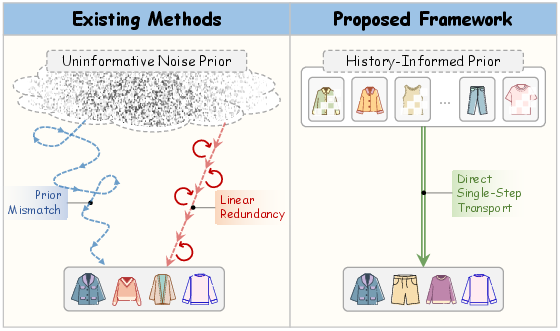
Figure 1: Existing "Noise-to-Data" paradigms (left) suffer from prior mismatch and linear redundancy; Fave (right) addresses these by trajectory transport from a semantic anchor prior.
Methodology
Fave incorporates a two-stage strategy that first establishes a stable latent preference manifold and then compresses the generative trajectory into a single, linear jump driven by a global average velocity under a semantically meaningful prior.
Stage 1: Manifold Construction
The model begins by projecting user histories and targets into a continuous embedding space. It introduces dual-end semantic alignment: constraints are applied on both the source (user history) and target (next item), stabilizing the representation and mitigating risks of embedding collapse. The model applies a dual-time representation to explicitly encode trajectory state (interpolating between start and endpoint) and employs stochastic modulation to avoid overfitting. Training is framed as denoising regression, estimating the target state directly and enforcing alignment through recovery, target cross-entropy, and source reconstruction losses.
Stage 2: Single-Step Consolidation
The second stage is critical, introducing two major innovations:
- Semantic Anchor Prior: Instead of initializing flow matching from noise (as in diffusion and prior flow-matching models), Fave initializes from a masked, perturbed embedding sampled from user history. This prior is shown to be structurally closer to the data manifold, effectively reducing trajectory distance and improving efficiency.
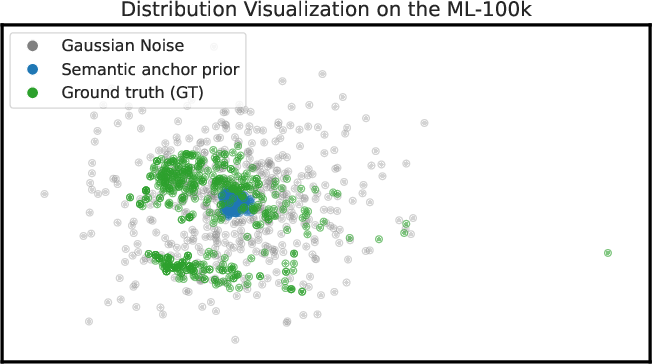
Figure 2: The proposed semantic anchor prior exhibits substantial overlap with ground-truth item embeddings, contrasting with the diffuse Gaussian noise distribution.
- Global Average Velocity and Consistency: The iterative flow matching ODE trajectory is condensed into a single transition by directly modeling the average velocity between the semantic anchor and the target. The Jacobian-vector product (JVP) regularization minimizes flow curvature, enforcing straightness for robust one-step inference.
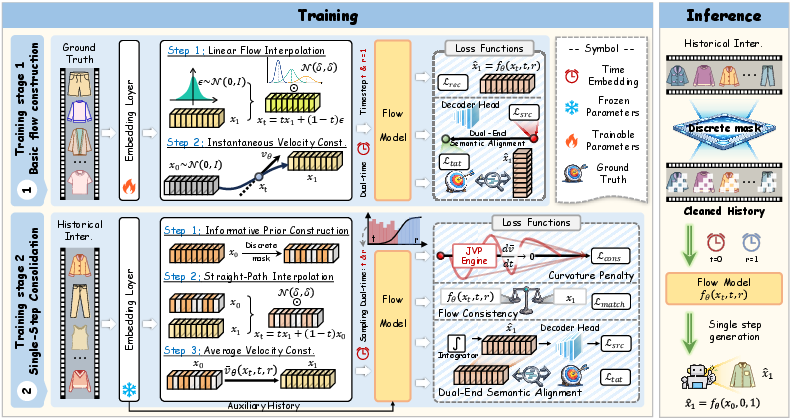
Figure 3: Fave adopts a two-stage process: Stage 1 learns the manifold from Gaussian noise; Stage 2 incorporates the semantic anchor prior and average velocity for direct, one-step inference.
Experimental Results
Experiments span three benchmarks—ML-100k, Amazon-Beauty, and Steam—comparing Fave to RNN/CNN, Transformer, and recent generative (diffusion/flow) baselines. Evaluation metrics include Hit Rate (H@K), NDCG, and efficiency measures (FLOPs, latency).
Key findings include:
- Superiority in Recommendation Accuracy: Fave achieves the highest scores across all datasets and metrics, demonstrating statistically significant improvements over the strongest baseline (FMRec), with +9.90% NDCG@20 and +7.48% H@20 on ML-100k.
- Efficiency: Fave reduces computational cost by over an order of magnitude compared to diffusion- and flow-based competitors, a consequence of direct, single-step generation without iterative ODE solving.
- Ablations: Most performance degradation is seen when the semantic anchor prior or the trajectory matching objective is ablated, validating their necessity.
- Inference Trajectory Visualization: Fave's one-step trajectory lands near or on the true target embedding, while FMRec's multi-step paths show significant and unstable deviations.
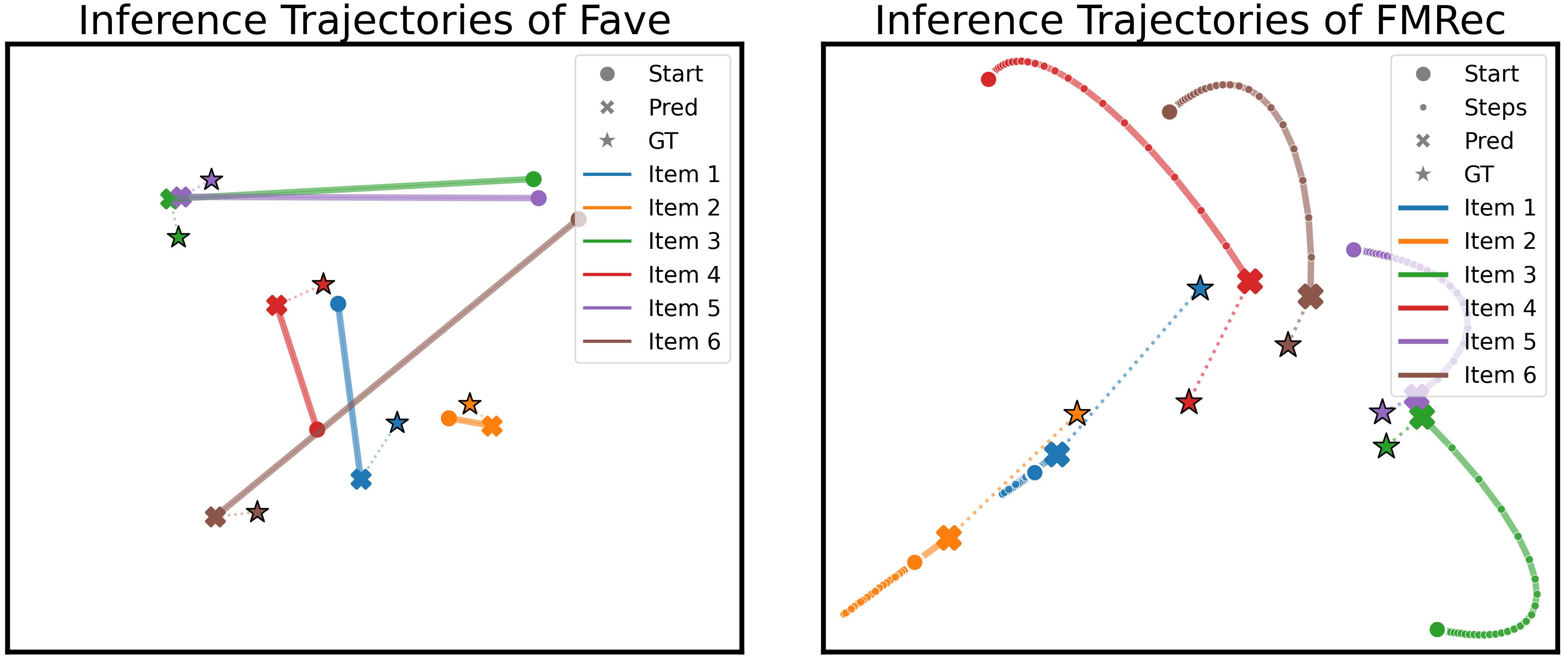
Figure 4: Fave (left) produces direct, stable, and target-adjacent inference trajectories, while FMRec (right) paths are more circuitous and variable.
- Initialization Analysis: Visualizing the distributions, the semantic anchor prior clusters tightly and overlaps with user-intent clusters, in contrast to widespread noise initialization.
- Diversity: Fave maintains high intra-list recommendation diversity, outperforming other flow-based models and avoiding mode collapse—the model's deterministic trajectory does not degenerate into trivial point estimations.
- Hyperparameter Robustness: The effectiveness of components Ltgt, Lsrc, Lcons, and the prior mask retention parameter is empirically corroborated.
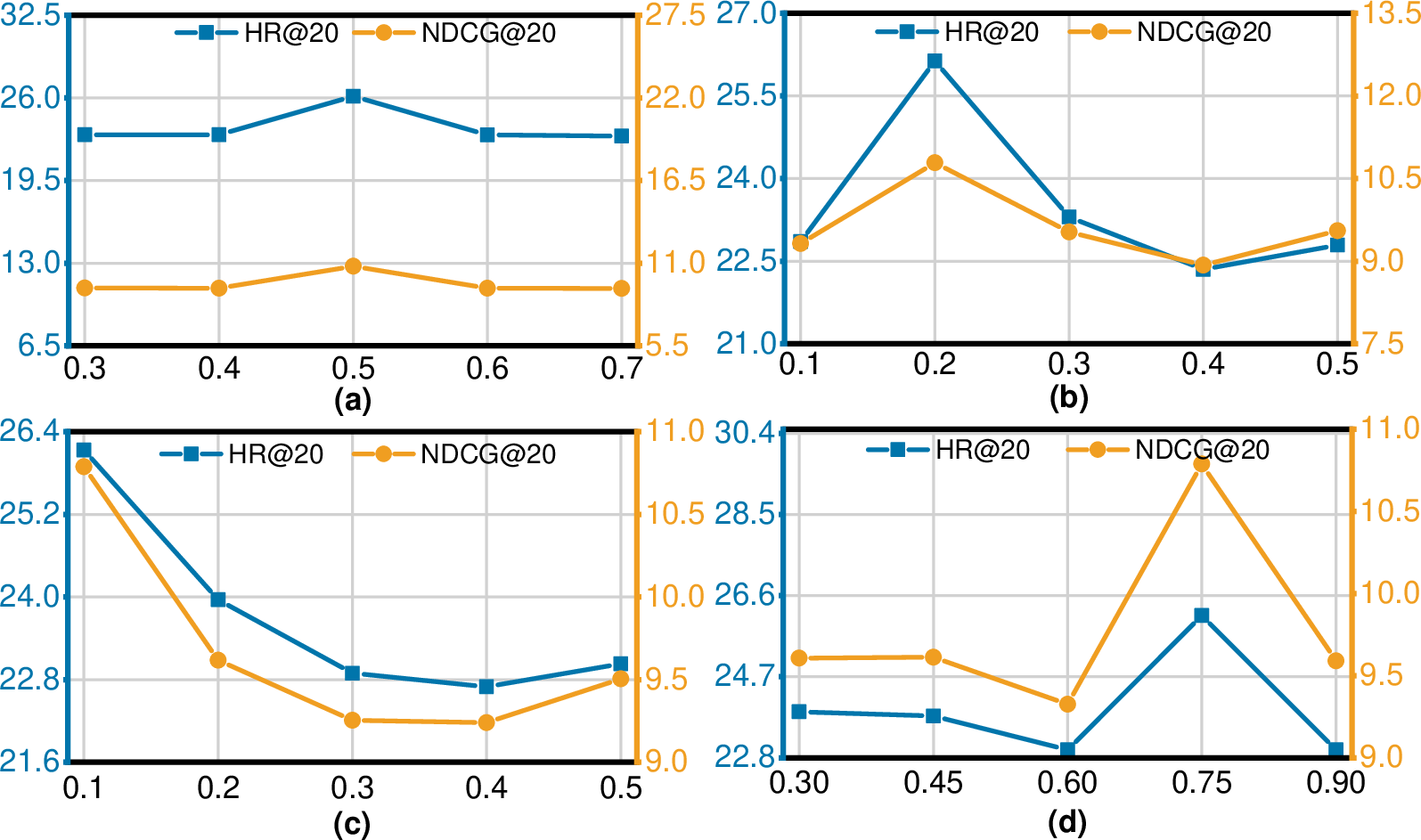
Figure 5: Model performance as a function of major hyperparameters, underscoring key regularization and masking trade-offs.
Implications
From a practical perspective, Fave bridges state-of-the-art generative modeling with the latency constraints of real-world recommender systems, demonstrating that one-step, semantically initialized generation is not only feasible but outperforms iterative paradigms on both accuracy and speed. Theoretically, the approach reframes sequential recommendation as a flow matching problem solved via displacement estimation under informative priors, which could generalize to other structured prediction and sequence transduction domains.
The deployment of a semantic anchor prior suggests a broader research direction: leveraging contextually derived priors (versus generic noise) in generative modeling to enhance efficiency and alignment with target distributions. The success of the Jacobian-projected straightness regularization indicates the potential for further exploration of curvature and higher-order consistency constraints for fast generative modeling.
Conclusion
Fave introduces a direct, flow-based, one-step generative sequential recommendation framework that replaces both the uninformative starting distribution and iterative inference with a global, semantically informed update. This leads to strong, consistent outperformance of previous baselines in both accuracy and inference efficiency, confirming the viability and promise of average-velocity-based modeling for sequential recommendation. The implications for both research and deployment in real-world RSs are immediate, with potential for broader adoption in other generative tasks.

