- The paper presents a novel variance reduction estimator that improves Monte Carlo efficiency by tailoring importance sampling and control variates to Dirichlet expectations.
- The paper develops a boundary-aware Laplace approximation to accurately capture asymptotic error when the mode lies on the simplex boundary.
- The paper validates its methods on synthetic LDA and Reuters-21578, demonstrating orders of magnitude variance reduction over traditional Monte Carlo approaches.
Variance Reduction for Dirichlet Expectations: Theory and Algorithms
Problem Setting and Motivation
The paper "Variance Reduction Methods for Dirichlet Expectations" (2604.04181) investigates Monte Carlo (MC) estimators for expectations of the form Eθ∼Dirα[exp(nH(θ))], where θ lies in the probability simplex, H is a smooth real-valued function, and n is a (large) scale parameter. This expectation is fundamental to Bayesian inference for categorical data, with applications such as model evidence evaluation in Latent Dirichlet Allocation (LDA). A critical setting arises when n is large—reflecting, for instance, evaluation on long documents—where standard MC estimators become inefficient due to exploding variance.
The authors present theoretically grounded variance reduction methods—an importance sampling (IS) algorithm and a control variate (CV) approach—explicitly tailored for the exponential family structure of the Dirichlet and the asymptotic regime of large n. The central technical tool is an extended Laplace approximation on the simplex, which enables precise asymptotic error analysis, especially in cases where the mode of H lies on the boundary of the simplex.
Laplace Method for Dirichlet Expectations
Standard Laplace approximation applies to integrals of the form
I(n)=∫Ff(x)exp(nh(x))dx
when the maximizer x∗ is an interior point. However, for Dirichlet expectations, the maximizer θ∗ frequently lies on a boundary face (i.e., some entries are zero), and the Dirichlet density itself is singular or vanishing near the boundary.
The authors develop a Laplace method applicable to this setting. The key result provides asymptotics of the form
θ0
where θ1 is the number of zero components of θ2 and θ3 are the corresponding Dirichlet parameters. The polynomial term explicitly captures how both the boundary geometry and the prior impact the integral—contrasting with classic BIC-style results in Bayesian model selection, where such dependence on the prior disappears in the leading order.
This analytic expansion is crucial for understanding (1) the severe loss of efficiency for plain MC at large θ4, (2) the precise effect of sparsity in θ5, and (3) the design of asymptotically optimal variance reduction schemes.
Importance Sampling for Dirichlet Integrals
The paper constructs an IS estimator based on proposing from a Dirichlet distribution parameterized as θ6. Here, θ7 is a scaling parameter controlling the concentration of the proposal distribution near the mode θ8. The IS ratio inherently involves a Kullback-Leibler divergence term in the exponent.
A central theoretical result is that for θ9, the IS estimator achieves mean squared error reduction: H0
and that the estimator’s relative error approaches a constant as H1. The variance reduction is controlled by the balance between the polynomial improvement obtained by concentrating samples near the support of the integrand, and the risk of increased variance from the likelihood ratio if the proposal concentrates too quickly (i.e., as H2).
The analysis rigorously treats estimator bias induced by the necessary truncation of the Dirichlet support to avoid singularities—proving that such bias is exponentially negligible in H3 compared to the variance.
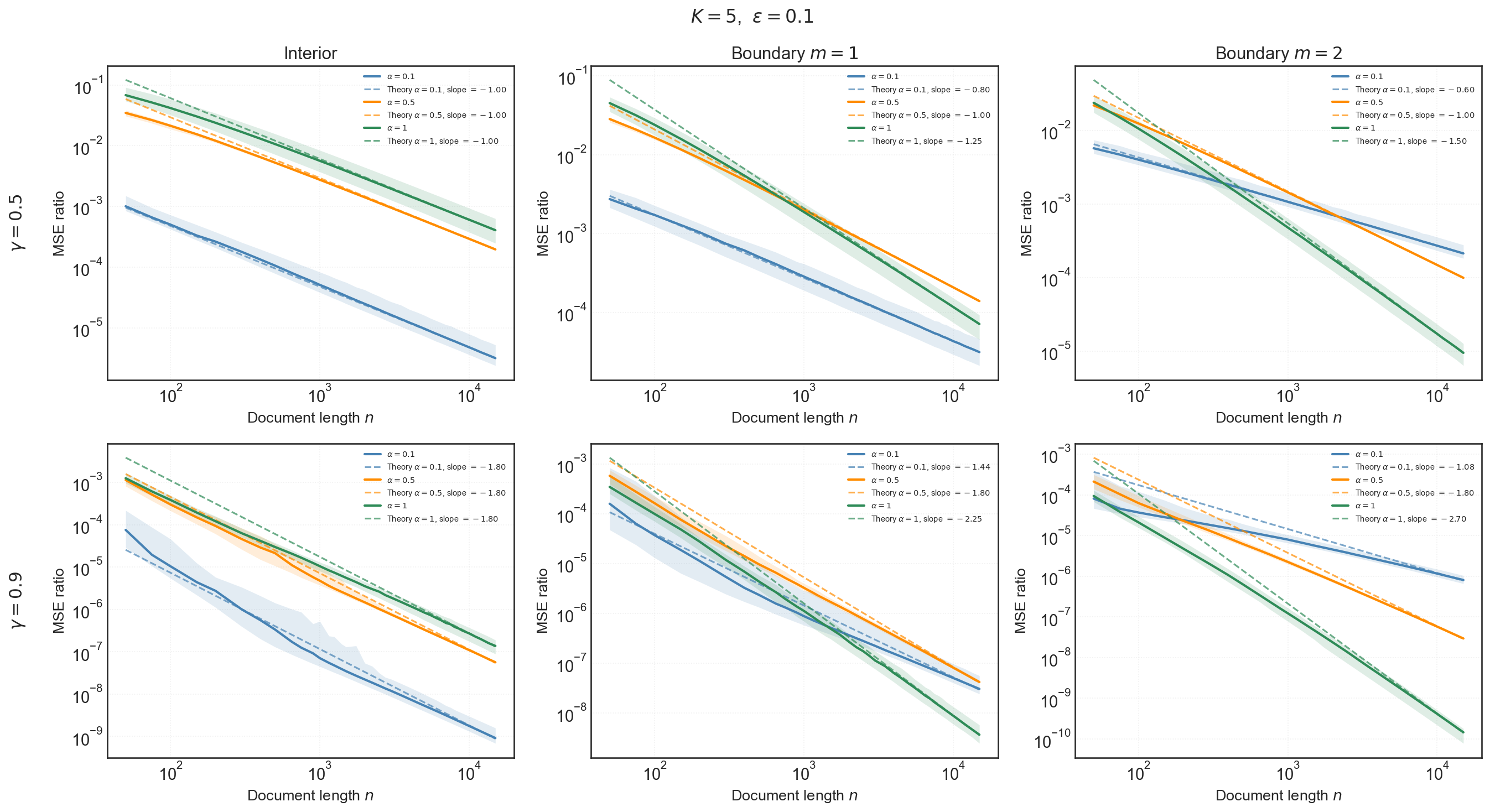
Figure 1: Log-log plot of MSE reduction for IS versus MC in synthetic LDA settings, illustrating strong agreement with theoretical rates across settings with varying boundary sparsity.
Control Variate Construction and Analysis
Leveraging the analytic form of the IS estimator, the paper identifies a natural CV: H4
The expectation H5 admits a closed form via the Beta function, and H6 is maximized at H7. The effect of this CV is to linearly remove leading-order variance along directions where H8 and H9 are highly aligned in curvature near n0.
The paper’s analysis—again relying on extensions of the Laplace method—shows that the limiting variance reduction achieved by the CV estimator is specified by the correlation between n1 and n2. Explicitly, for large n3,
n4
where n5 depends on the determinants of the Hessians of n6 and n7 at n8. In LDA settings where topic vectors are approximately orthogonal (empirically true and theoretically shown via n9-sparsity), this correlation is essentially n0, yielding a strong constant-factor variance reduction.
Numerical Validation
Extensive numerical results confirm the theoretical predictions. On synthetic LDA models, the IS estimator achieves polynomial and even exponential variance reduction over plain MC. The CV estimator reliably achieves constant factor improvement, consistent with the theoretical Hessian-based bound.
On the Reuters-21578 text dataset, using variationally estimated topics, the IS estimator regularly outperforms MC by orders of magnitude on real document likelihood evaluations.
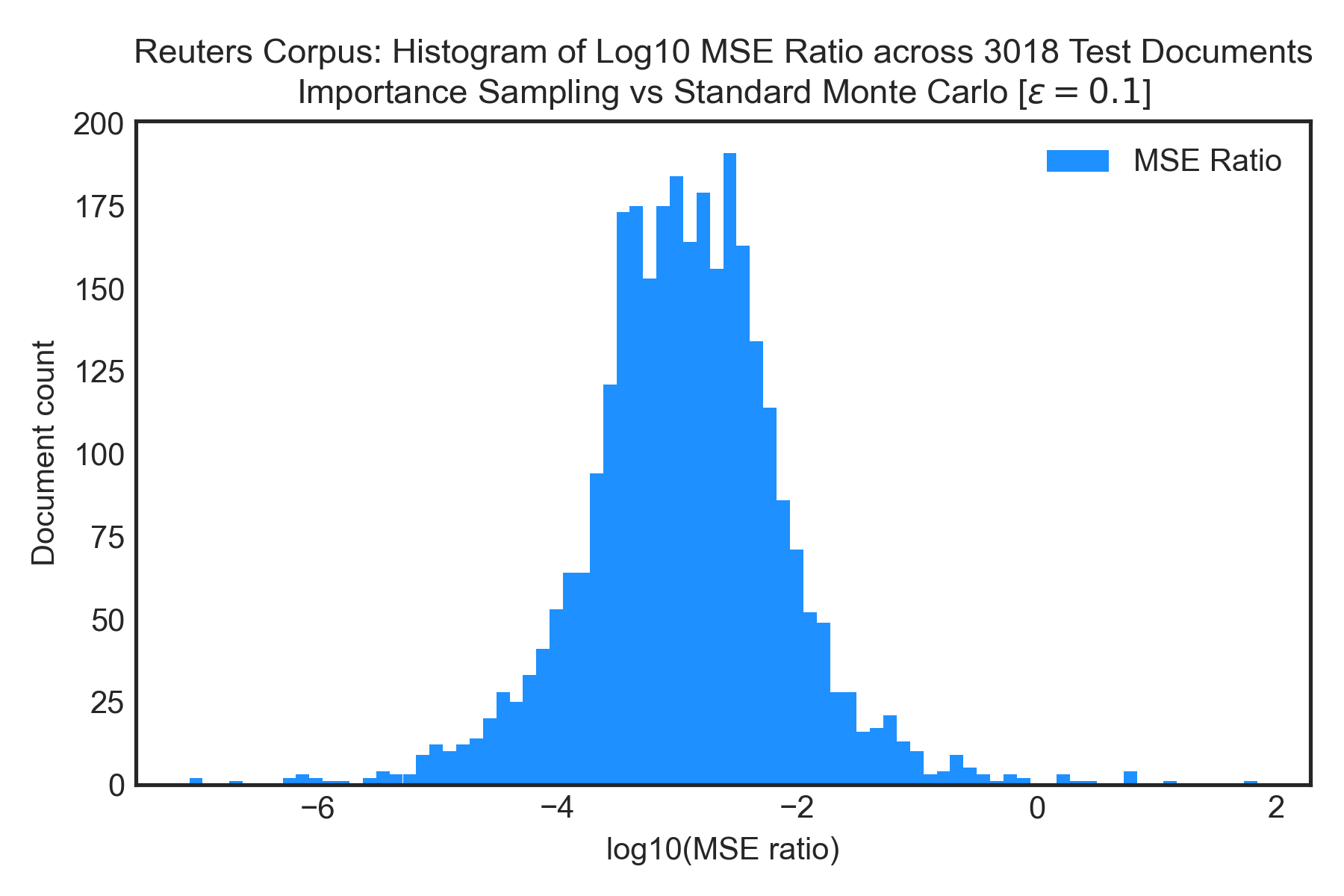
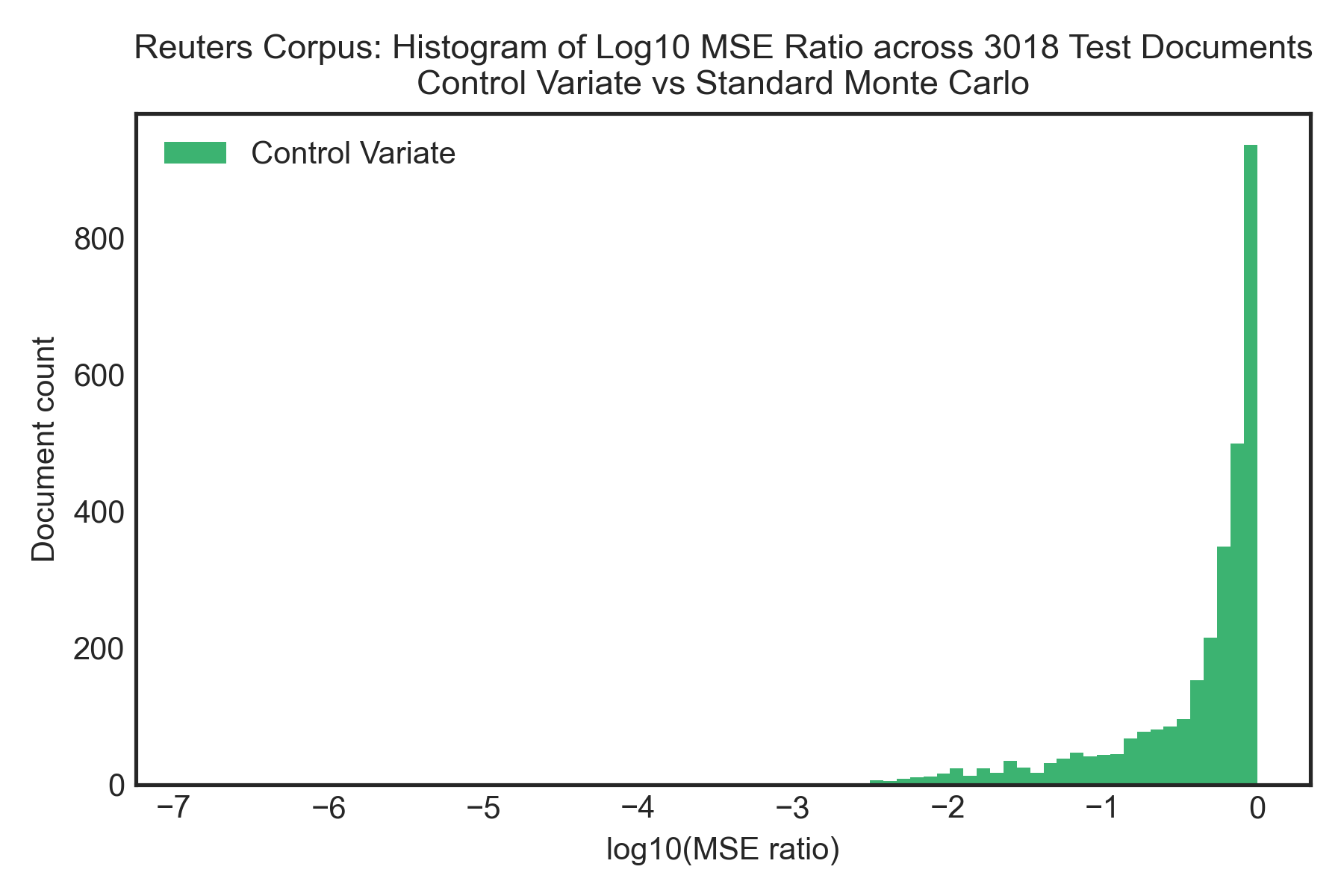
Figure 2: Distribution of log-MSE improvement for IS (left) and CV (right) estimators over MC across 3,018 test documents in the Reuters-21578 corpus; IS achieves dramatic variance reductions for the vast majority of cases.
Implications and Future Directions
The proposed variance reduction schemes are theoretically near-optimal for large-scale inference in Dirichlet-categorical models. Practically, they enable precise evidence computation or importance-weighted likelihood estimation in high-dimensional topic models without the variance explosion endemic to conventional MC.
Theoretically, the Laplace expansions highlight subtle but important distinctions between boundary and interior modes for Bayesian model selection, and expose polynomial factors often overlooked in large deviation analyses.
These methods also naturally connect with rare-event simulation and exponential family IS, but with the notable twist that the integrals of interest are expectations rather than probabilities, and the asymptotic analysis must account for sub-exponential (i.e., polynomial) prefactors.
Extensions to mixtures of Dirichlet distributions, hierarchical models, or application to stochastic variational inference are immediate next steps. Additional potential lies in leveraging the Laplace expansions to develop adaptive IS proposals and automated CV selection in more general families of Bayesian models.
Conclusion
The paper delivers a thorough asymptotic analysis and concrete algorithms for efficient Monte Carlo estimation of Dirichlet expectations under general, potentially sparse, boundary-concentrated regimes. Its theoretical tools, especially the boundary-aware Laplace method and concrete IS/CV constructions, constitute a robust foundation for scalable, variance-reduced estimation in categorical Bayesian models with broad relevance to computational statistics and machine learning.