- The paper establishes an explicit, multi-parameter product formula for the generating function of weighted domino tilings in cruciform regions.
- It leverages advanced graphical reduction techniques alongside symmetric function theory, including Schur functions, to simplify the tiling enumeration.
- The work generalizes classical results on Aztec-type tilings and lays a framework for studying refined statistics and weighted enumerations in complex domains.
Introduction
The enumeration of domino and lozenge tilings within combinatorial lattice regions has long served as a nexus between enumerative combinatorics, algebraic combinatorics, and statistical physics. "Domino Tilings of Cruciform Regions" (2604.04146) addresses an open direction in this domain by extending the product formula of Ciucu for the number of domino tilings of cruciform regions—a structured overlap of two Aztec rectangles. The paper not only provides weighted generating functions but also unifies several advanced techniques (graphical transformations, Schur functions, specialized weightings) to achieve explicit product-formula enumerations for these tilings.
A cruciform region Cm,na,b,c,d is constructed by overlapping two Aztec rectangles at orthogonal orientations, parametrized by the side lengths and overlap indices. These combinatorial objects interpolate between the Aztec diamond, rectangle, and richer families such as the Aztec triangle, sitting at the intersection of plane partition and perfect matching theories.
Domino tilings of a cruciform region admit reparameterization as perfect matchings of the associated planar dual graph. The paper studies not just the count, but the full generating function, under a nuanced weighted scheme: four kinds of colored dominoes are assigned weights depending on parity and orientation; further, even vertical and odd horizontal dominoes acquire q-dependent weights based on lattice coordinates.
The main technical result is an explicit, multi-parameter product formula for the generating function of weighted domino tilings on balanced cruciform regions, subsuming special cases in preceding work and extending to general weight assignments and q-enumerations.
A primary methodological advance is the systematic reduction of the enumeration problem to calculations on transformed graphs. Key local moves—vertex-splitting, the star lemma (reweighting), and the spider (urban renewal) lemma—are deployed to decompose the domino tiling problem into a sequence of tractable summations. The so-called "Sandwich Lemmas" (see transformation in Sandwich Lemma 1 and 2) formalize how the matching generating function translates through layers of Aztec rectangle and lozenge-based graphs.
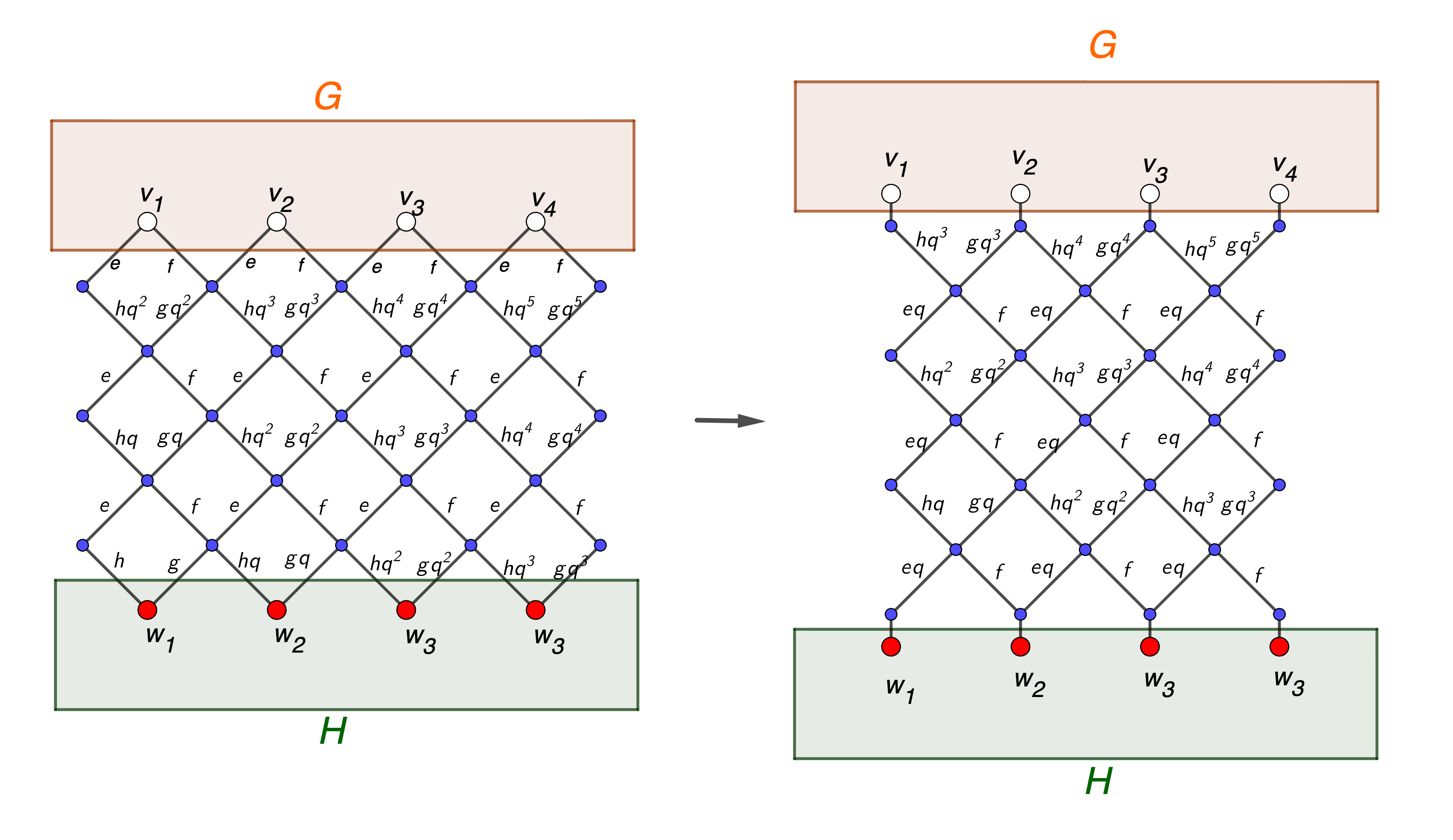
Figure 2: The transformation in Sandwich Lemma 1, replacing a complicated subgraph by a recursively defined simpler structure.
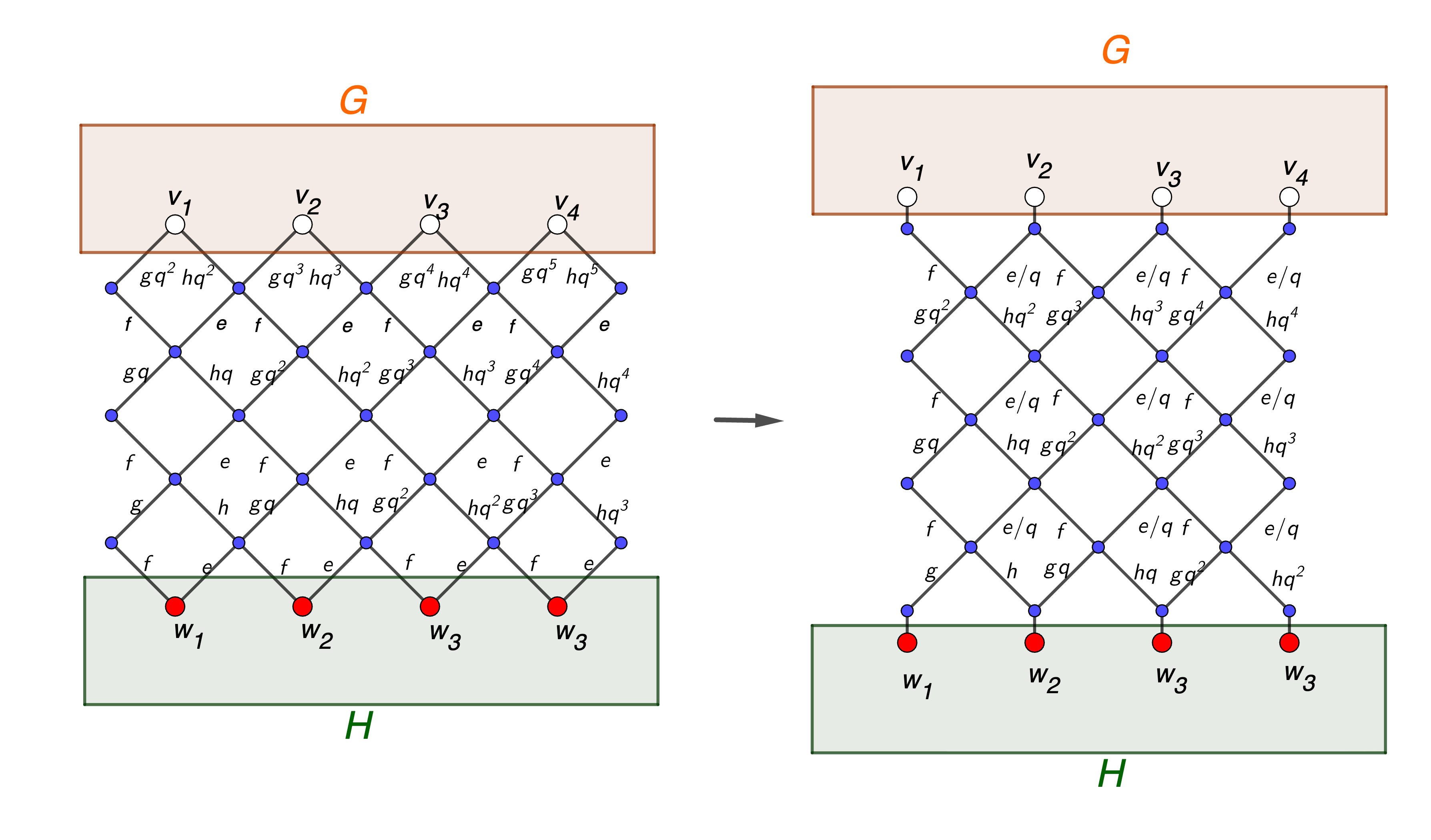
Figure 4: The transformation in Sandwich Lemma 2 for adapting nontrivial weightings on Aztec rectangles.
These results combine, in the "Mega-Sandwich Lemmas," to yield a recursive toolkit which ultimately enables the evaluation of the matching generating function via reduction to (weighted) lozenge tilings of semihexagons with dents.
Weighted Lozenge Tilings and Schur Function Connections
A deep connection to symmetric function theory is established by encoding lozenge tilings as families of nonintersecting lattice paths, which in turn correspond to semi-standard Young tableaux and Schur functions. The enumeration of weighted tilings is then equivalent to specialized Schur function evaluations, often with q and further weights e,f,g,h incorporated via multivariate generating functions.

Figure 6: The map between lozenge tilings of a semihexagon and column-strict plane partitions, emphasizing the Schur function enumeration.
The generating function for domino tilings of a cruciform region thus manifests as an explicit product, involving q-shifted factorials, hyperfactorials, and Schur polynomials indexed by configurations derived from the cruciform parameters. This move from combinatorics to algebraic combinatorics is precisely executed and proved, making crucial use of symmetric function identities (notably, those arising in the enumeration of alternating sign matrices and related objects).
The main explicit theorem specifies the total weighted generating function as a sum of multiplicative contributions drawn from:
- Factors of e,f,g,h raised to structural expressions in m,n,a,b,c,d
- Product terms over q-shifted factorials accounting for the positions and types of tiles
- Correction exponents in q, including binomial coefficients and cubic combinatorial sums
- Schur function and determinant-type factors corresponding to the combinatorial geometry of the region
The formula further splits into the two cases q0 even or odd, incorporating secondary factors dependent on this parity. The technical proof tracks these factors through the iterative application of reduction lemmas and graphical transformations, ultimately relying on determinantal and symmetric function identities.
Relations to Previous Work and Theoretical Consequences
This work generalizes all previously known exact formulas for domino tilings of Aztec-type regions, providing not only total counts but full generating functions under broad parameterizations. The techniques deployed—particularly the explicit graphical reductions and connections to Schur functions—set a new standard for complex region enumerations.
Key consequences include:
- Demonstrating divisibility and factorization properties for the number of domino tilings (confirming and extending observations by Ciucu)
- Providing a general framework for weighted enumeration, facilitating further specialization (e.g., to q1-enumerations or to cases relevant in statistical mechanics)
- Showing how families of tilings in nonrectangular, highly structured domains can still be exactly counted using combinatorial transformations and algebraic tools
Numerical Results and Claims
The explicit product formulas enable the computation of tiling numbers and generating functions for large parameter sets, far beyond hand enumeration or naively recursive computation. These explicit expressions confirm divisibility properties and strong algebraic structure (e.g., positivity, integrality under integer weights).
The singular claim—backed by intensive combinatorial and algebraic proof—is that the weighted generating function for domino tilings of any balanced cruciform region with prescribed weight parameters and q2 yields a multiplicative product formula, generalizing all previous exact results in this context.
Future Developments
The explicit enumeration of domino tilings for cruciform regions opens avenues for the study of refined statistics (e.g., limit shapes, arctic curves, local correlation, and fluctuation behavior), weighted versions relevant in physical models, and connections to symmetric function generalizations (such as Hall-Littlewood and Macdonald polynomials). The techniques outlined (notably the recursive graphical reductions and their symmetric function images) could be adapted to new classes of domains (including higher genus, multi-hole, or hexagonal variants) and to related systems in integrable probability and quantum algebras.
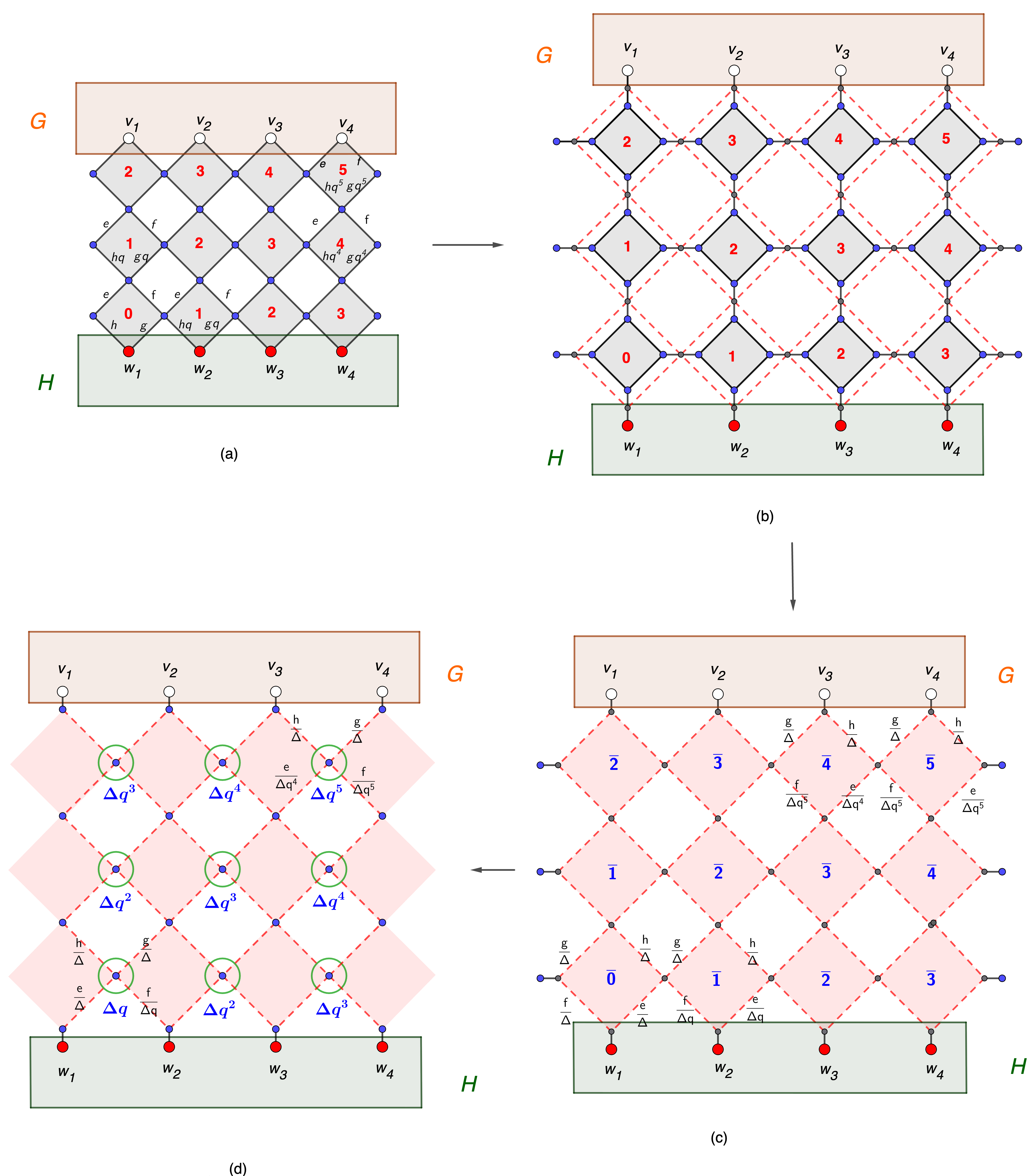
Figure 8: Illustration of graphical reductions used in lemma proofs; these reductions are central to the proof of explicit product formulas.
Conclusion
"Domino Tilings of Cruciform Regions" rigorously develops the explicit enumeration and weighted generating function of domino tilings for an important two-parameter family of lattice regions, unifying graphical combinatorics and symmetric function theory. The results supply both explicit formulas and a powerful technical framework for further investigations in tiling enumeration, perfect matchings, and their algebraic and probabilistic ramifications.