- The paper demonstrates that joint shape-position optimization minimizes the Cramér-Rao Bound, thereby enhancing 2D DOA estimation accuracy for movable antenna systems.
- By proving that an equilateral triangular movable region minimizes overlap area, the study provides a robust geometric framework for maximizing spatial diversity.
- Simulation results confirm that the proposed design outperforms square, circular, and rectangular arrays by achieving sharper spectral peaks and lower RMSE.
Joint Shape-Position Optimization for 2D DOA Estimation in Movable Antenna Systems
The paper conducts a rigorous investigation into two-dimensional (2D) direction-of-arrival (DOA) estimation for movable antenna (MA) systems with emphasis on spatial resource optimization. Accurate 2D DOA estimation is critical for integrated sensing and communication (ISAC) scenarios in 6G systems, enabling higher precision localization for IoT applications, autonomous robotics, and intelligent monitoring. Traditional DOA estimation methods using fixed-position antenna (FPA) arrays face constraints in physical aperture expansion due to power, RF chain, and spatial limitations, impeding performance in resource-constrained deployments.
Movable antenna technology introduces extra spatial degrees of freedom by allowing dynamic positioning within a confined movable region (MR), thereby synthesizing enlarged virtual apertures for improved angular resolution without increasing antenna count or RF complexity. Most prior works optimize antenna positioning but treat the shape of the MR as a fixed variable, neglecting its role in maximizing achievable array manifold diversity and spatial utilization. This paper advances the field by formulating a joint shape-position optimization problem aimed at minimizing the Cramér-Rao Bound (CRB) for 2D DOA estimation—an objective directly connected to estimation accuracy limits.
Theoretical Characterization: Shape and Position Optimization
The authors start from the 2D DOA estimation model for MAs, with each antenna coordinate subject to minimum spacing dmin and spatial constraints imposed by the MR. The CRB expressions reveal dependence on the variance and covariance of antenna coordinates, driving the optimization toward maximizing spatial spread while enforcing geometric constraints.
A foundational theoretical result is proven: the minimum overlap area for antennas positioned with minimum spacing is achieved when their centers form an equilateral triangle, i.e., an equilateral triangular MR maximizes spatial utilization under practical conditions. The structural symmetry of this geometry not only enhances aperture diversity but also simplifies the objective function due to invariance in coordinate expectations and cross terms. The optimization problem thus reduces to maximizing average squared radial distance of antennas from the centroid, subject to the placement and spacing constraints.
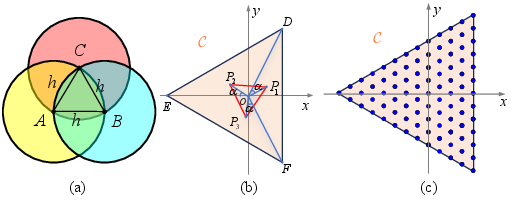
Figure 1: Schematic illustration of the proof for the equilateral triangular MR providing minimum overlap area and optimal symmetry for position selection.
The optimal strategy, given a discrete set of candidate positions in the triangular MR, is to select antenna locations furthest from the centroid—maximizing aperture and minimizing CRB.
Simulation benchmarks are provided comparing the proposed triangular MR-based MA array (PMA) against square area-based MA (SMA), uniform circular array (UCA), and uniform rectangular array (URA) configurations. The MUSIC algorithm is employed for spectral peak DOA estimation across different array geometries. Three main performance metrics are emphasized:
- Main lobe sharpness in the power spectrum function (reduced estimation ambiguity).
- Root mean square error (RMSE) of ϑ and φ as a function of SNR.
- Probability of successful resolution (PSR) as a function of angular separation.
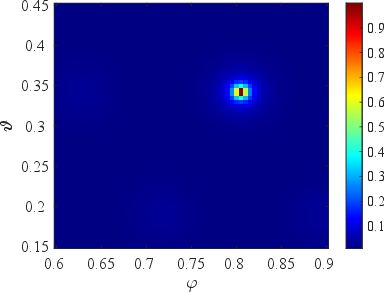
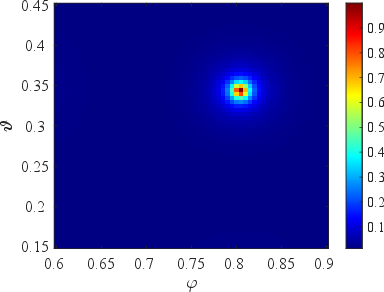
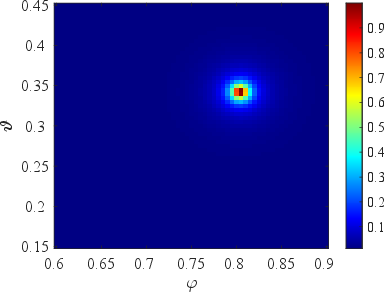
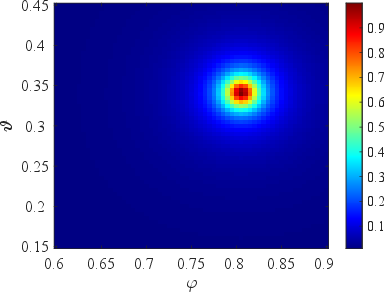
Figure 2: Power spectrum function versus ϑ and φ for various array geometries demonstrating PMA's sharper, narrower main lobe.
PMA exhibits a significantly narrower main lobe and sharper spectral peak than all reference arrays, directly translating to lower estimation error probabilities.
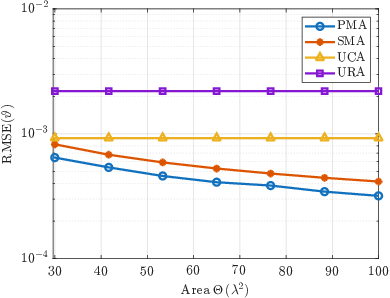
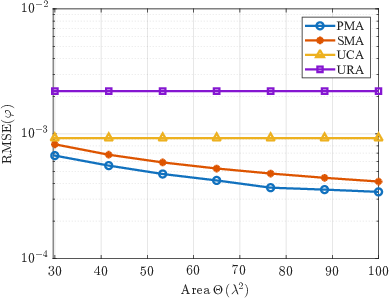
Figure 3: RMSE of ϑ versus SNR; PMA approaches the theoretical CRB at high SNR, outperforming SMA, UCA, and URA.
RMSE results show that PMA's performance converges to the CRB for SNR >0 dB, with notably smaller CRB than SMA, UCA, and URA, asserting the efficacy of spatial optimization.
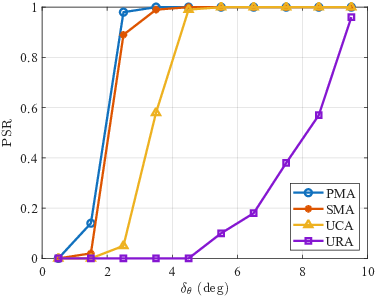
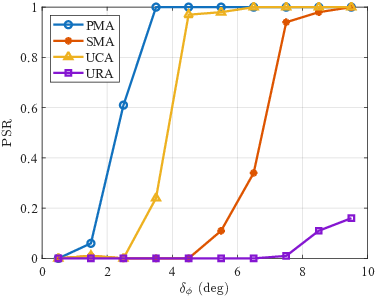
Figure 4: PSR versus δθ; PMA achieves successful resolution at angular separations as small as 3∘, surpassing conventional arrays.
PSR analysis indicates PMA can resolve sources with angular separations as low as 3∘, whereas URA requires separations ϑ0 for the same success rate.
Figure 5: RMSE(ϑ1) versus MR area; PMA shows monotonic improvement as area increases, consistently outperforming SMA and fixed-area arrays.
Furthermore, PMA and SMA show improved performance with increased MR area, but PMA always achieves lower RMSE, signaling shape-induced gains.
Implications and Future Directions
This work provides authoritative evidence that joint optimization of MR shape and antenna positions yields tangible improvements in spatial utilization and estimation accuracy for MA-aided DOA systems. The mathematical proof regarding equilateral triangular MR's optimality under minimum spacing constraints contradicts prior approaches that fix MR geometry, suggesting a revision of engineering standards for MA layouts.
Practically, these optimization strategies will be critical in the deployment of ISAC for dense IoT environments, robotics, vehicular localization, and emerging 6G applications where real-estate for antenna placement is severely limited. Theoretically, the results open pathways for further study of shape-induced spatial diversity and nonlinear geometric constraints in array configuration—possibly extending to three-dimensional layouts and rotation/tilt degrees of freedom (see [6DMAWSensing2025]).
AI-driven automated layout design, hardware reconfigurable metasurface antennas, and spatially aware channel state information acquisition will likely leverage these findings to optimize future communication and sensing platforms. Machine learning methods may augment these geometric insights with empirical data for environment-tailored MR selection and adaptive antenna placement.
Conclusion
The paper rigorously establishes that equilateral triangular MRs with optimal placement of antennas at maximal distance from the centroid minimize CRB, enabling substantially enhanced 2D DOA estimation accuracy in MA systems. Simulation evidence confirms sharper spectra, lower RMSE, and higher PSR, even at challenging angular separations and SNR regimes. This joint shape-position framework lays foundational principles for practical deployment and theoretical research in high-resolution wireless sensing and communications with MA technology (2604.04132).

