- The paper introduces a PET-ERG framework that modulates auxiliary references to guarantee both input and geometric constraint enforcement without online optimization.
- It decouples reference dynamics from inner-loop state fluctuations by updating references only at discrete sampling instants based on invariant Lyapunov sublevel sets.
- Numerical validation demonstrates exponential convergence and strict adherence to actuator saturation and safe pointing constraints in challenging configurations.
Periodic Event-Triggered Explicit Reference Governor for Constrained Attitude Control on SO(3)
Constrained attitude control for rigid bodies on the manifold SO(3) is crucial for precise orientation tasks in aerospace and robotics, where direct control on the manifold avoids the singularities and ambiguities inherent in local parameterizations such as Euler angles or quaternions. Systems are typically subject to strict actuator limits (input saturation) and geometric pointing constraints that enforce, for example, the exclusion of sensitive sensors from harmful directions. While Model Predictive Control (MPC) provides explicit constraint handling, its online optimization requirements are unattractive for systems on nonlinear manifolds. Explicit Reference Governor (ERG) schemes provide an alternative by modulating the input references using invariant sets to ensure constraint satisfaction without online optimization. However, traditional ERG approaches face challenges regarding the rigorous stability analysis of the nonlinear cascade interconnection on SO(3) due to intricate coupling between reference updates and the nonlinear Lyapunov function.
Methodological Contributions
This work introduces a Periodic Event-Triggered Explicit Reference Governor (PET-ERG) for SO(3) attitude control, which enforces input and geometric constraints while ensuring the rigorous asymptotic stability of the entire closed-loop system. The architecture is a hierarchical cascade: an inner-loop proportional-derivative (PD) controller asymptotically tracks an auxiliary reference $\rmr{g}$, and an outer-loop PET-ERG modulates $\rmr{g}$ towards the desired reference trajectory $\rmr{d}$ under strict safety conditions. The PET-ERG implements a supervisory mechanism so that the auxiliary reference is updated only at discrete sampling instants if a robust safety condition, tied to an invariant Lyapunov sublevel set, is validated.
The structured periodic event-triggered logic has two major outcomes:
- Decoupling Reference Dynamics and Inner-Loop State Fluctuations: By freezing the reference update between successful event triggers, the method establishes a mathematically tractable framework for bounding the total variation in the reference, whereas continuous-time ERGs entangle the Lyapunov function's time evolution and the reference flow.
- Rigorous Stability and Constraint Satisfaction: The scheme enables exact analytic guarantees that both the auxiliary reference and the plant state asymptotically converge to the desired trajectory for almost all initial conditions, with strict satisfaction of pointing and input constraints.
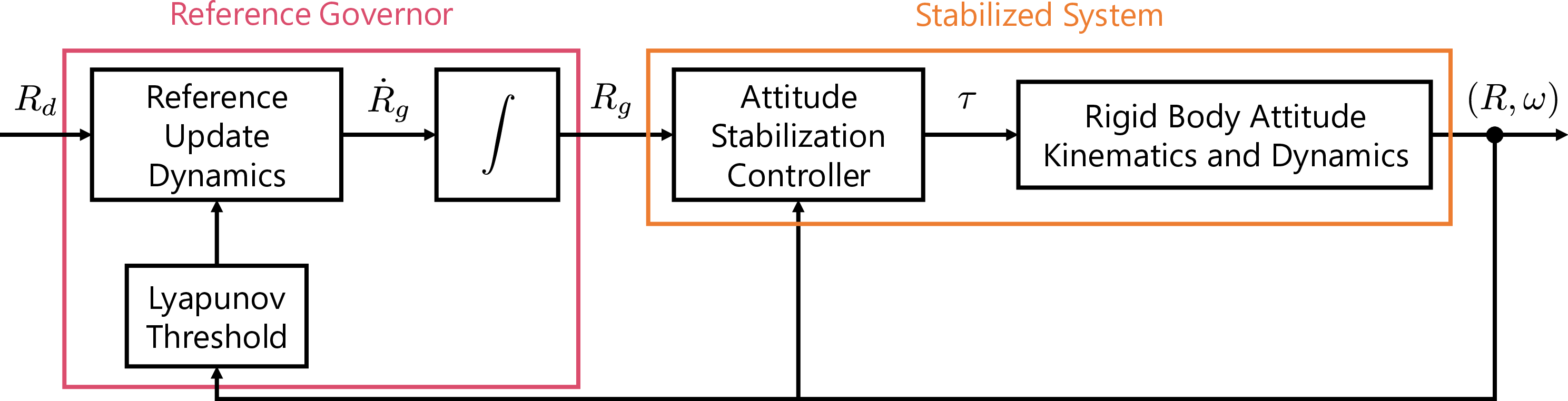
Figure 1: Block diagram of the PET-ERG control architecture, showing the inner-loop attitude controller and the outer-loop event-triggered reference governor.
Control Architecture and Analytical Results
The inner-loop PD controller is designed directly on SO(3) and stabilizes the rigid body to the moving auxiliary reference $\rmr{g}$. The Lyapunov function $V(\rmr{}, \ve{\omega}, \rmr{g})$ serves both as a certificate of local convergence and as a basis for deriving state-dependent constraint margins. Explicit dynamic safety margins $\Gamma(\rmr{g})$ are computed offline: the PET-ERG only updates the reference along the navigation field if SO(3)0 remains suitably below SO(3)1. The navigation field is constructed as a sum of attractive and smooth repulsive potentials, driving SO(3)2 towards SO(3)3 while maneuvering around forbidden regions induced by the pointing constraint.
The proposed PET-ERG update law is triggered periodically:
- At each sampling instant, if the safety margin is maintained, the reference moves continuously along the navigation field direction.
- Otherwise, the reference is held constant until the next sampling instant where the safety condition is met.
The main theoretical results are:
- Asymptotic and Exponential Stability: For almost all initial conditions (excluding a measure-zero set corresponding to topologically induced undesired equilibria), both the plant and the auxiliary reference achieve exponential convergence to the target, and the angular velocity converges to zero, with rigorous invariance of the constraint set throughout the transient dynamics.
- No Online Optimization: All set computations and constraint margins are precomputed, and online operation amounts to comparing the current Lyapunov level to stored thresholds and integrating ODEs on SO(3)4—satisfying stringent computational requirements for embedded systems.
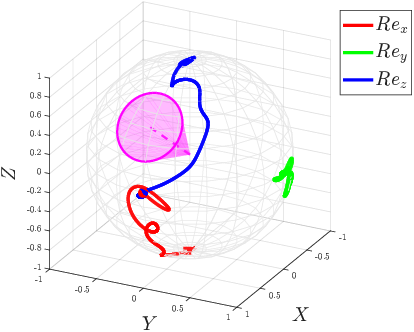
Figure 2: Evolution of system trajectories (PET-ERG); the body SO(3)5-axis safely skirts the forbidden cone and asymptotically aligns with the target.
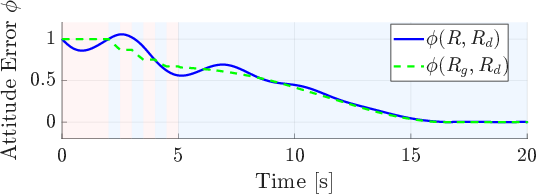
Figure 3: Time course of the attitude error SO(3)6 and the reference error SO(3)7 demonstrates exponential convergence of both the plant and auxiliary reference.
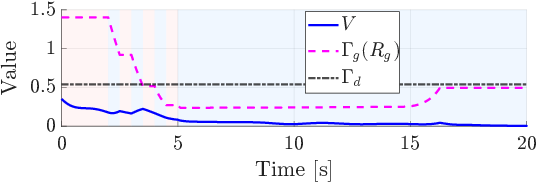
Figure 4: The Lyapunov function SO(3)8 is strictly kept below the calculated safety margins SO(3)9 and SO(3)0 by the PET-ERG, validating invariance and constraint satisfaction.
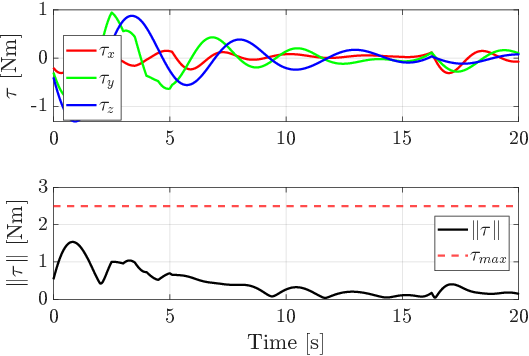
Figure 5: The control input SO(3)1 remains uniformly within the pre-specified torque saturation limit, confirming the input constraint enforcement.
Numerical Validation
Numerical experiments confirm the theoretical results, demonstrating that the PET-ERG successfully performs constrained attitude maneuvers even in challenging configurations where the geodesic path between the initial and desired attitude violates the geometric pointing constraint. The actual trajectory circumnavigates the forbidden region, the Lyapunov function remains below its safe bound throughout, and the control input strictly satisfies the saturation constraint. The auxiliary reference and system state both converge precisely to the target configuration, with the PET-ERG event-trigger logic introducing intervals of zero reference update, corresponding to the enforced hybrid constraint logic.
Implications and Future Directions
The PET-ERG constitutes a significant methodological advancement in the field of constraint-aware control on non-Euclidean manifolds. Its hybrid event-triggered approach overcomes longstanding analytic limitations associated with continuous-time ERGs and opens possibilities for constraint management in systems where geometric structure precludes conventional convex optimization. This technique is especially pertinent for real-time, computationally limited aerospace applications.
Looking forward, theoretical extensions could include accommodation of time-varying or uncertain constraints, event-triggered reference governors for underactuated systems on Lie groups beyond SO(3)2, or rigorous robustness analysis under real-world sensor and actuator uncertainty. Practical development may focus on embedded implementations and event-driven scheduling for multi-agent attitude synchronization subject to collision and actuation limits.
Conclusion
This paper establishes a new paradigm in constraint management for attitude control on SO(3)3 through periodic event-triggered explicit reference supervision, guaranteeing exponential convergence and strict satisfaction of both geometric and input constraints in a structure amenable to rigorous nonlinear analysis and practical real-time application. The work marks an important theoretical and practical advance in constrained geometric control, providing a robust, optimization-free architecture for safety-critical orientation tasks.