- The paper's main contribution is the development of a closed-form reference update law that enables optimization-free control while guaranteeing recursive feasibility.
- The methodology integrates a softmin-aggregated barrier function with Lyapunov-based arguments to enforce both transient and steady-state safety constraints.
- Simulation results on a high-DOF robotic manipulator confirm that the proposed approach systematically respects constraints and converges reliably to the target.
Optimization-Free Constrained Control with Guaranteed Recursive Feasibility: A CBF-Based Reference Governor Approach
Problem Framing and Limitations of Conventional Methods
This work formulates the constrained control of nonlinear systems as a reference management problem, addressing state and input constraints via an auxiliary reference g(t) that governs the actual plant input through a pre-stabilized controller. Standard approaches leveraging Control Barrier Functions (CBFs) ensure invariance of a safe set by applying online Quadratic Programming (QP) to filter a nominal controller. However, CBF-QPs have well-documented feasibility issues, predominantly when conflicting state/input constraints or tight actuation bounds exist. Such infeasibility is often handled heuristically, at the cost of increased computational load and unpredictable performance. Explicit Reference Governors (ERGs) provide an alternative, modulating the reference signal to preclude constraint violations using the concept of Dynamic Safety Margins (DSMs) derived from Lyapunov functions, ensuring invariance by construction. Traditional ERG schemes, however, require manually designed navigation fields and repulsion shaping, which are hard to generalize to high-dimensional, multi-constraint settings.
Aggregate Barrier-Based ERG: Theoretical Development
This paper introduces a CBF-based ERG framework that synthesizes the recursive feasibility guarantees of explicit reference management with the geometric constraint-handling generality of CBFs. The paper’s core innovation is a closed-form reference update law that eschews online optimization while preserving strict safety guarantees. The reference update is formulated as a virtual control input for an augmented dynamical system composed of the plant and the reference governor. The main components of the design are as follows:
- Softmin-Aggregated Barrier Function: All relevant constraint satisfaction measures—DSMs for transient safety and steady-state admissibility conditions—are composed into a single, smooth barrier H(x,g) via the softmin (log-sum-exp) operator. This provides a differentiable function H for the design of a CBF on the augmented state-reference space, enabling a smooth approximation of the intersection of constraint sets.
- Closed-Form Reference Law: The time derivative of g is calculated as the minimal correction to a nominal gradient flow toward the target reference, subject to the augmented CBF inequality H˙(x,g)+αH(H(x,g))≥0. This results in a single-step projection:
g˙=−∇gVg(g,r)−∥aH∥2max{0,aH⊤(−∇gVg(g,r))−bH}aH,
where aH=−∇gH and bH=∇xH⊤f(x,κ(x,g))+αH(H(x,g)). This form ensures the least-deviation modification from the unconstrained reference pursuit.
- Recursive Feasibility Guarantee: Critically, the construction ensures the existence of a feasible update (trivially, g˙=0) for any state inside the safe set—regardless of constraint activation or configuration—thus fully resolving the recursive feasibility issue endemic to CBF-QP approaches.
Safety, Convergence, and Comparative Properties
Theoretical analysis confirms that the proposed control law ensures forward invariance of the aggregated safe set and convergence to the target equilibrium under standard Lyapunov conditions. The two-level Lyapunov argument, utilizing reference-dependent Lyapunov functions for the plant and a potential function for the reference, establishes global convergence provided mild regularity and convexity conditions on the constraint set and potential function.
In contrast to classic ERG schemes, which rely heavily on manually engineered vector fields, this method's update direction is determined analytically from the softmin-aggregated constraint geometry and Lyapunov structure. Moreover, unlike CBF-QP methods that only filter plant input, the present scheme handles constraints at the higher level of reference management, sidestepping infeasibility even under mutually conflicting or dynamically incompatible constraints.
Application and Simulation: High-DOF Manipulation
The practical efficacy of the ERG-CBF framework is demonstrated on an n-DOF planar robotic manipulator navigating in the presence of circular obstacles. The reference governor operates on the robot's configuration space reference, with aggregated DSMs and softmin-based steady-state constraints computed for whole-arm collision avoidance. The simulation results show state trajectories systematically respecting both transient and steady-state safety specifications, with all runs converging to the desired target despite significant constraint activity.
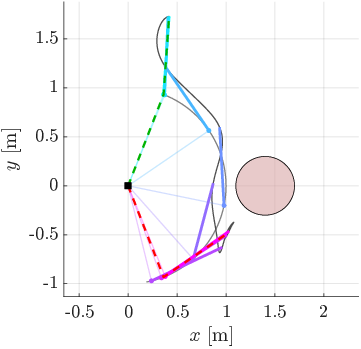
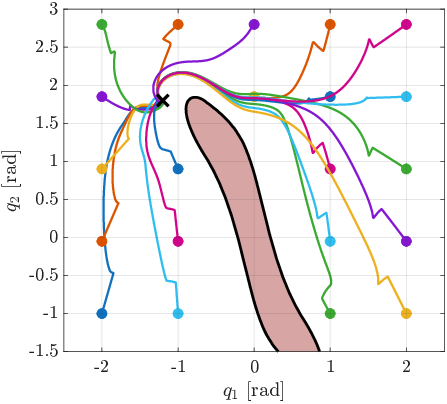
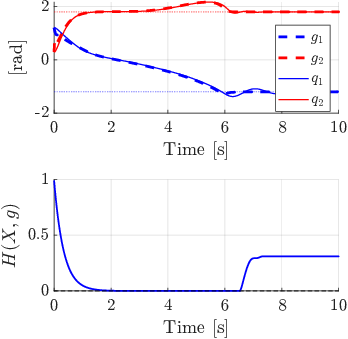
Figure 1: Workspace trajectory showing the manipulator safely avoiding the circular obstacle.
The results, further corroborated across 20 diverse initializations, illustrate that the projection-based reference update efficiently adapts to constraint geometry without manual tuning, as evidenced by governor trajectories converging robustly across the feasible set. The time-series of the aggregated barrier function H(x,g)0 confirms strict constraint satisfaction throughout.
Broader Implications and Future Directions
This CBF-based ERG scheme advances the systematic design of safe reference management for complex, nonlinear, and high-dimensional systems. Its closed-form nature, guaranteed recursive feasibility, and universality of constraint handling suggest immediate applicability for real-time control of safety-critical autonomous systems, including robotics, automotive, and aerospace domains. The framework's flexibility points toward seamless integration with learning-based or adaptive reference laws and potential extension to output feedback, robust, or distributed architectures.
Further research directions may focus on:
- Adaptive online tuning of the aggregation and CBF parameters for robustness to uncertainty or non-stationary environments
- Extension to hybrid and switched systems, and formal analysis under sampled-data implementations
- Integration with model learning techniques for uncertain plant dynamics while preserving safety and feasibility guarantees
Conclusion
The integration of CBF principles with an ERG via a softmin-aggregated, optimization-free reference update law constitutes a rigorous and practical approach for safety-critical control under constraints. The framework affords strong theoretical guarantees, alleviates common limitations of CBF-QP and traditional ERG methods, and is demonstrated to be effective in the control of complex robotic systems exhibiting stringent safety and input limits (2604.04001).