- The paper introduces an ANP-based framework that generalizes spatiotemporal interpolation for GEDI biomass data, enabling MRV-grade carbon accounting.
- It details the integration of foundation model embeddings from Sentinel data with contextual conditioning to produce calibrated uncertainty intervals even in disturbed environments.
- Empirical results across diverse biomes demonstrate the method's superior predictive accuracy and uncertainty calibration compared to traditional ensemble tree approaches.
Spatiotemporal Interpolation of GEDI Biomass with Calibrated Uncertainty
Introduction and Problem Context
Quantitative monitoring of deforestation-driven carbon emissions necessitates Measurement, Reporting, and Verification (MRV)-grade estimates of aboveground biomass density (AGBD) accompanied by trustworthy, calibrated uncertainty intervals. NASA’s Global Ecosystem Dynamics Investigation (GEDI) mission has become the canonical source of footprint-level LIDAR biomass data at ~25 m resolution, but orbital gaps and significant operational interruptions (notably, a 13-month hibernation) result in irregular, highly sparse spatiotemporal coverage. Conventional ML-based gap-filling approaches (Random Forests, XGBoost, etc.) have demonstrated spatial wall-to-wall AGBD mapping via satellite features, but crucially, temporal interpolation of biomass—especially across intervals of active disturbance—remains largely unresolved. Moreover, major ensemble approaches are systematically miscalibrated for interval prediction in both spatial and, by extension, temporal biomass mapping.
Methodological Framework
This study advances the Attentive Neural Process (ANP) paradigm, previously validated for purely spatial biomass interpolation, by generalizing it to the jointly sparse spatiotemporal operational regime of GEDI. The ANP architecture is conditioned not only on spatial but also temporal coordinates, treating both dimensions symmetrically. Tessera foundation model embeddings, extracted from contemporaneous Sentinel-1/2 data, serve as context-rich input. This alignment allows the model to operationalize a form of space-for-time substitution, where context points from neighboring locations and adjacent years inform predictive distributions for temporally unobserved intervals.
Performance is assessed across three ecologically and disturbance-contrasted biomes: (1) Guaviare, Colombia (tropical deforestation frontier), (2) Ucayali, Peru (dense Amazonian rainforest), and (3) Queensland, Australia (semi-arid woodland). The 2021 annual period is held out entirely (no GEDI observations), mimicking a real temporal gap. All model training and context is limited to {2019,2020,2022,2023}. The ANP is compared against Quantile Random Forest (QRF) and XGBoost with quantile regression (XGB), both equipped with the same feature set and cross-validation design.
Architectural Details
The ANP extends Conditional Neural Processes with cross-attention modules to adaptively aggregate spatial-temporal context, explicitly conditioning predictive distributions on local observation density and consistency. Encoder paths process the 3×3×128 Tessera embedding patches with spatial/temporal coordinates, with uncertainty decomposition realized via a stochastic latent path (global uncertainty) and a deterministic cross-attention path (context-dependent uncertainty). The network outputs a parameterized Gaussian at each query (location, year) for direct uncertainty quantification.
The spatiotemporal expansion is trivially achieved by concatenating annual and seasonal temporal encodings to the spatial input, with all features normalized. Episodic meta-learning ensures calibration, as the model is constantly challenged to predict at unobserved spacetime loci during training episodes.
Empirical Results
Strong empirical results—summarized numerically across calibration and predictive quality metrics—establish the superiority of ANP-based spatiotemporal interpolation vis-à-vis ensemble tree methods:
- Guaviare, Colombia: ANP yields log-space R2 of 0.75 (vs 0.70 for XGB and 0.66 for QRF), and 1σ interval coverage of 77.2% (closest to nominal 68% among all models), with Z-score std. ≈ 1.19 (ideal: 1).
- Ucayali, Peru: Despite significant sensor saturation issues in high-biomass regions, ANP preserves relative log R2 edge and notably achieves near-perfect uncertainty calibration (Z-score std. 0.92), while tree ensembles are overconfident, particularly under disturbance.
- Queensland, Australia: In a low-biomass, low-dynamic environment, all models are competitive in point-prediction, but only ANP maintains robust, trustworthy uncertainty intervals.
These patterns persist and are amplified in disturbance-stratified analysis. As disturbance intensity increases (higher relative biomass deviation, δ), the ANP's advantage in both predictive power and calibration grows. For heavily disturbed Ucayali strata, for example, tree ensemble R2 becomes negative (worse than the mean), and Z-score std. for XGB reaches extreme values (∼13), while ANP maintains positive R2 and calibrated standard deviations.
The model consistently generates well-calibrated, spatially and temporally resolved biomass predictions, with uncertainty intervals suitable for direct downstream MRV and carbon accounting tasks.
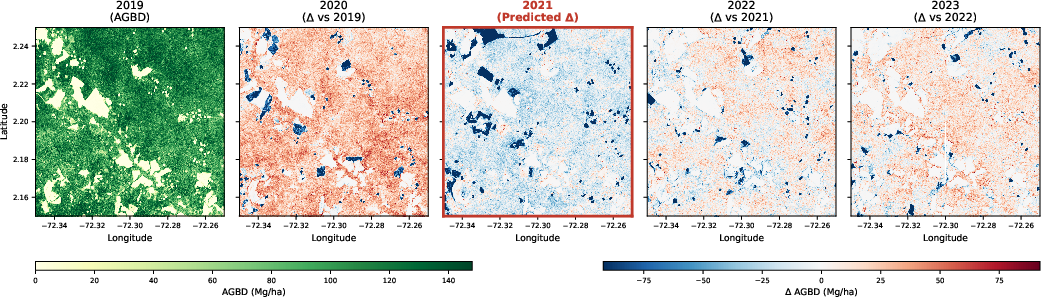
Figure 1: Temporal progression of biomass change for a tile in Guaviare, Colombia; the model interpolates year-to-year changes, including a wholly unobserved year (2021), showing plausible disturbance localization.
Theoretical and Practical Implications
The approach operationalizes a principled space-for-time substitution under explicit non-stationarity. Standard reservations about stationarity in space-time interpolation are mitigated by two aspects: (1) the ANP's context-conditioning enables it to recognize—and inflate uncertainty when—its inferential assumptions are weakest (i.e., during/after disturbance) and (2) the temporal foundation model embeddings capture local state changes directly. Unlike naive or marginal distribution-free methods (e.g., conformal prediction), ANP provides conditional calibration (i.e., valid intervals in the rare but critical subpopulation of rapidly changing forest) requisite for meaningful MRV reporting.
The generalization to arbitrary query points (latitude, longitude, year) defines a predictive field suitable for real MRV gap-filling, including extended interruptions such as the GEDI hibernation. The demonstrated performance is robust to ecological context, sensor limitations (with appropriate caveats for high-biomass saturation), and spatiotemporal observation sparsity.
With foundation models such as Tessera encoding temporally resolved land surface state, the framework is extensible to future LIDAR and SAR missions (e.g., NISAR, BIOMASS) and applications beyond forest biomass, provided temporal embeddings are correctly aligned with observation dates.
Limitations and Future Work
While the analysis is robust at the tile level (~11 km), footprint-level temporal change detection remains hampered by temporal sparseness. Sensor saturation in dense forests constrains ceiling performance, implying that modal integration (e.g., longer-wavelength SAR) could further enhance signal fidelity. Deeper temporal encoding strategies and ablation of context contributions for embeddings vs. explicit temporal features are promising future avenues. Active learning and adaptive sampling for targeted data collection, driven by spatially explicit model uncertainty, are natural next steps for closing the prediction-observation feedback loop.
Conclusion
The ANP-based spatiotemporal interpolation framework demonstrates robust accuracy and, critically, calibrated uncertainties across both spatial and temporal gaps in GEDI biomass observations, including highly disturbed environments. This capacity directly supports MRV requirements for trustworthy reporting in forest carbon accounting. The approach’s principled, context-aware uncertainty modeling and dependence on temporally resolved foundation model embeddings position it as a viable solution for current and future missions tasked with global ecosystem monitoring and climate MRV in the presence of deep spatiotemporal sampling gaps.