- The paper introduces annotation-guided latent augmentation using MATL that organizes backbone embeddings with both semantic and geometric context, enhancing detection performance.
- It employs a sliding-window framework to generate dense latent feature grids and explores fusion strategies, with spatial mask fusion yielding superior recall and mAP.
- Empirical results on the AWIR wildlife dataset demonstrate improved localization, reduced false positives, and overall robustness compared to traditional DTL methods.
Comprehensive Analysis of Annotation-Guided Latent Augmentation in Object Detection
Motivation and Foundations
Traditional object detection pipelines, especially those based on two-stage architectures such as Faster R-CNN with FPN, have been limited by task-driven feature learning. Backbone representations, primarily shaped by detection-specific loss gradients, exhibit a tendency to overfit to shortcut correlations and class boundaries rather than encoding meaningful object-centric structure. This limits the generalization capability, robustness to changing task definitions, and interpretability. The work proposes leveraging annotation-guided latent spaces constructed via Multi-Annotation Triplet Loss (MATL) as auxiliary priors that can be injected into the backbone, explicitly organizing embeddings around both semantic class identity and geometric attributes, thus overcoming the limitations imposed by task-only supervision.
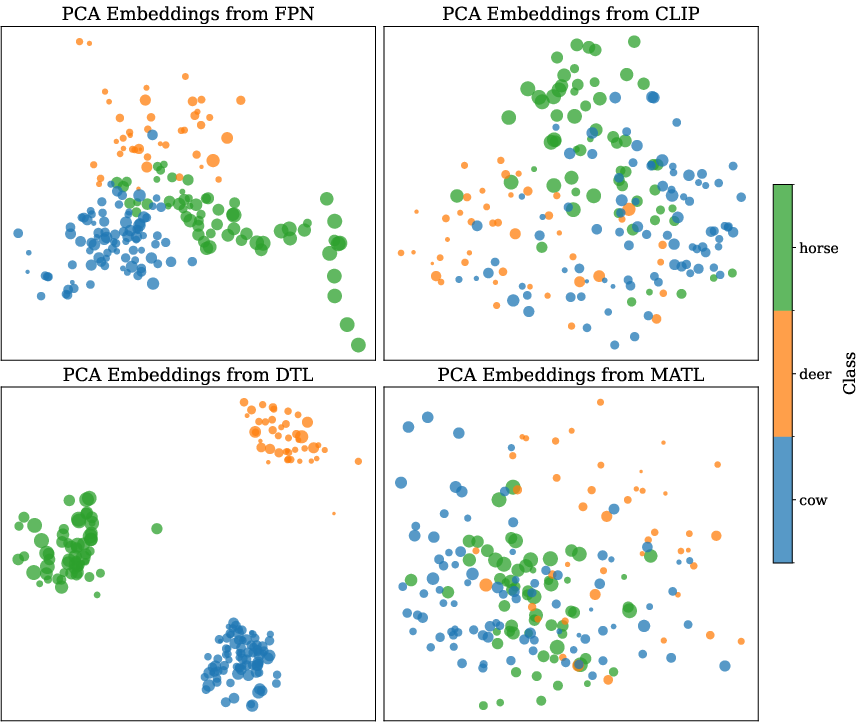
Figure 1: MATL-driven embeddings distinctly separate class labels while preserving intra-class structure, highlighting richer object-centric relationships than backbone, CLIP, or DTL embeddings.
Methodological Framework
The proposed methodology centers around three main components:
- Learning the Multi-Annotation Latent Space: A triplet-based objective (MATL) organizes latent embeddings not only by discrete class separation, as in traditional DTL, but by continuous annotations that capture both semantic and geometric information (e.g., bounding box area, squareness). This yields a more structured manifold, where spatial relationships and intra-class variation are preserved.
- Dense Latent Feature Grid Construction: The task-independent latent encoder (initialized via CLIP) is applied to detection scenes using a sliding-window approach, producing a dense spatial grid of embeddings. These grids encode localized object-aligned structure uncorrelated with the main detection objective.
- Backbone Feature Pyramid Augmentation: Dense latent grids are aligned to FPN resolutions and projected into the backbone channel space using learnable 1×1 convolutions. Three fusion strategies are considered:
- Additive fusion (element-wise sum)
- Feature-wise Linear Modulation (FiLM) fusion
- Spatial mask fusion (attention modulation via sigmoid-generated masks)
The augmented features replace original FPN outputs, influencing both region proposal and final prediction without modifying downstream heads. This process is architecture-agnostic and generalizes to other detection paradigms.
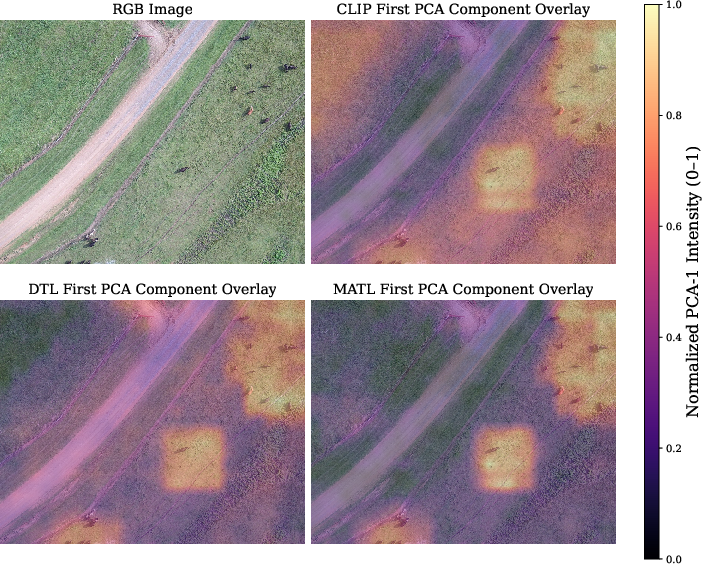
Figure 2: MATL activations in dense latent grids consistently concentrate on object-relevant regions, while CLIP and DTL are biased towards background responses.
Empirical Evaluation
Experiments were conducted on the AWIR wildlife dataset using Faster R-CNN with ResNet-50 and FPN, evaluating baseline, DTL-guided, and MATL-guided augmentation in multi-stage detection. Models were benchmarked across multiple supervision regimes, and all latent spaces were integrated at FPN levels P2,P3,P4,P5.
Qualitative and quantitative results demonstrate MATL's stronger localization and classification capabilities. MATL consistently produces feature activations concentrated on object regions (not backgrounds), improves proposal quality (measured by higher IoU), and reduces false positives (especially in challenging scenes). Across fusion strategies, spatial mask fusion yields the highest recall and mAP50, indicating that location-aware integration best exploits MATL structure.
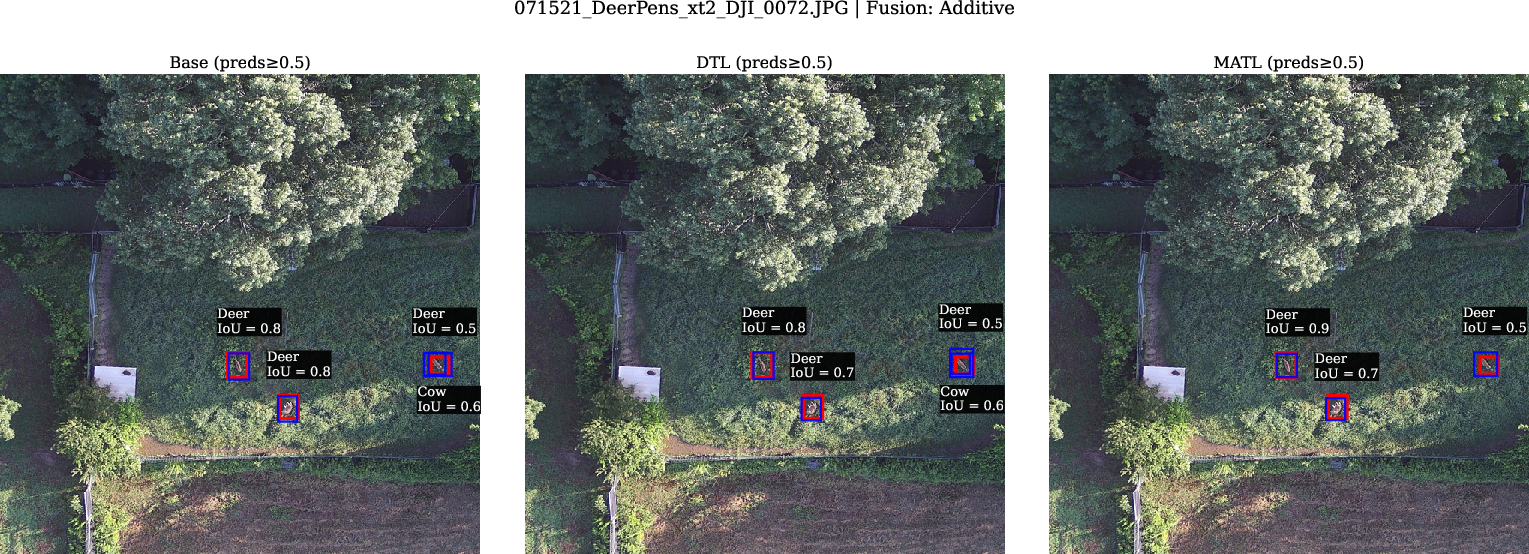
Figure 3: MATL-augmented Faster R-CNN achieves superior localization, accurate classification, and reduces false positives compared to baseline and DTL models (all predictions ≥0.5 confidence).
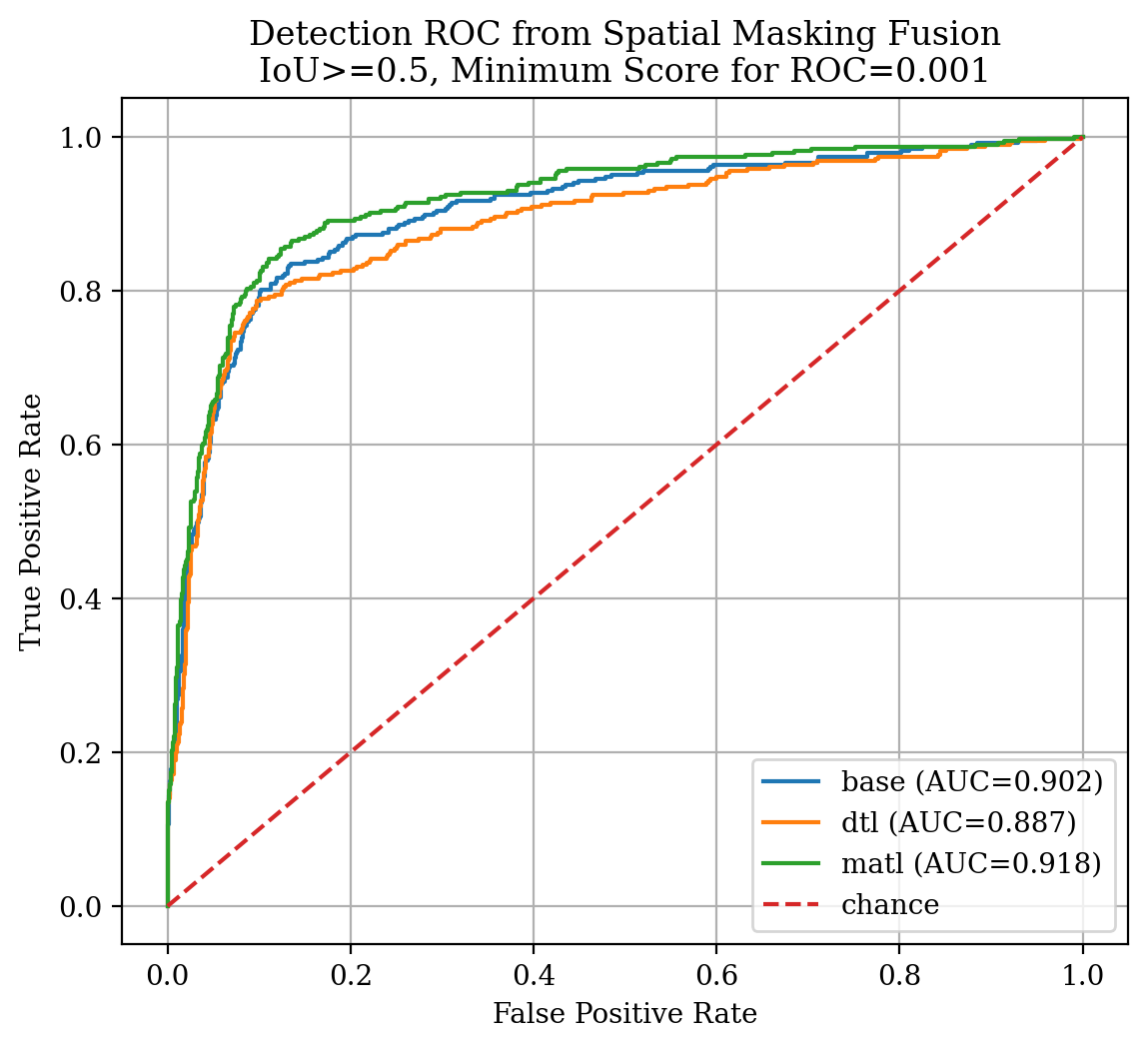
Figure 4: MATL-guided features deliver higher AUC in ROC curves, evidencing improved discrimination and maintained recall across thresholds.
Analysis and Implications
Integrating annotation-guided latent features improves detection quality, robustness, and generalization. MATL constructs a manifold that is stable across tasks and architectures, uncoupled from proposal-specific or classification-specific loss gradients, allowing for reusable representational augmentation. The spatial mask fusion mechanism is especially effective, suppressing background noise and focusing attention on true object-relevant regions.
DTL improves separability but overlooks geometric continuity; MATL overcomes this by explicitly encoding geometric attributes, benefiting both region proposal and box refinement. This reflects a joint encoding of semantics and geometry, a prerequisite for high-fidelity object detection in heterogeneous or weakly supervised scenarios.
The sliding-window approach is practical but presents limitations: ambiguity arises in windows containing multiple objects, and the tradeoff between stride size (grid density) and computational overhead must be managed. There is scope to develop latent encodings robust to multi-object scenarios or leveraging scene-level annotations.
Theoretical and Practical Outlook
The findings advocate for a shift from task-driven to annotation-guided latent space construction, positioning annotation priors as modular augmentations applicable to varied detection pipelines, including one-stage and transformer-based models. The observed gains in recall, localization, and reduction of spurious background activation indicate that annotation-guided augmentation is a scalable strategy for improving robustness, especially in domains with sparse or noisy supervision.
Future research can explore:
- Continuous latent space methods capturing multi-object geometric relationships
- Scene-level embeddings for complex environments
- Integration with advanced backbone designs (e.g., HS-FPN, region-controllable transformers)
- Computational optimization for dense sliding-window encoding
Conclusion
The paper delineates a principled methodology that augments backbone representations in object detectors with annotation-guided latent features, learned independently from task-driven objectives. MATL-based augmentation demonstrably improves object focus, recall, and detection quality—especially when coupled with spatial mask fusion—offering a generalizable mechanism for strengthening backbone representations. Prospective directions include scene-level embedding techniques and continuous annotation representations to further enhance generalization, efficiency, and adaptability in object detection systems.

