- The paper introduces a novel GOC denoising algorithm combined with Fourier analysis to extract the Helmi stream's accretion age of 6.8±0.8 Gyr.
- It leverages Gaia DR3 uncertainties to restore frequency-space clumping, providing a direct dynamical measurement of the merger event.
- Validation with mock simulations confirms the method's robustness, offering new insights into Milky Way assembly and future survey applications.
Dynamical Age of the Helmi Stream via Frequency-Space Clumping
Introduction and Scientific Motivation
The hierarchical assembly of the Milky Way, as predicted by ΛCDM, manifests in the form of accreted stellar streams within the Galactic halo. Quantitatively constraining the accretion timescales for individual merger remnants is central to reconstructing the Galaxy’s chronological formation sequence. The Helmi stream, one of the earliest identified halo substructures, remains a critical benchmark for such studies due to its relatively high metallicity, kinematic distinctiveness, and solar neighborhood accessibility. Although previous investigations have estimated its accretion epoch through indirect proxies—stellar ages, star-formation histories, and N-body simulations—the present work provides the first direct, model-independent dynamical age determination based exclusively on frequency-space substructure in phase-space data (2604.03786).
Theoretical Background: Frequency-Space Clumping as a Dynamical Chronometer
When a satellite galaxy is tidally disrupted, its stars gradually disperse in configuration space but retain coherence in action-angle or frequency space. Particularly, within a localized spatial volume such as the solar neighborhood, the frequency-space distribution becomes a semi-regular lattice of clumps, each corresponding to stars differing by an integer number of completed orbital cycles since disruption. The spacing in, for example, the radial frequency ΩR, labeled δΩ, is inversely proportional to the elapsed disruption time (Taccretion): δΩ≈2π/Taccretion.
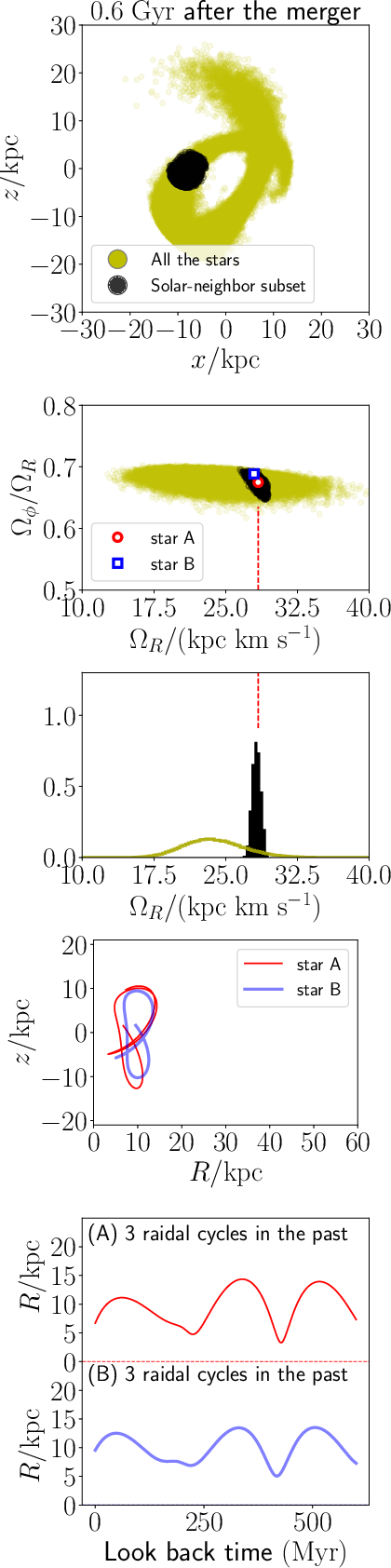
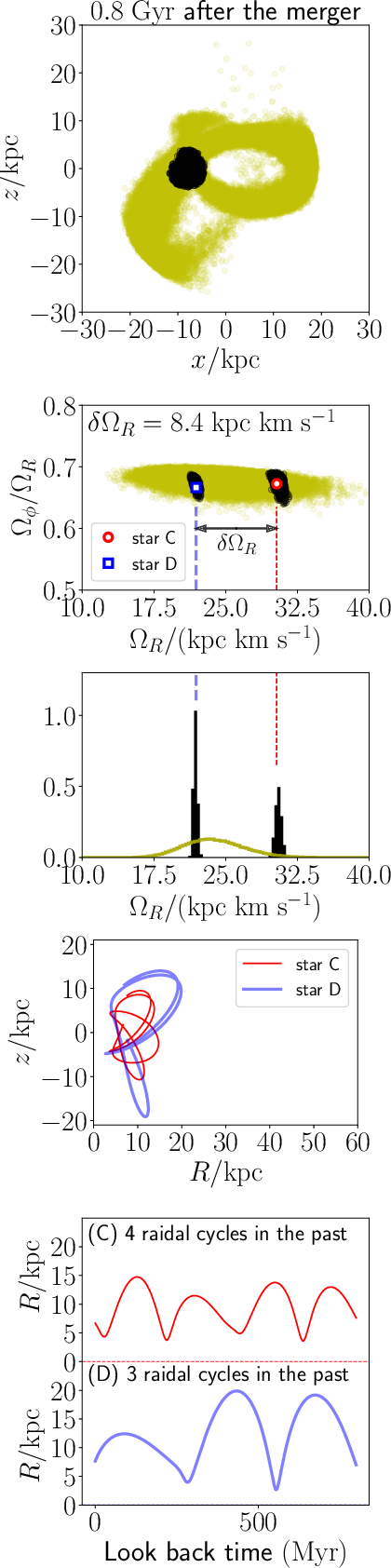
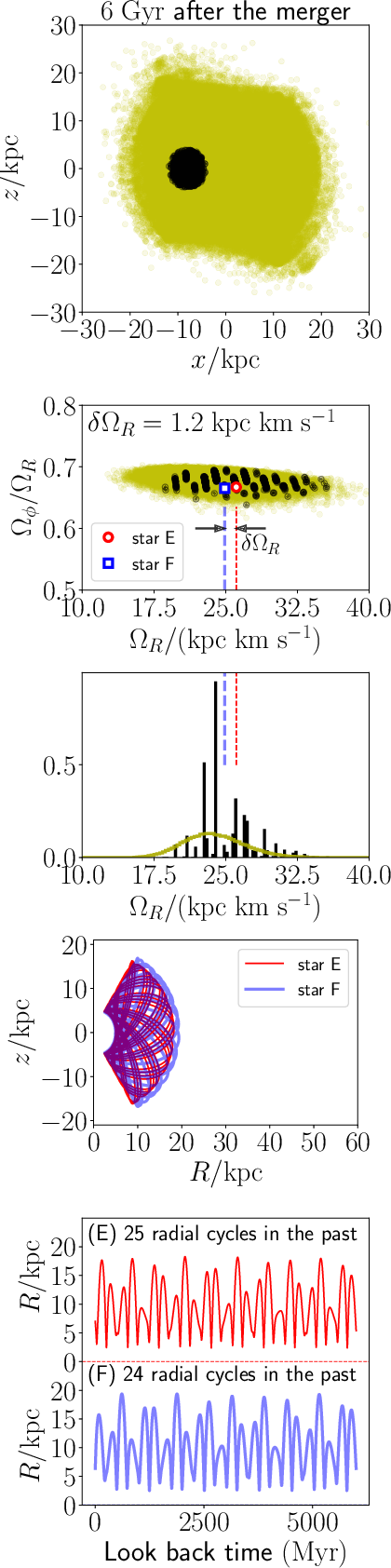
Figure 1: Test-particle simulation illustrates the progressive development of clumping in orbital frequency space for a Helmi-stream-like disruption at various epochs.
This simulation demonstrates the evolution from a single wrap to a highly multiplexed set of frequency clumps, directly encoding the accretion epoch in the density spectrum of recovered frequencies.
Overcoming Observational Noise: Greedy Optimistic Clustering
Real-world recovery of this lattice structure is confounded by astrometric and kinematic noise, which broadens individual frequency measurements and obscures periodicity in the stellar distribution. The standard Expectation-Maximization-based GMM approach fails when measurement uncertainty dominates the intrinsic frequency separation. This work introduces the Greedy Optimistic Clustering (GOC) algorithm [OkunoHattori2025], which selects within each star’s uncertainty set the realization that maximally enhances overall clustering, producing a denoised frequency-space configuration that is statistically consistent with the raw uncertainties.
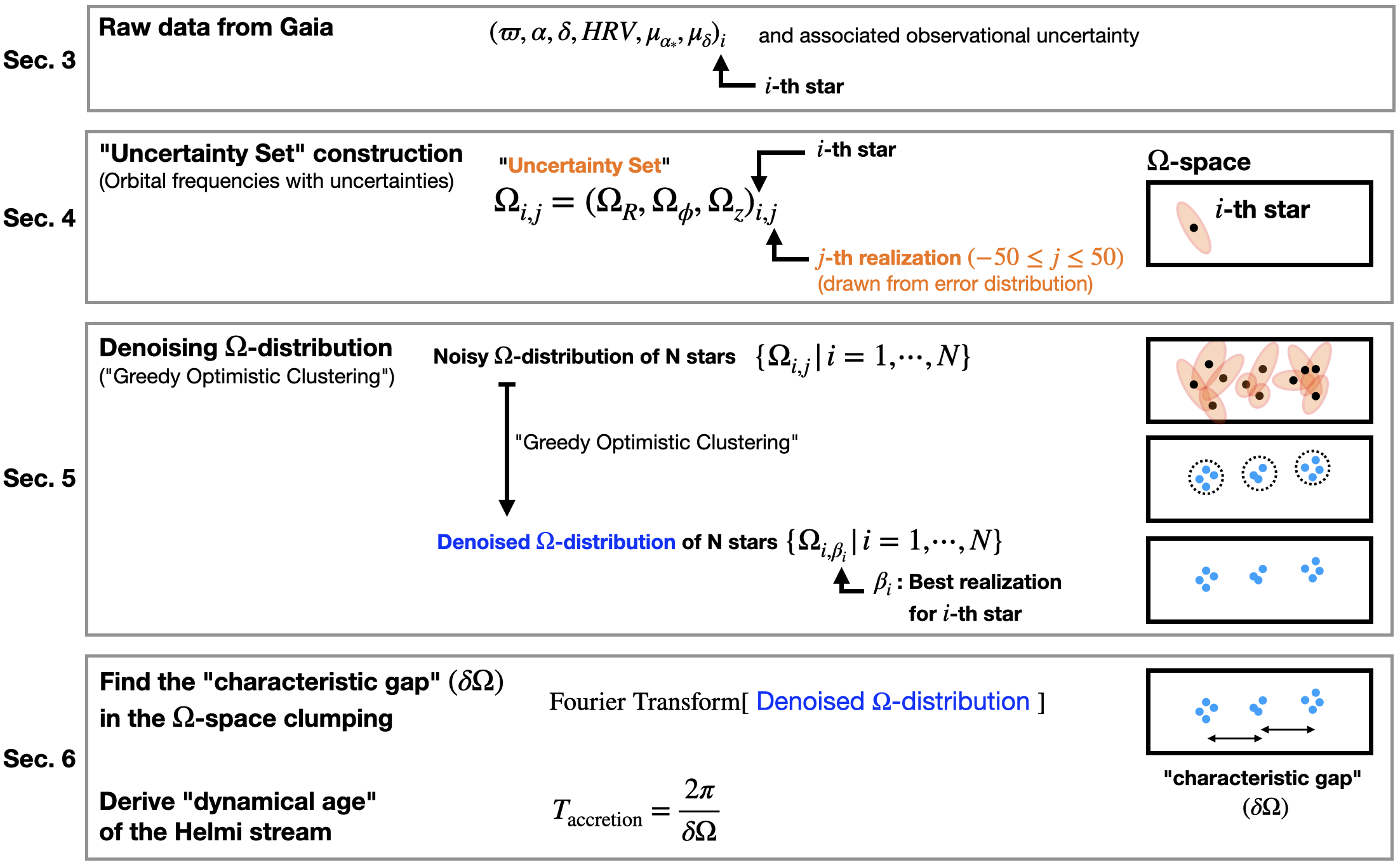
Figure 2: Schematic of the analysis: stars are propagated through uncertainty sampling, GOC denoising, and subsequent Fourier-based period determination.
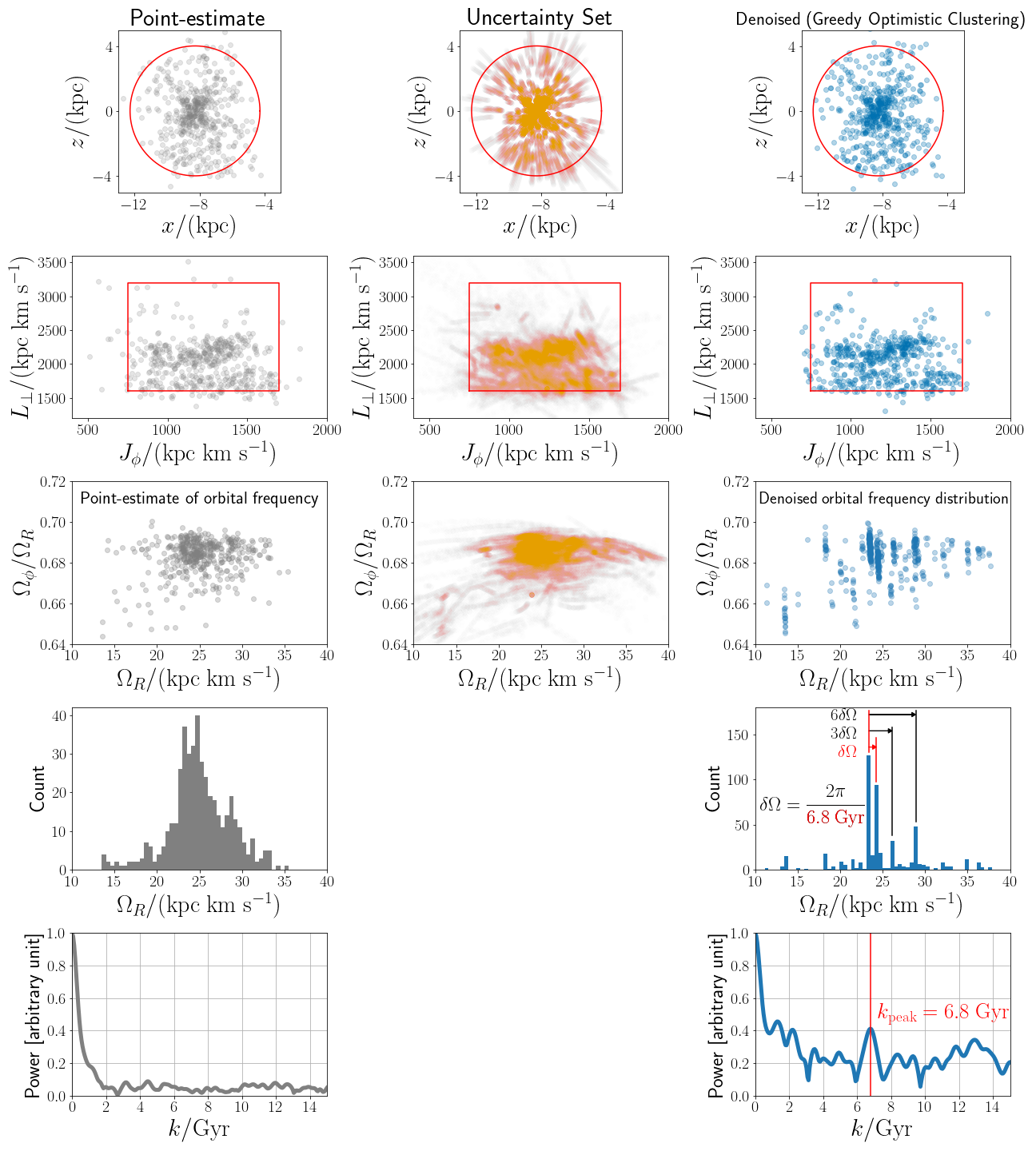
Figure 3: Data pipeline illustrated from point estimates (noisy), through uncertainty expansion, to the GOC-denoised clumpy realization.
The ensemble of denoised configurations obtained across optimization seeds is then used to extract robust ensemble statistics for the stream’s dynamical age.
Fourier Spectral Analysis for Dynamical Age Estimation
Periodic clumping in the denoised (ΩR,Ωϕ) distribution is quantified via two-dimensional discrete Fourier transform. The dominant mode (“primary peak”) in the 1D power spectrum reflects the characteristic frequency gap and thus the accretion time.
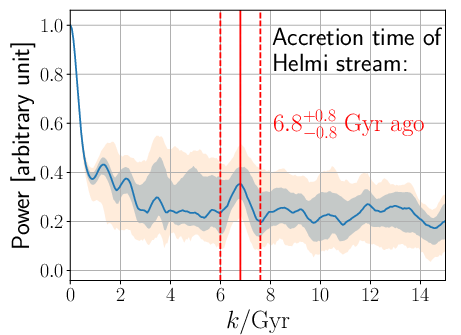
Figure 4: Ensemble Fourier spectrum for the Helmi-stream sample, with the primary peak at Taccretion≈6.8 Gyr arising robustly across realizations.
The central result is a well-localized spectral peak at Taccretion=6.8±0.8 Gyr, where the uncertainty derives from the interval bracketed by adjacent dips in the power spectrum, reflecting the full spectral support of the feature.
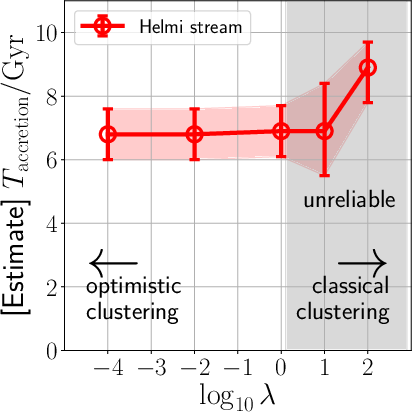
Figure 5: Estimated accretion time as a function of the GOC penalty hyperparameter λ; the result is stable for N0.
Validation with Mock Simulations
Extensive suite tests with simulated accretion events at known ages and realistic Gaia-like noise demonstrate robust recovery of N1 within the quoted uncertainties, up to N2 Gyr. The method maintains stability versus penalty hyperparameter choice in the GOC framework.
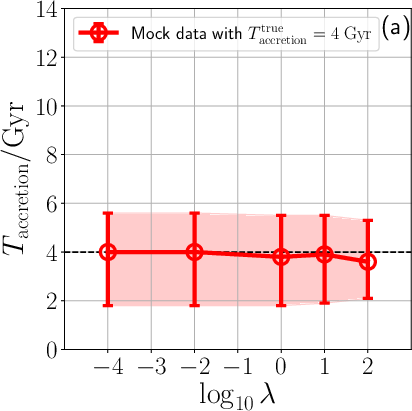
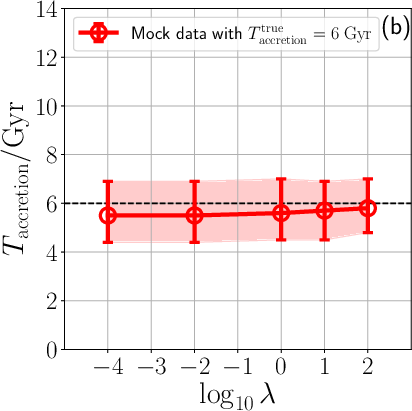
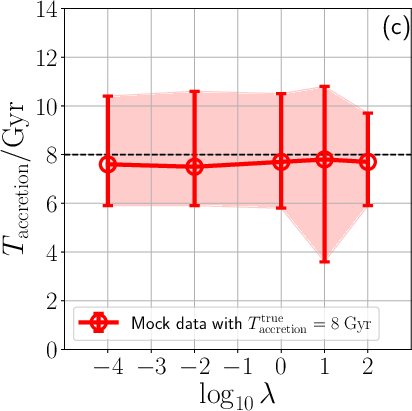
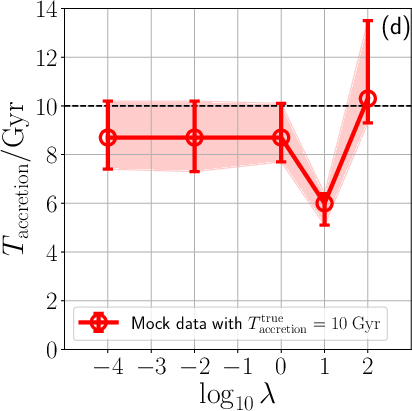
Figure 6: Recovered accretion time stability across penalty hyperparameter regimes for mock events spanning 4–10 Gyr true accretion ages.
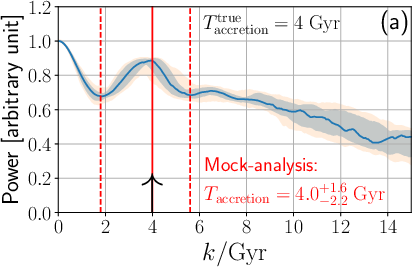
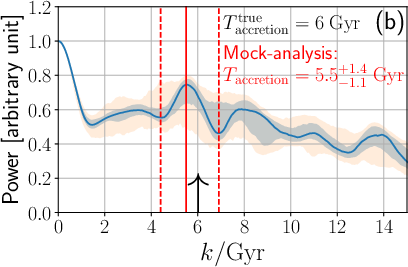
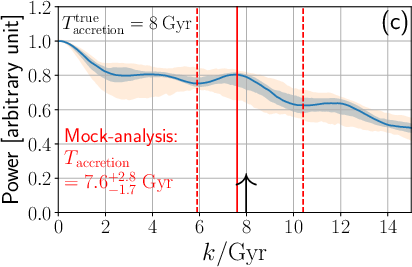
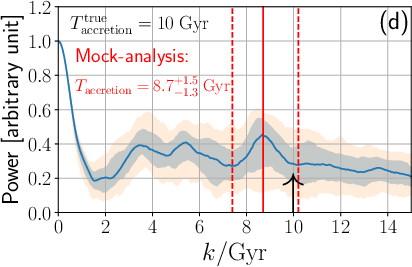
Figure 7: Median Fourier spectra for four mock datasets with different true accretion ages, demonstrating accurate peak recovery and uncertainty coverage.
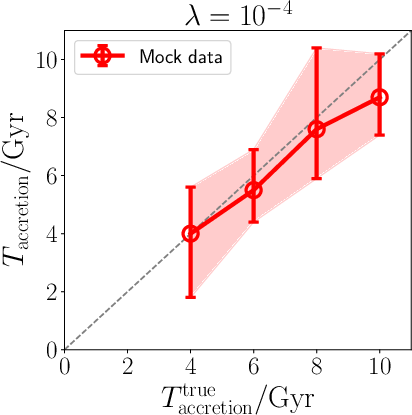
Figure 8: Recovered versus true accretion times for the validation simulations, confirming error budget and absence of bias for realistic input scenarios.
Astrophysical Implications and Future Prospects
This direct dynamical dating of the Helmi stream at N3 Gyr post-accretion significantly postdates Gaia-Sausage-Enceladus (GSE, N410 Gyr) and aligns with constraints from vertical velocity asymmetries and stellar population arguments. The finding that a satellite system containing old (N5 Gyr) but dynamically recently-accreted stars survived for several Gyr prior to disruption is critical to the interpretation of the stellar halo’s time-resolved assembly. The GOC+Fourier approach enables system-independent reconstruction of the Galactic merger timeline and is extensible to other streams and substructures.
The methodology is robust to current astrometric uncertainty regimes and will benefit from future Gaia releases and complementary spectroscopic surveys, further improving age resolution and enabling discrimination between subtle hierarchical assembly scenarios. The approach is limited by assumptions of a static Galactic potential and negligible dynamical diffusion from non-axisymmetric components (e.g., the bar, LMC), but these systematic effects have a subdominant impact at the present precision for high-inclination, halo-dominated orbits such as those of the Helmi stream. Future work incorporating time-dependent potentials and broader sampling will refine these constraints.
Conclusion
This study establishes a rigorous statistical and dynamical framework for dating the accretion of halo substructure via phase-space clustering under observational uncertainty. Application to the Helmi stream produces a direct age estimate of N6 Gyr, distinguishing it in the context of the Milky Way’s major accretion events and providing an essential time anchor for Galactic archaeology. The success of the GOC method in resolving frequency-space periodicity despite noise sets a new technical standard for chronometric analysis of disrupted substructures using high-dimensional astrometric data (2604.03786).