- The paper introduces the Quantum Algebraic Diversity theorem for enabling full-rank, spectrally consistent density matrix estimation from a single measurement outcome using group-structured POVMs.
- It demonstrates an O(d) reduction in copy complexity and guarantees spectral consistency when the measurement group’s orbit spans the Hilbert space.
- Empirical results show that QAD estimators achieve fidelity above 0.9 for qubits and qudits (d=2 to 13), paving the way for advances in quantum error correction and adaptive tomography.
Quantum Algebraic Diversity: Single-Copy Density Matrix Estimation via Group-Structured Measurements
Overview
"Quantum Algebraic Diversity: Single-Copy Density Matrix Estimation via Group-Structured Measurements" (2604.03725) rigorously establishes that core concepts from classical algebraic diversity (AD) can be lifted to quantum state tomography, enabling full-rank, spectrally consistent density matrix estimation from a single measurement outcome. The central result, the Quantum Algebraic Diversity (QAD) Theorem, demonstrates that group-structured POVMs—such as those governed by the Heisenberg-Weyl or Clifford groups—provide an O(d) reduction in copy complexity over conventional tomography. The paper introduces a formal Classical-Quantum Duality Map and an Optimality Inheritance Theorem, synthesizing a precise one-to-one correspondence between the classical and quantum frameworks. Strong empirical evidence is presented for qubits and high-dimensional qudits, with QAD estimators achieving fidelity above 0.9 across dimensions d=2 through d=13 from a single measurement, while standard tomography degrades inversely with dimension. The work also situates SIC-POVMs and MUBs within the AD paradigm and outlines efficient adaptive POVM selection via the double-commutator eigenvalue problem.
Algebraic Diversity and Quantum Tomography
Classical algebraic diversity leverages group action to extract statistical properties of multivariate data (e.g., eigenstructure of covariance matrices) from minimal observations. By extending the definition of a group-averaged estimator to quantum settings—where the density matrix replaces the covariance matrix and the Born probability vector plays the role of the observation—the QAD framework shows that a group-structured POVM acting on a single state copy yields a full-rank, spectrally aligned estimator. The QAD theorem formally guarantees that when the group action generates a spanning orbit in Hilbert space, the group-averaged estimator not only recovers the spectral content of the true state but also achieves an O(d) scaling improvement for trace-distance error compared to O(d2) for standard quantum tomography.
Theoretical Results
The QAD Theorem encompasses three core properties:
- Full-Rank Estimator: For group-structured POVMs whose orbits span the Hilbert space, the group-averaged estimator is full rank (i.e., $\rank(E[\hat{\rho}_G]) = d$), even from a single outcome.
- Spectral Consistency: If the measurement group commutes with the state, the estimator and the state are jointly diagonalizable, with spectral ordering preserved.
- O(d) Copy Reduction: Achieving trace error ε requires O(d/ε2) copies under QAD, a factor-d reduction relative to the d=20 cost for standard strategies.
The Optimality Inheritance Theorem formally transfers group selection optimality from the classical regime (covariance estimation) to the quantum, via the Born map. This means that if a group optimizes algebraic matching classically, it does so quantumly as well. The double-commutator generalized eigenvalue problem enables efficient, polynomial-time selection of measurement groups (adaptive POVM optimization), bridging rigorous algebraic formalism with tractable numerical algorithms.
Structural Insights: SIC-POVMs, MUBs, and Group Hierarchy
The quantum AD paradigm precisely situates widely used quantum measurement frameworks:
- SIC-POVMs are equivalent to QAD estimators built from the Heisenberg-Weyl group, yielding maximally symmetric informational completeness.
- MUBs arise from QAD with the Clifford group, corresponding to mutually unbiased informational partitions.
A hierarchy is elucidated: d=21, paralleling the classical spectral estimation hierarchy (DFT/DCT/KLT). This structure captures the universality-efficiency tradeoff: larger groups (like d=22) offer more universal estimation at the cost of higher requisite resources, while smaller, well-matched groups yield efficient, structure-exploiting recovery.
Empirical Validation: Qubits and High-Dimensional Qudits
A detailed worked example for single-qubit systems reveals that the QAD estimator, when constructed with a group closely matched to the dominant symmetry of the state, achieves fidelity 0.91 from a single outcome, versus 0.80 for standard single-basis tomography. Notably, group choice is crucial: overly large groups return uninformative estimators, while non-spanning groups cannot recover full rank.
For qudits (d=23—d=24), Heisenberg-Weyl–based QAD estimators systematically maintain d=25 across all dimensions with only a single measurement, whereas baseline tomography fidelity rapidly diminishes as d=26.
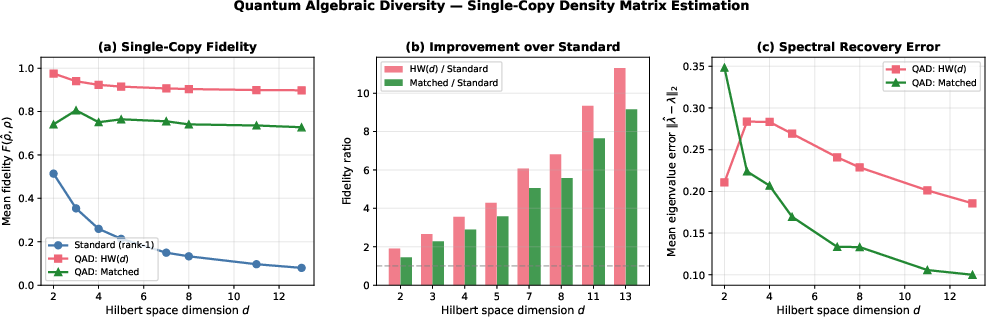
Figure 1: (a) Mean fidelity for Heisenberg-Weyl QAD vs. standard tomography; (b) Fidelity improvement ratio scales linearly with d=27, confirming the d=28 copy reduction.
The improvement ratio between QAD and standard methods increases linearly with d=29 (e.g., from d=130 at d=131 to d=132 at d=133). Even when compared against QAD with the "oracle" matched cyclic group, HW-based estimators deliver superior fidelity owing to their larger orbit size and increased structural diversity.
Implications, Connections, and Future Directions
The algebraic perspective advanced here offers novel opportunities in quantum information processing:
- Quantum error correction: Since stabilizer codes are defined by commutation with a Pauli subgroup, the QAD theorem suggests syndrome extraction can be accomplished with algebraic diversity, potentially collapsing multi-measurement routines into a single, group-averaged operation, thereby minimizing sample complexity.
- Adaptive tomography: The double-commutator eigenproblem enables iteratively optimized POVM selection, adapting measurement structure to the estimated symmetry of the quantum state, and bridging to similar approaches in classical adaptive spectral analysis.
- Hardware Agnosticism: The mathematical generality of group-structured POVMs ensures independent validity from specific experimental platforms, with implementability left to future advances in programmable measurement hardware.
The QAD framework extends conventional compressed sensing approaches, focusing on algebraic rather than low-rank structure. The two approaches are orthogonal, opening avenues for hybrid or context-adaptive tomography.
Conclusion
The QAD framework unifies the principles of algebraic diversity for classical and quantum systems, substantiating a powerful methodology for single-copy, full-rank, and spectrally informative density matrix estimation. By leveraging group-structured measurements, it achieves an order-of-magnitude reduction of resource requirements for high-dimensional quantum systems and provides a constructive pathway for adaptive, structure-exploiting quantum state characterization. These contributions not only recalibrate expectations for quantum sample efficiency but also facilitate practical and theoretical advances in quantum measurement, tomography, and error correction, with direct applicability to the scaling challenges of quantum technologies.

