- The paper demonstrates that zero-temperature avalanche criticality drives dynamical slowing down and heterogeneity in supercooled liquids via matching scaling relations.
- It integrates molecular dynamics with potential energy landscape analyses to connect overlap functions and unstable saddle modes with avalanche behavior.
- Finite-size scaling confirms critical exponents and uncovers a transition near the MCT crossover where avalanche correlations saturate and localization effects dominate.
Potential Energy Landscape and Avalanche Criticality in Supercooled Liquids
The study "Potential energy landscape picture of zero-temperature avalanche criticality governing dynamics in supercooled liquids" (2604.03580) synthesizes extensive molecular dynamics simulations of the canonical Kob-Andersen model (KAM) with contemporary conceptual advances in glass physics, centering on the emergence of zero-temperature avalanche criticality and its manifestation in supercooled liquid dynamics. By systematically bridging dynamical measurements with potential energy landscape (PEL) analysis, the authors articulate a unified scenario for dynamical slowing down and heterogeneity, resolving several open issues in the field.
Avalanche Criticality in Dynamical Heterogeneity
A central result is the quantitative demonstration that both the average structural relaxation, captured via the overlap function Q(t), and spatiotemporal dynamical heterogeneity, measured by the four-point dynamical susceptibility χ4(t), conform to scaling relations predicted by a zero-temperature avalanche criticality scenario. Avalanche criticality, previously established in sheared amorphous solids and elastoplastic models (EPM and T-EPM), is validated in equilibrium supercooled liquids here by finite-size scaling collapse of χ4∗ and the associated correlation length, with the critical exponents ν≈3.2 and γ≈6.0 determined independently via vibrational, dynamical, and saddle index analyses.
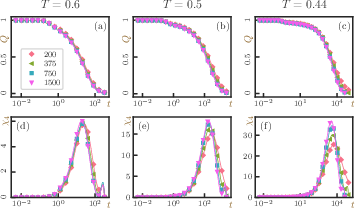
Figure 1: Time evolution of the overlap function Q(t) (top) and the dynamical susceptibility χ4(t) (bottom) at representative temperatures and system sizes. Symbols: simulation data; lines: two-mode or spline fits.
Correspondence between dynamical observables and avalanche criticality is further reinforced by direct connections between the number of negative eigenvalues (unstable modes) at saddle-point configurations in the PEL and the scaling of χ4∗ and its finite-size truncation.
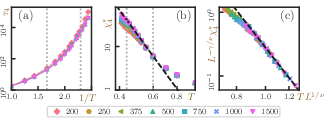
Figure 2: (a) Peak time τ4 of χ4(t) vs. inverse temperature. (b) System-size and temperature dependence of χ4(t)0. (c) Finite-size scaling collapse of χ4(t)1 using critical exponents χ4(t)2, χ4(t)3.
Structural Relaxation and Two-Mode Kinetics
The relaxation function χ4(t)4 at low temperatures and large χ4(t)5 is fitted by a two-mode model, where the slow component exhibits stretched exponential relaxation indicative of heterogeneous, facilitated dynamics. The stretching exponent χ4(t)6 becomes essentially temperature-independent within the critical regime, supporting the universal scaling of dynamical heterogeneity arising from avalanche processes. Finite-size systems deviate from this plateau due to truncated avalanche statistics, corroborated by the disappearance of unstable saddle modes at small χ4(t)7.
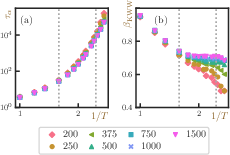
Figure 3: Fitted slow-mode parameters χ4(t)8 (α-relaxation time, semi-log scale) and χ4(t)9 (stretching exponent) as functions of inverse temperature and system size.
Potential Energy Landscape Diagnostics
To substantiate the central role of the PEL, the authors perform three orthogonal quantitative analyses:
1. Vibrational Density of States (VDOS) of Inherent Structures
The low-frequency limit of the non-Debye vibrational density of states of inherent structures, χ4∗0, for samples classified as stable, follows a χ4∗1 power-law scaling at all χ4∗2, with a prefactor χ4∗3 that decreases significantly only below a threshold χ4∗4. The reduction in χ4∗5 signals a depletion of quasilocalized vibrational modes (plasticity carriers)—a direct PEL signature of system stabilization closely aligned with the onset of avalanche criticality in dynamics.
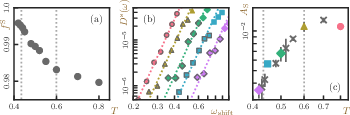
Figure 4: (a) Fraction of stable inherent structures, χ4∗6, vs. temperature. (b) Low-χ4∗7 scaling in VDOS χ4∗8. (c) Prefactor χ4∗9 vs. ν≈3.20.
2. Localization Transition of Unstable Saddle Modes
A detailed finite-size scaling analysis reveals a temperature-tunable mobility edge for the participation ratio of saddle-point unstable modes. Crucially, when scaling by ν≈3.21 (where ν≈3.22 is the avalanche fractal dimension), the mobility edge vanishes near the MCT crossover, confirming a transition from extended (hybridizable) to fully localized unstable modes as avalanches become spatially isolated.
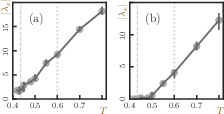
Figure 5: Temperature dependence of the absolute value of the mobility edge ν≈3.23 for saddle modes, measured with scaling by ν≈3.24 vs. ν≈3.25.
3. Inherent Structure Energetics
Both the mean and fluctuations of inherent structure energy per particle ν≈3.26 exhibit qualitative changes near ν≈3.27 and level off around the MCT temperature ν≈3.28. The distributions of ν≈3.29 remain Gaussian throughout, supporting the picture of metabasins and subbasin fluctuations within a smooth statistical ensemble, rather than the formation of new deep minima.
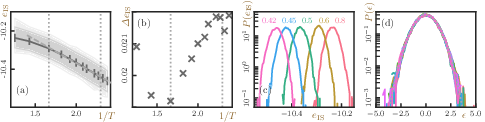
Figure 6: (a) Mean and (b) standard deviation of γ≈6.00 as functions of temperature. (c,d) Probability distributions (unscaled γ≈6.01 and rescaled γ≈6.02) confirming Gaussianity.
Unified Potential Energy Landscape Picture
Interpreting these results, the study posits a hierarchical PEL scenario: avalanches correspond to basin-to-basin (metabasin) hopping events facilitated by elastically mediated correlations among plasticity carriers (quasilocalized modes/stable clusters), with the depth and breadth of the hierarchy directly reflected in both the dynamical susceptibility and VDOS. The upper limit of avalanche correlation length, coinciding with the localization transition of saddle modes, marks the crossover out of the regime governed by avalanche criticality—corresponding to the breakdown of MCT scaling and the saturation of γ≈6.03. Below this threshold, dynamics are dominated not by further cooperative growth but by the statistics of rare, localized events.
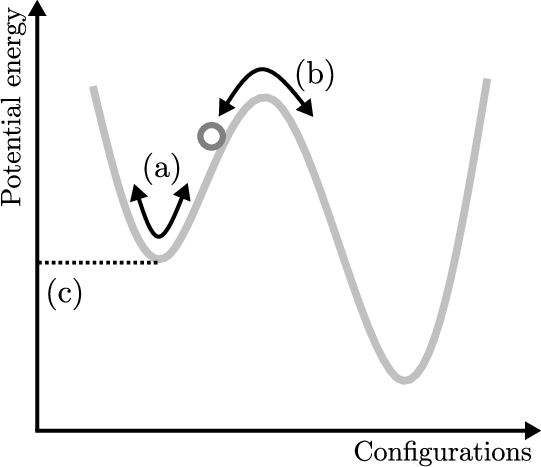
Figure 7: Schematic of the PEL: (a) inherent structure minimum; (b) saddle point; (c) inherent structure energy level.
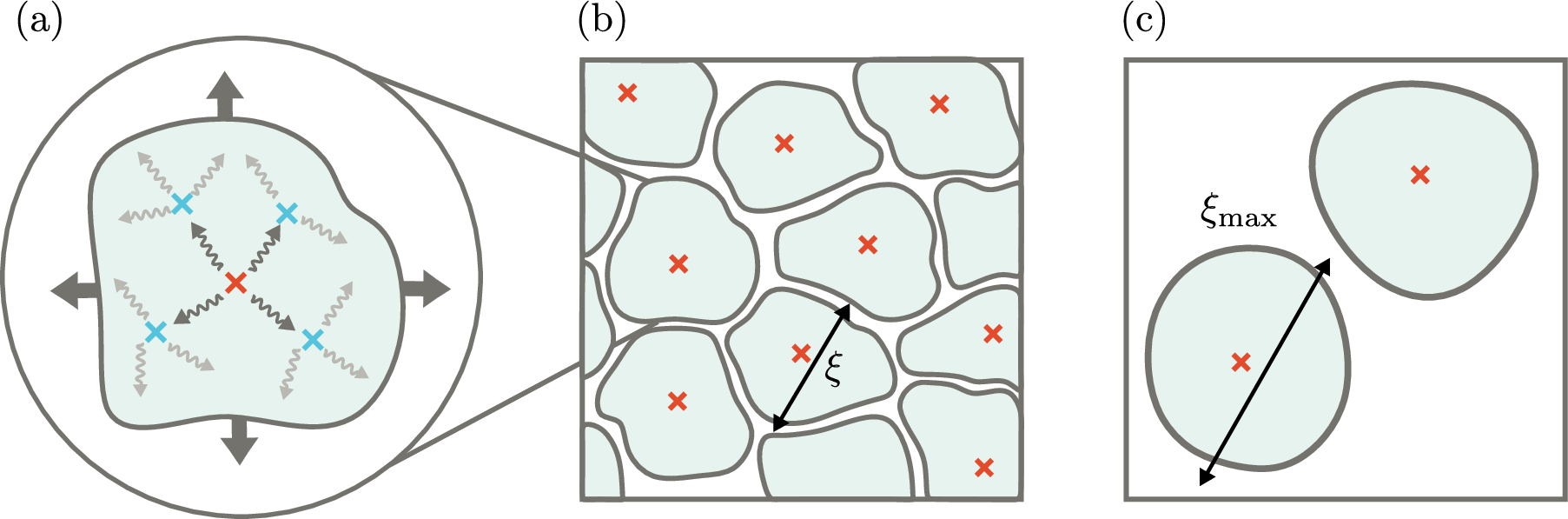
Figure 8: Sketches of avalanche growth processes and their jamming/unjamming transitions (defined as soft avalanche quasiparticle states), with regimes of high vs. low avalanche density.
Implications and Open Problems
Numerical Results and Contradictory Claims
- The scaling collapse of γ≈6.04 and independent determination of exponents constitute strong evidence for the zero-temperature avalanche scenario in the fragile KAM. However, this criticality applies only above the MCT crossover, beyond which saturated correlation lengths and complete mode localization take over.
- The study also addresses contradictory results regarding the low-temperature activation energy of relaxation events, highlighting the sensitivity to methodology and system size, and cautioning against universal extrapolation.
Broader Theoretical Context
- The results naturally connect dynamical facilitation models, elastoplasticity, MCT, and replica concepts of the Gardner transition in a cohesive PEL framework. The conclusion that avalanche criticality does not persist deep into the glassy regime challenges theories positing a zero-temperature glass transition underpinned by diverging length scales.
- The precise onset of criticality, its dependence on local vs. cooperative mechanisms, and distinctions between energy and entropy barriers in the landscape all emerge as testable features.
Future Directions
- The findings caution against universality, as similar analyses in strong glass-forming or swap-move-enabled systems (where γ≈6.05 changes only at or below γ≈6.06) suggest that the role and temperature window of avalanche criticality can be system-dependent.
- Open avenues include robust determination of activation energies via single-event protocols, connecting PEL descriptors with deep-network-based structural indicators, and extending analysis to higher-dimensional and experimentally relevant glass formers.
Conclusion
By coupling meticulous dynamical and PEL measurements, this work establishes the zero-temperature avalanche criticality scenario as a robust organizing principle for slow dynamics in fragile supercooled liquids, resolving puzzling behaviors near the MCT crossover and giving substance to the notion that avalanche-mediated collective events govern heterogeneity and relaxation—up to an intrinsic landscape-imposed limit. The implications for theoretical unification and experimental exploration are substantial, warranting further investigation across models and material classes.