- The paper demonstrates a unified framework integrating static program analysis with LLM-guided dynamic UI exploration to boost mobile ad widget detection.
- It combines a Window Transition Graph with semantic and structural guidance to navigate complex UI flows and trigger dynamic ads.
- Experimental results show a 62.4% detection rate and 133 identified regulation violations, outperforming existing baselines.
LLM-Guided Mobile Ads Detection: AdWise
Introduction
The mobile advertising ecosystem is characterized by an ever-growing diversity of in-app ad displays and placement strategies, which pose persistent challenges for detecting and regulating ad content in Android applications. Traditional approaches leveraging general-purpose UI exploration or static content matching often exhibit brittleness and inefficiency due to dynamic ad content and the proliferation of non-deterministic UI flows. The paper "From UI to Code: Mobile Ads Detection via LLM-Unified Static-Dynamic Analysis" (2604.03561) proposes AdWise, a systematic framework addressing these limitations via the integration of static program analysis with LLM-guided dynamic UI exploration. The design of AdWise systematically identifies ad widgets and leverages an iterative LLM agent loop for targeted UI traversal, improving both detection coverage and regulatory compliance assessment.
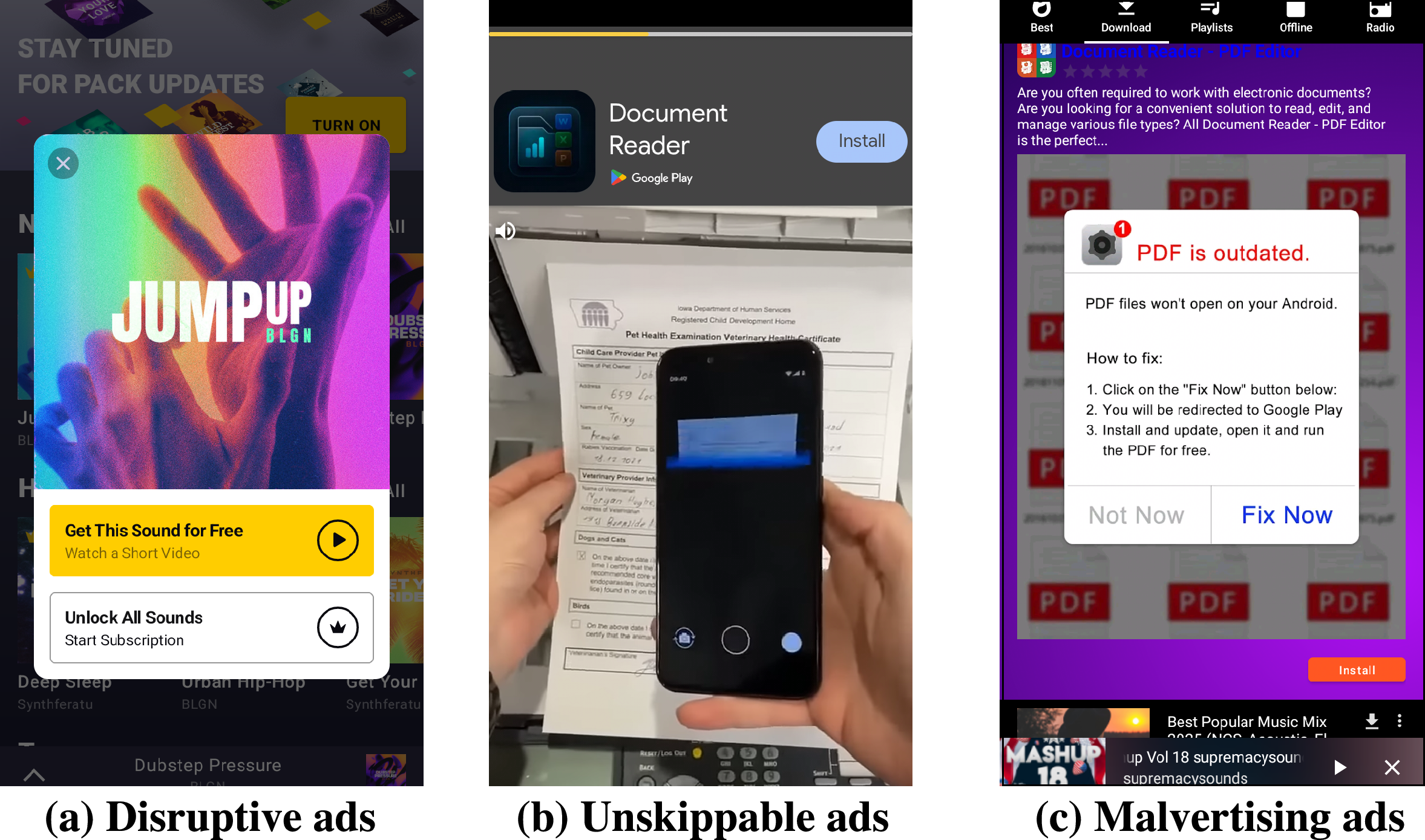
Figure 1: Examples of unwanted mobile ads, such as disruptive pop-ups and dynamically loaded banners.
The core problem addressed is the identification and dynamic activation of ad widgets across app UIs, followed by the detection of regulation violations. Ad widgets are specifically defined as UI components responsible for rendering advertisements—either via bundled ad libraries, developer-authored redirections, or interactions triggering ads upon user input. A principal insight is that ad widgets exhibit both semantic placement (integrated into core user flows) and structural placement (repetitive layouts, e.g., interstitials or menu-based ads), confounding pure static or content-based detection.
Exhaustive UI exploration is computationally prohibitive due to widget and state explosion, while static approaches cannot feasibly determine dynamic control flow reachability or triggerability for every ad widget due to over-approximation and practical imprecision. The explicit formalization of the detection challenge involves both: (1) identification of widgets with ad delivery potential in UI layouts, and (2) runtime triggering along feasible paths, with coverage constraints and efficient action budgets.
AdWise: Hybrid Static-Dynamic Detection via LLMs
AdWise is constructed as a pipeline with clear offline (static analysis) and online (dynamic exploration) phases:
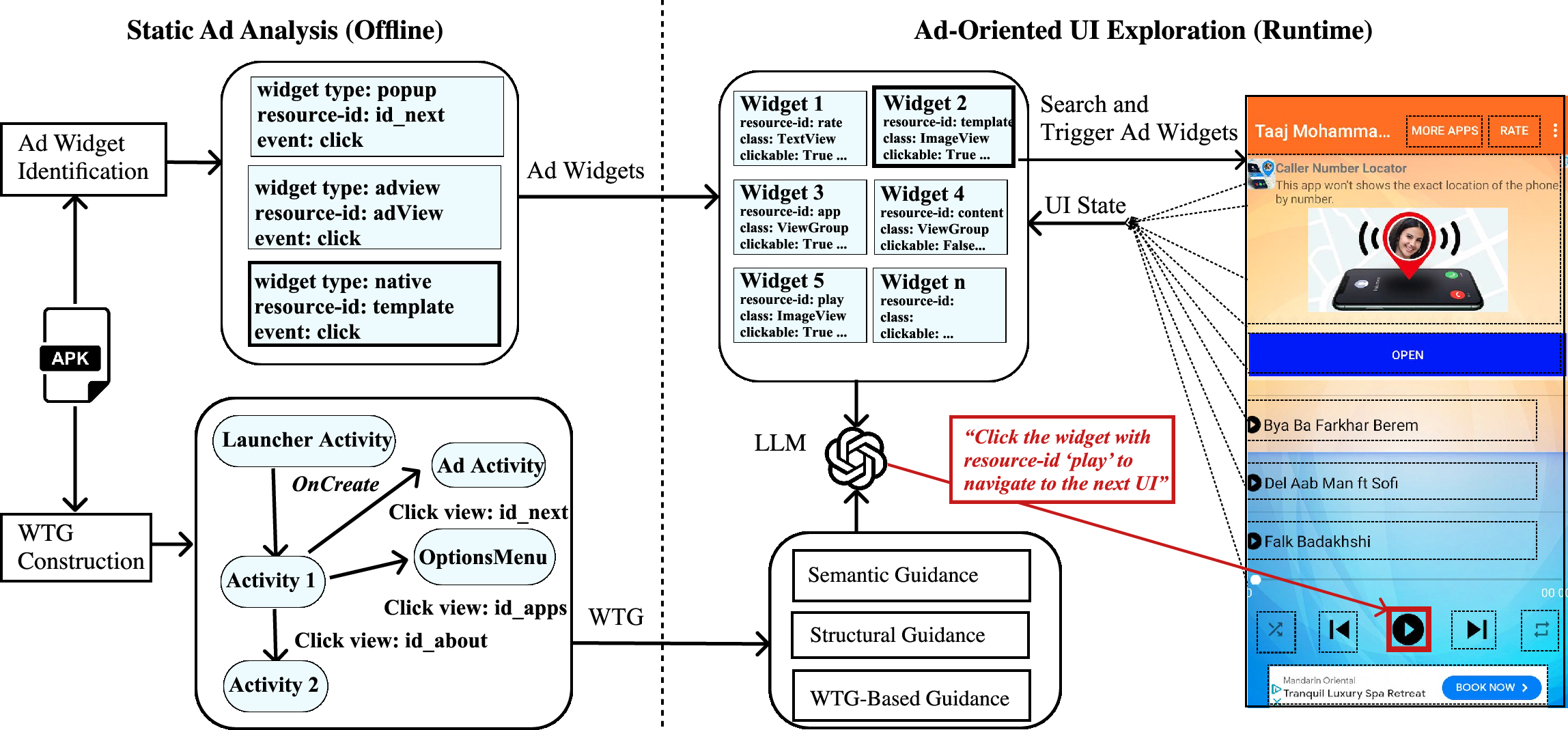
Figure 2: Overview of AdWise: static ad widget identification and WTG construction guide LLM-based interactive exploration of ad-related UIs, with WTG, semantic, and structural signals.
Static Ad Analysis
AdWise deploys dataflow analysis over APK code and layout resources to associate each widget with its view class, resource-id, and observed method invocations. Inference rules—parameterized over ad library APIs, method invocations, and intent destinations—classify widgets into three ad types: adview widgets, popup widgets, and native widgets. Overapproximate detections are retained for runtime pruning. The system synthesizes a Window Transition Graph (WTG), mapping possible transitions between windows (Activities, Dialogs, Menus, Fragments) with edge annotations specifying triggering widgets.
LLM-Guided UI Exploration
The LLM agent loop utilizes three orthogonal guidance signals at each step to maximally exploit prior knowledge and context:
- WTG-Based Guidance: Encodes global navigation priors using shortest-path distances, derived from the static WTG, and presented as textual context to optimize RL-based or instruction-following strategies.
- Semantic Guidance: Extracts application role, intent, and high-likelihood user flows using app store metadata (category, description), prompting the LLM to prioritize exploration trajectories consistent with typical usage.
- Structural Guidance: Employs retrieval-augmented generation (RAG), leveraging a knowledge base of prior ad-heavy UI layouts to supply analogical matches and common ad placement conventions, computed by embedding and similarity retrieval.
Critical to mitigating LLM hallucination are two runtime grounding techniques: explicit action reflection (comparing pre- and post-action UI states for effective feedback) and UI state verification (pruning non-clickable or occluded widgets), reinforcing the agent's reasoning with environment-grounded evidence.
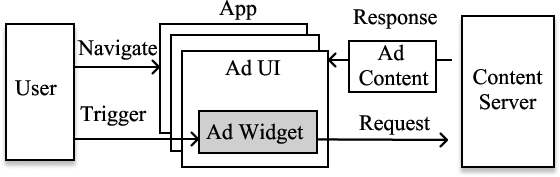
Figure 3: Mobile ad pipeline, highlighting the flow from user UI interactions through ad widget triggering, network content retrieval, and regulatory check points.
Experimental Results
Extensive empirical evaluation is conducted on a 100-app dataset (271 ad widgets), sampled to represent modern ad practices. AdWise is compared to multiple detection and exploration baselines, including MadDroid (UI class), AdGPE (textual), DARPA (vision), GoalExplorer (static WTG), Guardian (LLM-guided), and the default Monkey tool.
Key findings and strong numerical results:
- AdWise achieves a 62.4% detection rate (micro-averaged) across all ad widgets, exceeding GoalExplorer by 25.60%, and surpassing Guardian (LLM-guided UI exploration) by 42.33%.
- Detection of regulation violations is significantly higher: AdWise uncovers 133 violations (placement, interaction, content), a 34.34% improvement over the next-best baseline.
- Efficiency is also enhanced, with per-widget detection latency reduced by 8.68–53.23% relative to other methods.
Ablation experiments confirm the critical role of each guidance signal, with removal of structural, semantic, or WTG-based guidance resulting in detection rate drops of up to 25.97 percentage points.
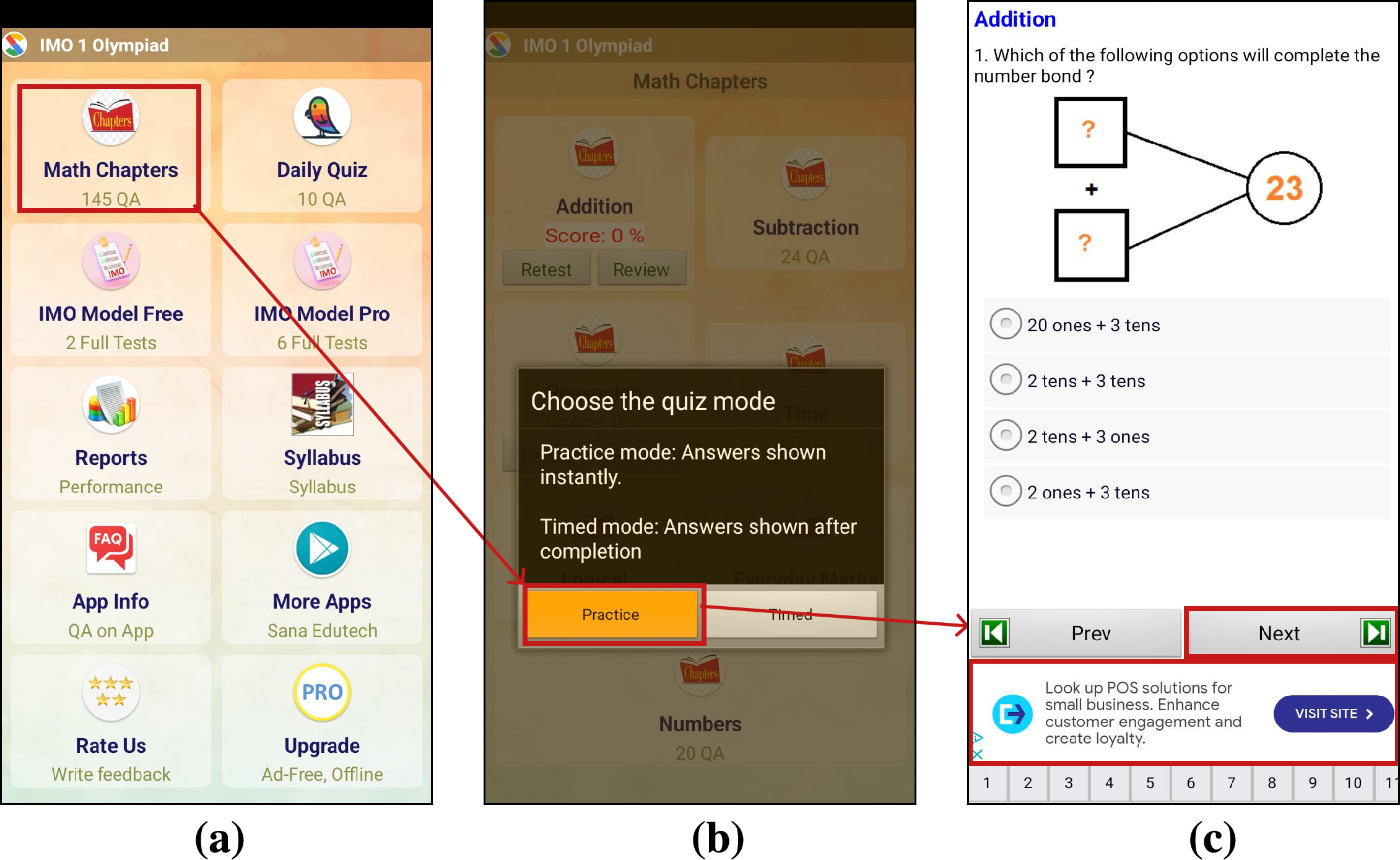
Figure 4: Case study illustrating AdWise's successful handling of non-trivial, multi-step UI navigation to trigger embedded popup and adview widgets.


Figure 5: Case study showing both correct static ad widget characterization and failure modes where dynamic exploration overcomes static imprecision.
Contradictory observation: Dynamic exploration can yield better coverage for certain ad widget placements (e.g., modal popups tied to non-explicit user actions) than static code analysis alone, demonstrating that holistic detection depends on the synergy of static and LLM-guided dynamic strategies.
Implications for AI, Mobile Security, and Future Work
The AdWise framework exemplifies how LLMs, when coupled with static program analysis, can operate as effective reasoning layers that reconcile over-approximate program semantics with observed UI dynamics, substantially improving task-oriented exploration in adversarial or highly dynamic mobile environments. The modular integration of domain signals (WTG, semantics, structure) provides a pattern for future agent-augmented program analysis systems.
The approach directly advances the state of compliance auditing for mobile ad ecosystems, enabling richer enforcement of placement, interaction, and content regulations—targeting both user experience degradation and privacy/security threats posed by malvertising.
Potential extensions include:
Conclusion
AdWise delivers a unified LLM-guided static-dynamic analysis framework for robust, efficient detection of mobile ad widgets and regulation violations. The system demonstrates strong empirical gains in detection rate and analytical coverage over state-of-the-art baselines, driven by its domain-guided LLM reasoning loop. The research substantiates the utility of combining static program analysis with LLM-based UI reasoning in addressing complex, open-world software security and compliance tasks, and suggests a trajectory toward more intelligent and policy-aware automation in mobile app analysis.
Reference: (2604.03561)


