- The paper shows that autoencoder-based clustering can extract phase boundaries from continuous quantum measurements without explicit order parameters.
- It utilizes unsupervised learning on high-dimensional quantum trajectories to accurately pinpoint critical regions consistent with theoretical predictions.
- The approach enables scalable, experimentally accessible diagnostics for nonequilibrium phase transitions in open many-body quantum systems.
Autoencoder-Based Detection of Nonequilibrium Phase Transitions in Continuously Monitored Quantum Systems
Introduction
The detection and characterization of nonequilibrium phase transitions in open quantum systems remains an acute challenge in many-body physics, primarily due to the experimental inaccessibility of suitable order parameters and the limitations posed by repeated projective measurements or quantum state tomography. The paper "Detecting nonequilibrium phase transitions via continuous monitoring of space-time trajectories and autoencoder-based clustering" (2602.17341) systematically investigates whether high-dimensional experimental records from continuous quantum measurements, notably heterodyne detection, contain sufficient information to identify dynamical phases and locate critical points without recourse to explicit knowledge of order parameters.
The study employs the quantum contact process as a testbed—a paradigmatic many-body stochastic model featuring an absorbing-state phase transition, analogous to classical directed percolation but complicated by strong quantum fluctuations and the presence of an absorbing state, which makes the steady-state order parameter uninformative in finite systems. The system comprises a chain of two-level sites evolving under both coherent and monitored dissipative processes, where heterodyne-detected emission records are continuously accessible during experiments.
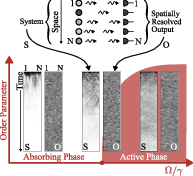
Figure 1: Quantum trajectories and measured outputs across the phase diagram of the quantum contact process. Distinct dynamical regimes are directly encoded in the local order parameter trajectories, while heterodyne currents appear structureless but are readily experimentally accessible.
The experimental protocol involves simulating the stochastic Schrödinger evolution (quantum-state diffusion) with system outputs processed to yield both the traditionally used local density of active sites and the real heterodyne current. The former is inaccessible experimentally; the latter can be continuously recorded, but appears, on visual inspection, to lack distinctive features distinguishing phases.
Unsupervised Machine Learning Approach
The central methodological advance is the deployment of unsupervised autoencoders—a class of neural networks that force high-dimensional inputs through a low-dimensional bottleneck. The autoencoder is trained to compress space-time quantum trajectories into a two-dimensional latent space representation optimized to retain essential reconstructive features. Phase identification is subsequently performed by clustering in the latent space, using a Gaussian mixture model to ascribe phase probabilities to individual trajectories.
Clustering and Identification of the Phase Transition
Analysis begins by benchmarking on the simulated trajectories of the local order parameter, verifying that autoencoder clustering reconstructs the expected phase boundary and associated crossover, with the transition point estimated as (Ω/γ)cAE∈[5.5,6.5], comparing favorably with prior estimates (5.9≤(Ω/γ)c≤7) obtained by other methods.
Extension to experimentally accessible heterodyne trajectories yields a similarly sharp separation in latent space and provides cluster assignments that interpolate smoothly between phases. Notably, these assignments exhibit robust agreement with the results from the inaccessible observable-based approach, with the critical region identified at (Ω/γ)cAE∈[5.0,6.5].
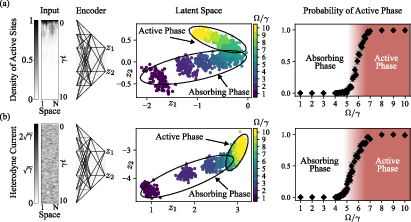
Figure 2: Latent space encoding of 1000 quantum trajectories by the autoencoder, showing clear phase separation and a sharp clustering transition as the control parameter Ω/γ is varied; results shown for both local order parameter and heterodyne current inputs.
This establishes that, despite their apparently noisy and unstructured appearance, measured heterodyne currents retain sufficient relational information for unsupervised machine learning to infer emergent collective behavior and locate phase transitions.
Model Architecture and Training Details
The autoencoder architecture is a fully connected network with input and output layers matching the dimensionality of the observed trajectories (up to $6000$ for full trajectories and $5730$ for time-averaged signals), two bottleneck latent dimensions, and symmetric hidden layers of $1000$ units. The network is trained over 20 epochs with Adam optimization at a learning rate of 10−3, with convergence validated by the loss function reaching a consistent minimum.
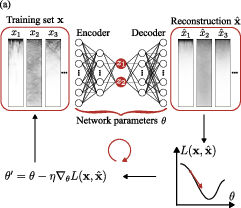
Figure 3: Schematic of the autoencoder architecture: high-dimensional trajectory data are compressed to two latent variables before being passed through the decoder to reconstruct the input, with training optimized via reconstruction loss.
Architectural simplicity was prioritized; more elaborate recurrent or transformer-based models were not required to achieve clear phase discrimination but remain promising for increased interpretability and performance.
Critical Behavior and Scaling Analysis
Criticality was quantitatively probed by fitting the association probability to a power-law form near the detected transition. For both order-parameter and heterodyne-based analyses, extracted exponents βAE are consistent with prior independent theoretical predictions and recent numerical evaluations of the critical scaling exponents for the quantum contact process, lending credibility to the physical nature of the autoencoder-inferred effective order parameter.
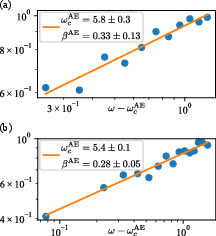
Figure 4: Power-law fit of the cluster-based probability to be in the active phase, revealing the critical exponent and location derived from both the order parameter and heterodyne current data.
Discussion and Implications
The results highlight two pivotal achievements. First, the entire space-time structure of continuously monitored signals—not just temporally local or ensemble-averaged observables—encapsulates the necessary information to distinguish nonequilibrium phases, given appropriate unsupervised learning frameworks. Second, the alignment of network-inferred critical exponents and points with those from theoretically principled but experimentally inaccessible order parameters validates the use of heterodyne current data as an experimental diagnostic for dynamical quantum phase transitions.
Practically, this implies that large-scale quantum simulation platforms with local-resolved continuous monitoring (e.g., Rydberg arrays, trapped ion simulators) can be paired with unsupervised learning pipelines to extract phase diagrams and study critical phenomena without detailed knowledge of the underlying Hamiltonian or dissipation mechanisms. This paradigm could be extended to circuits with mid-circuit measurements, quantum cellular automata, and more complex models where direct order parameter access is infeasible.
From a theoretical perspective, the observed success of low-dimensional latent representations in clustering phases from high-dimensional, highly nontrivial quantum dynamics supports conjectures regarding emergent dimensional reduction and effective order parameters being encoded in the measurement records themselves.
Ongoing developments could incorporate advanced neural architectures (recurrent, attention-based) for trajectory modeling, and systematic treatment of finite detection efficiency and other experimental imperfections.
Conclusion
This work demonstrates that autoencoder-based unsupervised clustering on continuous quantum measurement records provides a viable and robust strategy for detecting nonequilibrium phase transitions and extracting critical scaling behavior in open quantum many-body systems (2602.17341). The approach holds significant promise for experimental implementations, opening avenues for data-driven diagnostics of complex phases in synthetic quantum systems and informing future studies utilizing AI for quantum dynamical characterization.