- The paper's main contribution is highlighting rural educators' unique challenges and opportunities in adopting generative AI amid infrastructural inequities.
- It employed a rigorous qualitative methodology combining surveys (N=29) and interviews (N=6) to extract nuanced insights from rural contexts.
- Findings indicate that tailored professional development and participatory design are critical for effective, equitable GenAI integration in rural schools.
Amplifying Rural Educators' Perspectives: Generative AI's Impact in U.S. High Schools
Context and Research Motivation
The paper "Amplifying Rural Educators' Perspectives: A Qualitative Study of Generative AI's Impact in Rural U.S. High Schools" (2604.03542) investigates how rural high school educators across Arizona, Maine, and North Carolina are encountering, adopting, and envisioning the use of generative AI (GenAI) in K-12 educational contexts. The study foregrounds rural educators' voices, systematically addressing how GenAI both magnifies persistent institutional inequities and inspires future-oriented possibilities tailored to rural needs—gaps largely ignored in the dominant, urban-centric HCI and educational technology discourse.
Methodological Overview
A rigorous qualitative methodology combines an online survey (N=29) with semi-structured in-depth interviews (N=6), targeting current rural high school educators. Recruitment leveraged local networks and partnerships with rural education alliances to enhance trust and validity. Data analysis followed a grounded theory-informed open coding process, with emergent themes subsequently re-evaluated through a critical rural theory lens. Deductive codebook application to both interview and open-ended survey responses ensured alignment of findings.
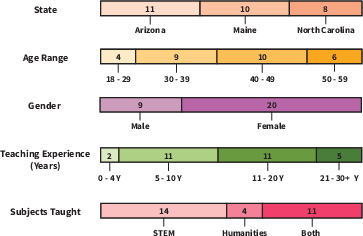
Figure 1: Demographics of survey and interview participants highlight state-level diversity, teaching experience, and subject distribution within the rural high school educator population.
Rural Educational Context and Technology Integration
Participants characterized their rural settings as geographically isolated, resource-constrained environments with small school and class sizes, limited connectivity, and minimal access to professional development (PD) or advanced technological infrastructure. Locally grounded, place-based pedagogies dominate instructional practice, emphasizing experiential, outdoor, or industry-relevant learning. Despite the presence of ubiquitous digital tools (e.g., smart boards, presentation software), persistent technical infrastructure gaps (unreliable broadband, device shortages) and high educator workload impede meaningful technology integration.
The majority of educators used GenAI instrumentally for teacher-facing tasks: curriculum and worksheet generation, grading, formative feedback, and differentiated instruction. Mechanisms cited for efficiency gains are consistent with prior findings on time-saving potential for repetitive or admin tasks [han2024teachers, tan2024more]. Adoption of mainstream GenAI platforms (ChatGPT, Gemini, Claude) was complemented by emerging educator-specific systems (MagicSchool AI, SchoolAI, Brisk), though usage remains constrained by inequitable access and insufficient training.
Persistent and Emerging Barriers to GenAI Adoption
Participants universally identified chronic infrastructural inequities—including unreliable internet access, device shortages, and prohibitive software costs—as primary barriers to GenAI adoption. These deficits are compounded by staffing instability, with rural educators often required to teach multi-grade or multi-disciplinary classrooms, further amplifying the demand for support.
A critical new challenge is the pronounced gap in AI literacy. Educators voiced deep concern over both their own lack of operational and critical understanding of GenAI and their inability to guide students in responsible usage. Fears extend to the exacerbation of plagiarism, academic dishonesty, and the "hallucination of learning"—where students gain a false sense of mastery via AI-generated content. Notably, 79.3% of educators expressed low confidence in building effective GenAI skills (see Figure 2), with 75.9% reporting difficulty in keeping pace with rapid technological shifts, which confirms the urgent need for rural-specific GenAI PD infrastructure.
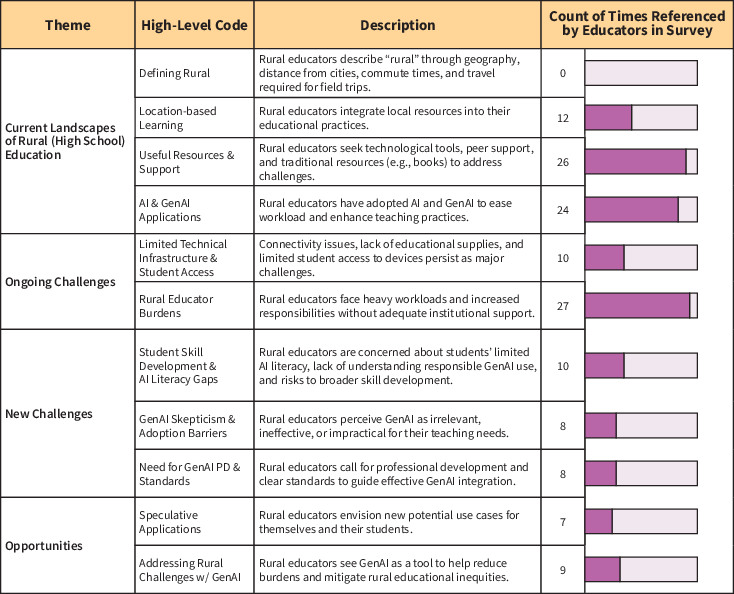
Figure 3: Prevalence of emergent barriers and opportunities codes, as quantified in the open-ended survey analysis.
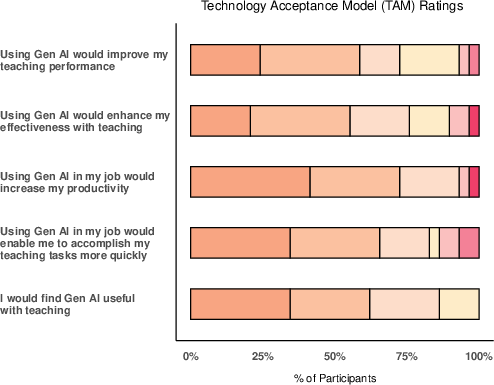
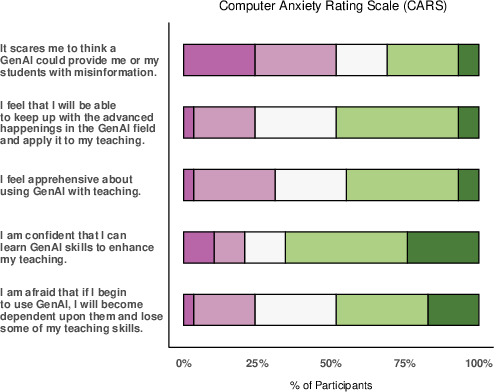
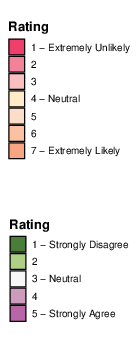
Figure 2: Distribution of Technology Acceptance Model (TAM) and Computer Anxiety Rating Scale (CARS) responses, indicating simultaneous high perceived usefulness and high anxiety among rural educators.
Beyond individual hesitancy, educators highlighted the absence of clear standards, actionable policy guidance, or systemic supports for AI integration—further complicated by community- and parent-level skepticism.
Opportunities and Speculative Visions
Despite systemic constraints, educators articulated a range of speculative and context-specific GenAI applications:
- Curriculum adaptation: On-demand lesson plan and material differentiation for diverse grade bands and reading levels.
- Resource augmentation: Automated quiz/question generation, multi-modal content creation, and robust support for after-school/extra-curricular programming.
- Student-facing supports: GenAI as peer-like writing partners, bilingual tutors, and accessibility companions for students with disabilities or learning differences.
- Operational automation: Streamlining grading, administrative communication, and classroom management tasks.
- Location-based learning: Tools to tie GenAI output to local resources, agricultural contexts, or regionally-relevant curricula—currently unsupported in mainstream AI deployments.
Adoption optimism is strongest when educators envision GenAI designed for rural constraints (e.g., offline/local models, low-bandwidth optimization). The majority (82.8–93.1%) see future GenAI as enhancing productivity, teaching performance, and overall effectiveness (see Figure 4).
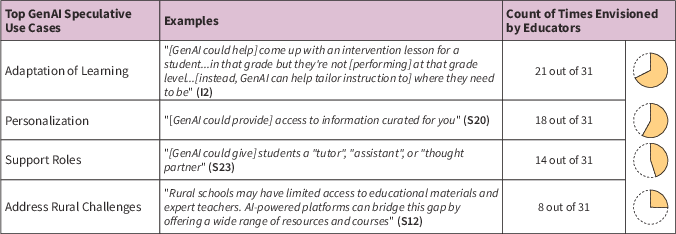
Figure 4: Top speculative GenAI use cases for rural educators and students, synthesized from survey and interview data, showing high enthusiasm for contextually adaptive and efficiency-driven applications.
Importantly, some educators identify their "rural lag" in technology adoption as a protective buffer, allowing them to learn from urban districts' challenges and proactively design locally responsive strategies.
Theoretical Analysis: Power, Equity, and the Rural Condition
Applying a critical rural theory framework, the study documents how ambiguous, urbannormative definitions of "rural" in education policy systematically reproduce resource disparities and digital exclusion ("digital redlining"). Rural educators' agency in technology adoption is systematically marginalized: they lack input into GenAI development, state-level standards, or PD resource allocation. Even well-intentioned "equity-driven" AI interventions can intensify the divide when not attuned to rural pedagogies and priorities.
The findings disrupt the linear "modernization" rhetoric, emphasizing that mere access to GenAI tools is inadequate for equity. Effective, responsible integration depends on culturally congruent designs (e.g., facilitating place-based learning, supporting communal and experiential practices fundamental to rural teaching).
Implications for HCI, Policy, and Future Research
The paper's results have several practice- and design-level implications:
- Professional Development and AI Literacy: There is a demonstrated need for comprehensive, recurring rural-centric AI and GenAI literacy programs. These should prioritize local in-person and asynchronous options that address unique infrastructure gaps and educator role multiplicity.
- Inclusive, Participatory Design: Effective GenAI integration requires authentic, long-term partnerships with rural education stakeholders—moving from "design for" to "design with" rural educators. Participatory co-design models should foreground locally-defined goals, curricular assets, and community values.
- Contextual and Adaptive AI Tooling: Development of GenAI systems for rural schools should include locally hosted, offline-capable, or low-bandwidth models and interfaces. This also benefits other under-resourced environments, underscoring broader relevance.
- Policy and Standards Development: Institutional and state actors must establish clear, flexible policies for responsible GenAI classroom use, incorporating diverse rural perspectives, parent concerns, and teacher agency.
- Research Scope Expansion: The sample skewed toward STEM educators, reflecting existing patterns of digital readiness. Further research must probe non-STEM rural contexts and triangulate educator data with student, family, and administrator perspectives across a broader geographic cross-section.
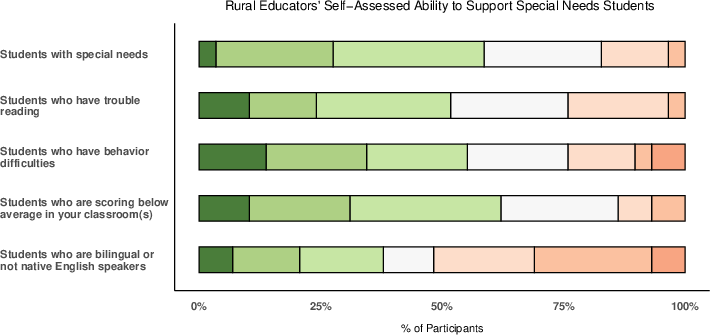

Figure 5: Rural educator ratings of their ability to support students with diverse needs, underscoring existing resilience but limited by resource and training deficiencies.
Conclusion
This study delivers an empirically grounded, critically reflective analysis of GenAI's role in rural U.S. high schools, highlighting the interplay between structural inequity, educator agency, and unaddressed design gaps. Amplifying rural educator perspectives reveals both the acute risks of exacerbating the digital divide and significant untapped potential for context-responsive, equity-centric GenAI innovation. Closing these gaps will require concerted investment in rural-specific PD, participatory design practices, and infrastructure transformation—lessons that are essential not only for rural communities but for any educational context navigating the rapid diffusion of AI.
Reference: "Amplifying Rural Educators' Perspectives: A Qualitative Study of Generative AI's Impact in Rural U.S. High Schools" (2604.03542)

