- The paper introduces Topaz, a novel framework that delivers explainable, cost-aware routing by synthesizing skill-based model capabilities.
- It formalizes model and task profiling through benchmark decomposition and employs dual-objective routing algorithms for optimized assignments.
- The framework generates evidence-based explanations to reduce black-box failures and enhance auditing in complex, agentic LLM workflows.
Explainable Model Routing in Agentic Workflows: The Topaz Framework
Introduction
The shift from monolithic LLM deployments to agentic pipeline architectures introduces critical complexity for routing tasks to models in a cost- and performance-efficient manner. However, the routing layer in agentic AI is now a locus for latent failures and opaque trade-offs, particularly as organizations increasingly rely upon routing architectures to allocate subtasks among a diverse set of models with highly varied price-performance profiles. The lack of formal, actionable explainability in routing decisions exposes deployed agentic systems to silent quality degradation and undermines developer trust.
"Explainable Model Routing for Agentic Workflows" (2604.03527) systematizes a solution by introducing Topaz, an inherently interpretable routing framework. This framework instruments the routing process at three levels: (i) synthesis of skill-based model capability profiles from public benchmarks, (ii) cost-aware, fully auditable routing algorithms, and (iii) developer-facing explanation generation grounded in actual decision traces. The central contribution is the extension of explainable AI (XAI) beyond single-model inference to the complex space of agentic orchestration.
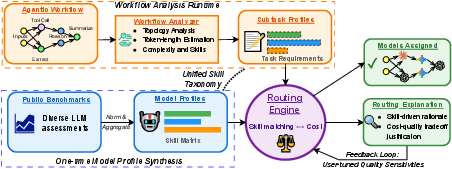
Figure 1: Topaz architecture: skills-based profiles are derived from benchmarks and subtasks, and cost-aware routing/traceability yield interpretable assignment explanations.
Topaz formalizes LLM and task capabilities within a shared, human-interpretable skill taxonomy. Each model is mapped from third-party benchmark performance scores to per-skill capabilities via benchmark decomposition, with each skill normalized and grounded in natural language. For agentic workflows, each subtask is mapped to a vector of required skill weights, as well as metadata such as estimated token counts, complexity, and fine-grained, developer-adjustable quality sensitivity.
Static model profiles are synthesized as weighted sums of normalized benchmark scores, decomposed by skill. Subtask profiles are determined by LLM-driven prompt analysis, which allocates per-skill weights and produces continuous-valued complexity and quality sensitivity estimates. The model-task fit is strictly capped—excess skill is not rewarded—ensuring saturation effects do not artificially boost high-end models and that routing signals remain discriminative in heterogeneous model pools.
Cost Modeling for LLM Inference
Topaz decouples cost optimization from brittle predictions of output length via a relative per-token rate computation informed by the estimated input/output skew. All costs are normalized over the available model pool, producing numerical cost penalties directly comparable to skill match scores. This calibration ensures that routing decisions are not only cost-optimal but also robust to API estimation errors, a practical necessity in real-world multi-LLM deployments.
Interpretable Routing Algorithms
Routing is operationalized via two dual-objective algorithms:
- Objective-based routing: For each subtask, an assignment is made by optimizing a user-parameterized weighted sum of quality (via skill match) and normalized cost penalty, with further weighting by the per-task quality sensitivity and a global cost sensitivity.
- Budget-based routing: Dynamic programming maximizes cumulative skill-weighted output quality subject to an explicit global budget, yielding consistent assignment recovery and supporting pipeline-level cost auditing.
Both approaches preserve complete intermediate computation traces, which serve as the factual substrate for explanation generation.
Explanation Generation and Auditing
Topaz produces both local (per-task) and global (pipeline-level) explanations by translating internal computation logs into concise, actionable rationales. This design is critical to supporting both debugging and system development workflows, as opaque or post-hoc rationalization undermines developer agency. Importantly, the explanations are grounded only in real optimization traces and not externally rationalized, ensuring fidelity and trust.
Case Study: Customer Support Pipeline
In a multi-stage customer support agentic pipeline, Topaz demonstrates coherent and explainable adaptation to global cost-quality preferences. For tasks such as technical diagnosis with maximal quality sensitivity and nontrivial complexity, the router consistently assigns the highest-performing models—e.g., Claude-Opus-4.5 or Gemini-3-Pro—while downgrading less critical subtasks, like ticket classification or escalation summary, to more economical models as cost sensitivity is increased.

Figure 2: An agentic customer support workflow, with subtask quality sensitivities and dominant skills mapped for model routing.
Explanations produced by Topaz for routing assignments are concise and evidence-based, detailing, for instance, that cost savings result from capability saturation rather than degradation, and directly indicating which subtasks would be most affected by further compression of budget constraints. Table-based results within the paper reveal threshold points where model assignments shift under increasing cost pressure, validating the granular control enabled by the joint quality-cost routing objective.
Theoretical and Practical Implications
Topaz sets a new standard for explainability in multi-model, agentic routing environments. The trade-space between cost, quality, and skill saturation is made explicit, enabling rigorous auditing and post-hoc re-tuning. In practice, this reduces the black-box failure risk inherent to cost-motivated routing and helps developers determine whether performance reductions are an artifact of legitimate task-model fit or a latent source of silent failure.
Theoretically, Topaz's formalization demonstrates that interpretable, skill-grounded routing can scale to real-world agentic workflows without incurring excessive complexity. By embedding explanation logic within the optimization loop, rather than as post-hoc rationalization, the framework supports more trustworthy and auditable AI orchestration. The approach further motivates future developments in:
- expanding skill taxonomies for workflow domains beyond language,
- automated benchmark decomposition and benchmarking for emerging LLM modalities,
- integrating downstream behavioral auditing in addition to model selection logic.
Conclusion
"Explainable Model Routing for Agentic Workflows" introduces the Topaz framework—a practical, explainable, and auditable solution to the increasingly salient problem of LLM routing in agentic systems. By grounding routing assignments in explicit, interpretable skill profiles and faithfully tracing cost-quality decisions, Topaz offers a scalable path to trustworthy, developer-centric agent orchestration.
The methods and formalism established here lay a foundation for broader adoption of agentic systems in mission-critical domains and inform future research in both human-centered XAI and multi-model orchestration.