- The paper shows that increasing the trap’s motional frequency significantly reduces decoherence and improves state preparation fidelity (from 89.5% to over 99.8%).
- It details an experimental design that balances factors such as ion charge-to-mass ratio, electrode spacing, RF drive frequency, and amplitude to achieve a nearly linear enhancement in radial confinement frequency.
- The study demonstrates that higher motional frequencies enable faster cooling rates and reduced operational runtimes, thereby facilitating scalable quantum error correction and more robust quantum information protocols.
Overview and Motivation
The paper "A High Motional Frequency Ion Trapping Regime for Quantum Information Science" (2604.03435) presents a comprehensive investigation of trapped-ion systems operated in a regime where the motional (secular) frequencies are increased by an order of magnitude or more. The motivation is grounded in the observation that decoherence mechanisms—including motional heating, dephasing, extended cooling durations, and recoil-induced excitations—are major limiting factors for fidelity, scalability, and runtime efficiency in quantum information protocols using trapped ions. High motional frequencies offer a pathway to mitigate these limitations, leading to enhanced quantum control techniques, faster experimental duty cycles, and improved robustness against environmental noise.
Experimental Design Considerations for High Frequency Operation
Achieving high motional frequencies in radio-frequency (rf) traps requires careful balancing of several experimental variables: the ion's charge-to-mass ratio (Q/m), ion-electrode spacing (r0), rf drive frequency (Ωrf), and rf amplitude (V0).
Increasing Ωrf is favored since it allows substantial gains in ν while maintaining adiabatic trapping with low micromotion amplitude (q2≪1). The scaling relationships reveal that, with fixed q, ν increases approximately linearly with Ωrf, whereas changes to r00, r01, or r02 alone are more constrained by technical and noise considerations, such as anomalous heating scaling with r03, or laser accessibility.
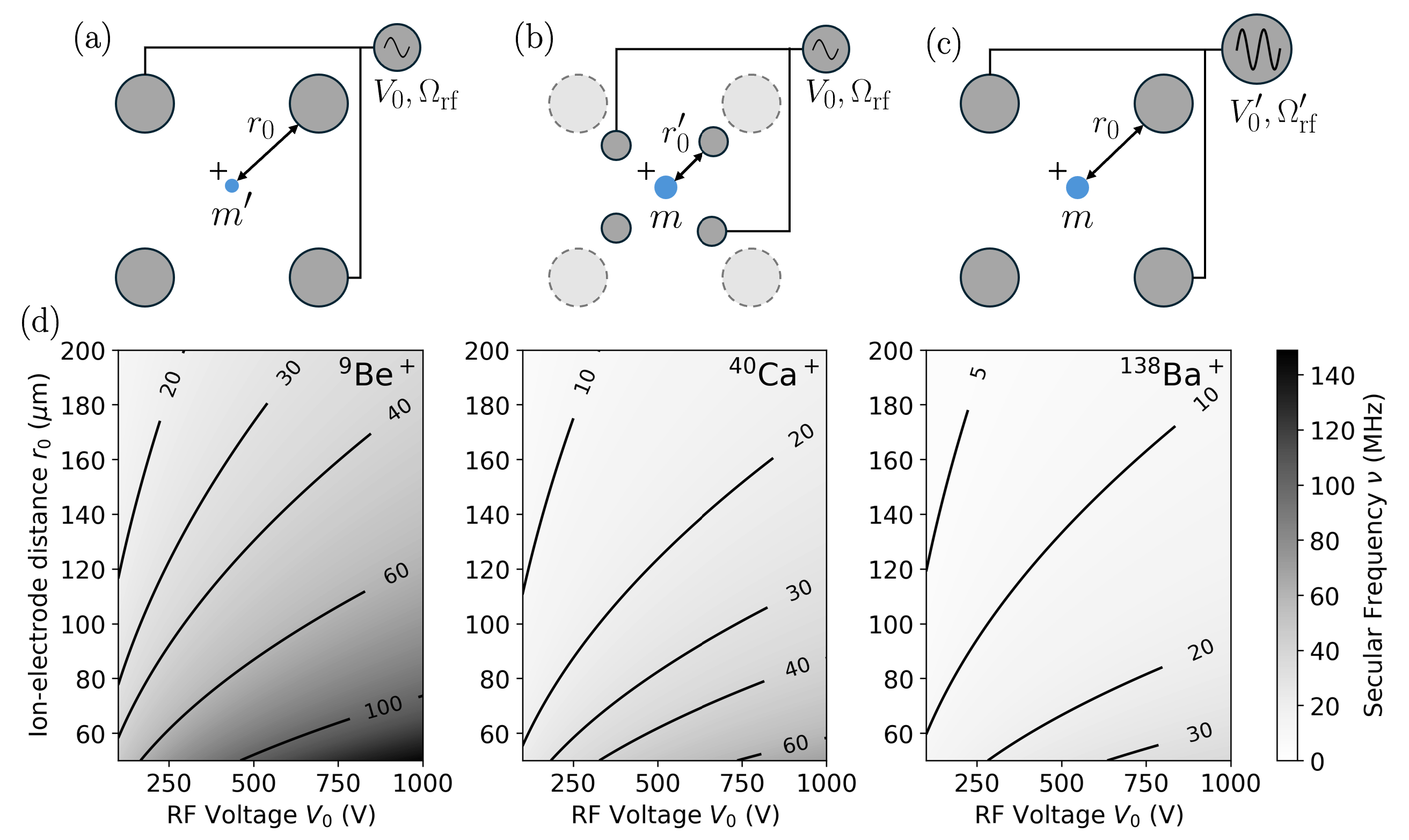
Figure 1: Variations in trap design parameters and the resultant changes in radial confinement frequency; lighter ions, smaller ion-electrode distances, and higher rf frequency/amplitude all contribute to increased motional frequencies.
The design flow Figure 2 encapsulates the optimization: target motional frequency and micromotion amplitude are set, r04 is selected accordingly, and remaining parameters are balanced for practical implementation.
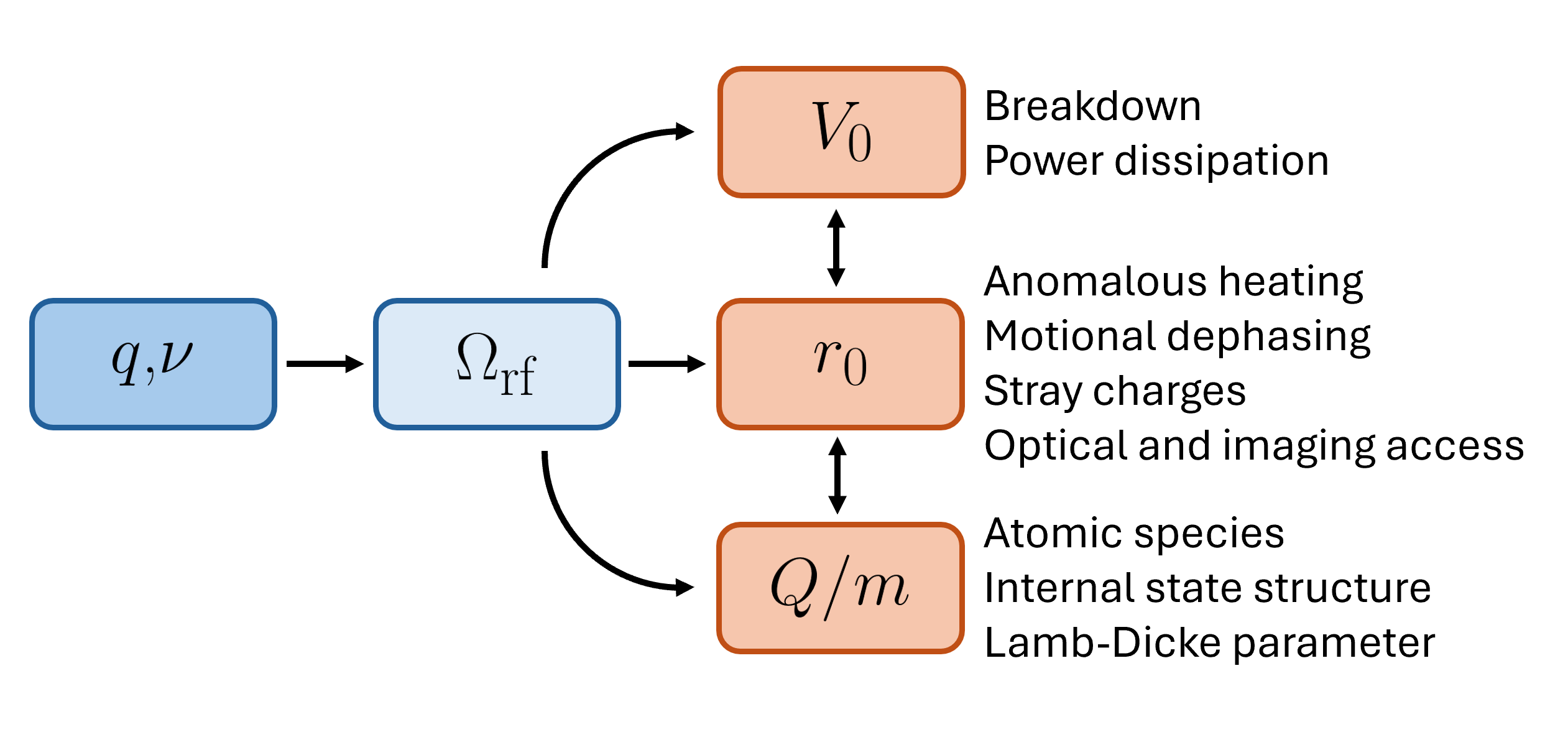
Figure 2: Schematic outlining the interplay of design parameters for realizing high r05 ion traps.
Laser Cooling Dynamics: Resolved vs. Unresolved Regimes
Laser cooling is dominated by two regimes: unresolved sideband (r06) and resolved Doppler (r07), where r08 is the atomic linewidth. The resolved regime enables spectrally distinct sidebands, which fundamentally alters cooling dynamics:
- Cooling rates are significantly faster in the resolved regime for light ions at high r09, with scaling sensitive to both Ωrf0 and Ωrf1.
- The cooling limit, i.e., the lowest achievable mean phonon occupation (Ωrf2), transitions from Ωrf3 (unresolved) to Ωrf4 (resolved), facilitating near-ground-state cooling without resorting to complex sub-Doppler protocols.
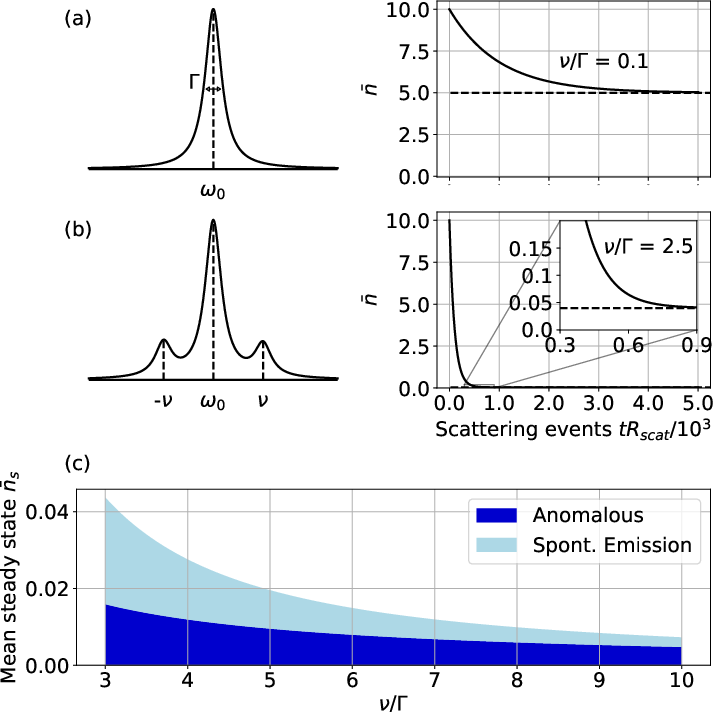
Figure 3: Comparative evolution of cooling rates and limits in resolved vs. unresolved Doppler sideband regimes; the resolved regime achieves faster cooling and lower steady-state Ωrf5.
Crucially, in multi-species or large-ion systems, the resolved regime improves scalability by reducing cooling load and enabling more accurate thermometry, critical for error mitigation.
Decoherence Mechanisms and High-Frequency Mitigation
Decoherence in trapped-ion motion arises from anomalous electric-field noise, photon recoil during measurement, and broadband dephasing. The paper delineates the scaling of these mechanisms with Ωrf6:
- Anomalous heating: Ωrf7 under typical assumptions; experimental constraints may reduce this to Ωrf8, but increased Ωrf9 consistently lowers heating rates.
- Measurement-induced recoil heating: Significantly suppressed at high V00 owing to reduction in Lamb-Dicke parameter (V01).
- Motional dephasing: High V02 moves noise sources into slower regimes, making them more amenable to mitigation; rate scales as V03.
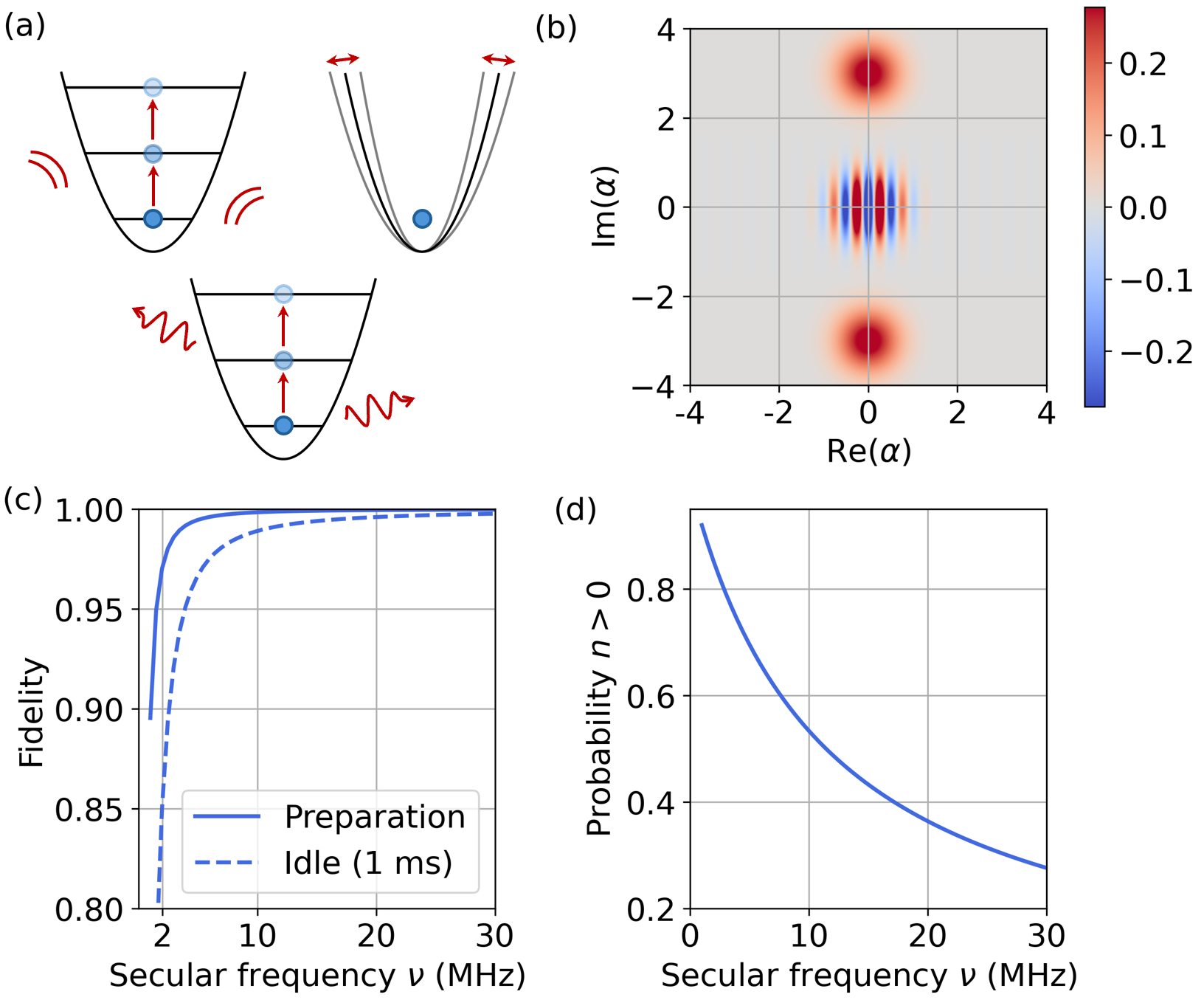
Figure 4: Reduction in primary decoherence processes—anomalous heating and photon recoil—as secular frequency increases; fidelity and lifetime of nonclassical motional states such as cat states are dramatically improved.
These improvements directly impact the preparation and preservation of highly nonclassical motional states used for bosonic encoding and advanced quantum error correction, with numerical results demonstrating a jump in preparation fidelities from V04 to V05 as V06 increases from V07 MHz to V08 MHz.
Runtime Efficiency and Scalability
The operational runtime in typical trapped-ion systems is dominated by laser cooling and transport. The paper quantifies how high motional frequencies reduce duty cycle durations:
- Cooling load and average runtime decrease by over an order of magnitude as V09 is increased, particularly when crossing into the resolved Doppler regime.
- Gate operation times, while mildly slowed for Mølmer-Sørensen gates (due to weaker spin-motion coupling), benefit from reduced mode crowding and selective multi-mode control.
- Transport protocols and adiabatic operations are significantly accelerated as the adiabatic condition scales inversely with Ωrf0.
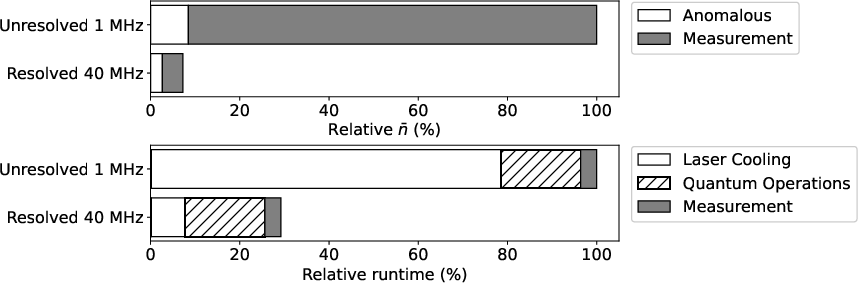
Figure 5: Comparative analysis of cooling load and experimental runtime for ion traps at 1 MHz and 40 MHz secular frequency, showing dramatic reductions in required cooling and total shot duration.
Quantum error correction protocols—which rely on repeated measurement and cooling—are particularly impacted. For example, cooling loads for the Ωrf1 bivariate bicycle code drop from over 1400 quanta per QEC round at 1 MHz to just 28 at 30 MHz.
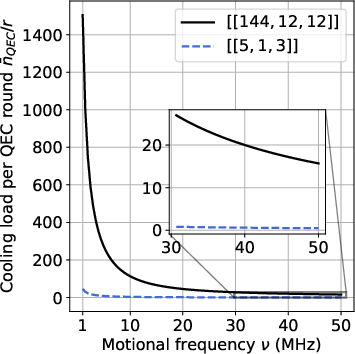
Figure 6: Cooling load per quantum error correction round for small and large stabilizer codes as Ωrf2 increases; scalability improves steeply in the high-frequency regime.
Practical and Theoretical Implications
High motional frequency operation in trapped-ion platforms opens several avenues for advancement:
- Enhanced motional coherence and fidelity: Nonclassical state preparation and lifetime benefit from reduced heating and dephasing, directly impacting bosonic codes and precision metrology.
- Efficient, scalable quantum error correction: Lower cooling loads and faster cooling rates address one of the primary bottlenecks for QEC implementation in large-scale computers.
- Experimental design flexibility: Higher Ωrf3 enables new architectures (e.g., dedicated fast zones in QCCD layouts), facilitates scalable optical cooling solutions, and allows easier mode selectivity for quantum simulation.
- Theoretical insight into noise mechanisms: Observing heating and dephasing rates in this regime can clarify their underlying scaling, which remains poorly measured above Ωrf420 MHz.
Speculatively, continued development and operation of high-frequency traps will catalyze advances in modular quantum computing, fault-tolerant architectures, quantum simulations of strongly correlated systems, and robust quantum metrology.
Conclusion
Operating trapped-ion systems in the high motional frequency regime provides a rigorous solution to longstanding decoherence and scalability challenges in quantum information science. The reduction in motional heating, faster cooling, improved state preparation fidelity, and runtime scalability collectively establish a new experimental and theoretical frontier. Further exploration will elucidate noise scalings at high frequencies and enable practical deployment for next-generation quantum processors and sensors.