- The paper shows deep K-band imaging with Keck/NIRC2 definitively excludes a luminous helium star companion by reaching a 5σ limit of Ks≈21.3.
- The analysis combines observational limits with spectral models, demonstrating that any He star (1.0–1.6 M☉) would have been detected, favoring a massive white dwarf companion.
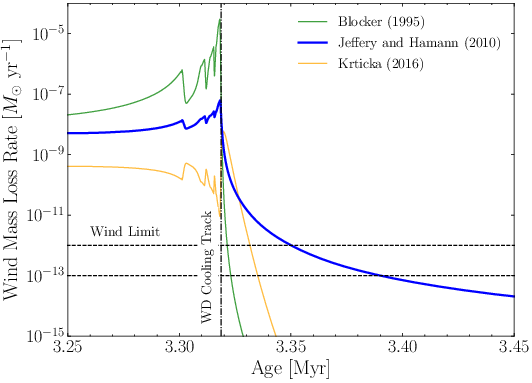
- Binary evolution simulations and wind models support a short-lived proto-WD phase, explaining the extended radio eclipses via synchrotron absorption.
Deep Adaptive Optics Imaging Excludes a Helium Star Companion to PSR J1928+1815
Introduction
The analysis centers on millisecond pulsar (MSP) PSR J1928+1815, a 10.55 ms pulsar in a 3.6 hr orbit with a massive companion displaying extended radio eclipses. The original hypothesis suggested the companion could be a stripped helium (He) star, given its high mass ($1.0$–1.6M⊙) and the radio eclipse profile, but a non-detection of any counterpart in prior optical/IR data left this interpretation uncertain. This work reports deep K-band imaging with Keck/NIRC2 laser guide star adaptive optics (LGS AO), yielding a 5σ limit of Ks≈21.3, and examines the implications for the companion’s nature, the eclipse mechanism, and binary evolution pathways.
Observational Constraints from Deep AO Imaging
The LGS AO-enabled NIRC2 imaging achieves substantially deeper and higher-spatial-resolution limits than prior near-IR surveys (e.g., UKIDSS, EMIR). The field is highly extincted, precluding optical detection, but these K-band limits are exceptionally constraining.
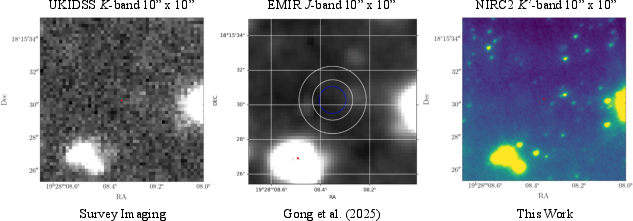
Figure 1: Comparison of near-infrared imaging cutouts from UKIDSS, EMIR, and Keck/NIRC2, all centered on the radio location of PSR J1928+1815. The Keck/NIRC2 data are deeper and resolve additional faint sources, yet none at the pulsar position.
To robustly quantify the detection threshold, artificial star injection and recovery are performed. These demonstrate that even for Ks=21, sources are visually obvious, and the 5σ detection limit is Ks≈21.3.
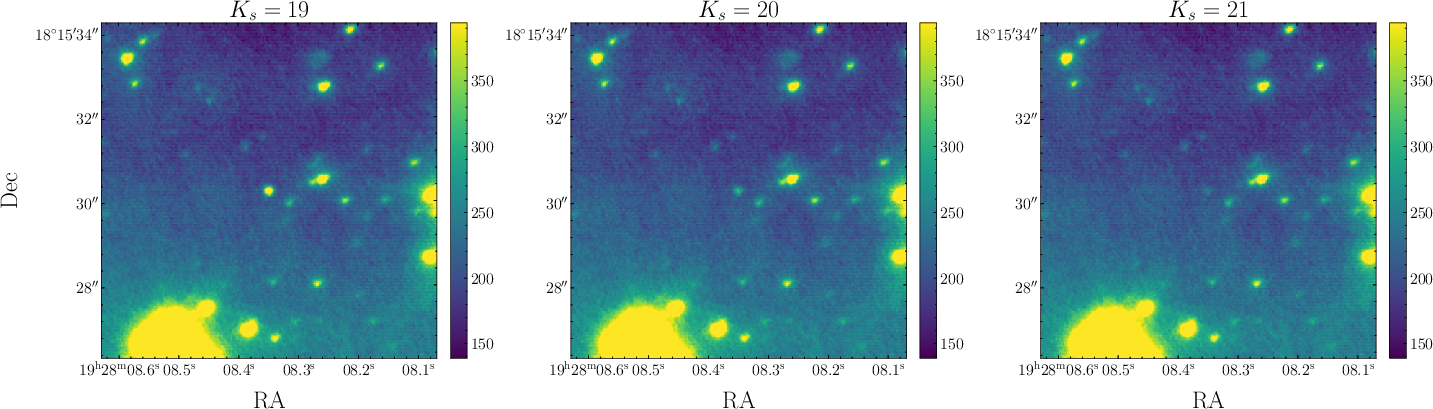
Figure 2: Injection/recovery of artificial point sources in the NIRC2 stack at the pulsar position demonstrates the 5σ limit is Ks≈21.3.
Exclusion of a Helium Star Companion
The combination of the deep Ks-band non-detection with theoretical models for stripped He stars yields strong constraints. Predictions using modern spectral libraries for He stars at plausible masses, distances, and extinction (using 3D dust maps) show that any He star with 1.6M⊙0–1.6M⊙1 in the Galactic plane towards PSR J1928+1815 should have been easily detected in these data, even under conservative assumptions. Thus, the hypothesis of a surviving luminous He star can be definitively rejected.
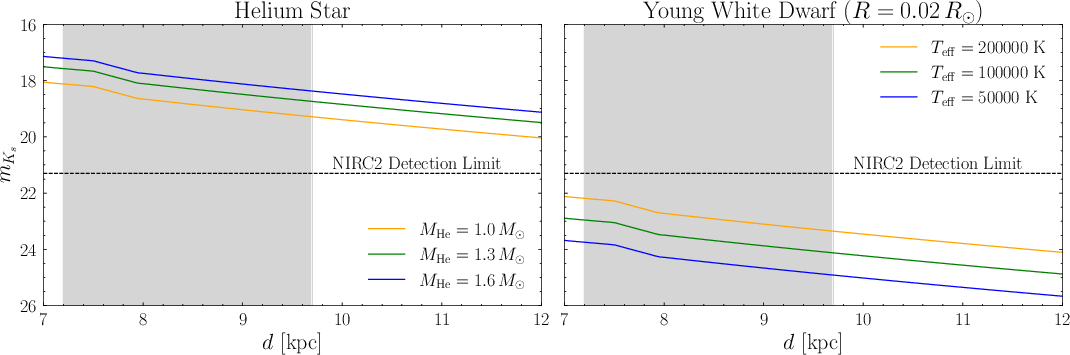
Figure 3: Predicted apparent 1.6M⊙2-band magnitudes for possible stripped He star and white dwarf (WD) companions as a function of distance, overplotted with the observational 1.6M⊙3 limit. All plausible He star models are excluded, but WD models remain allowed.
Astrometric distance constraints from pulsar dispersion measure (using NE2001 and YMW16 models) place the system at 1.6M⊙4–1.6M⊙5 kpc, further reinforcing that a He star would have been visible at this sensitivity.
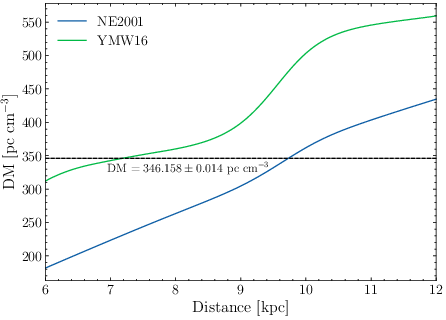
Figure 4: Pulsar dispersion measure as a function of distance from electron density models, with the observed DM shaded, constraining the plausible distance to 1.6M⊙68 kpc.
Nature of the Companion: Evidence for a White Dwarf
Constraining the companion to 1.6M⊙7–1.6M⊙8 and eliminating luminous He stars or neutron stars (the latter ruled out by the orbit’s low eccentricity and the lack of detectable luminous signature), the remaining viable scenario is a massive white dwarf (WD). Synthetic photometry and blackbody models for hot (proto-)WDs, even at the highest plausible temperatures, place such objects well below the detection threshold in 1.6M⊙9. Thus, a massive WD (likely CO or ONe composition) is highly favored.
The Radio Eclipse Mechanism
Given the small physical size of the WD (5σ0), the radio eclipses cannot be due to geometric occultation and must arise from plasma in the system. Two mechanisms are considered:
The required wind mass-loss rate and expected eclipse duration match the observations if the system is caught during this early (short-lived) WD phase.
MESA simulations that reproduce the observed system invoke common envelope evolution followed by stable Case BB mass transfer. The NS is spun up to millisecond periods as the He star completes its post-core helium burning evolution. Ultimately, a 5σ7 ONe WD is produced. The WD is expected to display a hot, wind-driving, short-lived pre-cooling phase, consistent with the observed current properties.
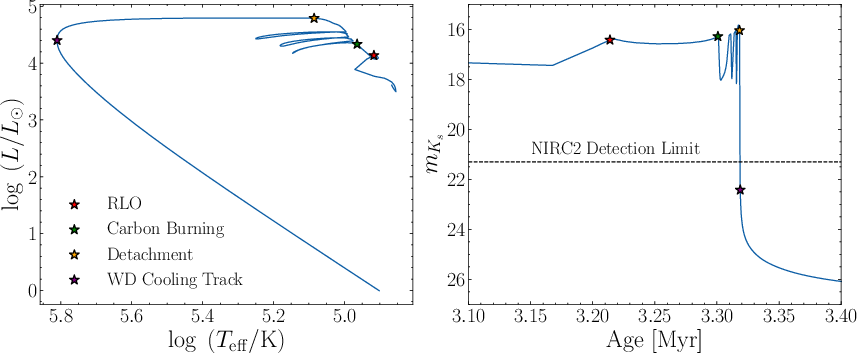
Figure 6: Simulated H-R diagram for the He star companion's evolution during and after Case BB mass transfer. The image tracks the path from He star to WD, with wind-launching and observable timescales highlighted.
Population and Selection Effects
The rarity of such systems is explained by the short (5σ8–5σ9 yr) visibility window for strong winds from a proto-WD. Binary population synthesis models predict order-unity detection rates for eclipsing systems in present pulsar surveys, in agreement with the uniqueness of PSR J1928+1815.
Theoretical and Practical Implications
This study rules out the He star scenario for PSR J1928+1815, requiring a massive, young, hot WD companion driving its own wind as the source of the eclipsing material. This places the system as a key empirical anchor for the late evolutionary channels of close binary MSPs with massive WDs formed via Case BB mass transfer, and constrains the physics of WD winds in post-AGB or post-extreme He star phases.
The predicted detectability of the WD at Ks≈21.30-band with sufficiently deep imaging (e.g., JWST) can test the wind model further. X-ray and radio searches for bow-shock emission are also highlighted as promising.
Conclusion
Deep Keck/NIRC2 LGS AO imaging robustly excludes all plausible He star companions to PSR J1928+1815. The data strongly favor a massive, young, hot WD companion, whose early wind phase provides the plasma required for the extended radio eclipses via synchrotron absorption. The short-lived nature of this phase explains the unique nature of the system in pulsar surveys. These results set stringent benchmarks for massive MSP–WD binary modeling, the physics of post-stripping WD winds, and the mechanisms of radio eclipses in post-CE binary MSP systems.