- The paper presents a rigorous classification of nonreciprocal phenomena in many-body systems, detailing unidirectional, antagonistic, and structured nonreciprocity.
- It employs operator theory and nonvariational dynamics to elucidate noise amplification, transient growth, and nonequilibrium phase transitions.
- Nonreciprocal interactions underpin emergent collective behaviors such as limit cycles and moving solitons, offering innovative design principles for advanced devices.
Nonreciprocal Many-Body Physics: A Technical Synthesis
Introduction and Motivation
Nonreciprocity— the breakdown of symmetry manifested as the inequality between the action of A on B and of B on A— constitutes a central organizing principle in the physics of dynamical, stochastic, and many-body systems. This paper delivers an exhaustive treatment of nonreciprocal phenomena, beginning with their formal classification, proceeding through their physical realizations across domains (from fluids to neural networks and quantum systems), and culminating in a unified discussion of their theoretical and practical implications for collective behavior, phase transitions, noise amplification, and universality.
Classification of Nonreciprocity
The authors present a rigorous structure for types of nonreciprocal interactions, extending beyond elementary pairwise asymmetry to encompass higher-order, spatial, and complex-valued (e.g., phase) nonreciprocity. The taxonomy distinguishes:
- Unidirectional nonreciprocity (Aij=0, Aji=0),
- Antagonistic/nonconservative couplings (opposite signs),
- Weak asymmetric response (same sign, unequal amplitude),
- Structured vs. unstructured nonreciprocity in complex networks or spatially extended systems.
This categorical scheme provides a robust mathematical and graphical language for cross-domain comparison (Figure 1).
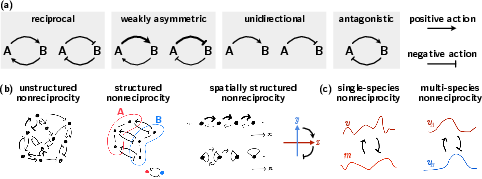
Figure 1: Classes of nonreciprocity, including unidirectional, antagonistic, and structured network-induced asymmetries.
Nonvariational Dynamics and Operator-Theoretic Foundations
Nonvariational systems—where the evolution cannot be described as gradient descent on a potential—necessarily induce nonreciprocal Jacobians (Jij=Jji). The exposition reviews:
- Systematic decompositions (Helmholtz-Hodge, transverse/orthogonal, metriplectic GENERIC structures) revealing the split between gradient (relaxational) and non-gradient (rotational/nonreciprocal) contributions.
- The centrality of Lyapunov/quasipotential functions in rare-event theory and stochastic escape, even under explicit irreversibility.
- The impact of symmetries (and symmetry breaking) in shaping attractors and limit cycles, particularly within the context of equivariant bifurcation theory.
Analytical and numerical techniques for computing these decompositions and their consequences in the weak-noise regime are surveyed, alongside the role of non-normal operators and the emergent transient amplification phenomena therein.
Physical Manifestations
Violations of Newton's Third Law
Nonreciprocity naturally emerges in effective (mediated) interparticle interactions (e.g., hydrodynamics, electromagnetism, optically or acoustically mediated forces). The departure from Newton's third law (Fi→j=−Fj→i) is not just a microscopic peculiarity but induces new dynamical couplings between center-of-mass and internal degrees of freedom, leading to collective phenomena such as run-and-chase dynamics and limit cycles—demonstrated concretely in mechanical, biological, and synthetic active systems (Figures 7, 9).
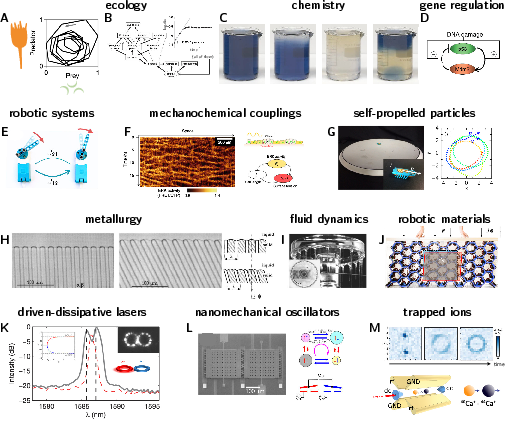
Figure 2: Example systems with structure-induced nonreciprocal interactions, including mechanical and field-mediated cases.
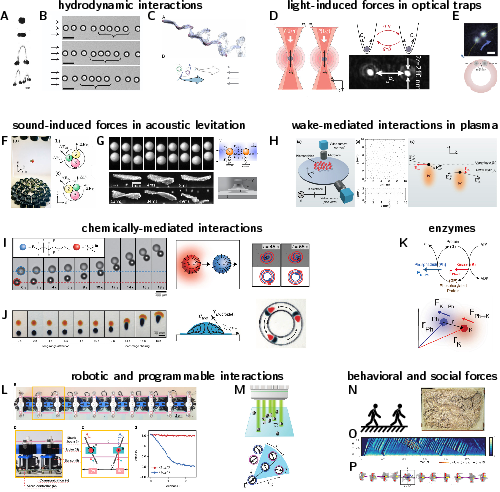
Figure 3: Empirical examples from hydrodynamic and optical systems demonstrating violations of Newton's third law and the resulting collective states.
Nonreciprocal Linear and Scattering Responses
The authors develop the operator-based definition of reciprocity and demonstrate how its violation is encoded in asymmetric (or more generally non-Hermitian and non-normal) response matrices. Lorentz and Onsager-Casimir reciprocity theorems (and their breakdown) appear as central organizing constraints on the emergent collective dynamics, revealing both constraints and new freedoms in engineered and natural materials (Figure 4).
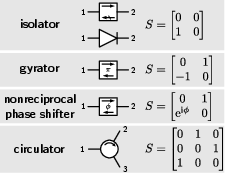
Figure 4: Canonical nonreciprocal elements characterized by scattering matrices, illustrating concepts such as isolators, phase shifters, and circulators.
Stochastic Nonreciprocity: Broken Detailed Balance
Stochastic processes are shown to admit precise graphical and operator formulations of (non)reciprocity through the detailed balance condition and its breakdown. This breach fosters stationary dynamical flux loops, entropy production, and phase transitions forbidden at equilibrium, rigorously linked via fluctuation theorems and spectral properties of the generator.
Quantum Nonreciprocal Systems
Quantum master equations with Lindbladian (nonreciprocal) dissipative contributions support the emergence of quantum analogs of classical nonreciprocal behaviors, including unidirectional transport, exceptional points, and quantum limit cycles. The paper formalizes how classical nonreciprocity maps onto quantum open-system dynamics, underpinning design principles for nonreciprocal quantum devices (Figure 5).
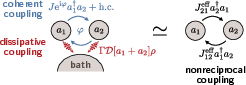
Figure 5: Model for quantum nonreciprocity—Drivings and dissipations induce asymmetric hybridization between modes.
Consequences for Many-Body and Collective Phenomena
Nonequilibrium Phase Transitions and Universality
The review generalizes the classification of phase transitions and universality classes from equilibrium to nonreciprocal systems. In particular:
- Hopf and exceptional-point bifurcations yield dynamic (oscillatory/time-crystalline) phases, classified via normal form and symmetry arguments.
- Nonreciprocal Ising/XY and Cahn-Hilliard models display limit cycles, oscillations, and traveling waves with critical behaviors (e.g., exponents, scaling) potentially belonging to extended or distinct universality classes.
Figures 12 and 14 summarize bifurcation diagrams and the diversification of dynamic phases unavailable to equilibrium analogs.
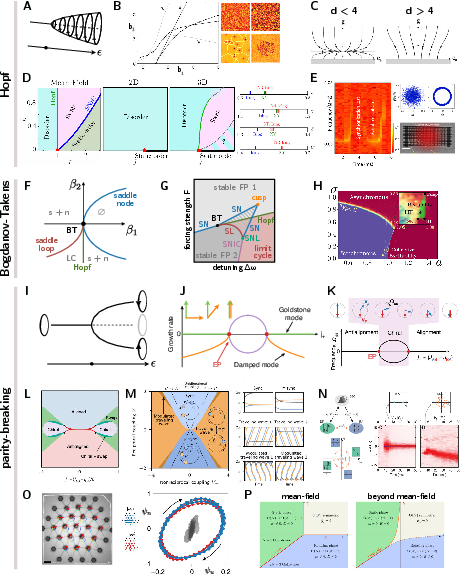
Figure 6: Many-body bifurcation classes—Hopf and drift-pitchfork bifurcations, and schematic phase diagrams for archetypal nonreciprocal models.
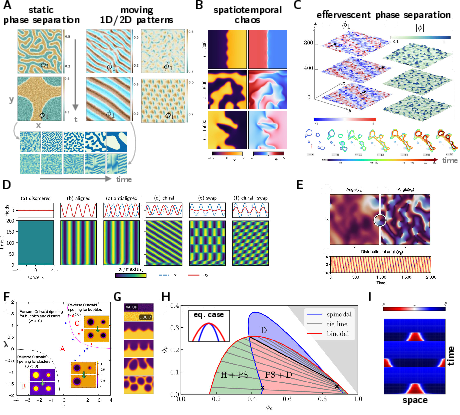
Figure 7: Dynamic states in extended nonreciprocal systems, including spatiotemporal chaos, interrupted coarsening, and sustained dynamic phase separation.
Noise Amplification, Transient Growth, and Exceptional Points
Non-normal linear operators engender transient amplification and giant noise-driven fluctuations, even when all eigenvalues indicate stability. This effect is critical in pattern-formation, ecological models, and neural computation, and is inherently tied to the spectrum of the operator, exceptional points, and the non-normality measure. Figure 8 visualizes this dynamical amplification and its dependence on operator structure.
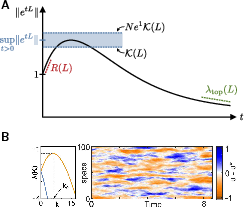
Figure 8: The evolution of disturbances under non-normal dynamics—transient growth beyond eigenvalue-determined asymptotics.
Defects, Localized Structures, and Topological Implications
The breakdown of reciprocal symmetry transforms the behavior and classification of defects, domain walls, and localized modes. Nonreciprocity engenders self-propelled domain walls, moving solitons, and defects with altered interactions and self-organization logics, which feed back into phase-ordering and pattern-selection processes (Figure 9).
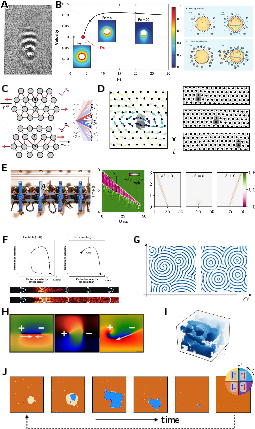
Figure 9: Localized structures (e.g., moving pulses, self-propelled droplets) uniquely stabilized or propelled by nonreciprocal couplings.
Theoretical Implications: Renormalization and Universality
Nonvariational dynamics challenge the conventional RG paradigm. Limit cycles, tori, and even chaos can appear in RG flows themselves, driven by inherently nonreciprocal coarse-grained beta functions, leading to discrete scale invariance, complex exponents, and universality class proliferation (Figure 10).
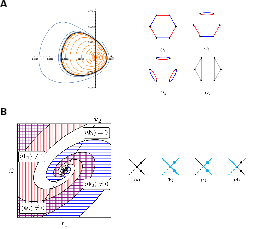
Figure 10: Illustration of nonvariational RG flows leading to limit cycles and novel universality scenarios outside standard Morse-Smale topology.
Implications and Future Directions
The synthesis suggests several immediate theoretical and practical implications:
- Device Engineering: Rational design of nonreciprocal materials and metamaterials can exploit dynamic phase, noise, and transport amplification for robust unidirectional devices, modulators, and sensing platforms.
- Biological and Neural Computation: Understanding nonreciprocal many-body states opens paths for harnessing dynamic attractors in learning, memory, and computation, including explicit sequence retrieval and dynamical associative memory.
- Mathematical Physics and RG: The universality and scaling theory of nonreciprocal systems promises new classes, breakdowns of conventional symmetry-based predictions, and challenges for rigorous RG flows in non-Hermitian or nonvariational landscapes.
- Open Problems: Signal selection in large-scale active assemblies, the emergence of dynamic orders in finite or noisy systems, and the characterization of dynamical phases in disordered or aging systems under structured nonreciprocity remain largely open.
Conclusion
This review constructs a comprehensive, multi-level framework for nonreciprocal many-body physics, integrating operator theory, stochastic thermodynamics, nonlinear dynamics, and statistical field theory. It provides canonical models, analytical methods, and escalating evidence (numerical, experimental, theoretical) that nonreciprocity is both a generic source of novel collective phenomena and a key to technological functionality in rigid and living matter. Substantial room remains for the classification of dynamic phases, the systematics of universality, and the translation of these findings into scientific and engineering advances in the years ahead.