- The paper presents PhaseTNN that overcomes spectral bias by decomposing high-frequency functions into low-frequency subproblems via phase-shift operations.
- PhaseTNN employs novel filtering methods and fixed shape parameters to achieve near-machine precision in function approximation and PDE solutions.
- The work demonstrates significant runtime reduction and enhanced robustness compared to prior methods, enabling scalable high-performance scientific computing.
Phase-Shift Transferable Neural Networks for High-Frequency Function Approximation and PDEs
Introduction and Motivation
Neural network-based approaches for scientific computing, especially for the approximation of high-frequency functions and PDE solutions, have been significantly hampered by spectral bias—DNNs naturally emphasize low-frequency components, leading to systematic failures when capturing sharp oscillatory details (2604.03186). This paper proposes the Phase-Shift Transferable Neural Network (PhaseTNN) framework, which integrates phase-shift frequency decomposition and efficient least-squares training, to overcome these bottlenecks. Unlike prior methods such as TransNet or phase-shift DNNs, PhaseTNN avoids costly manual parameter tuning and achieves superior robustness and accuracy for high-frequency problems.
Transferable Neural Feature Space
The foundation relies on the transferable neural feature space construction, wherein hidden-layer parameters are reparameterized via location parameters and a shape parameter. Standard TransNet methods require precise shape parameter tuning, which becomes computationally infeasible for high-frequency target functions. Instead, PhaseTNN leverages frequency-domain filtering and phase-shift operations, converting challenging high-frequency functions into equivalent low-frequency subproblems. By fixing the shape parameter to a constant (e.g., γ=2), costly tuning is eliminated without degradation in expressivity.
Improved Filtering Methods
Two novel filtering strategies are introduced for decomposing arbitrary functions (defined on bounded domains or sampled at finite nodes) into frequency components with extreme accuracy—methodologically, decaying extensions (such as exponential tails) are used to guarantee rapid spectral decay and ensure that error in numerical filtering approaches machine precision.
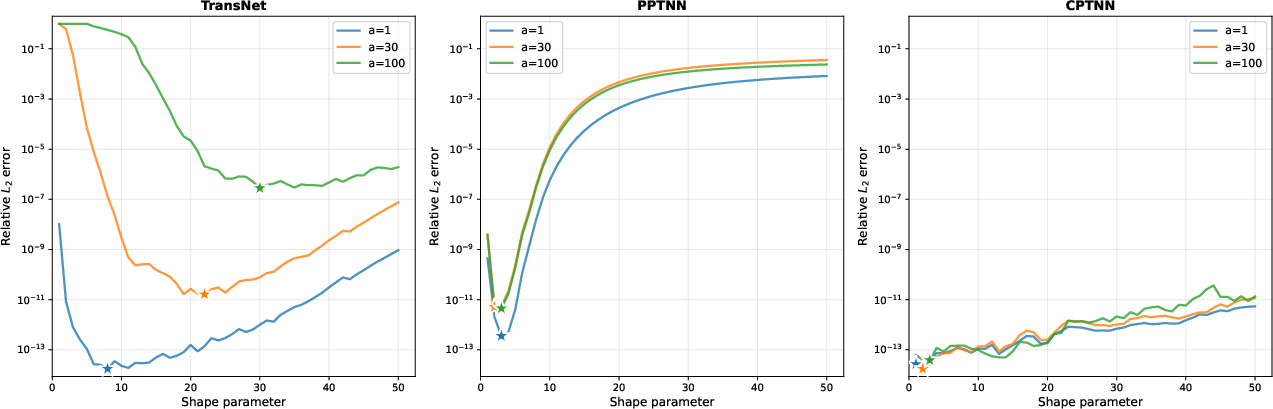
Figure 1: Relative L2 error vs. γ for f1 at various frequencies, comparing TransNet, PPTNN, and CPTNN.
Parallel Phase-Shift Transferable Neural Network (PPTNN)
PPTNN decomposes a target function into narrow-band frequency components via partition-of-unity filtering and then phase-shifts each component to the baseband. Each shifted subproblem is independently fitted using a TransNet sub-network with fixed shape parameter. This enables parallel training and significantly improves robustness compared to parameter-sensitive prior architectures. For multidimensional functions, PPTNN generalizes via tensor products of filtering bases and phase modulation, supporting high-precision approximation for 1D and 2D domains.
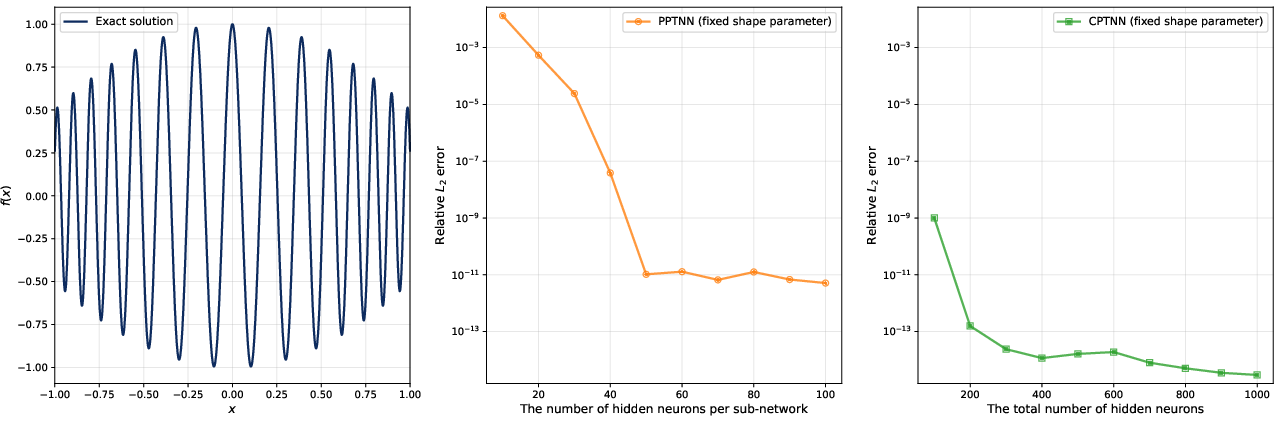
Figure 2: PPTNN and CPTNN convergence for f1 (a=30); error vs. network capacity illustrating monotonic decay.
Coupled Phase-Shift Transferable Neural Network (CPTNN)
CPTNN integrates phase modulation directly within the network architecture, allowing a single model to simultaneously represent an entire spectrum of frequency components. The basis functions are phase-modulated neural activations (complex-valued or sine/cosine expansions), with all parameters fixed except output-layer weights. Model training reduces to a linear least-squares problem for function approximation and to a composite least-squares loss for PDE solution. CPTNN's architecture circumvents scalability limits, supports efficient multi-frequency representation, and is particularly suited for high-dimensional challenges.
Application to High-Frequency PDEs
CPTNN is applied to a suite of high-frequency PDEs: variable-coefficient elliptic, high-wavenumber linear and nonlinear Helmholtz, wave equations, and diffusion interface problems. For linear operators, solution is obtained by minimizing the residuals of the PDE and boundary conditions on collocation points, exploiting the linearity to construct large feature matrices and solve via least-squares. For nonlinear cases, a Picard iterative linearization is employed. CPTNN maintains accuracy and efficiency across both smooth and discontinuous targets, easily integrating domain decomposition for interface problems.
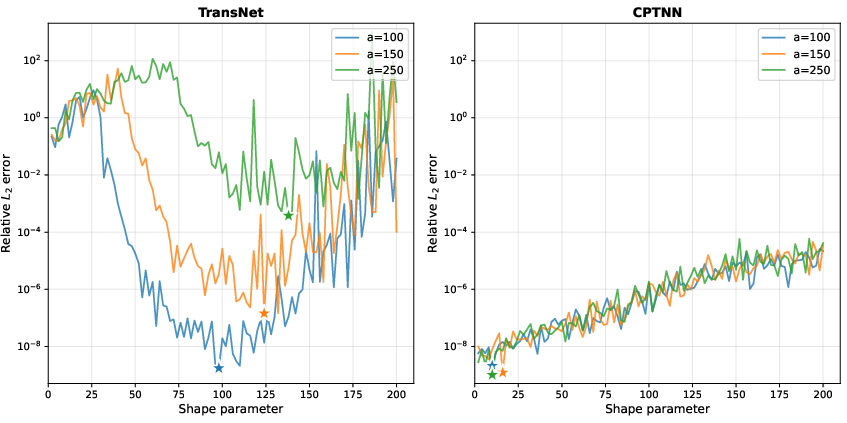
Figure 3: Relative L2 error vs. shape parameter γ for variable-coefficient elliptic equation.
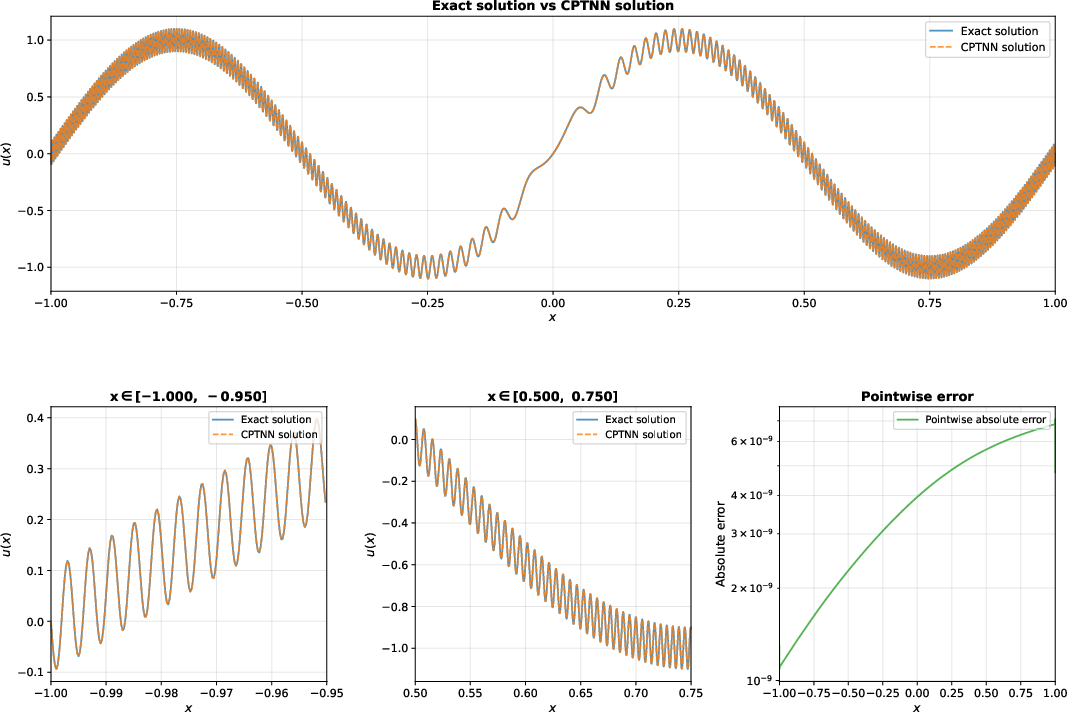
Figure 4: Numerical solution and absolute error obtained by CPTNN for the variable-coefficient elliptic equation.
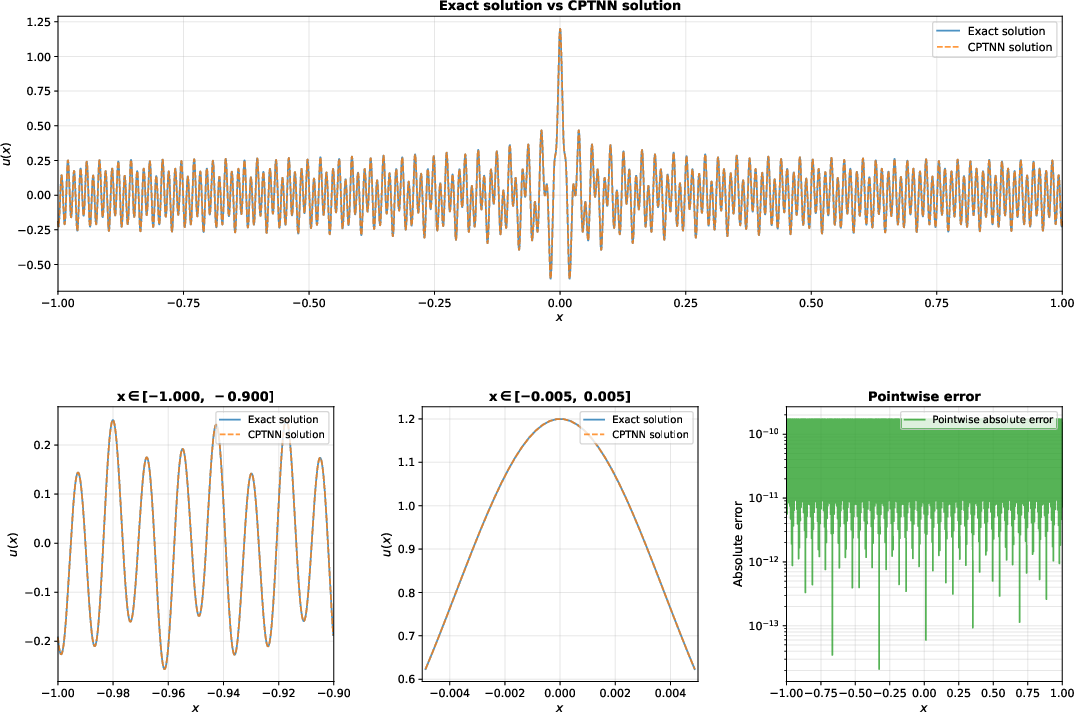
Figure 5: Numerical solution and absolute error obtained by CPTNN for Helmholtz equation.
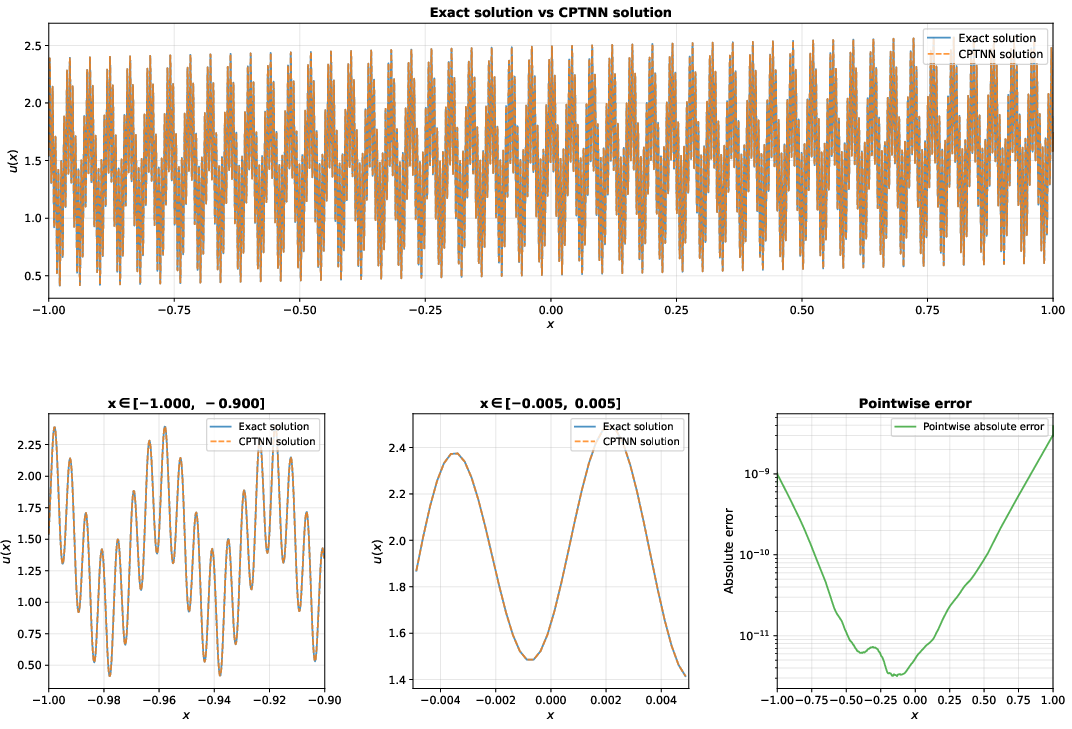
Figure 6: Numerical solution and absolute error obtained by CPTNN for the nonlinear Helmholtz equation.
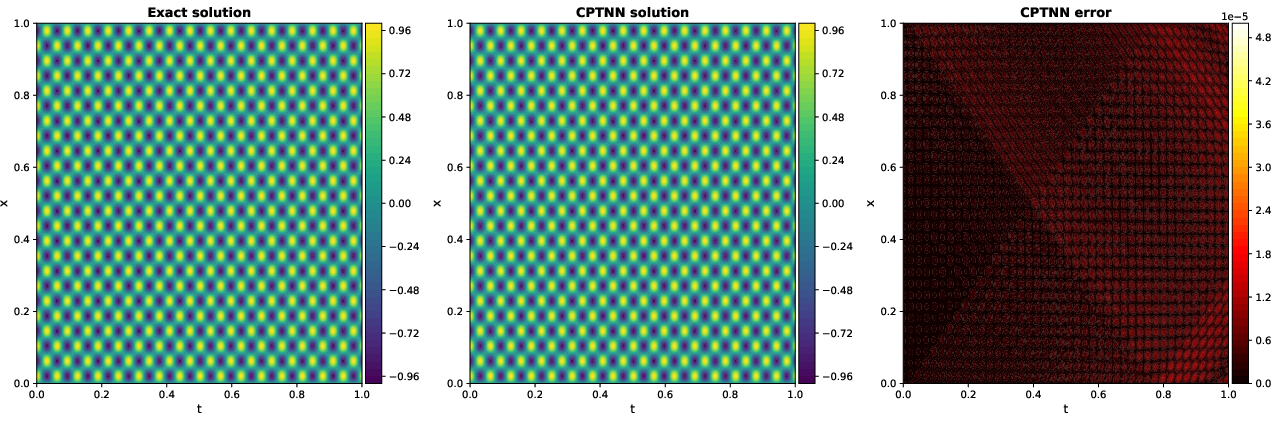
Figure 7: Numerical solution and absolute error obtained by CPTNN for the wave equation.
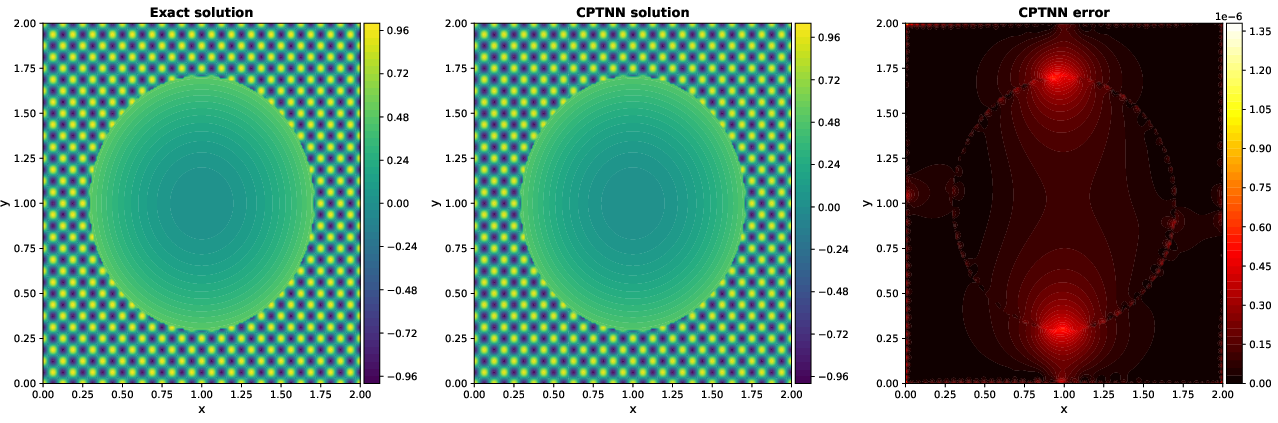
Figure 8: Numerical solution and absolute error obtained by CPTNN for the 2D diffusion interface problem.
PhaseTNN achieves extreme numerical precision across benchmarks, validated by robust comparative studies:
- Filtering Accuracy: Two proposed filtering methods outperform conventional frequency domain filtering by several orders of magnitude, achieving errors close to 10−15.
- Function Approximation: CPTNN achieves near-machine precision (relative L2 errors L20), outperforming FNN, RFM, MSNN, and TransNet baselines, while PPTNN matches TransNet for most cases and avoids exhaustive parameter searches.
- PDE Solution: For high-frequency PDEs, CPTNN attains relative errors of L21–L22 versus L23–L24 for prior parameter-tuned methods. For interface problems and discontinuous targets, CPTNN robustly handles sharp jumps without any hyperparameter tuning or domain-specific architecture modification.
- Computational Efficiency: PPTNN and CPTNN drastically reduce runtime, often by several orders of magnitude, due to the removal of shape parameter tuning and the ability to parallelize subnetwork training.
Implications and Future Directions
This research demonstrates the feasibility of attaining near-machine precision for high-frequency function approximation and PDE solutions using DNNs when spectral bias is addressed via principled frequency-domain decomposition and network architecture design. CPTNN offers a scalable and robust mechanism for multi-frequency representation, paving the way for neural solvers in high-performance scientific computing. Theoretical implications include aligning network expressivity with multi-scale PDE structure and achieving optimal accuracy-efficiency trade-offs in deep learning for numerical analysis.
Practically, PhaseTNN architectures are well-suited for stochastic PDEs, singular or discontinuous problems, and high-frequency inverse problems. The elimination of manual parameter tuning further enables large-scale deployment across diverse scientific computing applications, including engineering simulation, signal processing, and computational physics.
Conclusion
The PhaseTNN framework systematically overcomes spectral bias and practical computational barriers in neural network-based scientific computing, providing high-precision, highly efficient approximation and PDE solutions for high-frequency regimes. The method's architecture and frequency decomposition techniques enforce robustness, generalizability, and scalability. Potential developments include integration with uncertainty quantification, extension to inverse problems, and adaptation for non-smooth high-frequency phenomena in AI-driven scientific models.