- The paper provides an econometric analysis quantifying CPTR on Italian electricity prices, revealing an average national CPTR of around 0.30.
- It employs daily panel data (2016–2024) and robust methods, including OLS and quantile regressions, to address local zonal dynamics.
- Findings reveal incomplete cost pass-through with significant regional variations that imply challenges for decarbonization and targeted policy actions.
Carbon Cost Pass-Through in the Italian Power Market under the EU ETS: An Econometric Analysis
Introduction
This paper provides a comprehensive econometric analysis of carbon cost pass-through rates (CPTR) in the Italian electricity market under the EU Emissions Trading System (EU ETS), focusing on Phases 3 (2016–2020) and 4 (2021–2024). Leveraging daily market data and robust statistical methodologies, the study quantifies how carbon allowance prices are transmitted to wholesale electricity prices, both at the national and zonal levels, and isolates the determinants of temporal and spatial heterogeneity in pass-through. The research offers evidence-based insights into how market design, zonal generation mix, and exogenous shocks (e.g., fuel price crises, renewable integration, regulatory interventions) interact to shape the efficacy of the EU ETS in incentivizing decarbonization in Italy.
Background: EU ETS Evolution and Italian Electricity Market Structure
The EU ETS—operational since 2005—has transitioned through regulatory phases, gradually tightening emission caps, shifting allocation from grandfathering to auctioning, and expanding sectoral scope. Italy's power market exhibits notable zonal segmentation, with discernible differences in fuel mix and generation infrastructure across its seven market zones. This granularity enables the disentangling of local effects from national trends and is essential for understanding the spatially heterogeneous impact of carbon pricing on marginal production costs.
The progressive reduction in the cap on EU allowances (Figure 1) and the associated rise in carbon spot prices have fundamentally altered the cost structure of thermal generation in Italy, reinforcing the need for high-frequency econometric monitoring of pass-through patterns.
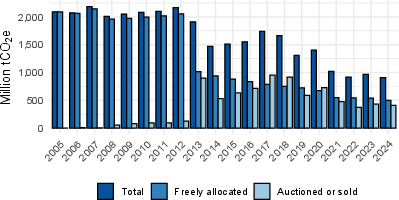
Figure 1: EU ETS allowances by year highlight declining allocation volumes and the shift from free allocation to auctioning.
Data and Empirical Framework
The analysis utilizes daily panel data from January 2016 to December 2024, comprising volume-weighted wholesale electricity prices, detailed zonal fuel cost proxies (coal, gas, oil), precise carbon cost computations (determined as product of carbon price and generation carbon intensity per MWh), and demand data. The CPTR metric is formally defined as the elasticity of the electricity price–fuel cost spread with respect to carbon cost.
A log-difference transformation is employed for all non-stationary variables, confirmed through ADF and KPSS tests and evidenced by autocorrelation plots (Figure 2), and an autoregressive model structure is adopted to address short- and seasonal autocorrelation in the residuals.
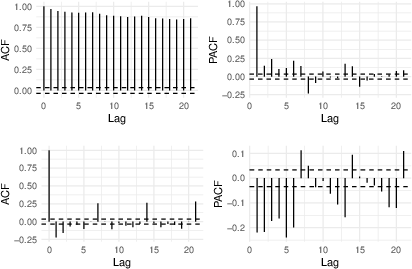
Figure 2: ACF and PACF functions for the Italian spread, demonstrating strong persistence in levels and stationarity after differencing.
Main Results: Zonal and Temporal Heterogeneity in Pass-Through
OLS regression models and quantile regressions are used to estimate CPTRs across market zones and over both EU ETS phases. All specifications employ Newey-West robust standard errors to accommodate any heteroskedasticity and autocorrelation.
National-Level Findings
At the aggregate level, the CPTR is stable—statistically significant, but consistently incomplete, and persistently below unity across both phases—implying that Italian power generators do not fully transfer carbon costs to consumers. The mean CPTR at the national level is approximately 0.30, constituting a 70% attenuation compared to perfect pass-through. Notably, the pass-through does not exhibit pronounced variation across quantiles (Figure 3), indicating low dependence on the conditional spread level.
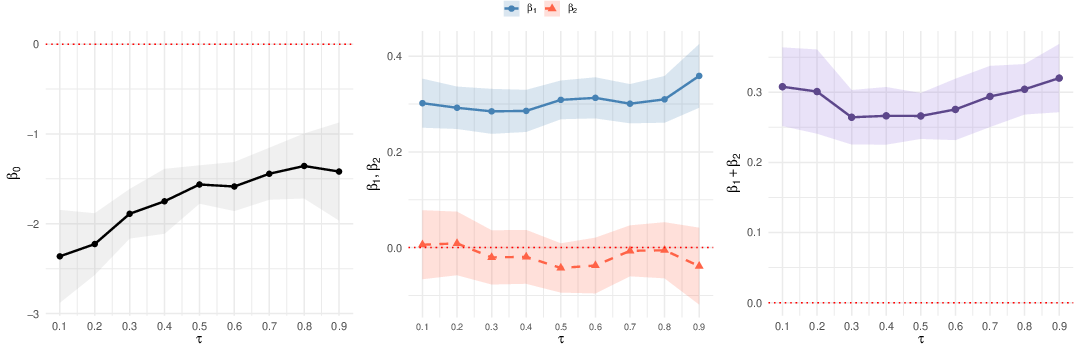
Figure 3: Quantile regression estimates for Italy showing that both the baseline pass-through rate and phase shift are positive but uniformly below complete cost transfer, with narrow confidence intervals across quantiles.
Zonal Heterogeneity
Detailed zonal analysis uncovers substantial heterogeneity in CPTR response to the transition from Phase 3 to Phase 4:
- North, Centre-North, and Sardinia: These zones demonstrate a statistically significant increase in pass-through during Phase 4 (e.g., CPTR increases from 0.17 to 0.24 in the North, and from 0.12 to 0.41 in Sardinia), tracking increased local carbon intensity and a greater reliance on thermal generation during the period of contracted hydroelectric output and fuel supply shocks.
- Sicily and Centre-South: These regions exhibit a marked decline in pass-through (from 0.41 to 0.20 in Sicily, and from 0.20 to 0.05 in Centre-South), attributable to compositional effects: strong renewable penetration (notably solar PV and wind), decarbonization of the fuel mix, and transmission upgrades that decreased local marginal costs.
- Robustness Checks: Results are robust across alternative price definitions, higher-order demand specifications, and generalized additive models.
Zonal autocorrelation diagnostics (Figure 4) confirm the adequacy of the model specification for capturing short-run dependence.
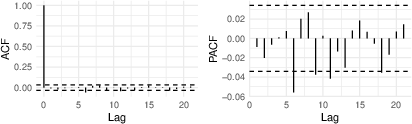
Figure 4: ACF and PACF functions of regression residuals for Italy indicate absence of residual autocorrelation.
Policy Implications and Fuel Switching Constraints
The observed incomplete and heterogeneous CPTR implies generators partially absorb the carbon cost shock, which can dilute short-run incentives for fuel switching—especially under conditions of fuel price volatility. During the acute 2021–22 gas price surge, Italy's switching price between coal and gas generation deviated sharply from EU ETS carbon spot rates, leading to a temporary resurgence in coal dispatch and a weakening of carbon price effectiveness as an incentive for system-wide decarbonization (Figure 5).
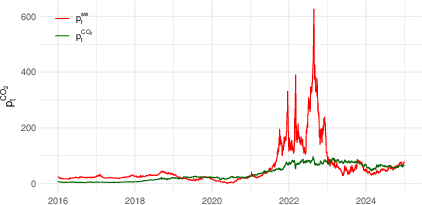
Figure 5: EU ETS carbon spot price compared to the fuel switching price, illustrating impaired carbon pricing incentives during the energy crisis.
This underscores that the theoretical incentivization for decarbonization via ETS price signals can be counteracted or delayed by exogenous shocks in fossil fuel markets. Policy mechanisms—potentially including temporary targeted interventions—are essential to preserve decarbonization incentives when switching price spikes are driven by external crises.
Theoretical and Empirical Contributions
The study extends existing literature by providing:
- Empirical CPTR estimates during the most recent (and most regulated) EU ETS periods, filling a notable gap post-Phase 2.
- Zonal disaggregation revealing that carbon pass-through is conditioned by local marginal generator mix, interconnection constraints, and renewable integration trajectories.
- Econometric rigor: overt treatment of non-stationarity, robust control for autocorrelation and seasonalities, and use of quantile regressions for distributional insight.
Future Directions
Potential methodological enhancements include the explicit modeling of cointegrating relationships among allowance prices, electricity prices, and fuel costs; formal causality testing; and increased time-resolution to disentangle intra-day and peak/off-peak effects—of particular relevance in systems with growing intermittent generation share and price volatility.
Conclusion
The Italian power market exhibits positive but incomplete pass-through of carbon costs under the EU ETS, with substantial zonal heterogeneity correlated to local carbon intensity dynamics and fuel mix transitions. These findings suggest both the effectiveness and the limitations of carbon pricing as a decarbonization tool in partially segmented markets. Targeted policy adjustments may be required to preserve incentive compatibility during episodes of exogenous fuel market stress, while continued econometric monitoring at the zonal level is essential for the evaluation and design of market-based climate policies.

